

E-Financial
How and Why Obafemi Awolowo Coined the Term Naira

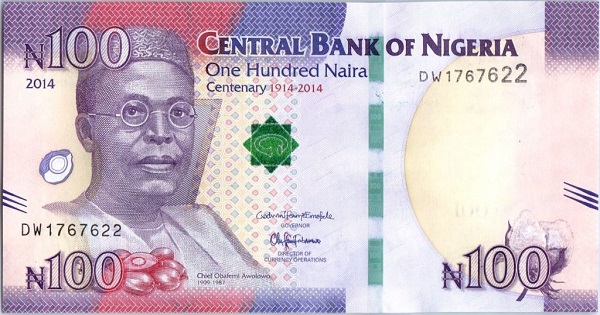
Chief Obafemi Awolowo coined the term Naira- Nigeria’s currency when he was the Federal Commissioner for Finance between 1967 and 1971, according to Tokunbo Awolowo, the daughter of the late age.
Tokunbo Awolowo said her father collapsed the name of the country and arrive at the term Naira.
”He just took the name of Nigeria and collapsed it to Naira. That’s what he told us and that was how he arrived at the name ‘Naira’ and that was when he was the Federal Commissioner for Finance” she said in an interview with the Punch

 late Chief Obafemi Awolowo
Federal Government of Nigeria introduced the Naira as new money system on Monday, January 1, 1973.
Before then, the official currency was the Nigerian Pounds which was introduced in 1907 while the minor unit of the currency was Shillings.
According to the Central Bank of Nigeria, the decision to change to decimal currency followed the recommendations of the Decimal Currency Committee set up in 1962 which submitted its report in 1964.
Meanwhile, prior to the introduction of the new currency in 1973, Chief Obafemi Awolowo was the Federal Commissioner for Finance between 1967 and 1971.
 Emefiele, CBN gov
And as the Finance Minister, Awolowo took it upon himself to come up with a new name for the new currency as the then Head of State, General Yakubu Gowon had reportedly announced in March 1971, that Nigeria would change to decimal currency on January 1, 1973.
The N100 denomination was introduced in December 1999 bearing the portrait of Chief of Obafemi Awolowo.
However, as of 1973, one Naira was the major currency unit in the country.
Four years after the introduction of Naira, a new banknote denomination of the value of 20 Naira was issued on Friday, February 11, 1977, and as a result, N20 became the first Nigerian currency bearing the portrait of a Nigerian citizen, General Murtala Ramat Muhammad.
Interestingly, 26 years after Naira became the official currency of the Federal Republic of Nigeria, another denomination of the value of N100 was introduced with the portrait of Chief Obafemi Awolowo precisely in December 1999.
And in a bid to facilitate an efficient payment system, the Central Bank of Nigeria introduced N200, N500 and N1000 notes in November 2000, April 2001 and October 2005 respectively.


ChatPay has launched Africa’s conversational banking platform, enabling individuals and businesses to access financial services through WhatsApp.

The Lagos-based fintech startup, is in controlled rollout, connecting WhatsApp to linked-bank management, airtime and supported electricity payments through simple conversations.
The company said the platform is designed to enable users to send money, pay bills, buy airtime and manage business transactions within WhatsApp conversations, subject to the completion of regulatory approvals and integration with licensed banking partners.
According to ChatPay, the platform is operated by CP Technology Limited and is currently undergoing a phased rollout ahead of its planned public launch.
The company said the initiative is intended to simplify access to financial services by leveraging WhatsApp, which it estimates is used by more than 50 million Nigerians monthly.
Speaking on the idea behind the platform, Adeoluwasubomi Odebunmi, product lead and co-founder, said the concept emerged while she was studying Software Engineering at Babcock University.
“I saw the gap while I was still in school—how much friction there was just to move money. I didn’t want to just study the problem. I wanted to help fix it,” she said.
Odebunmi said she had previously worked on software solutions spanning e-commerce, real estate management, school administration and artificial intelligence applications before co-founding ChatPay.
Aseoluwa Siyanbola, growth lead and co-founder, said his experience managing Nigerian bank accounts while studying abroad highlighted some of the challenges users face with digital banking services.
According to him, difficulties such as one-time password (OTP) failures and inconsistent banking applications inspired the team to explore conversational banking solutions.
“We each encountered similar challenges and came together to build a solution that simplifies everyday financial transactions,” he said.
cAbraham William, tech lead and co-founder, said the company is focused on improving access to financial services through a platform that many Nigerians already use daily.
“We want to make financial services easier to access by allowing people to carry out transactions through a familiar messaging platform,” he said.
William said he oversees the company’s engineering, technology strategy and system architecture.
ChatPay said its services will be introduced in phases as regulatory requirements are met and integrations with banking partners are completed.
The company added that its newly launched “Founding 2,500” programme will enable selected early users to test features, provide feedback and participate in product development before the platform’s wider rollout.
According to the company, interested users can register for the waitlist and the Founding 2,500 programme through its website.
Founded by Odebunmi, Siyanbola and William, ChatPay said its long-term goal is to expand conversational banking services beyond Nigeria into other African markets after its domestic rollout.


United Bank for Africa (UBA) Plc has been named Nigeria’s Best Bank for Retail Banking and Best Bank for Sustainability Leadership (ESG) at the 2026 Euromoney Awards for Excellence, reinforcing its position as one of Africa’s leading financial institutions.

The awards were presented on July 17 at The Peninsula London in the United Kingdom, recognising financial institutions that have demonstrated outstanding performance, innovation, customer impact and sustainable banking practices.
The double recognition highlights UBA’s growing influence in retail banking and its commitment to advancing environmental, social and governance (ESG) principles across its operations.
According to Euromoney, UBA distinguished itself through a series of sustainability initiatives, including the introduction of a Green Financing Facility designed to support households and businesses transitioning to renewable energy.
The publication also cited the bank’s ₦5 billion financing programme, implemented in partnership with the Bank of Industry (BOI), to provide funding for women-owned businesses.
Euromoney further recognised UBA’s commitment to achieving net-zero carbon emissions by 2050, describing it as a demonstration of the bank’s long-term sustainability strategy.
The publication also highlighted the bank’s efforts to integrate sustainability into its operations through the deployment of solar-powered energy solutions across 50 branches and comprehensive ESG capacity-building programmes that have trained more than 16,000 employees across the UBA Group.
In the retail banking category, Euromoney noted that UBA continued to consolidate its position as one of Africa’s largest retail banking institutions.
According to the publication, the bank expanded its customer base to more than 37 million by the end of 2025, while retail banking revenue increased more than fourfold to ₦429.5 billion.
The awards also recognised UBA’s continued investment in digital banking innovation, particularly enhancements to its artificial intelligence-powered chatbot, LEO.
Euromoney noted that LEO became Africa’s first AI-powered banking platform to facilitate cross-border money transfers in local currencies through the Pan-African Payment and Settlement System (PAPSS).
Commenting on the awards, UBA’s Group Managing Director and Chief Executive Officer, Mr Oliver Alawuba, described the recognition as a validation of the bank’s commitment to delivering value to customers while promoting sustainable development across Africa.
“To be recognised as Nigeria’s Best Bank for both ESG and Retail Banking in the same year sends a powerful message that sustainable banking and commercial success are mutually reinforcing.
“At UBA, we are committed to financing Africa’s future, supporting businesses and communities, promoting financial inclusion, and delivering innovative banking solutions that improve lives.
“These awards belong to our customers for their confidence in us and to every member of the UBA family whose dedication continues to make our vision a reality,” he said.
Also speaking, UBA’s Group Head, Marketing, Brand and Corporate Communications, Mrs Alero Ladipo, said the awards reflected the bank’s unwavering commitment to putting customers at the centre of its operations.
According to her, every innovation, investment and banking solution introduced by UBA is aimed at creating exceptional value for customers while expanding access to financial services.
“These awards are a powerful affirmation of our Customer First philosophy.
“Whether it is supporting entrepreneurs with access to finance, enabling seamless digital payments, advancing clean energy financing or expanding financial inclusion across Africa, UBA remains focused on delivering meaningful impact.
“We are honoured that one of the world’s most respected financial publications has recognised these efforts,” she said.
UBA currently operates in 20 African countries, as well as the United Kingdom, United States, France and the United Arab Emirates, serving more than 45 million customers through a combination of digital banking platforms and physical branch networks.
The bank said it remains committed to strengthening financial inclusion, driving innovation and supporting sustainable economic development across Africa and beyond.
Nigeria Deposit Insurance Corporation (NDIC) has begun paying insured deposits to customers of the 46 recently failed microfinance banks.

Mr Thompson Sunday, managing director and chief executive, NDIC, disclosed this in an interview with the News Agency of Nigeria (NAN) in Abuja.
The interview took place on the sidelines of the International Association of Deposit Insurers Africa Regional Committee meeting.
Sunday said the corporation was using the Nigeria Inter-Bank Settlement System (NIBBS) and customers’ Bank Verification Numbers (BVN) for the payments.
He said the NDIC had traced depositors’ alternative bank accounts and credited them directly without requiring physical visits.
He advised depositors without BVNs to visit the nearest NDIC zonal office for verification and payment processing
“The CBN revoked the licences of the 46 microfinance banks on July 1, 2026,” he said.
He said the NDIC automatically became the provisional liquidator after the revocation, in line with the law.
Sunday said the corporation had commenced payment of the insured maximum deposit of N2 million to eligible customers.
He explained that further payments would depend on the recovery of the failed banks’ assets and outstanding debts.
He said proceeds realised from recoveries would be distributed as liquidation dividends to eligible depositors.
Sunday cited Heritage Bank, Aso Savings and Union Homes as examples of the NDIC’s prompt reimbursement efforts.
He said insured depositors of Heritage Bank were paid within four days of the revocation of its licence.
He added that customers of Aso Savings and Union Homes received payments within 72 hours.
“The law allows us 30 days, but we are working to surpass our previous records,” he said.
The Central Bank of Nigeria (CBN) revoked the banks’ licences for failing to meet regulatory requirements for continued operations.
The apex bank said the action was aimed at protecting depositors, strengthening financial stability and ensuring regulatory compliance.

Senate Moves to Compel Social Media Companies to Open Offices in Nigeria

Nigeria Leads Africa in Online Gambling Regulation – GCI

CBN Has Not Published Annual Financial Statements Since 2022 despite Legal Requirement

ChatPay Unveils Public Waitlist for WhatsApp-Based Banking Platform

GSMA Says High Smartphone Costs Threatens Africa’s AI Future

NRC, Ponzi Scheme Collapses Resulting Loss of Billions of Naira

NASENI Moves to Digitize CCB’s 5m Assets Declaration and Operations

Tokenization, Blockchain Technology will Transform Financial Institutions – IMF

EFCC Busts NIS Visa Overstay Racket, Uncovers N700m in an Account

From Scarcity to Scale: What Africa Can Learn from India’s Agricultural Transformation




 General News3 days ago
FG Launches C.L.I.C.K.D., Consumer Credit Scheme for Tech Devices

 Telecom3 days ago
Airtel Nigeria Expands Retail Footprint to Strengthen Customer Access Nationwide

 Telecom3 days ago
MTN Nigeria Opens Applications for Next Afrobeats Star Season 2 with Bigger Prizes

 News3 days ago
NPC Opens Nationwide Digital Birth, Death Registration Platform

 Telecom3 days ago
Kaspersky Survey Highlights the Need for Smartphone Security

 E-Business3 days ago
Ovaloop Technologies Unveils Digital Tools to Formalize SMEs Operations Across Africa

 E-Financial3 days ago
CBN Retains Interest Rate at 26.5% as Cardoso Cites Global Uncertainty Despite Inflation Drop

 Telecom2 days ago
Court Dismisses Pan African Towers’ Bid to Halt Ex-CEO’s Suit, Awards ₦500,000 Costs