

Telecom
MTN Declares N60Bn H1 Dividend

MTN Nigeria Communications Plc has earmarked N60 billion as interim cash dividend to shareholders as the telecommunication company marked its first post-listing performance with considerable growths across major indices.
The board of the telco indicated shareholders will receive a dividend per share of N2.95 for the first half ended June 30, 2019. This however represented a drop of 17.83 per cent from N3.59 per share paid for the first half of 2018.
Key extracts of the six-month report showed that profit before tax rose by 30.9 per cent to N141.8 billion in first half 2019 as against N108.35 billion recorded in comparable period of 2018. Profit after tax grew by 34.8 per cent from N73.4 billion to N98.93 billion.
Total turnover grew by 12.12 per cent to N566.95 billion as against N505.67 billion. Operating profit had risen by 39.49 per cent from N136.50 billion to N190.4 billion. Earnings per share rose by 34.8 per cent to N4.86 compared with N3.61.
The report showed that the telco’s mobile subscribers increased by 3.3 million within the first six months of this year to 61.5 million while service revenue increased by 12.2 per cent.
Voice revenue increased by 11.4 per cent, data revenue rose by 31.7 per cent while fintech revenue increased by 21.2 per cent.
However, digital revenue dropped by 64.5 per cent. The company’s earnings before interest, tax depreciation and amortisation (EBITDA) rose by 40 per cent to N304.9 billion while EBITDA margin improved by 10.7 percentage points to 53.8 per cent.
Ferdi Moolman, MTN Nigeria Communications Plc Chief Executive Officer, described the first half performance as a solid performance as the company continued to invest to improve network quality and expand 4G coverage.
He noted that recent work on revamping data prices and accelerating 4G network has put the company in a strong competitive position to offer more value to customers and provide new impetus for overall corporate growth.
He said the listing of the company on the Nigerian Stock Exchange (NSE) in May, this year demonstrated the company’s commitment to the market while providing opportunity to domestic investors to participate in and benefit from the company’s growth.
“Our overriding priority for the rest of the year is to focus on our BRIGHT strategy to build a sustainable business and create value for customers. We will continue to progress in the second half of the year making improvements to our network experience, subscriber growth and enhance operational efficiency. We expect lower data pricing and our acceleration of the 4G network expansion to bolster the acquisition of customers and data traffic volumes in the second half,” Moolman said.



The Federal Government has backed moves to deregulate Nigeria’s airtime credit and data advance market, a step aimed at increasing indigenous participation, promoting competition and reducing capital flight from the country.

The move follows regulatory efforts by the Federal Competition and Consumer Protection Commission (FCCPC), which has advocated opening the market to Nigerian financial technology firms after years of dominance by foreign service providers.
Sources familiar with the development said President Bola Tinubu approved measures designed to dismantle the long-standing dominance of a South African technology firm, Optasia, in the airtime credit and data advance segment.
According to the sources, the FCCPC argued that the existing market structure had limited competition, restricted local participation and encouraged significant profit repatriation outside Nigeria.
The commission reportedly maintained that opening the sector would align with the Federal Government’s broader economic objectives of promoting local content, strengthening the digital economy, creating jobs and retaining more value within the domestic economy.
Optasia, formerly known as Channel VAS, has operated in the airtime credit and data advance market for about 12 years, providing services primarily to telecommunications operators, including MTN and some of its African affiliates.
The FCCPC is said to have raised concerns about the company’s operational structure and its contribution to Nigeria’s technology ecosystem despite its extensive activities within the country.
According to sources, the commission believes deregulation will encourage innovation, expand opportunities for indigenous fintech companies and support the implementation of the government’s Nigeria First Technology Policy.
“The commission’s position is that opening the market will promote competition, support local technology firms, create employment opportunities and reduce capital flight,” a source familiar with the matter said.
The deregulation initiative is also expected to deepen indigenous participation in Nigeria’s fast-growing fintech industry and reduce foreign exchange outflows associated with technology services.
Sources further disclosed that the FCCPC had presented the Presidency with a list of nine licensed Nigerian companies considered capable of providing airtime credit and data advance services in a competitive market environment.
The commission reportedly argued that local firms possess the technical expertise and operational capacity required to deliver the services currently dominated by foreign operators.
However, sources said Optasia had opposed the deregulation effort through legal and diplomatic channels.
According to the sources, the company has sought judicial intervention while also pursuing diplomatic engagements aimed at preserving its position in the market.
Despite those efforts, the Federal Government is said to have maintained its support for opening the sector to greater competition.
Industry stakeholders believe the move could reshape Nigeria’s digital financial services landscape by encouraging innovation, improving service delivery and creating new opportunities for indigenous technology firms.
Neither the Presidency, FCCPC nor Optasia had issued an official statement on the development as of the time of filing this report.
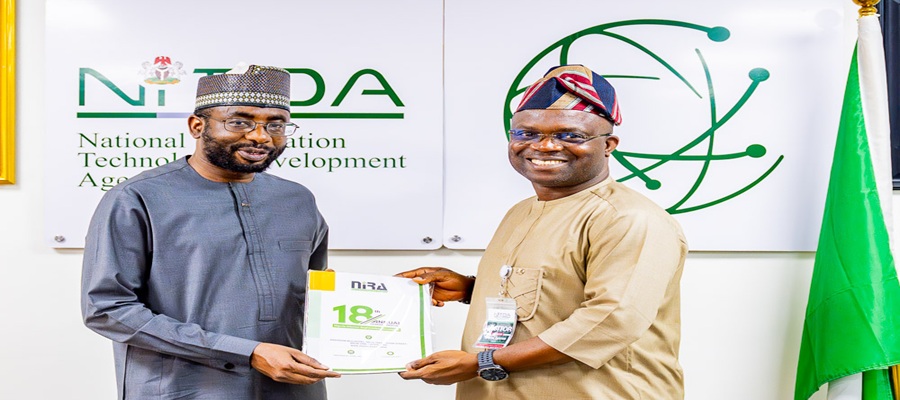
As part of its commitment to fast-track Nigeria’s digital economy, the National Information Technology Development Agency (NITDA) has officially approved the 2025 Annual Report and the 2026 Business Plan of the Nigeria Internet Registration Association (NiRA).

The Director General of NITDA, Kashifu Inuwa, receives the Nigeria Internet Registration Association (NiRA) Annual Report from its President, Adesola Akinsanya, after a briefing on the Association’s yearly activities, milestones, and ongoing efforts to strengthen Nigeria’s internet and digital landscape
The approval came during a meeting at NITDA headquarters where NiRA’s President, Mr. Adesola Akinsanya led his board members to present the association’s 2026 vision to NITDA Director General, Kashifu Inuwa, CCIE.
Following the approval, both organisations expressed the resolve to reinforce their collaborative efforts to ensure smooth, rapid execution of their shared goals of increasing the adoption of the .ng domain across
To actualise the business plan, the DG directed NiRA to work hand-in-hand with NITDA’s e-Governance and Digital Economy Department for effective implementation, daily updates, and project tracking.
“You have my full approval for these initiatives. Let us change our strategy, sync up more closely, and ensure everything we have agreed upon during this presentation is fully implemented by next year,” Inuwa declared.
Highlighting some of NiRA’s impressive achievements achievements over the past year, Akinsanya said 98,285 new registrations, 71,470 renewals, and 1,970 restorations were recorded in 2025, while there are 241,000 active domains.
Beyond the numbers, NiRA also implemented important security upgrades, including the Domain Name System Security Extensions (DNSSEC), for a more secure and resilient internet experience for local users, as well as improvements in registrar support and engagement.
Looking into the future, Akinsanya said NiRA is intensifying action to make .ng and .gov.ng domains the gold standard across the country. He expressed gratitude for NITDA’s ongoing support, calling for joint awareness campaigns and digital capacity-building to bring more state governments, local councils, and public institutions under the secure official domain.
Also, the NiRA president added that the association is updating its internal systems, introducing automation, and revising its constitution to meet globally acceptable standards to ensure sustainable growth.
“NiRA is looking into deeper stakeholder engagement and moving into areas where we see massive possibilities. We are specifically targeting startups and aligning with tech events across the country. With stronger collaboration, we can drive widespread adoption across every tier of government’’, Akinsanya said.

TikTok users in UK are being warned to keep an eye out for tax scams after two men were arrested in east London over an alleged scheme involving £153 million in fraudulent claims.

TikTok
The pair, aged 22 and 25, have been accused of luring Brits into giving away their personal tax details by offering financial rewards over the app.
Investigators believe they then used those details to lodge false claims worth tens of millions of pounds, claims which were ultimately blocked by HMRC.
The tax body is now urging social media users to be skeptical of posts that promise “risk-free” rewards in return for their tax information.
That information, HMRC warned, is then used to apply for fraudulent tax repayments. Because the criminals hide their identity, it is the person whose details were used who will owe money to HMRC as a result. Similar scams are also run on apps such as Instagram and Snapchat.
TikTokers arrested in London after ?running 153,000,000 tax scam? over app
Simon Grunwell, HMRC’s head of cybercrime investigations, told users to “protect your personal tax details in the same way you protect your bank details.”
He added: “Claims of quick, risk-free cash in return for sharing your personal information are a scam. They aim to defraud you and the taxpayer.”
The two Romanian men involved in the alleged TikTok scheme were arrested in Newham on April 23.
They were accused of offences under the Fraud Act, the Serious Crime Act, the Computer Misuse Act, and the Proceeds of Crime Act. Both have since been released on bail, and the investigation is ongoing

NITDA, Benin’s Digital Agency Strengthen Ties on Digital Transformation

IFC, NGX Group Unveil Nigeria Gender Programme

FG Targets Alleged N3tn Capital Flight, Opens Airtime Credit Market to Nigerian Fintechs

NITDA Backs NiRA’s Ambitious 2026 Plan to Drive Massive .ng Domain Adoption

TikTok Tax Scam Exposed: Two Arrested Over Alleged £153 Million Fraud Scheme

MTN, VDT, Zoracom, Digital Realty Back 2026 Girls in ICT Campaign

CPN Begins Crackdown on Quack IT Professionals, Vows Tougher Action against Cybercrime

FG to Launch Nationwide Free Digital TV Platform June 17

Nigeria Hit by 24.1m Data Breaches – Surfshark

Jumia Nigeria Records Strong Q1 2026 Growth as Technology-Led Strategy Drives Market Expansion




 Telecom3 days ago
Aba to Host MTN’s “The Gathering” with Pitchathon Offering ₦5 Million Prize Pool for Emerging Startup Founders

 General News3 days ago
PalmPay Young Star Awardee Hopes to Become a Governor

 Telecom3 days ago
Meta Unveils AI-Powered Business Agent to Support Customer Engagement

 Telecom3 days ago
Data on Trial: MTN Opens Its Books to Public Scrutiny Over Data Consumption

 E-Business3 days ago
Kaspersky Reveals Credential Abuse Techniques Rank as Attackers’ Most Effective Tactic

 News3 days ago
Japan, UNESCO Boost Digital Learning in 15 CoEs with Donation of ICT Equipment

 Telecom3 days ago
Digital Encode Calls for Immediate Action as Cyber Threats Escalate Nationwide

 Telecom3 days ago
NITDA DG Highlights Nigeria’s Digital Infrastructure Strategy at Datacloud Global Congress 2026