

Telecom
African ICT Foundation Opens Portal for Volunteers Tech Trainers

The African ICT Foundation (AfICTF) has opened application for its volunteer’s trainers for its Digital Connect Africa (DCA) Project in Nigeria.
The Digital Connect Africa (DCA) is a digital skills training and empowerment program of the Foundation designed to cover the five Regions of the Northern, Western, Southern, Eastern and Central Africa with West Africa as a pilot scheme starting with Nigeria and covering the Six Geopolitical Zones in Nigeria.
According to statement from Foundation, the AfICTF Secretariat offers a limited number of volunteers’ opportunities for its train-the-trainers (ToT) programs in Nigeria from which graduates of the program (Train-the-Trainers) shall be absorbed into the main project.
Quoting the Executive Secretary of the Foundation, Emmanuel Bassey, the statement said that the intending applicants must be able to demonstrate a strong interest in ICT related programs such as Big data analytics, Block-Chain, Agri-tech, Digital government, Internet of Things, Fintech, Media-tech, Mobile technology, Supply chain, Artificial Intelligence, Cloud, Coding, Cyber Security, Quantum Computing, Programming,Digital Business Analysis, Digital Design and Data Visualization, Digital Project Management,Digital Product Management, Digital Marketing,Decision Making for Leaders, Web and App Development.
He stated that the training (DCA- Train-the-Trainers) will last approximately one month with possible extension. Volunteers are expected to participate full time adding that volunteers may be applicants, students who may have completed their studies, and Graduates awaiting primary assignments, etc.
The statement disclosed that volunteers must have basic knowledge of computing and/or work experience in one of the following fields: Internet governance, information and communications technology, public policy, public relations, international relations, political sciences, international law and economics.
Interested candidates should send detail Curriculum Vitae to [email protected] on Monday, September 23rd, 2019 before close of Business.


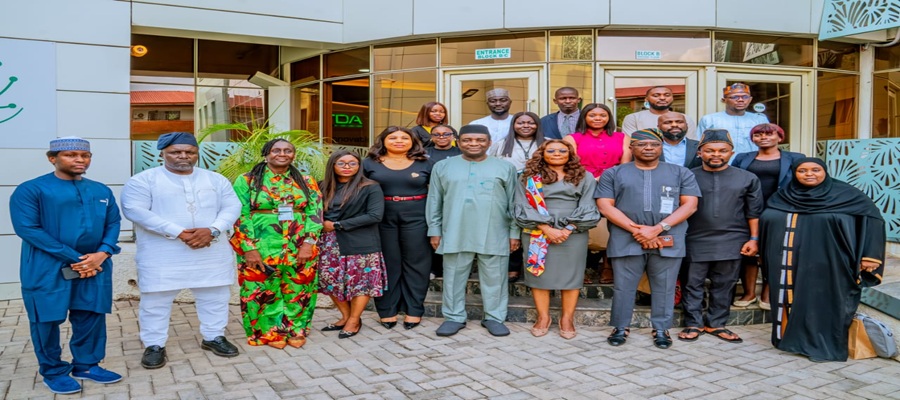
National Information Technology Development Agency (NITDA) has intensified efforts to foster a more enabling environment for innovation by inaugurating a Technical Working Group (TWG) aimed at strengthening regulatory collaboration and advancing a coordinated sandbox framework for Nigeria’s digital economy.

Group photograph of the Director General of the National Information Technology Development Agency (NITDA), Kashifu Inuwa, CCIE, represented by the Acting Director of Regulation and Compliance, Barrister Emmanuel Edet, with the newly inaugurated members of the Technical Working Group (TWG) for the National Regulatory Sandbox, at the Agency’s Corporate Headquarters in Abuja.
Speaking at the inauguration, the Director General of NITDA, Kashifu Inuwa, represented by the Acting Director of Regulation and Compliance, Barrister Emmanuel Edet, emphasised the critical need for stronger cross-agency cooperation to address structural regulatory challenges that often hinder the pace of innovation.
Inuwa noted that members of the Technical Working Group were deliberately selected based on their strategic institutional roles and capacity to contribute practical solutions tailored to the evolving realities of Nigeria’s digital ecosystem.
He explained that while regulatory agencies have legitimate and clearly defined mandates, the increasing complexity of digital technologies requires greater institutional alignment and collaboration to ensure regulatory frameworks support, rather than constrain, innovation.
“As government institutions, our core responsibility is to provide solutions to the challenges faced by Nigerians. The issue is not a lack of commitment, but a structural one. Regulators often operate in silos while implementing their mandates, and in today’s digital environment, that model presents significant limitations,” he said.
The NITDA Director General observed that the rapid expansion of the digital economy continues to outpace conventional regulatory systems, creating gaps that can inadvertently delay or obstruct the deployment of innovative solutions capable of improving livelihoods and driving national development.
To address these challenges, he said the Agency is championing a multi-agency regulatory framework designed to bring regulators together, foster understanding of overlapping mandates, and collectively develop adaptive mechanisms that create room for innovation while maintaining effective oversight.
Central to this strategy, Inuwa explained, is the adoption of regulatory sandboxes—controlled environments where innovators can test emerging technologies and solutions under the supervision and guidance of relevant regulatory authorities.
“Our guiding principle is that we learn by doing. Through these sandboxes, regulators can contribute to building safe spaces where innovation can be nurtured, tested, and scaled for the benefit of Nigerians,” he added.
He further reassured stakeholders that the initiative is not intended to weaken or override any agency’s statutory powers, but rather to improve coordination and build a more responsive regulatory ecosystem capable of keeping pace with technological advancement.
According to him, stronger inter-agency collaboration is essential to ensuring that Nigeria remains competitive in the global digital economy and fully harnesses innovation as a driver of inclusive economic growth and national prosperity.
Inuwa expressed optimism that the Technical Working Group would serve as a strategic platform for shaping forward-looking regulatory solutions while advancing NITDA’s broader vision of repositioning the Agency as an ecosystem orchestrator committed to enabling digital transformation and sustainable national development.
Presenting an overview of the National Regulatory Sandbox, the National Coordinator of the Office for Nigerian Digital Innovation (ONDI), Victoria Fabunmi, said the initiative is designed to provide a structured, legal, and multi-agency framework that enables innovators to test emerging technologies under regulatory supervision before obtaining full market approval.
According to her, despite rapid advancements across sectors such as Artificial Intelligence, fintech, health technology, and blockchain, innovators continue to face significant challenges due to siloed regulations, fragmented approval processes, and the absence of coordinated mechanisms for testing new technologies.
Fabunmi noted that while Nigeria’s digital economy continues to witness remarkable growth, the lack of harmonised regulatory engagement has often delayed innovation and increased uncertainty for startups and technology-driven enterprises.
Describing the National Regulatory Sandbox as more than just a digital platform, she explained that it is fundamentally a governance and legal framework aimed at creating an enabling environment where innovation can thrive responsibly.
Unlike traditional sandbox models often associated primarily with financial services regulation, Fabunmi said Nigeria’s approach is intentionally sector-agnostic, allowing regulators from multiple sectors—including agriculture, digital health, mobility, clean energy, and digital public infrastructure—to collaborate in supporting innovative solutions.
Under the framework, startups and innovators will be able to engage multiple regulators simultaneously within a controlled testing environment, reducing bureaucratic bottlenecks and significantly shortening time-to-market for emerging solutions.
She added that the sandbox will also generate shared, evidence-based regulatory insights, enabling participating agencies to make informed decisions collectively and develop adaptive policies that support responsible innovation.
The inauguration of the Technical Working Group marks another significant step in NITDA’s efforts to build a more agile, collaborative, and innovation-friendly regulatory environment—one that aligns with Nigeria’s broader ambition of becoming a leading digital economy in Africa.
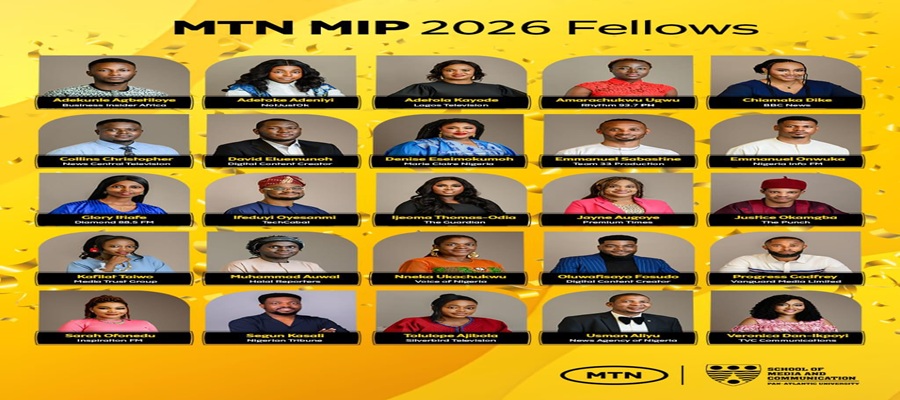
MTN Nigeria has announced the selection of 25 media practitioners and digital content creators for the fifth cohort of its Media Innovation Programme (MIP), reinforcing its commitment to strengthening Nigeria’s media industry through capacity building, innovation, and leadership development.

MTN MIP 2026
The Media Innovation Programme (MIP), implemented in partnership with the School of Media and Communication, Pan-Atlantic University, continues to serve as a platform for equipping journalists, broadcasters, and digital content creators with the skills, exposure, and mentorship required to thrive in today’s evolving media ecosystem.
This year’s fellows were selected from a highly competitive pool of applicants across print, broadcast, digital media, and content creation, reflecting the programme’s growing reputation and influence within the industry. In commemoration of the techo’s 25th anniversary, the cohort has been expanded from 20 fellows in previous editions to 25 for the year.
Speaking on the first day of the programme, Tobe Okigbo, Chief Corporate Services and Sustainability Officer, MTN Nigeria, described the initiative as a reflection of the company’s commitment to innovation, partnership, and continuous learning. “At MTN Nigeria, innovation, insight, knowledge, skills, and partnership matter deeply to us.
“The Media Innovation Programme represents all these values – a partnership not just with Pan-Atlantic University, but with every fellow.
“This programme is an adventure in learning, one that challenges participants to reconsider assumptions, revise opinions, rethink ideas, and ultimately grow both professionally and personally,” he said.
Also speaking during the session, Dr. Ikechukwu Obiaya, Dean, School of Media and Communication, Pan-Atlantic University, encouraged the fellows to recognise the programme as more than a professional milestone, describing it as a transformative experience designed to prepare them to make meaningful contributions to the media industry and society at large.
“The media space today faces significant challenges, and this programme equips participants not just for personal development, but to make a real difference.
“Beyond skills and exposure, we place strong emphasis on values such as truth, honesty, ethics, and responsibility to society. We hope that every fellow leaves this programme better prepared to contribute significantly to the future of media,” he said.
The selected fellows for the fifth cohort include:
1. Agbetiloye David Adekunle (Senior Reporter, Business Insider Africa)
2. Adeniyi Fatima Adetoke (Content Writer, NotJustOk)
3. Adetola Kayode (State House Correspondent/ News Anchor, Lagos Television)
4. Ajibola Tolulope (Presenter, Silverbird Television)
5. Aliyu Usman (Assistant Chief Correspondent/ Editor, News Agency of Nigeria)
6. Augoye Jayne (Arts, Entertainment and Culture Editor, Premium Times)
7. Auwal Muhammad Ibrahim (Senior Editor, Halal Reporters)
8. Collins Christopher (Programmes Producer, News Central Television)
9. Dan-Ikpoyi Veronica (Senior Anchor, TVC Communications)
10. Dike Chiamaka Patricia (Broadcast Journalist, BBC News)
11. Eluemunoh David (Digital Content Creator)
12. Eseimokumoh Denise Loliaba (Editor-in-Chief, Marie Claire Nigeria)
13. Fosudo Oluwafisayo (Digital Content Creator)
14. Godfrey Progress (Reporter, Vanguard Media Limited)
15. Itiafe Glory Ugonma (Broadcast Journalist, Diamond 88.5 FM)
16. Kasali Segun (ICT Correspondent, Nigerian Tribune);
17. Ofonedu Sarah (On-Air Personality, Inspiration FM)
18. Okamgba Justice (Reporter, The Punch)
19. Onwuka Emmanuel (Presenter & Executive Producer, Nigeria Info FM)
20. Oyesanmi Ifeduyi (Managing Editor, TechCabal)
21. Sabastine Emmanuel (Sports Commentator, Team 33 Production)
22. Taiwo Kafilat (Data Journalist, Media Trust Group)
23. Thomas-Odia Ijeoma (Editor, The Guardian Woman, The Guardian)
24. Ugwu Amarachukwu Deborah (On-Air Personality, Rhythm 93.7 FM PH) and
25. Ukachukwu Nneka (Editor/Producer, Voice of Nigeria).
Over the years, the Media Innovation Programme has grown into a leading media fellowship in Nigeria, providing participants with access to industry experts, structured mentorship, hands-on learning experiences, and global best practices in media and communication.
The six-month programme commenced on Monday, May 18, 2026. During this period, the fellows will receive intensive education focused on media innovation, digital transformation, strategic communication, storytelling, and leadership development both in Nigeria and during their one-week study visit to South Africa
MTN reiterates its commitment to supporting journalism and advancing media excellence in Nigeria, while empowering professionals who continue to shape important conversations across the continent.

Airtel Africa Plc has announced a strategic initiative in partnership with Barclays Capital Securities Limited to execute on-market share purchases totaling up to $110 million.

This initiative will be divided into non-discretionary and discretionary segments, marking a proactive step in optimizing the company’s capital structure and enhancing shareholder value.
In a statement released on the Nigerian Exchange and signed by Simon O’Hara, group company secretary, Airtel Africa described this share buyback program as a key component of its broader strategy to return cash to shareholders.
It noted that the program aims to repurchase up to one percent of the company’s issued share capital as of the date of this announcement.
“This decision by the Board reflects the organization’s strong financial position and its commitment to maintaining flexibility while continuing to invest for growth across its markets.
“The initial phase of the program will see Airtel Africa collaborating with Barclays Capital Securities to facilitate the purchase of its ordinary shares,” the statement noted.
According to Airtel Africa, the agreement features two key components operating concurrently: a non-discretionary segment allowing Barclays to purchase up to $60 million of ordinary shares independently of the company, and a discretionary segment where Airtel Africa can guide Barclays in purchasing an additional $50 million, adhering to the regulations set forth by the Market Abuse Regulation (EU) No 596/2014.
“The program is set to commence today and is expected to conclude by November 27, 2026, unless terminated earlier under the agreement’s terms. Airtel Africa has signaled that as the initiative progresses, further tranches may be announced to achieve its objective of repurchasing up to one percent of its issued share capital.
“The primary aim of this buyback program is to streamline the company’s capital. Accordingly, all shares purchased will be cancelled, contributing to a more efficient capital structure. Any transactions will be performed in alignment with pre-defined parameters outlined in the agreement with Barclays and comply with the authority granted by shareholders for share repurchases.”
At the annual general meeting on July 9, 2025, shareholders authorized the company to buy back a maximum of 366.073 million ordinary shares.
Following the previous buyback program, the remaining authority now stands at a maximum of 357.042 million ordinary shares, demonstrating ongoing support from shareholders for these initiatives.

Court Orders FG to Reveal Identity of Local Contractors in $460m Abuja CCTV Project

NCAA Suspends Services to Air Peace, Others over Debts

Legend Internet Repays N10Bn Commercial Paper

FG Classifies Ebola Importation into Nigeria as High Risk

Transfers Fail as Banks Suffer USSD Glitches

MTN, VDT, Zoracom, Digital Realty Back 2026 Girls in ICT Campaign

Vitel Wireless Partners Fintechs to Expand Access to Services

FG Okays 112 as Toll-Free National Emergency Response Number

Opay Plans IPO in US, Targets $4Bn in Valuation

Elon Musk Launches XChat with Video Calling to Take on WhatsApp, Messenger




 Telecom2 days ago
NCC Drafts New Rules for Virtual Mobile Operators

 Telecom2 days ago
Airtel Africa Launches $110m Share Buyback Programme for Capital Efficiency
 General News2 days ago
WHO Says Ebola Risk Now at Highest Level

 E-Business2 days ago
LG Electronics Showcases Advanced HVAC Solutions at Mega Clima Nigeria 2026

 Telecom2 days ago
MTN Nigeria Tops Gender Equality Rankings After Major Workplace Transformation, IFC Report Reveals

 News2 days ago
FG Unveils AI Public Services Platform

 Telecom2 days ago
Microsoft, Partners Launch ‘LINGUA Initiative’ to Save African Languages From Digital Extinction

 Telecom2 days ago
Australian Court Upholds Fine Against X Over Child Safety Compliance Failures