

News
New Horizons Offers 3 Students Scholarship @ eBusiness Life Career Fair 2019

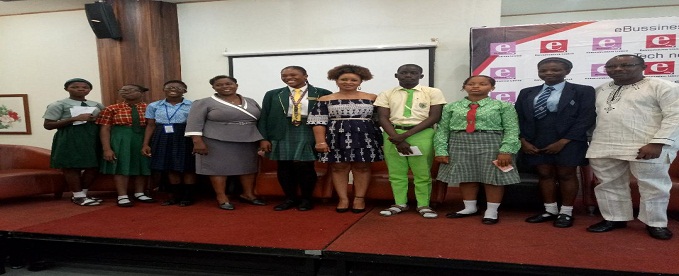
Three Nigerian students have won 100 percent fully paid scholarship from premier IT training institute, New Horizons Nigeria, this is fallout of the Maiden edition of ICT Career Fair event recently organized by eBusiness Life Communication Limited in Lagos.
Offering the scholarship, Mr. Tim Akano, founder and ceo, New Horizons, noted that the best gift the adults can give the youths today is an opportunity to get empowered in technology, as that is the global future.
Mr. Akano, who encouraged the participating students to be inquisitive and develop the knack to search out answers using technology tools, further charged them to seek to create and add value to humanity.

According to him, the teenage age is the most creative age because it is the age where concentration is not divided, but have adequate time to create and think out solutions.
“You are living in a technology kingdom. The technology of the future will merge everything in a world of the Internet of Things and Artificial Intelligence.”
The New Horizons boss, who during the presentation, asked the students varied questions, used the opportunity to award scholarships to students.
The beneficiaries of the scholarship are Femi Odunubi, an SS3 Student from Kuramo College, a public school in Lagos; Opeoluwa Ogunfeitimi, SS2 Student from Peaklane International College; and TimehinAtsagbede, SS1 student from The Lagoon School.
The students are allowed to choose a course of training at any of the New Horizons study centes.
Mr. Akano also offered all the participating school that are interested in entering into a partnership with New Horizons, a special arrangement that will ensure that their students are trained to give them an edge above their peers to prepare them for a future that is technology-driven.
While pointing out that the new world is a world of a shared economy, he told the students to prepare to compete with other countries like China and Japan that have advanced in technological feats.
According to him: “You are going to live in a multi-cultural world where the only thing that matters is what you can create with your mind.”
Also speaking at the event, Mrs. Ufuoma Emuophedaro, convener and ceo, eBusiness Life Communication Limited, encouraged the students to consider a career in ICT due to the global nature of the profession, creating opportunities in every facet of the economy and in every part of the world.
Pointing out further needs for the young students to expand their knowledge and skill in ICT, Mrs, Emuophedaro explained: “Even beyond careers, it is increasingly critical to encourage young people today to take STEM programmes and develop the kind of business, entrepreneurial and complex problem-solving skills that are required in today’s world.

“By becoming fluent in Information and Communication Technology, young people will learn to use the essential tools of the 21st century for whatever career they choose as science and technology are pervasive across occupations and critical to Nigeria’s growth, innovation and the knowledge-based economy.
“The Career Fair is one of eBusiness Life’s avenues of sensitizing and educating Nigerian youths on the need for self-development, which will lead to a greater need to contribute their quota in developing the country and impacting the world using ICT as a bargaining chip for global competitiveness.
This year’s event was themed, “ICT Career: Laying The Blocks For The Future”.
e-Business Life Communication Limited is the publisher of e-Business Life Magazine, a monthly Information and Communications Technology (ICT) Magazine.
The company also run an online news portal for faster and wider-reaching dissemination of information and product/services advisory medium (www.eBusinesslife.com.ng ).
It further organizes annual youth-centred events such as the International Girls in ICT Day and the International Girls Day events.
In addition, the media organization is poised to encourage and help the Nigerian youths, especially the girl child, to have a better understanding and get interested in modern technologies, so that they could easily deploy these technologies to develop their communities and subsequently the society at large.
New Horizons Computer Learning Centre has grown to become the largest independent IT training company worldwide Since 1982, offering more courses, at more times and in more locations than any other computer and business training organization.
Businesses and individuals can choose from hundreds of course offerings, delivered by experts, and offered in hundreds of convenient locations around the world. New Horizons Nigeria is an affiliate of New Horizons USA.



The World Bank Group has announced the 31-month debarments of United Aviation Services Limited (UNASEL), a transportation services company based in Nigeria, and Air Vice Marshal Alkali Mamu, its owner and president, “in connection with fraudulent practices under the Enhancing Niger Northeastern Connectivity Project,” according to a press release issued by the multilateral development bank.

The statement said that the project aims to enhance connectivity and road safety along the Zinder-Agadez Road section and improve access to basic socioeconomic infrastructure for selected communities in that road section.
However, according to the statement: “UNASEL and Mr. Mamu presented false experience documents in a prequalification application to qualify for a contract under the project. This was a fraudulent practice under the World Bank’s sanctions framework.”
“The debarments make UNASEL and Mr. Mamu ineligible to participate in projects and operations financed by Bank Group institutions. The debarments are part of two settlement agreements under which UNASEL and Mr. Mamu admit culpability for the underlying sanctionable practices,” it added.
The statement further said: “Per the Bank Group Sanctioning Guidelines, the settlement agreements provide for a reduced period of debarment in light of UNASEL and Mr. Mamu’s cooperation.
As a condition for release from sanction under the terms of the settlement agreements, UNASEL and Mr. Mamu commit to developing and implementing integrity compliance measures that reflect the relevant principles set out in the Bank Group Integrity Compliance Guidelines, and Mr. Mamu further agrees to complete corporate ethics training.
UNASEL and Mr. Mamu also commit to continue to fully cooperate with the Bank Group’s Integrity Vice Presidency.
“The debarments of UNA SEL and Mr. Mamu qualify for cross-debarment by other multilateral development banks under the Agreement for Mutual Enforcement of Debarment Decisions that was signed on April 9, 2010.”


Governor Peter Mbah of Enugu State, has approved the allocation of a parcel of land in Enugu, the state capital, for the establishment of a state-of-the-art Digital Fabrication Centre by the Industrial Training Fund.

Mbah announced this while receiving a delegation from the Industrial Training Fund on a courtesy visit to the Government House, Enugu.
The ITF disclosed this on Friday in a statement signed by its Director of Press and Public Relations, Thomas Ngor.
According to the statement, Mbah described the proposed project as timely and aligned with his administration’s vision of transforming Enugu into a leading destination for investment, innovation and technology-driven industrial development.
He noted that the future of economic prosperity lies in deliberate investments in human capital and emerging technologies, adding that the state has continued to create an enabling environment for innovation, enterprise and sustainable growth.
The governor explained that his administration has made technical education compulsory in the state’s basic education system, with emphasis on digital literacy, robotics and mechatronics to prepare learners for the future of work.
According to him, many traditional trades are now driven by digital technologies, making it imperative to equip young people with relevant technical competencies that will enable them to compete globally and contribute meaningfully to economic development.
Governor Mbah further disclosed that his administration has built smart schools across the state, equipped with robotics centres, mechatronics laboratories and other modern learning facilities, to prepare youths for the evolving global economy.
He noted that artificial intelligence is expected to contribute about $20tn to the global economy in the coming years.
He therefore stressed that the state must be intentional about upskilling its citizens, adding that the establishment of the ITF Digital Fabrication Centre will significantly strengthen the state’s drive to build a knowledge-based economy, foster innovation, promote local manufacturing and create employment opportunities for its growing youthful population.
Earlier, Afiz Ogun, the Director-General of the ITF, who led the delegation, said that upon his appointment by President Bola Tinubu, he was mandated to upskill Nigerian artisans to international standards.
He explained that the Fund subsequently repositioned its technical and vocational skills development efforts through strategic initiatives, including the Skill-Up Artisans Programme, which is designed to train, certify and license Nigerian artisans to international standards.
Ogun disclosed that the Fund had already established a Digital Fabrication Centre in Ikeja, Lagos, with the capacity to produce more than 400 different products. He therefore requested the allocation of land in Enugu State to establish a similar centre with the same production capacity.
According to him, the initiative is aimed at promoting industrialisation, reducing dependence on imports and preparing Nigerians for opportunities in the Fourth Industrial Revolution.
He also reaffirmed the Fund’s readiness to enter into public-private partnerships that will transform Nigeria’s artisanal ecosystem.
Ogun further noted that digital technologies, including artificial intelligence, robotics and computer-aided manufacturing, are rapidly transforming the global economy, making it imperative for Nigeria to deliberately invest in upskilling its workforce to remain globally competitive.
The ITF delegation was later conducted on a guided tour of facilities at one of the smart schools established by the Enugu State Government.

Glovo, a multi-category tech company, has announced its integration into the generative AI ecosystem with the launch of its “Shopping Assistant” for ChatGPT and Claude. Users can now discover retail products, compare prices, and seamlessly order any item using natural conversational language with the AI systems.

The Glovo experience inside such platforms introduces a conversational commerce model that shifts from a search-based web to an intent-based web. Rather than navigating traditional app menus and filters, users can express needs, such as asking for a “last-minute gift for a coffee lover under ₦50,000”, and the assistant handles semantic search, location validation, and product curation.
A Seamless, Concierge-Like Experience
Once both platforms have been connected through either ChatGPT or Claude apps, the user will be able to have a multi-turn dialogue where the assistant remembers context and constraints, such as budget caps. Users receive a visual carousel of up to five highly customised product options available at local stores. Each product displays its image, name, store details and ratings, and price. While the search and discovery experience takes place directly on the Generative AI platforms, selecting a product via the “view on Glovo” button takes the user to the Glovo mobile or web app, where the payment and final purchase are exclusively completed.
Strategic Focus on Retail and Growth
Glovo is prioritising the retail and grocery sectors for this initial launch, capturing the established habit of using AI for product research. Generative AI has driven a significant jump in retail traffic globally, so this first-mover advantage aims to meet customers where they are meeting Gen AI daily, and ensure it captures high-intent organic traffic as search behaviours evolve.
“We’re always looking for ways to meet our customers where they already are. Being available on Claude and ChatGPT means people can discover what Glovo has to offer as part of a natural conversation, with no friction. Glovo has always been about being the everyday app that provides choice and convenience, and this is another step in that direction”, said Shiro Theuri, Chief Technology Officer at Glovo.
How to look for products in the Glovo app through ChatGPT or Claude
- The user must sync ChatGPT or Claude with the Glovo app with the plug-in.
- Once synced, the user must type in @glovo followed by their request.
- The AI platform displays a carousel with 5 available options for the user.
- If the user wants to purchase any of the products or continue searching within the Glovo app, they must click “View on Glovo”, which will redirect the user to the Glovo app or website.
- After the order is confirmed, the store will prepare the item(s) and the courier will head up to the pick-up location. The user will receive the order in minutes.

Fake Agency: ICPC Indicts NITDA, Others over Inadequate Due Diligence

Tax Reform Built on Taxing Prosperity, Not Poverty– Adedeji

UNESCO Taps Oguamanam,Nigerian Scholar to Advisory Body on Science, Tech Ethics

MTN Alerts Subscribers over Fake 25GB Anniversary MTN Data Giveaway

X Replaces Revenue Sharing wit New Creator Rewards Programme

EFCC Busts NIS Visa Overstay Racket, Uncovers N700m in an Account

Fact-Check: Elon Musk’s “Tesla Pi Phone” is Internet Rumor

NBC Tasks Broadcasting Stations over 2028 DSO Global Deadline

NBC Scraps Annual Digital Access Fee on DSO

Glo Sponsored African Voices to Feature Netflix’s “The Polygamist” Stars




 General News2 days ago
Guinness Rewards Consumers with ₦17 Million in First Week of ‘Open for More’ Promo Draw

 News3 days ago
Glovo Pioneers AI Quick-Commerce

 News2 days ago
World Bank Debars United Aviation Services, Owner over Fraudulent Activities

 E-Business2 days ago
NITDA Introduces Cloud Certification Boost Data Localisation Compliance

 Telecom2 days ago
NCC, Enugu Sign Deal to Operate Digital Industrial Park, Learning Centre

 E-Financial2 days ago
BOI Opens N250Bn Bond Offer to Fund Businesses

 News2 days ago
Enugu State Approves Land for ITF’s Digital Fabrication Centre

 General News2 days ago
Meta Hit With $567m US Court Order Over Alleged Harm to Children