

News
Good News: Nigerians Create Unique Vaccine for Treatment of COVID-19


Nigerian Universities’ Scientists, under the aegis of COVID-19 Research Group, on Friday announced the discovery of a vaccine for the prevention of Coronavirus (COVID-19) pandemic.

Addressing a news conference on Friday at Adeleke University, Ede, in Osun, Dr Oladipo Kolawole, leader of the team, said the vaccine was being developed locally in Africa for Africans.
Kolawole, a Specialist in Medical Virology, Immunology and Bioinformatics, at Adeleke University, Ede, however, said the vaccine would also work for other continents when unveiled.
He said the study, which led to the discovery of the vaccine, had enjoyed initial funding by the Trinity Immunodeficient Laboratory and Helix Biogen Consult, Ogbomosho, to the tune of about N7.8 million.
Kolawole said the group had been working extensively by exploring the SARS-CoV-2 genome from African countries to select the best possible potential vaccine candidates.
He said after trying out some selected processes of vaccine development, the researchers had been able to choose the best potential vaccine candidates for the SARS-CoV-2 and had made the possible latent vaccine constructs.
On how soon the unnamed vaccine would be unveiled to the public, Kolawole said that it would take a minimum of 18 months.
According to him, this is because a lot of analysis and studies, as well as approvals by medical authorities, were still required.
Also, Prof. Solomon Adebola, the Acting Vice-Chancellor of the university, said the university was poised to assist in the funding of the research with a view to bringing the vaccine to the limelight.
“We are glad that a vaccine that will provide a solution to a global problem like Coronavirus pandemic is coming from the garden.
“It is our passion to be a solution provider to such a global pandemic, and we are ready to throw our weights behind the team and make the vaccine a reality,” Adebola said.
Commenting, Prof. Julius Oloke, head, Coordinating Unit of the Research Group and Vice-Chancellor of Precious Cornerstone University, Ibadan, said the vaccine was real.
He said, “It’s a pleasure that we have come together to produce a vaccine at a time that the world is in need of solution to a ravaging pandemic.
“It’s a proof that we are working and not folding our hands or looking away from the problem.
“The vaccine is real. We have validated it severally. It is targeted at Africans, but will also work for other races.
“It will work. It cannot be faked. This is a result of the determination. It took a lot of scientific efforts.
“The population of those that need vaccines is more than those that need drugs. That is why the research focussed on a vaccine.”


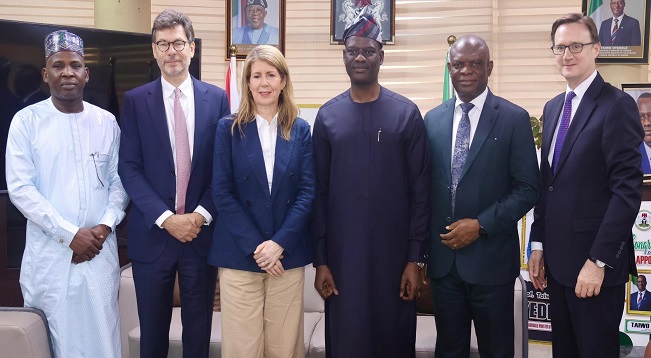
The UK Minister for Africa and International Development, Baroness Jenny Chapman, has concluded a two-day visit to Nigeria, during which she announced a new £15 million Growth Programme, deepened cooperation on digital transformation and health, and visited communities benefiting directly from UK investment on the ground.

The visit, spanning Abuja and Kaduna, underscored the breadth and depth of the UK–Nigeria Strategic Partnership and marked a significant step towards both countries’ shared priorities.
The UK–Nigeria Growth Programme
The centrepiece was the meeting with Nigeria’s Minister of Finance and Coordinating Minister of the Economy, Mr. Taiwo Oyedele. During their meeting, they discussed the new UK–Nigeria Growth Programme. Over three years, it will accelerate economic transformation, unlock private investment and support Nigeria’s transition from macroeconomic stabilisation to sustained, reform-led growth.
Alongside the Growth Programme, the UK announced deeper collaboration on Nigeria’s digital economy through the SPRIRET initiative, delivered under the UK’s Digital Access Programme. SPRIRET will support digital governance reforms across five Nigerian states, reducing regulatory barriers and enabling greater investment and innovation in broadband, digital services and emerging technology.
The Minister of Finance and Coordinating Minister of the Economy, Mr. Taiwo Oyedele said: “We continue to value the UK–Nigeria relationship, one of the most important partnerships for both our countries. Today, that relationship extends beyond traditional ties and now focuses on development, growth, and shared prosperity.
“The UK–Nigeria Growth Programme helps bring this partnership to life—supporting capital market development, technology investment, small businesses, and technical assistance. We look forward to seeing how these opportunities deliver lasting benefits and drive progress for both countries.”
Trade and bilateral ministerial meeting
During the visit, Baroness Chapman met with the Minister of Industry, Trade and Investment, Dr Jumoke Oduwole. Discussions covered progress under the Enhanced Trade and Investment Partnership (ETIP), including boosting exports via the Developing Countries Trading Scheme, fintech and capital markets links.
Kaduna: building on two decades of partnership
In Kaduna, Baroness Chapman met with Governor Uba Sani to take stock of over 20 years of UK–Kaduna partnership and explore how cooperation can deepen shared priorities. She heard from the business community and key institutional investors about their investment aspirations and the role of the UK in supporting investment mobilisation and enabling climate finance.
She met with community animal health workers and livestock breeders to discuss the UK’s support on breeding techniques, animal health and livestock vaccines. She also visited Unguwan Sanusi Primary Health Care Centre, which serves approximately 20,000 people in Kaduna South, hearing directly from patients and frontline health workers about the impact of UK-supported health programmes.
At the end of the visit, the UK Minister for Africa and International Development, Baroness Jenny Chapman, said: “This visit has reinforced everything I believe about the UK–Nigeria partnership.
“That it is deep, it is real, and it is moving in the right direction. From launching our new Growth Programme with Honourable Minister Oyedele, to meeting from frontline health workers in Kaduna — every conversation this week has shown me a country full of ambition and a partnership that is genuinely delivering for both sides.
“Nigeria is a partner that the UK is proud to stand alongside and I leave more convinced than ever that the next chapter of this partnership is its most exciting yet. The UK is here for the long term, and we are ready to grow together.”

More than 810 million women across low- and middle-income countries (LMICs) remain offline, with Sub-Saharan Africa recording one of the world’s widest mobile internet gender gaps.

According to the GSM Association’s (GSMA’s) Mobile Gender Gap Report 2026, released this week, women in LMICs are still 12% less likely to use mobile internet than men, leaving an estimated 200 million fewer women connected than their male counterparts.
This is despite mobile internet becoming the primary gateway to the digital economy, according to new research from the GSMA.
The report reveals that of the 810 million women who remain offline globally, more than two-thirds live in Sub-Saharan Africa and South Asia −regions that continue to experience the widest disparities in digital access.
The findings highlight significant implications for Africa, and the challenges facing governments, mobile operators and development agencies seeking to expand digital inclusion.
The report notes that Sub-Saharan Africa’s mobile internet gender gap stands at 26%, second only to South Asia’s 25%. The divide becomes even more pronounced outside major cities.
“In LMICs, the gender gap in mobile internet adoption tends to be two to three times wider in rural areas than urban areas. In 2025, across all LMICs, the gender gap in mobile internet adoption was more than three times wider in rural areas than in urban areas.
“There is also a difference at the regional level, where the gender gap in mobile internet adoption is wider in rural than urban areas of LMICs in every region except Europe and Central Asia.”
For Africa, the rural challenge is particularly severe, the report warns.
The GSMA found that the gender gap in mobile internet adoption reaches 34% in rural areas of Sub-Saharan Africa, compared to 21% in urban centres.
Device challenge
Smartphone ownership remains a major obstacle to digital inclusion. The report found that women across LMICs are 13% less likely to own a smartphone than men, representing approximately 210 million fewer women with access to internet-enabled devices.
Across Sub-Saharan Africa, only 34% of women own smartphones, with the region recording a smartphone ownership gender gap of 22%, with access to internet-enabled devices remaining one of the most important factors influencing whether women eventually adopt mobile internet services.
“The type of mobile device a person owns matters, as it typically affects whether and how they use the internet. Once someone owns a smartphone, they are much more likely to be aware of mobile internet, adopt it and use it regularly and in a variety of ways. In fact, once women own a smartphone, these metrics more closely resemble those of men,” notes the report.
Barriers persist
Despite growing awareness of mobile internet and its benefits, women continue to face multiple barriers to meaningful participation in the digital economy.
The report identifies affordability, literacy and digital skills as the leading barriers preventing women from getting online.
Even after gaining access, women frequently report safety and security concerns, data costs and connectivity quality as obstacles to broader internet use.
The report notes: “Addressing rural gender gaps is essential to advancing digital inclusion for women overall. In particular, women who live in rural areas tend to have limited physical access to essential services and may have the most to gain from better access to mobile and mobile internet.
“Addressing gender gaps in mobile ownership, particularly of smartphones, and in mobile internet use can help women in rural areas benefit from these digital technologies to the same extent as men.”
Claire Sibthorpe, head of digital inclusion at the GSMA, warns that progress is not happening quickly enough and emerging technologies such as artificial intelligence risk creating new forms of digital exclusion.
“While there has been a slow narrowing of the mobile gender gap since 2022, much more is needed to address the persistent and significant gender gaps in mobile internet adoption and use.
“We live in an increasingly digital world and the proliferation of technologies such as AI are creating greater digital divides and inequities, elevating the need to ensure digital inclusion for all.”
Payaza Africa, a payments infrastructure company, has earned strong credit ratings from four major rating agencies, reinforcing its growing reputation as a resilient and credible player in Africa’s financial services ecosystem.

The payment company recorded upgrades across the board, with DataPro raising its rating from A to AA-, Intelligence Africa assigning it an A- investment-grade rating, Agusto upgrading it from BBB to A-, and GCR, an affiliate of Moody’s, also moving it from BBB to A-.
A credit rating reflects a company’s financial strength and its ability to meet debt obligations, indicating how safe it is for lenders and investors to extend credit.
In a statement on Monday, the company described the achievement as a validation of its disciplined growth trajectory and operational resilience in a dynamic fintech landscape. It added that the upgrades position Payaza as a future-ready brand with increasing relevance not only within Africa but also in the global fintech space.
Commenting on the development, Seyi Ebenezer, the Chief Executive Officer of Payaza Africa, said the ratings reflect years of deliberate effort to build a sustainable and globally competitive institution.
“This milestone is a strong affirmation of the work we have done to build Payaza on a foundation of discipline, trust, and long-term value creation. Receiving these upgraded ratings sends a clear message that Payaza is not only growing, but growing with strength, structure, and sustainability,” he said.
Ebenezer noted that the recognition goes beyond financial performance, highlighting the company’s ability to execute strategically while maintaining strong risk management practices.
“For us, this is bigger than recognition. It reflects our commitment to building a world-class institution that can compete globally while continuing to serve businesses and consumers across the continent with excellence.
“Over time, our ratings journey has reflected more than strong financial performance. It speaks to a business built on disciplined execution, prudent management, and the ability to scale responsibly in a dynamic market. This has helped us stand out not only as an innovator in digital payments, but as a maturing financial institution with the operational depth to compete globally.
“These new ratings are expected to further strengthen Payaza’s standing with investors, regulators, partners, enterprise clients, and the wider financial community. In a sector where trust, resilience, and compliance are increasingly central to long-term success, independent ratings remain a powerful endorsement of a company’s ability to manage risk, meet obligations, and sustain growth,” Ebenezer said.
Payaza Africa provides payment infrastructure solutions focused on collections, payouts, embedded finance, and digital commerce enablement for businesses across Africa.
The company has also continued to expand its product ecosystem with solutions such as Payaza Checkout for payment collections and payouts, Chat and Pay by Payaza for WhatsApp-based transactions, Payaza Give for donations and digital contributions, and Shopaza, its e-commerce platform designed to help businesses sell and receive payments more efficiently.

AI-Powered Cyber Threats Put Nigerian Banks on Alert

Guinea-Bissau Taps United Nigeria Airlines to Establish AIR BISSAU, National Carrier

IMF Urges FG to Introduce Fuel, Telecom Taxes

CBN to Expand eNaira for Salaries, Pensions and Welfare Payments

CSOs Raise Alarm over Nigeria’s Data Protection Crisis

CBN Extends PoS Geo-Fencing Enforcement Deadline to August 2026

NCC Drafts New Rules for Virtual Mobile Operators

TD Africa, HPE Drive Conversations on the Future of Intelligent Networking

Easybuy Partners WAWUAfrica to Upskill 10 Million Youths and Women, Boosting Nigeria’s Economic and Financial Inclusion

Anthropic Raises $65 Bn to Expand AI Research, Innovation




 News3 days ago
UK, Nigeria Launch £15m Growth Programme to Accelerate Economic Transformation

 General News3 days ago
Haleon Introduces New Corporate Identity in Nigeria

 General News3 days ago
Elon Musk Makes History as the World’s First Trillionaire

 Telecom3 days ago
NITDA Unveils Ambitious Strategy to Turn Southwest into Nigeria’s Next Innovation Powerhouse

 General News16 hours ago
₦5m up for Grabs as 10 Startups Clash at the Gathering on 100 Pitchathon Aba
 E-Business16 hours ago
CSOs Raise Alarm over Nigeria’s Data Protection Crisis
 E-Financial16 hours ago
CBN to Expand eNaira for Salaries, Pensions and Welfare Payments

 Telecom16 hours ago
NITDA Reveals Why AI Could Be Nigeria’s Biggest Wealth Creator, Not Oil