

E-Financial
Expert Says Paystack Acquisition is Boost for Nigerian Tech Ecosystem


The acquisition of Paystack, a Nigerian FinTech company, by Stripe is a huge boost for the Nigerian technology ecosystem, according to Jide Awe, chief executive officer of Jidaw Systems Limited.

Awe who spoke with the News Agency of Nigeria (NAN) in Abuja while reacting to the development, said that a massive investment of this nature is a plus for Nigeria’s tech community, an incredible boost and source of pride even in this time of great volatility.
Paystack, a technology company solving payment problems for businesses, was recently acquired by Stripe, a U.S. FinTech company for over $200 million.
The deal will enable Paystack explore diversification to other African countries.
“It certainly rewards and encourages those who took a chance and invested in Paystack.
“Stripe’s investment is a welcome sign of investor confidence in Nigerian tech industry, it is a recognition of potential.
“It is a rebranding beyond words with the world beginning to recognise Nigeria as a tech nation not one identified with negative activities,’’ Awe said.
He further said that the partnership would encourage other global investors to pay attention to the technology sector in Nigeria and Africa.
Awe added that there was great potential in Nigeria that needed to be harnessed because the country’s ICT industry was growing at a very fast rate.
He said that the Paystack solution was workable, would be more beneficial with digitisation and the Fourth Industrial Revolution (4IR), as well as address more needs.
Awe further said that the deal would serve as motivation for Nigerian youths, adding that they had the capacity to build a better future.
He acknowledged that young people with entrepreneurial and mobile drive dominated the country’s population, hence the need to ensure digital inclusion, digital education, capacity building, enabling environment to unlock potential.
“The Paystack acquisition tells our young people to continue their work in tech, coming up with great ideas, continue creating and keep pushing boundaries and breaking barriers despite challenges in the environment.
“The enabling environment just needs to be in place in tech and in other areas.
“Coming at a time when there are protests against youth brutality, it highlights the importance of why the country must value youth and ensure practical youth inclusion,’’ he said.
He identified that the country had lots of promising startups but financing their ideas was a huge challenge.
According to Awe, Nigeria’s developmental challenges are opportunities.
“There are huge unmet needs and the right approach can open up promising and rewarding opportunities.
“It also sends a message to local investors that technology offers rewards.
“The world is becoming increasingly digital and technologies are disrupting industries and creating new structures.
“Investors will need to consider investing in tech startups not just in the traditional areas of real estate, construction, oil and gas, among others,’’ he said.
He added that young people constituted a significant number in Nigeria’s tech community and their experience should not be overlooked.
According to him, in the world of emerging technologies, the society needs to understand the youths, connect with them and support their innovations.
Awe pointed out that the country needs an environment that enables digital growth, transformation through supporting the provision of fast, reliable, affordable internet connectivity.
He recommended high quality digital education for all, strengthening of the local tech sector and promotion of innovation culture beyond policies.


Africa Prudential Plc has launched Sabivest, a digital shareholder and investment management application, as part of efforts to deepen access to investment opportunities and enhance transparency in Nigeria’s capital market.

Unveiled in Lagos, the platform is designed to provide investors with a centralised system for managing shareholdings and tracking portfolio performance across multiple investment products.
At the launch, the Chairperson of Africa Prudential Plc, Christabel Onyejekwe, said the initiative reflects the company’s commitment to leveraging innovation to improve investor experience and participation.
“Sabivest provides a unified ecosystem that enables individuals and institutions to seamlessly access, monitor and grow diversified financial assets through a single interface,” she said, describing the platform as a significant step in advancing digital transformation within the capital market.
The Managing Director, Catherine Nwosu, noted that the application, which is available for download on both iOS and Android platforms, was developed to address structural challenges that have continued to limit investor efficiency, including fragmented investment accounts, restricted access to diverse financial instruments, and inadequate visibility into portfolio performance.
According to her, the platform aggregates multiple investment services, offering users real-time insights and control through a centralised dashboard.
She added that Sabivest features consolidated portfolio views, performance tracking, asset allocation insights, and electronic dividend management, alongside tools for monitoring, documenting, and recovering unclaimed dividends.
The launch also featured a roundtable session themed, “Building Trust and Driving Innovation in Nigeria’s Capital Market,” where stakeholders emphasised the importance of technology-driven solutions in strengthening investor confidence and expanding market participation.

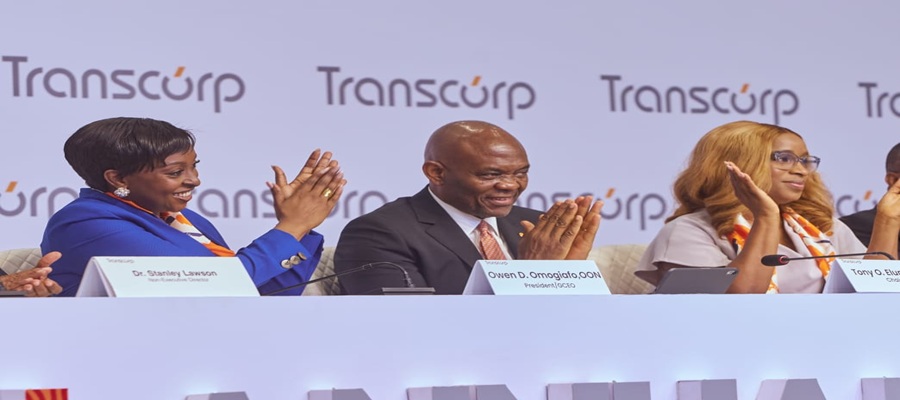
Transnational Corporation Plc (“Transcorp Group” or the “Company”) (NGX: TRANSCORP), Africa’s leading listed conglomerate with strategic investments in power, hospitality and energy, has declared a total dividend of ₦20,323,995,148, representing ₦2.00 per share to its shareholders, at its 20th Annual General Meeting (AGM), held at the new state-of-the-art Transcorp Centre Abuja.

Group Chairman, Mr Tony O. Elumelu, CFR; President/Group CEO,, Mrs. Owen D. Omogiafo, OON; and Company Secretary, Ms. Atinuke Kolade, during the 20th Annual General Meeting (AGM) of Transnational Corporation Plc( Transcorp Group) held in Abuja at the weekend
The total dividend comprises an interim dividend payment of ₦4,064,799.030, representing 40 kobo per share, paid in August 2025, together with a final dividend of ₦16,259,196,118, equivalent to ₦1.60 per share.
At the AGM, where the shareholders approved the Audited Financial Statements for the year ended December 31, 2025, the Group Chairman of Transcorp Plc, Mr Tony O. Elumelu, CFR, restated the company’s commitment to delivering sustainable long-term value creation as shareholders commended the conglomerate and its management for sustained performance.
In 2025, the Group, with a combined market capitalisation of ₦4.78 trillion ($3.52 billion) as of May 7, 2026, recorded strong year-on-year growth across all key metrics. Revenue increased by 33% to ₦544 billion (FY 2024: ₦408 billion). Profit Before Tax rose 31% to ₦179.5 billion (FY 2024: ₦136.7 billion), while Profit After Tax surged 44% to ₦135.9 billion (FY 2024: ₦94.1 billion)
Group Chairman, Mr Tony O. Elumelu, CFR; President/Group CEO,, Mrs. Owen D. Omogiafo, OON; and Company Secretary, Ms. Atinuke Kolade, during the 20th Annual General Meeting (AGM) of Transnational Corporation Plc( Transcorp Group) held in Abuja at the weekend
Mr. Tony O. Elumelu, CFR, Group Chairman, Transnational Corporation Plc said: “Transcorp Group remains firmly focused on strong corporate governance and the disciplined execution of its strategic priorities to deliver sustainable, long-term value. Despite a challenging macroeconomic environment, the Group continues to benefit from its diversified portfolio, which has underpinned resilient financial performance in 2025.
Mrs. Owen D. Omogiafo, OON, President/Group CEO, Transnational Corporation Plc said: “FY 2025 was a year defined by disciplined execution, strategic resolve, and resilient performance. Transcorp Group is committed to resolving the energy crisis in Nigeria; we have an energy situation, and the gap between the demand and supply is still very wide. Hence, we will continue to work assiduously and tirelessly towards bridging that gap, creating value for the wider country.
In our hospitality business, the 5,000-seat capacity Transcorp Centre hosting us today is a testament to our disciplined execution, and you will see more in the coming years.
While commenting on the performance, one of the shareholders, Mrs E. O. Obideyi, commended the management of Transcorp Group, saying, “I commend the management and staff of Transcorp for sustained performance year-on-year. While we appreciate the Board, I am also extending my commendation to the members of staff of Transcorp for a job well done.”
Another Shareholder, Mr Moses Igrude, commended the Board, Management and Staff of Transcorp Plc. He said: “I appreciate the vision behind Transcorp and what it has become. When I look at the history, and how far it has come under Mr Tony Elumelu’s leadership, I am proud that the aim and objectives are being achieved. That payoff line, ‘Improving lives and transforming Africa,’ is a reality we are witnessing.
Transnational Corporation Plc (Transcorp Group) is one of Africa’s leading listed conglomerates, with strategic investments in power, hospitality and energy, driven by its mission to improve lives and transform Africa.
The Group’s power businesses — Transcorp Power Plc and Transafam Power — provide over 20% of Nigeria’s installed power capacity. Transcorp is also advancing Nigeria’s domestic energy value chain through its investment in OPL281. Its hospitality subsidiary, Transcorp Hotels Plc, owns the iconic Transcorp Hilton Abuja and the landmark Transcorp Centre Abuja.


International Monetary Fund (IMF) has warned that artificial intelligence (AI) is significantly increasing the danger of cyberattacks on the global financial system.

Pic credit… saturnpartners
According to a blog post from the IMF, these AI-driven threats could turn isolated security breaches into severe economic disruptions, potentially freezing payments, shaking markets, and undermining public trust in banks worldwide.
In its analysis, the fund highlighted a specific example involving the controlled release of an advanced AI model called Claude Mythos Preview by Anthropic.
The IMF noted that this model demonstrated the ability to identify and exploit weaknesses in all major operating systems and web browsers, even when used by individuals without specialized expertise.
The IMF cautioned that AI could heighten risk concentration within the financial system.
A single exploited vulnerability might cascade across numerous institutions simultaneously due to heavy reliance on a limited number of cloud providers, software platforms, and AI models.
Such events could escalate from operational issues to macro-financial shocks, triggering confidence crises, liquidity problems, and fire-sale dynamics in markets. The organization also acknowledged that AI forms part of the solution.
As attackers operate at machine speed, financial institutions are deploying their own AI-assisted tools for threat detection, fraud prevention, and faster incident response.
The IMF highlighted a geopolitical dimension to the threat, noting that cyber risk crosses national borders and that inconsistent oversight among countries could weaken the globally interconnected financial system.
Emerging economies, often with limited resources, may face disproportionate exposure.
The fund urged policymakers to treat cybersecurity as a core financial stability concern rather than a technical or operational matter.
It called for prioritization of resilience standards, systemic supervision, and international coordination to contain breaches before they spread.

Africa Prudential Launches Sabivest to Boost Digital Investment Access

Interswitch Inducts 3rd Interns into Its Developer Academy

Transcorp Excites Shareholders with ₦20.3 Billion Dividend @20th AGM

PIN Records 3.07bn Media Reach, Expands Digital Rights Impact Across Africa in 2025

PAFON 3.0: Agency Banking Key to Reaching Millions of Unbanked Nigerians – AMMBAN

Kaspersky Discovers Vulnerability in Qualcomm Snapdragon Chips that can Lead to Data Loss & Device Compromise

MTN Suspends Data, Airtime Borrowing Service over New FCCPC Lending Rules

Bank Customers to Pay N1,500 for ATM Card Issuance, Replacement – CBN

FCCPC Licenses 5 Firms for Airtime, Data Lending as Telcos Step Aside

ATM Card Fees Jump to ₦1,500 as CBN Scraps Maintenance Charges




 E-Financial3 days ago
IMF Fears AI-Powered Cyberattack Could Spark Global Financial Crisis

 Telecom3 days ago
ATCON Seeks Stiffer Penalities to Deter Infrastructure Attacks, Vandalism

 E-Business3 days ago
CPN Begins Crackdown on Quack IT Professionals, Vows Tougher Action against Cybercrime

 Telecom3 days ago
Airtel Africa Profits Hit $813m on Strong Nigerian Operations Performance

 Telecom3 days ago
Unity Bank Disburses N500m Loan Facility to Support Small Traders

 General News3 days ago
FG Says It May Reject World Bank Loans over Delays

 E-Financial3 days ago
MasterCard, BMONI Partner to Improve Digital Payments

 E-Financial3 days ago
Fidelity Bank Provides Critical Funding Support to Abuja Special Needs Orphanage