

News
Felak Concepts Explains Relocation of of Ibom Deep Sea Port from Okposo to Ibeno

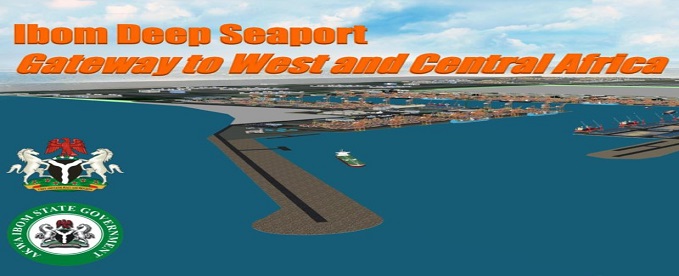
The relocation of the $4.6 billion Ibom Deep Sea Port (IDSP) from Okposo to Ibeno is not political but based on professional and engineering decisions, said Felak Concepts Ltd, the Transaction Advisor/Consultants to the IDSP and Free Trade Zone project.

In a statement issued by Mr. Ezekail Adamu, spokesman for the consultant, it explained that the essence of the project initiated by the Federal Ministry of Transport and Akwa Ibom State Government as a full scale Greenfield Commercial Deep Sea Port Development in line with the proposed Ibom Industrial City (IIC) was too strategic for the Nigerian government and Akwa Ibom state to be subjected to politics.
According to Adamu: “Our company observed due diligence and subjected the selection process to high level transparency as evidenced in all the technical reports submitted. We did not influence or manipulate the relocation of the ports from Okposo to Ibeno.”
Findings showed that five locations were initially shortlisted for the mega-project expected to provide no fewer than 300,000 jobs. Out of the five locations, Okposo was selected as the site at the preliminary stage based on initial/ preceding studies for the Initial Due Diligence (IDD) which itself was subjected to further studies and research to ascertain its suitability.
The consultant explained that this was in tune with global best practices for projects of this magnitude and nature as all the characteristics and parameters were considered “leading or required to arrive at and make a fully founded location selection in the Final OBC/PPF document.”
On its selection as transaction advisor cum consultant, the statement explained: “The State Government through a selective bid tendering process engaged Felak Concept Limited and her Technical Partners, MTBS of Netherlands with clear schedule and terms of reference towards the realization of the development of the Ibom Deep Sea Port.
“The Federal Ministry of Transport was duly notified of our appointment and they swiftly inaugurated the already constituted Ministerial Project Development and Steering Committee (MPDSC) and the Project Delivery Team to midwife/drive the process, as well as direct the TA/Consultants in their deliverables in line with the Infrastructure Concession Regulatory Commission (ICRC) guidelines,” the statement said.
Consequently, according to the statement, the team commenced work and ensured the Initial Due Diligence Report for the Ibom Deep Sea Port and Free Trade Zone was ready by January 2013.
“The goal and objective of this report was to carefully assess the project, verify its feasibility/viability and design a structural approach for the subsequent phases. In other words, the IDD was a preliminary report covering the location analysis of the pre-selected locations, development options for the Port and Free Trade Zone, implementation plan, and preliminary business case among others.”
Adamu explained that none of these is a political decision but basic engineering, economic and other professional considerations. He said that though the initial name was Ibeno Deep Sea Port, it is now Ibom Deep Sea Port to “depict an all-inclusive project for the entire state.”
To make clarifications on change of location and name, Adamu said the consultant wrote a letter dated 3rd October, 2015 to Akwa Ibom State Government “on the need to convene an immediate town hall meeting involving the TAs, Surveyors, MPDSC members, the Governor, His Exco and all stakeholders within the state on the resolution of salient communal issues; such as the clarification and basis of the change of name from Ibaka to Ibom Deep Sea Port, change of location due to a new engineering alignment and other critical factors and analysis.”
The total cost of construction of the Ibom Deep Seaport is $4.6 billion but the first phase of it is $2.016 billion which was approved on Wednesday Dec. 16, 2020 by the Federal Government.
Ownership structure of the project is 60 per cent for the private sector and 40 per cent for the public sector.


National Reading Culture (NRC), an online investment platform targeting Nigerians has collapsed, resulting in the loss of billions of Naira for investors.

The website unexpectedly shut down, blocking users from withdrawing their funds and locking in their investments.
Just like all other investment scams, victims were lured with promises of doubling their money in few weeks.
When National Reading Culture eventually crashed, the operators vanished with users’ funds, leaving investors devastated.
How the Platform WorkedTask-Based Earning:
According findings, National Reading Culture lured users with promises of making money by completing simple daily tasks like reading articles, clicking links, or inviting friends.
They also offered investment tiers to earn higher daily profits, where users had to deposit their own money into the platform.
Evidence showed the website previously operated as a Chinese job search platform before rebranding into an “earning” scheme.


The Nigeria Social Insurance Trust Fund (NSITF) has signed a memorandum of understanding (MoU) with Rand Mutual Assurance (RMA) to collaborate on digital transformation aimed at strengthening worker protection systems and support economic growth.

According to RMA, the agreement was concluded during a visit by its delegation to Abuja.
The partnership will focus on institutional capability development, modernising operating models, improving service delivery and sharing knowledge between the two organisations.
Through the partnership, RMA and NSITF will collaborate to strengthen institutional capability, modernise operating models, accelerate digital transformation and improve services for workers and employers.
The organisations will also explore opportunities for knowledge exchange and the adoption of best practices in social security administration.
RMA said the agreement forms part of its broader engagement with governments, regulators and social security institutions across Africa to support improvements in governance, operational resilience and service delivery.
“Our partnership with NSITF reflects much more than the signing of an agreement,” said Mandla Shezi, group chief executive officer of RMA. “This partnership is not simply about sharing knowledge. It is about co-creating the next generation of African social security systems.”
He added: “By combining our respective strengths, we can help build institutions that are more resilient, more responsive and better equipped to protect workers while supporting national development.”
Shezi said the future of social security depends on integrated systems where prevention, insurance, healthcare, rehabilitation, technology, investment management and institutional capability work together.
Microsoft has announced plans to cut about 4,800 jobs, representing roughly 2.1 percent of its global workforce, with Xbox, its gaming division, expected to bear the largest share of the layoffs.

The company said more than 1,600 positions at Xbox would be eliminated immediately, while another 1,600 jobs would be phased out over the next year as part of a major restructuring of the gaming business.
In a memo to employees, Amy Coleman, executive vice president, Microsoft, said the company was streamlining its operations to focus on areas that deliver greater value to customers in a rapidly changing technology industry.
Asha Sharma, chief executive officer, Xbox, described the move as “the most significant restructure in Xbox history,” saying the changes are intended to position the gaming business for long-term growth rather than downsizing.

Court Declares ARCON’s N60Bn Fine against Facebook Nigeria Illegal

NIN Enrollment Hits over 136m as New ID Law Takes Effect

NRC, Ponzi Scheme Collapses Resulting Loss of Billions of Naira

Plateau PCC Collects Nigerians’ Data without Privacy Policy – FIJ

FG Suspends New Internet Regulations to Prevent Overlapping Rules

Mobile Internet Gender Gap Widest in Africa – GSMA

NASENI Moves to Digitize CCB’s 5m Assets Declaration and Operations

Nigeria Launches FreeTV Nationwide

CANAL+ Partners Samsung to Pre-Load DStv Stream on New Samsung TVs In Nigeria, Other African Countries

UK, Nigeria Launch £15m Growth Programme to Accelerate Economic Transformation




 E-Financial2 days ago
Tokenization, Blockchain Technology will Transform Financial Institutions – IMF

 General News2 days ago
NIS Deploys Advanced Surveillance Masts, other Critical Infrastructure to Boost Border Security

 Broadcasting2 days ago
Obi, NDC Presidential Candidate Faces N50Bn Defamation Claim over Alleged Podcast Remark

 E-Business2 days ago
Weebly Websites to Shut Down for Nigeria, 66 Other Countries from September

 E-Financial2 days ago
FG Denies N8 Trillion ‘Shadow Budget’, Says IMF Quoted out of Context

 Telecom2 days ago
No Plans for Fresh Tariff Hike – MTN

 General News1 day ago
IHS Nigeria, FCT-HSES Concludes Clean Cooking Energy Campaign “Project Breathe Clean Air” in Abuja

 News2 days ago
World Bank Sounds Alarm: Low Revenue, Not Debt, Is Nigeria’s Biggest Fiscal Threat