

Broadcasting
Reps in Fresh Moves to Force Paytv Operators to Implement Pay-per-View

The House of Representatives has considered the pay-per-view, pay-as-you-go and price reduction for DSTV and other cable satellite operators in the country.

Pay-per-view is a type of pay television or webcast service by which a viewer can purchase events to view via private telecast, while pay-as-you-go is a system in which a person or organization pays for the costs of something when they occur rather than before or afterwards
So there is a renewed interest following the adoption of the reports and recommendation of the Ad hoc Committee on Non–Implementation of Pay–As–You–Go and sudden Increment of Tariffs plan by Broadcast Digital Satellite Service Providers.
Unyime Idem, chairman of the Committee had earlier laid the report before the House and was considered by the House on Wednesday in Abuja.
The House called on the Federal Government as a matter of urgency to expedite action on implementing the content of the National Broadcasting Code and the Nigeria information Policy of 2014.
The House noted that this would trigger healthy competition in the industry, adding that the entertainment industry had a wider spectrum with limitless opportunities for the teeming youths.
The House stated that the visible absence of competitors in the industry was a tacit approval of monopoly of the industry by the present operators.
The House suggested that timely application of government regulatory intervention measures already articulated would revolutionise the industry and meet the people’s yearnings for Pay-as-you-go, Pay-Per-View and price reduction.
According to the recommendation, our extant laws that moderate operations in the industry is to be fine-tuned to meet the 21st- century regulatory laws of the industry that is dynamic as the entertainment industry.
The House noted that the commission that had the power to license and regulate the activities of service providers must also have the power to moderate in the protection of consumers.
The House stated that there was little or nothing a regulator could do if he was handicapped by laws that were not properly tailored to the needs of the society.
According to the reports, price increase and reduction have always been contentious issues for producers and consumers in the business world.
The House also listed the factors responsible for hike in subscription fee as recent increment of VAT by 2.5 per cent by Financial Amendment Act of Jan. 13 2020, the fluctuating foreign exchange rate in the country that affects the cost of content.
Others are: broadcast equipment, experienced hire and technical infrastructure, increase in bouquets for a wider choice, inflation on the cost of production and need to maintain workforce.
They identified the need of not throwing many young Nigerians, who are gainfully employed by pay-tv into the labour market were some necessary indices for price hike.


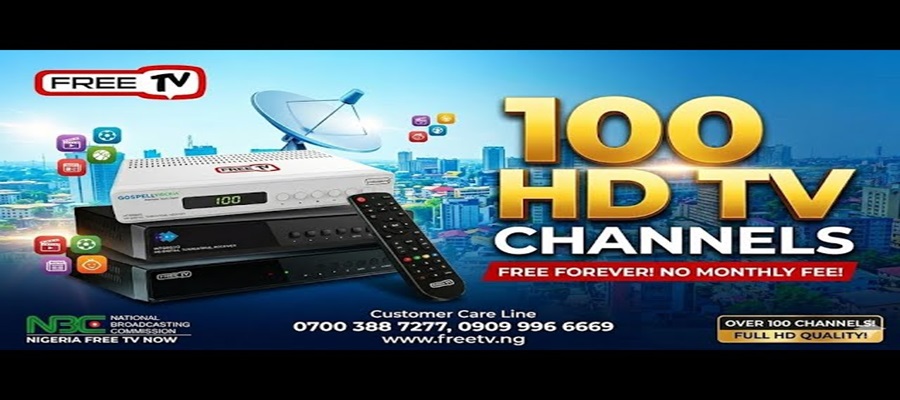
Federal government, yesterday, said that it will now launch the so-called FreeTV, with over 100 channels for news, sports, education, entertainment and children’s programming in multiple Nigerian languages on June 17.

National Broadcasting Commission (NBC) had initially scheduled for May 15 for the launch.
But the new date was announced by Mohammed Idris, minister of Information and National Orientation, on Wednesday during a facility tour of NIGCOMSAT, alongside Dr Charles Ebuebu, director general of the National Broadcasting Commission (NBC) and other stakeholders.
Idris said the long-awaited migration from analogue to digital broadcasting had finally become a reality after years of failed attempts and delays, describing the project as a major breakthrough for Nigeria’s broadcasting industry.
“I have been grappling with this idea of the DSO for many years. Moving our transmissions from analogue to digital has now happened and is ready to be commissioned by June 17,” the minister said.
He revealed that several channels had already been bundled onto the platform, adding that the digital transition would transform broadcasting, advertising and television consumption across Nigeria and Sub-Saharan Africa.
According to him, the new platform introduces scientific audience measurement tools capable of tracking viewership patterns in real time, thereby giving advertisers reliable data for targeted campaigns.
“Now science is at play. If you are viewing a station, we know who is watching what and how many people are watching. Advertisers can now take informed decisions about the kind of programming Nigerians want to watch across all demographics,” Idris stated.
The minister said the collaboration between NIGCOMSAT, NBC, the Ministry of Communications and the Ministry of Information had made the digital transition possible, while commending President Bola Tinubu for providing the necessary support and resources.
He described previous DSO efforts as limited and expensive due to encrypted set-top boxes but noted that the new system would be free and accessible to millions of Nigerians.
“In the past, the boxes were encrypted and costly. Now this is free. Government has taken off some of those costs on behalf of Nigerians,” he said.
Idris stressed that unlike earlier pilot phases restricted to a few cities, the new digital platform would have nationwide and regional reach through NIGCOMSAT’s satellite infrastructure.
“Everybody can now watch whatever he wants in real time and painlessly. Free TV everywhere for everybody”, he declared.
The minister also hinted that the platform would challenge the dominance of existing pay-TV operators by offering Nigerians wider viewing options at no cost.
“I don’t want to always use the word ‘substitute’, but this offers opportunities you didn’t get before. You no longer have that monopoly again. Competition is going to set in. Content will grow and viewership will grow,” he said.
He added that the platform would initially launch in standard definition, SD, before quickly transitioning to high definition, HD, bringing Nigerian broadcasting in line with global standards.
“Soon after the launch, we are moving to HD. Nigeria will now compete globally. What you watch here is what you get anywhere,” Idris said.
The minister further disclosed that the service was already available via mobile application and had successfully undergone testing ahead of the official unveiling.
Also speaking during the tour, managing director and chief executive officer of NIGCOMSAT, described the collaboration between NIGCOMSAT and NBC as a strategic partnership that has strengthened service delivery and raised operational standards within Nigeria’s digital broadcasting ecosystem.
According to her, ongoing investments and satellite expansion plans under the current administration will guarantee reliable and continuous service delivery.
“The work has only just started. The work has only just begun,” she said.
Among those who accompanied the Honourable Minister on the tour were Salihu Abdullahi Dembos, director-general, Nigerian Television Authority (NTA); Jibrin Baba Ndace, director-general, Voice of Nigeria (VON); Mohammed Bulama, director-general, Federal Radio Corporation of Nigeria (FRCN); and Lanre Issa-Onilu, director-general, National Orientation Agency (NOA), alongside other senior government officials and dignitaries.
Metro Digital Limited, a licenced Indigenous broadcasting organisation, has accused Multichoice, pay television company, of refusing to obey judgements emanating from Courts in Nigeria.

It said the latest of such judgements is the one that was delivered by Justice Chinelo Odili of Rivers State High Court on May 4, 2026 in Suit No. PHC/3943/FHR/2025.
Dr. Paul Osuji, operations manager of Metro Digital, at a press conference in Port Harcourt, Rivers State,
said the suit was filed by the organisation and two others against Multichoice and the Economic and Financial Crimes Commission (EFCC).
Osuji stated that Justice Odili has in the judgement described the arrest of a staff member of the company and the carting away of it’s properties and disruption of it’s broadcasting business by the EFCC over a civil dispute of copyrighy as unlawful and violations of the applicants’ rights.
The manager recalled that in October 2025, Multichoice instigated the EFCC to read their office in Port Harcourt, arrested a staff of the company and staff of another company, while the suit was still pending.
“On October 16, 2025, the premises of Metro Digital Limited, a licenced indigenous broadcasting organisation was raided by the Nigerian anti-graft agency, EFCC, instigated by Multichoice Nigeria, purportedly acting on a preservation order made by the Federal High Court sitting in Port Harcourt over the sub licensing of broadcasting content right.
“The preservation order came from a civil dispute already adjudicated by the Court of Appeal No. CA/CS/188/2021 – Multichoice Vs Metro Digital Limited and 20 others, which is a subject of a pending appeal -No. SC/CV/1248/2022 -Multichoice and 20 others before the Supreme Court.
“Instructively, while suit No. PHC/ 3943/ FHR/2025 was still pending, Metro Digital Limited filed an application to set aside the said preservation orders of the Federal High Court sitting in Port Harcourt and presided over by Hon. Justice A.T Mohammed.
“In his ruling delivered on December 10, 2025, set aside the preservation orders and it’s legal execution on Metro Digital Limited. The court also ordered EFCC to return unconditionally all the properties and records of Metro Digital Limited, illegally and unlawfully carted away during the raid but the agency has till today not obeyed those orders of the Court,” he said.
Metro Digital Limited is known for operating SLTV, a direct-to-home satellite television service launched to provide affordable, locally-owned alternatives to international pay TV

A Federal High Court in Lagos has restrained the National Broadcasting Commission (NBC) from sanctioning or punishing broadcast stations and presenters over the expression of personal opinions, alleged bullying of guests, or failure to maintain neutrality on air.

NBC
Justice Daniel Osiagor granted the interim injunction following an ex parte application filed by the Socio-Economic Rights and Accountability Project (SERAP) and the Nigerian Guild of Editors (NGE).
The court specifically restrained the NBC, its officers, agents and affiliated persons from enforcing its recently issued “Formal Notice” or imposing sanctions, fines or penalties on broadcasters based on provisions of the 6th Edition of the Nigeria Broadcasting Code, pending the hearing and determination of the substantive suit.
SERAP and NGE had approached the court to challenge what they described as an arbitrary and unlawful move by the commission to punish broadcasters for allegedly expressing personal opinions as facts, bullying or intimidating guests, or failing to maintain neutrality during programmes.
The groups also asked the court to determine whether the provisions of the Nigeria Broadcasting Code relied upon by NBC were inconsistent with the 1999 Constitution, as amended, and Nigeria’s international human rights obligations.
The suit followed an April statement by the NBC in which it raised concerns over what it described as increasing violations of the broadcasting code across news, current affairs and political programmes.
The commission had warned that presenters who expressed personal opinions as facts or bullied guests during live broadcasts would be sanctioned.
However, Justice Osiagor, in his ruling, held that pending the hearing of the substantive matter, the commission must refrain from using the formal notice to threaten, sanction or punish broadcast organisations and on-air personalities under the contested code provisions.
The matter was adjourned until June 1, 2026, for hearing of the motion on notice.

Systems, Not Skin Colour, Hold the Key to Africa’s Development, Says Evans Woherem

Maida, EVC NCC to Lead Speakers @ 17th Africa’s BoICT Merit & Leadership Lecture

Court Orders Globus Bank to Pay Firm N256m for Breach of Contract

WASPAN Drags Bello, FCCPB Boss to Court over Alleged Disobedience of Order

Pantami, Ex Minister of Communication Withdraws from Gombe APC Governorship Primaries over Alleged Electoral Violations

MTN, VDT, Zoracom, Digital Realty Back 2026 Girls in ICT Campaign

Vitel Wireless Partners Fintechs to Expand Access to Services

Kaspersky Discovers Vulnerability in Qualcomm Snapdragon Chips that can Lead to Data Loss & Device Compromise

Bank Customers to Pay N1,500 for ATM Card Issuance, Replacement – CBN

FCCPC Licenses 5 Firms for Airtime, Data Lending as Telcos Step Aside




 General News2 days ago
Xenophobic Attacks: Anonymous Nigeria Threatens to Leak South African Stolen Data

 Telecom2 days ago
MTN Targets 8m Homes in Fibre Expansion Drive

 E-Financial2 days ago
Chapel Hill Denham Says Banks Lose N2.5 Trillion Annually to High CRR in New Report

 E-Financial2 days ago
Lagos Sanctions 15 Money Lending Firms for Operational Violations

 Telecom2 days ago
GBB Says Cross-border Partnerships Key to Africa’s Digital Transformation

 E-Financial2 days ago
AfDB Approves $200m for BoI to Support MSMEs

 News2 days ago
WHO Says Ebola Outbreak Worse than Reported

 E-Financial2 days ago
FirstBank, Visa Launch Multicurrency Signature, Naira Debit Cards