

E-Financial
AFC Closes US$250m Syndicated Term Loan Facility

The Africa Finance Corporation (AFC) has signed a US$ 250 million syndicated term loan facility, marking its debut in the international syndicated loan market.
The facility, which was oversubscribed, has a tenor of 2 years and will be used to enhance the corporation’s ability to support investment and trade finance across the continent, in line with AFC’s establishment agreement and charter.
Citibank, FirstRand Bank, acting through its Rand Merchant Bank division, The Standard Bank of South Africa Limited and Standard Chartered Bank, acted as the Initial Mandated Lead Arrangers and Bookrunners.
AFC, a multilateral finance institution, was established in 2007 with an initial capital base of USD1 billion, to be a catalyst for private sector infrastructure investment across Africa. AFC was established to help fill a critical void in providing project structuring expertise and risk capital to address Africa’s infrastructure development needs, and is increasingly being seen as the benchmark institution for private sector-led investment in the core infrastructure sectors of power, natural resources, heavy industry, transport and telecommunications.
Commenting on the loan facility Andrew Alli, president & chief executive officer, AFC said “This facility is a further endorsement of our approach to investment on the continent, following the completion of facilities with a number of multilateral financial institutions earlier this year. Enhancing our ability to on-lend to projects across Africa is core to our strategic objective to broaden our asset portfolio on the continent and we are extremely pleased at the level of interest expressed”.
AFC is an African-led international financial institution, established in 2007 whose mission is to improve African economies by proactively developing and financing infrastructure, industrial and financial assets. AFC is involved as an investor, developer and financier of various infrastructure projects, and is gaining recognition as the benchmark institution for financing the development of infrastructure projects in Africa.
AFC’s current authorized share capital is USD2.0 billion with shareholders’ funds of USD1.24 billion and a 2013 funding programme of USD700 million. To complement its shareholders funds and enhance its financing capacity, AFC has completed several other bilateral borrowings from other DFIs and international commercial banks including; a landmark US$200 million funding facility from the African Development Bank; a USD60 million facility from the German Development Finance Instituion (DEG) and the Netherlands Development Finance Company (FMO); and a EURO 50 million facility from the Society for the Promotion and Participation for Economic Cooperation (PROPARCO) with the participation of European Financing Partners S.A (EFP).
To execute its mandate, AFC has established partnerships regionally, with other institutions such as the African Development Bank, African Export-Import Bank, PTA Bank, Islamic Development Bank, Banque Quest Africaine de Developpement, the Nigerian Sovereign Investment Authority (NSIA); and Internationally with the China Africa Fund, the Infrastructure Development Finance Company of India (IDFC), FMO and the US Government through USAID in the US Presidential “Power Africa Initiative”.
AFC is the lead investor in the award winning Cabeolica project, a USD90 million, 26MW landmark renewable energy wind power project in Cape Verde. AFC is the Technical Adviser to the Central Bank of Nigeria (CBN) on the CBN’s USD2.0 billion Power and Aviation Intervention Fund (PAIF). AFC is a partner with Vigeo Holdings Limited and Tata Power Delhi Distribution Limited for the acquisition of power distribution assets, and a lead financier in the acquisitions of the Kainji and Ughelli power generation plants in the current Nigerian Government power sector privatisation round.
Additionally in Nigeria, AFC made investments to support marginal field operators in the up and mid-stream oil and gas sector companies such as Neconde, FHN and Seven Energy. AFC is also the lead investor in Cenpower Generation Company Limited (Cenpower), which is implementing the Kpone IPP project – a 340 megawatt combined cycle gas turbine power plant in Tema, Ghana.
AFC is the lead investor in the Main One fibre optic cable project, enhancing West Africa’s connection to Europe and the rest of the world through faster and more technologically advanced broadband capacity. AFC provided a USD50 million convertible debt investment in ARM Cement Limited (ARM), the second largest cement operator in Kenya to support expansion initiatives across Eastern and Southern Africa including; development and construction of a lime plant in Tanzania and expansion of ARM’s cement capacity in Kenya.
The transaction marked AFC’s first bilateral investment in Kenya. AFC provided financing for Ethiopian airlines fleet expansion in the acquisition of Africa’s first Boeing 777 airline. AFC also invested in the Bakwena toll road project in South Africa, and in the EURO 270 million Konan Bedie Toll Bridge in Côte d’Ivoire; the signature Transport PPP project in Francophone Africa, underscoring its interest in investing in PPPs/PFIs in its focal sectors across the African continent.
AFC launched a landmark USD15 million project development facility with the Dutch Development Bank FMO in January 2013, to fund early-stage equity investments in projects under development pre-financial close, in the infrastructure sector across sub-Saharan Africa.
“As a way of showing appreciation for the massive support from our Original Equipment Manufacturers, OEMs and our customer loyalty, we have a culture of giving out gifts at the end of the year. This is the fifth year of this annual bonanza tagged ‘Slot Promo 5’.
“We have fantastic gifts which include N500, 000 cash prize, a motorbike, double door refrigerators, LED TVS, several models of phones and the grand prize of a brand new saloon car.”



Nigeria Data Protection Commission (NDPC) has launched investigation into the activities of so-called ‘sharp sharp’ loan operators over alleged violations of customers’ data privacy.

‘Sharp sharp’ loan operators, also known as loan sharks are illegal, unlicensed moneylenders who operate outside of government regulation.
They typically target individuals who cannot access traditional bank loans due to low income or poor credit history.
Vincent Olatunji, national commissioner of the Nigeria Data Protection Commission, told the News Agency of Nigeria, that some of the violations include accessing borrowers’ phone contact lists and using them to reach their family members and friends, as well as sharing images without consent and sending defamatory or threatening messages.
Olatunji, who spoke on the sidelines of a training for Data Protection Officers in Abuja, said the federal government was aware of some lenders breaching customers’ data privacy in their desperate bid to recover loans.
He emphasised the need for increased public awareness, urging Nigerians to understand their rights and carefully review loan agreements before accepting offers.
Olatunji, however, said unethical data practices by loan operators remained a global concern.
“Many borrowers unknowingly expose their personal data due to failure to read loan agreements. This is not peculiar to Nigeria; it is common in every part of the world.
“Unfortunately, most of the information are from those who obtained loans without going through the agreement they signed before accessing the loans.
“Many operators function solely online, without physical offices. This makes regulations more complex. However, compliance with data protection laws remains mandatory.
“Before any digital loan giver operates in Nigeria, it is mandatory to look at the areas of privacy,” he said.
Olatunji said that Nigeria had several consumer protection entities such as the Federal Competition and Consumer Protection Commission, which takes the lead on consumer protection.
The NDPC boss listed other key agencies involved in regulating the space to include the National Information Technology Development Agency (NITDA), the Nigerian Communications Commission (NCC), the Central Bank of Nigeria (CBN), and the Nigeria Police.
He said that any digital lender must obtain approval and licensing from the FCCPC, with strict requirements to uphold user privacy.
“Part of the requirements is to ensure provisions around privacy are complied with so that they do not infringe on the rights of their customers.
“Any unauthorised access to people’s contacts is an offence and we will come after them,” he warned.
Ecobank Transnational Incorporated delivered one of its strongest performances in years in 2025, posting $801 million in pre-tax profit, up 21% from a year earlier, alongside net revenue of $2.45 billion, a 17% increase.

The results mark a high point since Jeremy Awori, CEO took over in 2022 and offer early validation of the group’s long-criticized Growth, Transformation and Returns strategy.
The improvement is especially clear in operating efficiency.
The cost-to-income ratio dropped to 48.3%, from 52.8% a year earlier and above 70% in the group’s more difficult years before 2018. For a bank operating across more than 33 markets with uneven macroeconomic conditions, the shift is significant: Ecobank now spends less than 49 cents to generate one dollar of revenue.
It also marks a structural change, with revenue growth now outpacing expenses at the group level.
Performance was led by the Corporate and Investment Banking division, which posted $697 million in pre-tax profit, up 40%, driven by trade finance, cash management, and capital markets activity.
The Consumer and Commercial Banking segment followed with $480 million, up 27%, supported by stronger deposit mobilization and a 33% increase in lending.
Customer deposits rose by $4.9 billion to reach $25.3 billion, while total loans stood at $12.8 billion.
Return on tangible equity reached 27.8%, signaling a renewed capacity to generate value.
The board’s recommendation to pay $40 million in dividends, or $0.0016 per share, carries more symbolic weight than financial impact.
Over the nine years leading up to 2022, Ecobank paid dividends only twice, the last time in 2016.
From 2017 to 2021, shareholders saw no payouts as the group focused on repairing its balance sheet, transitioning to Basel III standards, and navigating the pandemic.
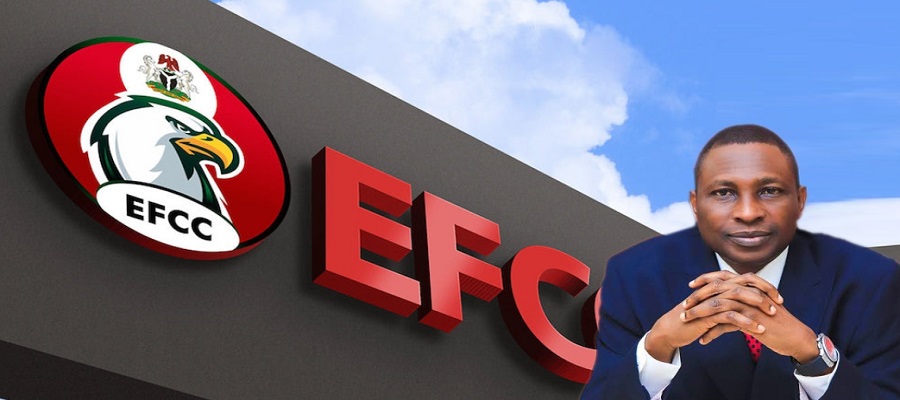
Ola Olukoyede, executive chairman, Economic and Financial Crimes Commission (EFCC), has cautioned Nigerian banks against granting loans without credible collateral, warning that such practices often lead to insider abuse and non-performing loans.

Olukoyede issued the warning recently when he received Mufutau Olawale Abiola, chief audit executive, First Bank Plc, who led a delegation on a courtesy visit to the Lagos Zonal Directorate 2 of the Commission in Ikoyi.
Speaking through Bawa Usman Kaltungo, acting zonal director, Lagos Zonal Directorate 2, Ikoyi, Olukoyede expressed grave concerns over how banks in the country grant loans, noting that loans backed only by personal guarantees, including those of top executives, are inadequate and put depositors’ funds at risk.
He said: “We have issues with banks’ mode of giving loans. The process often shows insider abuse.”
While emphasizing that banks should desist from issuing loans without visible or credible collateral, he added that “Top-down loans are not secured. You cannot give a loan based solely on the personal guarantee of the Chief Executive.
This is not security. Banks must not issue loans without verifiable collateral. If there is proper collateral for loans obtained by bank customers, this will reduce the rate of non-performing loans.”
He further warned that a bank is only a custodian, and that giving loans without adequate collateral “amounts to tampering with depositors’ funds.”
He also urged banks to implement measures, including thorough due diligence on its customers, to prevent loan defaults.
According to him, “Even in situations where you outsource due diligence, there must be a clause of liability,” he said.
Reaffirming the Commission’s commitment to continued cooperation with the bank in tackling financial crimes, he urged the bank to release its staff promptly when invited during investigations of alleged financial crimes.
“When we invite your staff, especially where insider connivance is suspected, you must release them so we can jointly fight economic and financial crimes. We must work together to stay ahead of criminals. Let me add that where money is, that is where people’s hearts are. Most of the time, we escalate issues to foreign security agencies as may be necessary,” he added.
Earlier, Abiola expressed gratitude to the EFCC leadership for the engagement, noting that the visit was intended to strengthen the existing collaboration between the bank and the Commission.
While urging the EFCC to expedite investigations into cases involving its staff and others, Abiola also disclosed that a designated team in his bank handles requests from the EFCC.

FG Investigates ‘Sharp Sharp’ Loan Operators over Alleged Privacy Violations

CISA Asks NDPC, Police to Act on Alleged Data Breach by NIPSS

Fela Makes History as First African to be Inducted into Rock and Roll Hall of Fame

Lawmakers Ask CBN to Suspend Payment to ZTE for Failed $460m CCTV Project

Ecobank Delivers Strong Results, Posts $801m in Pre-Tax Profit for 2025

Spotify’s Loud & Clear Report Reveals Over ₦60Bn Revenue for Nigerian Artists in 2025

Kuda MFB Increases Kuda for Her Business Grants to ₦10 Million

Canal+ to Cut Jobs as Part Sweeping Restructuring

Nigeria tops global rankings for USDT, USDC ownership

NBC Boss Urges Content Ceators to Participate in DSO




 Telecom2 days ago
SpaceX Hints at Home‑Built Chip Module for Starlink Mobile

 General News2 days ago
Teenager Hacks Celebrities Whatsapps, Sells Adult Content in Delta

 E-Financial1 day ago
Fidelity Surges Ahead in Recapitalisation Drive with ₦564bn Capital

 Telecom2 days ago
Digital Realty, IXPN Expand Peering Network with New Internet Exchange Point of Presence in Nigeria

 Telecom2 days ago
Elon Musk Accuses South Africa of Racism over Starlink Licence Block

 E-Financial2 days ago
Lawyers Sue CBN over One-Time BVN Phone Number Change

 News2 days ago
Meta Files Appeal over $25,000 Damages Awarded to Falana

 E-Business2 days ago
FG Unveils ePharmacy Platform to Regulate Digital Pharmaceutical Services