

News
AfDB Backs Spending of Pension Funds on Infrastructure


President of the African Development Bank, AfDB, Dr. Akinwunmi Adesina, gave his support for Nigeria to spend pension fund on infrastructure. Adesina said with the continent’s $1.8trillion pension and sovereign wealth assets, it has no business going a broad to borrow to fund project.
Speaking with State House correspondents after meeting behind closed doors with President Muhammadu Buhari at the presidential villa, Abuja, the AfDB boss said that the country could address the infrastructure deficit by committing the pension funds that are idle on infrastructure.
He argued that investing in other countries sovereign wealth funds and going back to borrow “your own money” doesn’t really make a lot of sense.
He said that he was at the State House to discuss security issues as well as how to address the country’s infrastructural gaps among other issues.
He advised governments on the continent to invest the $1.8 trillion pension and sovereign wealth assets on the development of infrastructure in Africa.
According to him, Africa had an infrastructure gap of $68 billion to $108 billion which could be adequately addressed by utilising the $1.8 trillion accrued pension and sovereign wealth funds, adding that there was the need for African leaders to invest in infrastructure development.
He said doing so would be a case of “charity begins at home”, instead of going elsewhere to seek funds for development or investing the funds.
He also explained that with good infrastructure, Africa would be better positioned to compete favourably with trading partners from other continents.
The former Minister of Agriculture said: “Today, Africa has an infrastructure gap of about roughly $68 billion to $108 billion infrastructure financing gap. At the AfDB, we have been working so hard to close that particular gap.
“When it comes to the issue of attracting capital to do that, there are three things that I will say; first, we have to also look at home.
Today, in Africa, the size of the sovereign wealth fund and pension fund and insurance pull of fund (mutual funds) is about $1.8 trillion.
“If we can just tap a little part of that, we will close very quickly the infrastructure gap that we are talking about.
But, you see a lot of sovereign investment funds being invested in other sovereigns outside the continent.
“So, they become the sovereign wealth of others and then you go back and borrow back your own money; it doesn’t really make a lot of sense. I say that charity always begins at home.”
The AfDB President assured that the bank would continue to support development on the continent, especially now that its shareholders had strengthened it with $115 billion.
On the proposed single currency for the Economic Community of West Africa sub-region, the Eco, Adesina described it as a good development for West African countries, stressing that with the African Continental Free Trade Area Agreement, AfCTA, coming on board, a unified currency for the sub-region also meant it would be better placed to compete with the rest of Africa.
He said, “I support the Eco fully,” he said, adding that the AFCTA is “the biggest thing to happen to Africa”.
“That free trade area itself is worth over $3.3 trillion in terms of trade. Obviously, it’s not optimum to trade in so many currencies. “So, it makes common sense to have a unified currency and of course for that to even be achieved, the Eco; I support Eco greatly. I think it’s a great idea to do.
“But, obviously, there are a number of convergence criteria that will have to be met and I am sure that our President is talking with other presidents to be sure that they can meet those criteria and the region can be fully integrated.”



By Naeemah Junaid
The National Information Technology Development Agency (NITDA) has held strategic discussions with representatives of Trust Stamp, a NASDAQ-listed global technology company, to explore potential areas of partnership aimed at strengthening Nigeria’s digital trust framework and advancing innovation within the digital economy.

The meeting, chaired by NITDA Director General, Kashifu Inuwa Abdullahi, focused on identifying collaborative opportunities aligned with Nigeria’s digital transformation agenda and the Agency’s strategic priorities for building a secure, inclusive, and innovation-driven digital ecosystem.
Inuwa emphasised that trust remains a critical foundation for the growth of the digital economy, noting that secure systems and strong cybersecurity frameworks are essential for driving innovation, economic growth, and national development. He stated that building trust in digital platforms and services is key to accelerating adoption and unlocking opportunities across sectors.
He reiterated NITDA’s mandate as a regulator to create an enabling environment through forward-looking policies and regulatory frameworks that support innovation rather than promote specific technologies. According to him, government interventions are designed to stimulate markets, create opportunities, and empower both businesses and citizens to participate fully in the digital economy.
The Director General further reaffirmed Nigeria’s openness to investments that strengthen digital infrastructure and enhance digital services, stressing that sustainable national development is best driven by private sector participation under supportive regulatory and policy frameworks. He called for continued engagement to ensure alignment with national priorities and effective integration into Nigeria’s digital ecosystem.
In his remarks, Trust Stamp Vice President, Jonathan Pasha, highlighted the company’s global experience in secure verification and trust technologies, describing its approach as partnership-oriented and focused on delivering long-term value within local ecosystems. He noted that the company prioritises collaboration with governments and private sector stakeholders to address local challenges and expand access to secure digital services.
Pasha referenced Trust Stamp’s ongoing operations in Nigeria, including its collaboration with a telecommunications provider to enhance SIM swap prevention and fraud detection capabilities. He also outlined the firm’s biometric tokenisation technology, which converts biometric data into secure, privacy-preserving representations, enabling verification processes without exposing sensitive information.
He explained that the technology supports secure verification, fraud prevention, financial inclusion initiatives, and the tokenisation of real-world assets, while being designed to function effectively in low-connectivity environments and on low-specification devices to expand access to digital services.
Both parties expressed interest in advancing technical-level discussions to identify specific areas of collaboration aligned with national priorities and Nigeria’s digital transformation objectives.
NITDA reaffirmed its commitment to fostering a secure and trusted digital economy through strategic partnerships, robust regulatory frameworks, and initiatives that promote innovation, inclusion, and sustainable growth.

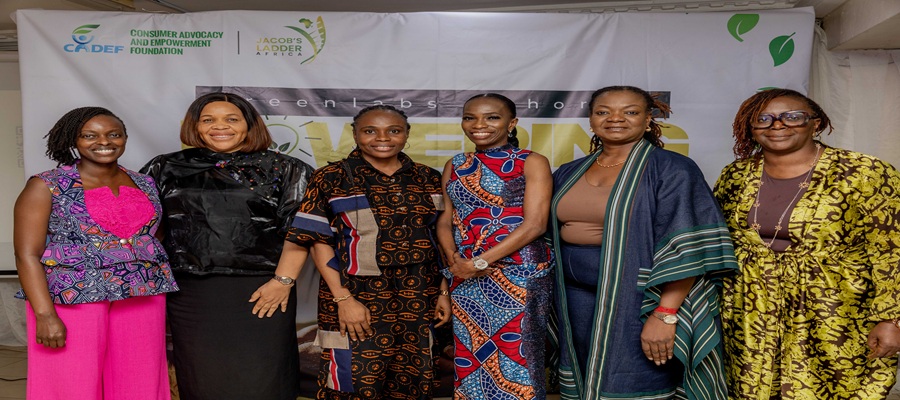
Three youth-led startups — Geocycle, Ecobag Mart and Leovia Farms — have emerged top winners at the Greenlabs Cohort 2 “Powering Food Systems” Demo Day, securing pre-seed funding to scale solutions targeting Nigeria’s food insecurity, post-harvest losses and climate pressures.

CADEF
The Demo Day, hosted under the Greenlabs Incubation Programme powered by the Consumer Advocacy and Empowerment Foundation (CADEF) in partnership with Jacobs Ladder Africa (JLA), spotlighted 16 innovators selected through a nationwide call and intensive mentor-guided screening process.
Organisers said the winning solutions stood out for their scalability, environmental sustainability and potential to strengthen fragile agricultural value chains. The pre-seed support will fund prototype refinement, business registration, market validation and early commercial deployment.
Other finalists showcased at the event included Agricool and Dry Heat Solutions, with all participants advancing into a structured nine-month incubation programme focused on enterprise development, expert mentorship and access to growth resources aimed at transforming early-stage ideas into viable green businesses.
Delivering the keynote on behalf of the Permanent Secretary, Ministry of Agriculture and Food Systems, Emmanuel Audu Fatai described the emergence of the winners as proof that youth innovation is becoming central to Africa’s food future.
According to him, the continent’s vast agricultural potential continues to coexist with food shortages, climate stress and weak value chains, making technology-driven and energy-efficient solutions critical to achieving sustainable food security.
Executive Director of CADEF, Prof. Chiso Ndukwe-Okafor, said the selection of the three winners reflects the programme’s shift from ideas to impact-driven enterprises capable of creating jobs and delivering measurable community value.
She added that beyond funding, the incubation framework is designed to instil financial discipline, integrity and long-term business sustainability among participating founders.
Chief Innovation Officer at Jacobs Ladder Africa, Karen Chelang’at, noted that the winning solutions directly address real food-system failures through renewable-energy integration, loss reduction and productivity improvement across sectors such as poultry, aquaculture and agricultural logistics.
She emphasised that the ultimate measure of success will be the ability of the startups to achieve market readiness, scale operations and generate tangible economic and environmental impact.
Organisers stressed that while policy support remains important, cross-sector collaboration and youth-driven enterprise will play a decisive role in building resilient food systems and advancing Nigeria’s transition to a green economy.
With incubation now underway and funding secured, the emergence of Geocycle, Ecobag Mart and Leovia Farms marks a significant step toward translating youth innovation into practical solutions for Nigeria’s food and climate challenges.

The Nigeria Deposit Insurance Corporation (NDIC) has reaffirmed its commitment to safeguarding the nation’s financial system, announcing that its recent upward review of the maximum deposit insurance coverage now protects about 99% of depositors in the Country.

Kabir Katata, Executive Director (Operations), NDIC, stated this on Wednesday at the Corporation’s 2025 Stakeholders’ Town Hall Meeting held in Enugu.
Katata, while speaking on the theme, “Deepening Stakeholder Engagement,” said the policy to expand deposit insurance coverage was deliberately designed to protect small savers, promote financial inclusion and strengthen public confidence in the banking sector.
He explained that the town hall meeting was aimed at engaging stakeholders across various sectors, including academia, market associations and civil society groups.
“The essence of this town hall meeting is to interact with our stakeholders, tell them what we do and listen to their questions so they can better understand the role NDIC plays in society. We guarantee depositors’ funds and supervise banks to ensure that depositors are protected”, he said.
Katata noted that following the 2024 review of deposit insurance coverage, depositors in Deposit Money Banks (DMBs), Mobile Money Operators (MMOs) and Non-Interest Banks (NIBs) are now insured up to N5 million per depositor.
Similarly, depositors in Microfinance Banks (MFBs), Primary Mortgage Banks (PMBs) and Payment Service Banks (PSBs) now enjoy insurance coverage of up to N2 million per depositor.
“This means that in the event of a bank failure, depositors are promptly paid up to the insured limit,” he said.
He added that depositors with balances exceeding the insured limit would receive the initial insured sum, while the outstanding balance would be paid as liquidation dividends upon realisation of the failed bank’s assets and recovery of debts.
Highlighting improvements in the payout process, Katata referenced the recent resolution of defunct institutions, including Heritage Bank Limited, Union Homes PLC and Aso Savings and Loans PLC.
He said that the Corporation successfully leveraged the Bank Verification Number (BVN) as a unique identifier to trace depositors’ alternative accounts and transfer insured sums within days of bank closures.
“I urge all depositors to ensure that their BVN is properly linked to their bank accounts and identity records. This greatly facilitates seamless and timely access to insured deposits in the event of bank failure,” he advised.
Katata emphasised that although the NDIC works closely with the Central Bank of Nigeria (CBN) to ensure sound corporate governance and regulatory compliance in banks, financial system stability remains a shared responsibility.
“While the CBN and NDIC continue to strengthen oversight, depositors also have a responsibility to remain vigilant and well-informed,” he said.

UBA Unveils Diaspora Platform to Connect Global Africans with Investment, Wealth Opportunities

BOI, MTN Foundation Unveil N1Bn Fund for Women Entrepreneurs

No VAT on Land, Buildings and Rent Under New Tax Law — Oyedele

CBN Slams Up to N10m Fine on Banks and Cheque Printers for Security Breaches

Jumia Targets Break-even in 2026 After Strong Q4 Surge

Firm Detected a Fivefold Surge in QR Code Phishing Attacks in the Second Half of 2025
Nigeria’s 9 Top FinTech Firms Valued at $10.6Bn in January 2026

DG NCC Tasks University Dons on Research Commercialization, IP Management to Build Global Competitive Ecosystems

Firm Detected a Scam Exploiting OpenAI’s Teamwork Features

Kaspersky Launches OT Calculator to Align Cybersecurity Investments with Business Goals




 E-Financial2 days ago
NAICOM Targets Resilient, Global Competition Market in Insurance Sector Consolidation

 News2 days ago
NITDA Explores Partnership with Trust Stamp on Digital Trust and Innovation

 Telecom2 days ago
NCC Orders Telcos Inform Subscribers of Data Breach within 48 Hours

 E-Financial2 days ago
IGP Designates Banks National Security Asset, Orders Crackdown on Cyber Frauds

 General News2 days ago
Cybersecurity Firm Warns Against Gift Card Scams @ Saint Valentine’s Day

 E-Financial2 days ago
Rashidat Adebisi Unveils Strategic Roadmap for Nigeria’s Insurance Sector under NIIRA 2025

 Telecom2 days ago
Globacom Promotes Valentine Gifting with Huge Discounts on Smartphones

 Telecom2 days ago
MTN Backs Bosun Tijani’s Vision for Africa’s AI Leadership