

Telecom
Africa Data Centres Commits to West African Hub with Lagos Datacentre


Africa Data Centres, the pan-African network of interconnected, carrier-and cloud-neutral datacentres and part of the Liquid Telecom Group, has confirmed a significant investment into the construction of a new 10MW datacentre facility in Lagos, Nigeria.

In May 2020 Strive Masiyiwa, Executive Chairman of the Liquid Telecom Group, said plans were “at an advanced stage” to enter West Africa and that the company had secured land “to build the largest datacentres in Ghana and Nigeria.”
Almost a year later, Stephane Duproz, CEO of Africa Data Centres, said construction of the datacentre is underway. “This region is hungry for digitisation and to pave the way for our hyperscale customers to deploy digitisation solutions to West Africa, Africa Data Centres’ construction of a 10-megawatt data centre in Lagos is well underway.
The Nigerian datacentre will form Africa Data Centres’ West African hub. The company’s datacentre network includes Johannesburg, Nairobi, Cape Town, Harare, and Kigali.
“Our expansion into Nigeria marks one aspect of the company’s growth on the continent,” said Duproz. “In response to demand generated by hyperscalers, key cloud operators and multinational enterprises already making use of our data centres, we have purchased the Samrand facility in South Africa and our key build in Midrand is under-way. These same clients, who have trusted us with their expansions into Kenya and other African territories, have expressed their interest in bringing digitisation at scale to West Africa. Our leadership and best practice in data centre operations have made us the obvious choice in their expansion strategies.”
Duproz added that multinational enterprises will want to be housed under the same roof as hyperscaler customers due to the lower latency enjoyed.
“As such, the combination of cloud providers and enterprises make these data centres marketplaces of the ecosystem – and, most importantly, the base for the country’s digital and economic development. Additionally, keeping African data on African soil is another key consideration driving the demand for local data centre facilities. We are proud to be ensuring that African data stays in Africa.”
Africa Data Centres believes the Lagos resource will spur the economy and create jobs.
“The stimulus effect to the economy of digitisation is well documented and Nigeria is ready for this technology boon. Furthermore, our construction policy is to uplift the community as far as possible, employing local contractors and creating work opportunities within the communities we enter – so the job creation opportunities are realised at both grass-roots and high-tech levels,” said Duproz.


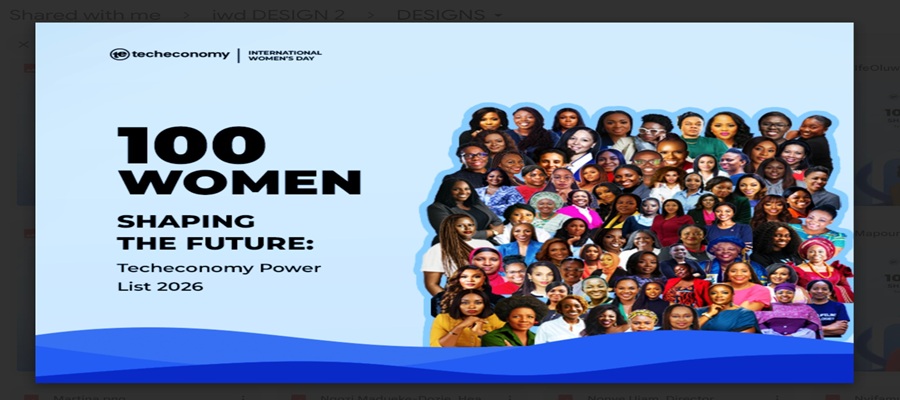
In celebration of International Women’s Day (IWD) 2026, Techeconomy, a leading business news platform in Nigeria, has unveiled its “100 Women Shaping the Future: Techeconomy Power List 2026,” recognizing exceptional women driving innovation, leadership, and impact across technology and the broader digital economy.

Techeconomy
The annual recognition spotlights women who are transforming industries through entrepreneurship, policy leadership, digital innovation, financial inclusion, media, education, and emerging technologies.
The initiative is part of Techeconomy’s commitment to promoting gender inclusion and highlighting female leadership shaping Africa’s technology ecosystem.
The Techeconomy IWD Power List features a diverse group of women, from corporate executives and startup founders to policymakers, ecosystem builders, and social innovators, whose work continues to influence the future of technology, business, and digital transformation in Nigeria and across Africa.
Speaking on the initiative, Joan Aimuengheuwa, the Managing Editor at Techeconomy, noted that the recognition goes beyond celebrating titles, focusing instead on impact, resilience, and the ability to shape the future through innovation and leadership.
According to her, “the women on the list represent different sectors including fintech, banking, healthcare, agriculture, education, communications, and the creative economy, demonstrating the growing role of women in advancing technology-driven development.
The unveiling aligns with the global celebration of International Women’s Day, which highlights the achievements of women and calls for accelerated progress toward gender equality. Across the world, the technology sector continues to push for greater female representation and leadership as part of efforts to build more inclusive digital economies.
Also speaking, Oluwatosin Aloba, the Brand Manager at Techeconomy, said: “Techeconomy IWD 2026 Power List is specially designed to inspire the next generation of female innovators and leaders by showcasing role models who are breaking barriers and redefining possibilities in the technology landscape.
“Techeconomy encouraged industry stakeholders, institutions, and the broader public to celebrate the achievements of these women while continuing to support policies, programs, and investments that expand opportunities for women in technology”, she added.
The full list of the “100 Women Shaping the Future: Techeconomy Power List 2026” is available on the Techeconomy website or visit: https://techeconomy.ng/techeconomy-iwd-2026-power-list-celebrates-100-women-shaping-the-future-of-tech/.

National Information Technology Development Agency (NITDA), via its Office for Nigerian Digital Innovation (ONDI), has partnered with the Japan International Cooperation Agency (JICA) to launch applications for the fifth cohort of the iHatch Startup Incubation Programme, targeting 37 innovation hubs—one per state and the Federal Capital Territory (FCT).

NITDA
The initiative selects hubs as state-level managers to run incubation programmes, addressing uneven support outside Lagos and Abuja. “Nigeria’s startup ecosystem has grown rapidly, but access remains uneven,” said ONDI National Coordinator Victoria Fabunmi. “iHatch builds stronger hubs, standardises quality, and boosts investment readiness across all regions.”
Amid Africa’s $3.42 billion startup funding in 2025, Nigeria’s innovation clusters in major cities, sidelining rural founders. Selected hubs will incubate five startups each for at least one year, providing structured guidance for growth and funding. Hubs gain operational support, resources, and performance rewards—prioritizing ecosystem leadership over cash grants.
Eligibility and Timeline
Eligible hubs must:
Operate for at least one year with local engagement.
Possess infrastructure for incubation activities.
Applications close March 16 at ondi.nitda.gov.ng/#/ihatch.
Fabunmi emphasized: “By equipping hubs with tools, curriculum, and oversight, iHatch ensures consistent outcomes for founders everywhere,” tackling geographic gaps to scale local innovation.

Thrifto, a new Nigerian fintech, is modernizing age-old group savings like ajo (Yoruba), esusu (South-West), and adashe (North) with a bank-integrated web app, slashing risks of defaults, disputes, and lost funds.

Founded by media entrepreneur Sulaimon Biodun Durojaiye, Thrifto lets users create or join groups, set contributions, cycles, and payouts.
It tracks records transparently, preserving cultural collaboration while adding tech accountability. “We’re providing structure and transparency without replacing the spirit of ajo,” Durojaiye said.
Early users—salary earners, entrepreneurs, small businesses—form groups for school fees, rent, or capital. The platform eliminates friction like poor bookkeeping and payout fights, driving organic growth nationwide.
Launching next week, a self-saving feature lets users automate fixed amounts (e.g., ₦5,000 daily or ₦50,000 weekly) toward goals, enforcing consistency solo.
A Trust Rating Score, based on participation history, rewards reliable users, aiding smarter group choices and fostering responsible behavior.
Tailored for Nigerian realities, Thrifto taps informal savings to expand inclusion. Observers see it strengthening networks and discipline in Nigeria’s fintech landscape.

Easybuy Sales Talent Program to Empower 10,000 Nigerians to Become Millionaires

Ghana Nabs 93 Nigerians in Cybercrime Crackdown

Kaspersky Uncovers a New Android Malware Campaign Disguised as Starlink Application

APC Chairman Yilwatda Set for Keynote at 2026 WACC, Charts Tech Path for 2027 Polls

Techeconomy Unveils IWD 2026 Power List Celebrating 100 Women Shaping the Future

Dr. Cairo Ojougboh Foundation Bolsters Nigeria’s Education Drive with ₦2.7m Student Support

Kaspersky Brings more Transparency to Threat Detection with New Hunt Hub

Kaspersky Discovers New Phishing Campaign Exploiting Google Tasks Notifications to Steal Corporate Credentials

esentry 2025 Report Shows Healthcare, Financial Services and Telecoms as Staging Grounds for Increased Cyberattacks in Africa

AfDB, UNDP Launch $10Bn AI Initiative for Africa




 Telecom2 days ago
US Court Dismisses All Claims Against Binance in Major Anti-Terrorism Lawsuit Victory

 Telecom2 days ago
China Threatens to Shut Nigeria’s Satellite Over $11.44m Unpaid Debt

 News3 days ago
Africa Startups Raised $272m in Funding in February

 Telecom2 days ago
TikTok Pumps $200k into AI Media Literacy for Sub-Saharan Africa at Nairobi Summit

 General News2 days ago
More Nigerians Emerge Millionaires in Week 9 of NIVEA’s Consumer Campaign

 E-Business2 days ago
NITDA, Nkenne AI Seek to Localise AI for Nigerians

 Telecom2 days ago
NCC Orders Telcos to Report Cyberattacks Within 4 Hours from 2027

 E-Business1 day ago
FG Moves to Strengthen Children’s Online Safety