

News
Airlines Flee Heavy Taxes, Ditch Local Maintenance


Uncoordinated tax administration is increasingly getting unfriendly and becoming a disincentive to businesses including the aviation industry which has been forced to carry out major checks abroad instead of locally, Nigeria CommunicationsWeek has learnt.
Though Nigeria can lay claim to some domestic aircraft maintenance, the savings from doing the checks locally are quite little due to the current taxation policy.
The tax system highlights the difficulties in doing business in the country and the aviation industry is worried at the huge foreign exchange expended abroad in the maintenance of the nation’s aircraft.
Captain Akinlawon George, managing director, Aero Contractors said tax system put maintenance provider in a big disadvantage against foreign players.
“Nigeria has relatively high import duties on aircraft parts. Airlines typically fly their aircraft to, say, Turkey to have them serviced and relevant parts replaced. Once that aircraft flies back to Nigeria, the new parts are not subject to import duties as they are already installed on the plane. This puts any Nigerian maintenance provider in a big disadvantage against foreign players.” George said
He explained that “A Nigerian maintenance provider would need to import all spares used in maintenance and thus incur the import duties that those maintaining their aircraft abroad avoid completely.”
Prescribing a panacea to the problem, George said the resolution to this issue can be either that spares imported as installed on a plane are subject to import duty, or that Nigerian maintenance businesses would get import duty relief.
“If Nigeria ever wants to allow for aircraft maintenance business to develop in Nigeria, it needs to create a level playing field between domestic and foreign operations. Right now, Nigeria is subsidizing maintenance businesses abroad and as a result is not allowing the same business develop in Nigeria,” he added.
Nigeria CommunicationsWeek gathered that the Nigerian Civil Aviation Authority (NCAA) had recently approved Aero as an Aircraft Maintenance Organisation (AMO) for “A” and “B” checks on Boeing aircraft, various levels of checks on other airplanes.
With that certification, Aero intends to expand existing hangar to enable it meet the requirements of aircraft maintenance work including third party work so that it would be able to service the West African sub-region market for third party maintenance work, provide employment opportunities, training and staff enhancement programmes for employees.



EFCC


The African Development Bank Group last week approved an investment of €6.5 million in the Saviu II fund in order to support technology start-ups through their seed phase and first institutional fundraising, mainly in French-speaking Central and West Africa.

The Bank will invest €4.5 million as equity and €2 million as a first-loss hedging tranche on behalf of the European Commission, under the Boost Africa Programme.
This participation of the Bank Group will enable the Saviu II fund to give priority to companies with a strong technological or digital component.
Saviu II, the second investment vehicle of Saviu Partners, plans to invest between €500,000 and €3 million in about 20 technology or technology-oriented business-to-business start-ups in the seed phase or carrying out first institutional fundraising.
The Saviu II venture capital fund aims to make at least 60% of its commitments in the French-speaking countries of West and Central Africa: Côte d ‘Ivoire, Cameroon, Benin, Senegal, Togo, Burkina Faso and Mali.
The fund can also co-invest in promising technology companies in East Africa that have a strong team and business model, and whose strategy includes entering the market in French-speaking West African countries and establishing a strong presence there.
In addition, the fund will devote a dedicated envelope to pre-seed investments, focusing on minority equity investments, usually in co-investment with studios, incubators or other ecosystem partners.

Nigerian Government has signed a $1.3 billion Memorandum of Understanding (MoU) with Africa Finance Corporation (AFC) via the Solid Minerals Development Fund (SMDF) to fund an alumina refinery, national geoscience mapping, and a strategic investment vehicle for mining growth.

Special Assistant to the Minister of Solid Minerals Development, Segun Tomori, said the refinery will process one million tonnes of bauxite yearly using a modern Bayer process, powered by an on-site gas-fired cogeneration plant.
Minister Dele Alake called it a transformative milestone boosting GDP, aligning with reforms that improve investment climate, regulations, and licensing to attract private capital. He directed agencies to fast-track permits.
The 20-year project at 95% utilization eyes 19 million tonnes total output, $1.2 billion annual GDP addition, $25 billion economic impact, and $8 billion forex earnings, per feasibility studies.
SMDF Executive Secretary Fatima Shinkafi termed it the agency’s biggest funding deal, supporting value-addition policy.
The partnership extends to geoscience mapping for mineral data, de-risking exploration, and a joint vehicle for mining assets.
Permanent Secretary Engr. Farouk Yabo praised the reforms. Shinkafi signed for government; AFC’s Franklin Edochie for the corporation, witnessed by AFC CEO Samaila Zubairu.
Tomori positioned it as Nigeria’s largest private mining investment and FDI magnet.

MultiChoice to Discontinue Showmax Streaming Platform

GCR Affirms Afreximbank’s International Scale Ratings of A, A2

SmartCash Launches ‘No Be Cho Cho Cho’ Campaign to Boost Digital Banking in Nigeria

MTN Nigeria Non-Executive Director Mazen Mroue Quits to Focus on Group Role

Google Adds Yorùbá, Hausa to AI Search, Boosting Access for Millions of Nigerians

Dr. Cairo Ojougboh Foundation Bolsters Nigeria’s Education Drive with ₦2.7m Student Support

Kaspersky Brings more Transparency to Threat Detection with New Hunt Hub

NDPC Commits to Balancing Data Privacy, Protection Information

PwC Reveals AI Scaling Gap Slows Africa’s Digital Transformation

Firm Reviews the Evolution of Phishing Threats in 2025




 E-Financial2 days ago
NRS Targets N40trillion in Tax, Royalty Revenue in 2026

 E-Financial2 days ago
SEC Revokes Registration of Kensington Agro Trading Limited

 General News2 days ago
Purple Woman 3.0 Is Back, to Empower Women in Tech this IWD 2026

 News2 days ago
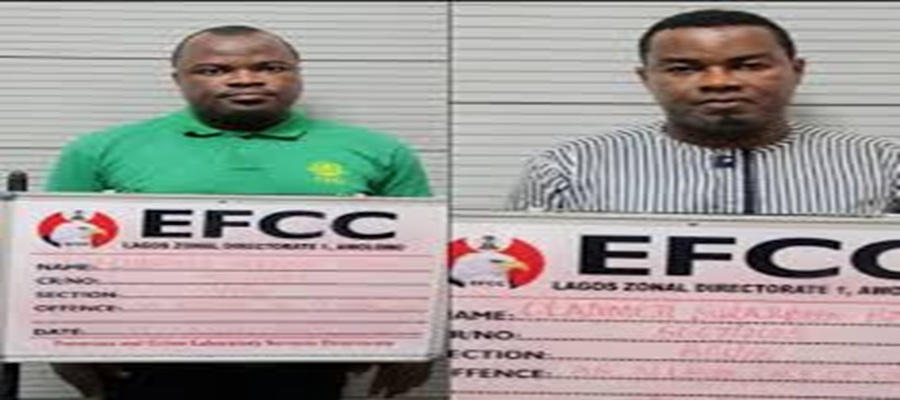
EFCC Arraigns Two FSDH Bank Officials Over $307k, €50k Fraud

 Telecom2 days ago
Konga Launches ‘Berekete Sales’ with Up to 50% Discounts Across Major Categories
 E-Business2 days ago
NDPC, 60 DPAs Collaborate on Enforcing Privacy Rights in the Use of Al

 General News2 days ago
NCDC Raises Alarm over Lassa Fever Ravaging 18 States in Nigeria

 E-Financial2 days ago
Nigeria’s Net Reserves Surge 50% to $34.8bn in 2025 – CBN Governor