

Telecom
Airtel, Renmoney Offer Nigerians Easy Way to Own SOLO Aspire M

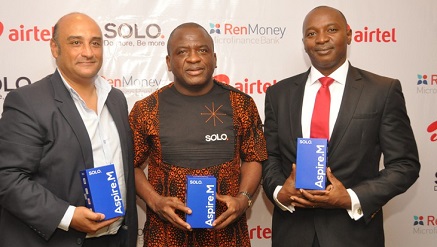
Airtel Nigeria, SOLO and RenMoney have partnered to offer telecoms consumers across the country an opportunity to own premium, quality Smartphones for free, without charge.
Under this partnership, customers can subscribe to the special Smartphone bundle from Airtel for just N4, 150/month for 12months and walk away with the SOLO Aspire M for free.
This special Smartphone bundle gives telecoms consumers 1GB data plan; 60 minutes voice call, 60 SMS and unlimited Social Media access, monthly.
This exciting offer is in line with the partners’ quest to democratize mobile Internet access and ownership while empowering more telecoms consumers to connect with the larger society as well as fulfill their personal, professional and business endeavors; uninhibited by rising costs and reducing purchasing power.
Commenting on the partnership with SOLO, Ahmad Mokhles, chief commercial officer of Airtel Nigeria, said the telco is committed to creating opportunities that will enable telecoms consumers enjoy the very best of mobile experience by providing innovative solutions that enrich a customers’ life.
“With our wide spectrum coverage and super-fast data services, Airtel is well positioned as Nigeria’s number one mobile Internet Company, offering telecoms consumers bespoke and innovative value offerings that will empower them to succeed in their respective endeavors.”
Speaking on the rationale for the package, Tayo Ogundipe, founder & chief executive officer of SOLO said: “Accelerating smartphone adoption in Nigeria is critical to delivering the rich experience that SOLO brings to market. Our Partnership with Airtel and RenMoney is designed to change the game and bring to Nigeria, the same mechanism that has propelled Smartphone adoption in developed markets.
“At a time of difficult economic conditions across Africa, making Smartphones affordable especially for the mass market requires fresh thinking and innovative ideas. That’s SOLO’s DNA and we are proud to be part of the team that’s delivering this unique solution in Nigeria.”
On his part, Ian Abrahams, CEO, RenMoney Microfinance Bank Limited commented: “Partnering with Solo and Airtel for this project was an obvious choice as it aligns with RenMoney’s objectives of providing inclusive, convenient and simple money solutions; we have therefore developed a convenient customer experience that is open to all. It’s something we have a passion for, and we are excited about partnering to provide these affordable smartphones to all Nigerians.”
To fulfill the monthly N4,150 bundle obligations, customers are required to recharge their lines with corresponding airtime value after obtaining the device.
This can be done using physical recharge cards of any denomination. Customers may wish to reserve airtime on their lines before the expiration of their bundle by using the special *486*PIN# to refill airtime directly into the special account reserved for the phone.
With this new offer, customers can walk into Airtel retail outlets or select phone stores across the country to pick up a brand-new SOLO Aspire M.
A security feature that requires the customer to recharge the monthly commitment is installed; but, in the event the subscription expires, the customer needs only enter the recharge PIN for N4,150 into the dial pad that appears on the screen for recharge to happen.
The SOLO Aspire M is a 5 inch Dual SIM smartphone that runs on Android 5.1 operating system, with 8GB ROM and 1GB RAM.
The offer is a pocket-friendly route to ownership of a smartphone with the added benefit of equivalent value of data, voice call and social media access; giving consumers 12 months of consistent service and ownership.



With its meteoric rise in data centre development and it accounting for 20% of the global population, Africa still only has 0.6% of global data centre capacity.

This is based on the 2026 Economic Report: Data Centres in Africa, published by Africa Data Centres Association (ADCA), in partnership with Rising Advisory.
The US hosts about 45% of the world’s data centres, while Africa accounts for less than 1% of global capacity.
According to the report, Africa’s active capacity stands at 360MW, with 238MW under construction and 656MW in the pipeline.
By comparison, global active capacity is at 5.5GW, with 1.5GW under construction and a development pipeline of 13.5GW.
Even if all of Africa’s announced projects materialise, says the report, the continent is projected to maintain rather than increase its global share, as hyperscale expansion accelerates elsewhere.
“This is not a catch-up cycle; it is a race to avoid deeper structural marginalisation in global compute,” notes Faith Waithaka, chairperson of ADCA.
“Capacity development in Africa must be approached with a long-term perspective, recognising that infrastructure growth will precede full utilisation as digital ecosystems continue to evolve.
“Sustainability is now a central consideration for the sector. Improving energy-efficiency and integrating renewable energy sources are essential to the viability of data centre operations. Africa is uniquely positioned in this regard, with vast untapped potential across solar, wind, hydro and geothermal resources. Leveraging these assets can support greener data centres, while strengthening energy security and long-term competitiveness.”
Africa’s data centre market is projected by Mordor Intelligence to reach $4.36 billion by 2031, with the South African market considered a “sweet spot” due to its favourable position on the African continent.
South Africa is the largest data centre market on the continent, with55 data centres already built. The country’s geographical position also makes it a strategic hub for regional and international connectivity.
Firms such as Digital Realty-owned Teraco, Vantage Data Centres, Open Access Data Centres and Equinix have expanded their data centre footprint in SA, while hyperscalers Amazon Web Services (AWS), Google and Microsoft Azure have also built local data centre facilities.
The country’s data centre momentum has been highlighted by president Cyril Ramaphosa on several occasions, notably stating that more than R50 billion in investment is expected in the local data centre space over the next three years.
The data centre capacity buildout has also resulted in government calling for accelerated cloud migration, as the state’s digital transformation efforts require greater use of cloud.
Digital rush
The report notes that the global data centre industry is booming as demand for this “digital gold” accelerates.
Valued at $243 billion in 2025, the market is projected to double by 2032, according to the World Economic Forum.
Meanwhile, UN Trade and Development reports that data centre projects accounted for over one-fifth of all greenfield foreign direct investment in 2025.
“This surge reflects the growing need for artificial intelligence (AI) infrastructure, cloud services and digital networks, positioning data centres as indispensable assets driving global growth strategies,” states the report.
“Several converging trends are driving this expansion. Cloud adoption continues to shift workloads off-premises, while AI and big data are reshaping infrastructure needs.”
On the other hand, hyperscale facilities − operated by giants like AWS, Microsoft, Google and Alibaba − have doubled in number roughly every five years, with hyperscale capital expenditure rising nearly 58% year-on-year in 2024.
“Governments across Asia, the Middle East and Africa are offering incentives to attract greenfield projects, recognising data centres as foundations for innovation, skilled employment, and adjacent industries like fintech and AI. Yet Africa faces a stark challenge.
“The continent’s share is expected to expand only in line with global growth, rather than closing the gap. This opportunity has not stayed unnoticed, and investors, expecting high returns, have poured funds into increasing the sector’s capacity by approximately two-thirds.”
Legal steps
According to the report, the heightened activity in the data centre market has resulted in data sovereignty becoming policy reality.
It notes that as of early this year, over 40 African nations have enacted data protection legislation or established data protection authorities, while five additional countries are drafting laws.
Additionally, 15 countries have formalised national AI strategies.
As noted in the ADCA report, the frameworks aim to protect citizens’ rights, while providing legal certainty for investors and digital service providers.
“Governments are increasingly recognising data centres as critical national infrastructure, central to digital sovereignty, financial stability and AI competitiveness.
“As Africa’s digital economies expand, the rules governing ‘where’ and ‘how’ data is stored, processed and transferred are becoming central to economic competitiveness and state capacity.
“Data sovereignty – the principle that data generated within a country should be governed by that country’s laws – has evolved from a legal aspiration into a strategic policy lever, shaping investment patterns, infrastructure deployment and the localisation of digital value chains.”
Even with the frameworks, enforcement capacity often lags legislative ambition, states the report.
“World Bank and GSMA assessments highlight constraints linked to staffing, funding and technical expertise. Yet this enforcement gap also represents a growth opportunity: stronger, more predictable regulation is increasingly seen by investors as a prerequisite for scaling local digital infrastructure. And well-functioning regulation is increasingly functioning as a demand signal.
“Clear localisation and data-protection requirements create predictable demand for compliant, in-country infrastructure, improving bankability for data centre projects and attracting long-term capital.
“Data localisation policies are emerging as part of this broader regulatory maturation. When aligned with market realities, localisation can strengthen oversight, improve accountability and support the development of domestic data centre ecosystems.”


GigaLayer, a prominent player in Africa’s cloud infrastructure and domain services sector, has announced the acquisition of Registeram, a Nigerian domain registration and hosting firm.

GigaLayer
This move marks a significant consolidation in the local tech ecosystem, as GigaLayer continues its aggressive expansion strategy to dominate the digital infrastructure market in Nigeria and across the continent.
Consolidating the Digital Backbone
The acquisition of Registeram, which has been operational since 2008, is the latest in a series of strategic buyouts by GigaLayer.
The company has previously integrated brands such as Trudigits, Hub8, MainOne’s SMEinaBox, and LagosHost, effectively positioning itself as a primary consolidator in a fragmented hosting industry.
According to Ahmad Mukoshy, Founder and CEO of GigaLayer, the deal is less about increasing headcount and more about infrastructure resilience.
“This acquisition reinforces our commitment to building resilient, locally operated cloud and domain infrastructure for African businesses. We are not just acquiring customers; we are strengthening Africa’s digital backbone,” Mukoshy stated.
What this means for Registeram customers
GigaLayer has assured Registeram’s existing clientele of a seamless transition with no immediate service disruptions.
Key highlights of the integration include:
Infrastructure Upgrade: Services will be migrated to GigaLayer’s enterprise-grade platform to improve performance and redundancy.
Security & Support: Users will gain access to enhanced security standards and GigaLayer’s robust support system.
Product Expansion: Existing customers will now have access to broader cloud compute and high-availability hosting solutions.
Focus on Local Cloud Sovereignty
As Nigerian businesses face increasing pressure to comply with local data residency regulations, GigaLayer is doubling down on local cloud sovereignty.
The company currently operates infrastructure across two data centers in Lagos, focusing on bare-metal and cloud compute capabilities designed for enterprise workloads.
By reducing reliance on offshore providers, GigaLayer aims to provide high-performance solutions that are both compliance-ready and tailored for the Nigerian economic climate.
“We believe Africa’s digital future must be built on African infrastructure,” Mukoshy added.
Strategic Outlook
The founders of Registeram are expected to exit to pursue other ventures, while GigaLayer takes full operational control of the assets and client portfolio.
This acquisition signals a maturing market where local players are scaling up to compete with global giants by offering localized support, Naira-based pricing stability, and low-latency infrastructure.

Olugbenga Agboola, Flutterwave CEO has joined a $22 million funding extension for Nigerian defensetech start-up Terra Industries as Africa’s fast-growing drone and security technology sector begins to attract capital far beyond traditional venture circles.

The round was led by Lux Capital, with participation from Agboola through Resilience17 Capital and returning investors including 8VC and Nova Global.
It follows an $11.75 million raise just weeks earlier, bringing Terra’s total funding to $34 million as the company accelerates expansion into high-risk security markets.
Terra, founded in 2024 by 24-year-old chief engineer Maxwell Maduka and CEO Nathan Nwachuku, builds autonomous drones and surveillance systems designed to protect critical infrastructure such as energy facilities, logistics corridors and industrial sites. The startup says it is already safeguarding assets worth billions of dollars while securing early federal and commercial contracts.
Agboola’s involvement highlights a broader shift in African tech investment patterns. While fintech has long dominated venture flows, escalating infrastructure sabotage and terrorism threats have elevated demand for locally developed security hardware.
“Nigeria’s drone ecosystem is rapidly evolving from hobbyist and mapping use cases toward industrial monitoring, border surveillance and energy protection, areas increasingly seen as foundational to economic stability.
“This is about backing infrastructure security at scale. Africa’s growth depends on resilient systems that protect critical assets,” said Agboola.
Terra CEO Nwachuku is adamant that locally engineered systems are better suited to African operating conditions. “We are building tools designed for the realities on the ground. Security technology should not always be imported when local innovation can respond faster and more effectively,” he stated.
Lux Capital partner Brandon Reeves underlined that the investor appetite, which has drawn fintech heavyweight interest such as Agboola, reflects rising cross-sector confidence in African defense technology as a commercial category. “Security is a prerequisite for economic growth,” he said.
“As Terra ramps production and expands regionally, its funding milestone illustrates a wider transformation. Drone and autonomous security platforms are no longer peripheral experiments but emerging pillars in Africa’s technology landscape, where fintech leaders and venture capital converge around safeguarding the infrastructure powering the continent’s next growth phase,” said Reeves

Ecobank Nigeria Fully Repays $300m Eurobond Notes

Chams Carves Out Subsidiary to Support Africa’s Digital Transformation

BoI Secures CBN’s Approval for Non-interest Banking Operation

Nigeria, South Africa Drive Stablecoin Spending in Africa

Africa’s Active Data Centres’ Capacity on Back Foot, Despite Investment Push
Nigeria’s 9 Top FinTech Firms Valued at $10.6Bn in January 2026

Firm Detected a Fivefold Surge in QR Code Phishing Attacks in the Second Half of 2025

DG NCC Tasks University Dons on Research Commercialization, IP Management to Build Global Competitive Ecosystems

Kaspersky Launches OT Calculator to Align Cybersecurity Investments with Business Goals

Firm Detected a Scam Exploiting OpenAI’s Teamwork Features




 News3 days ago
African Leaders Highlight Africa’s AI Ambitions

 General News3 days ago
NDPC Orders Probe into Temu over Alleged Data Privacy Breaches

 Telecom2 days ago
Terra Moves to Expand in African Drone Sector, Secures $22m Funding

 Telecom3 days ago
MTN, BUA, Dangote & Other Industry Giants Triumph at NGX Made of Africa Awards

 Telecom3 days ago
X Suffers Global Outage, Millions Barred from Access

 Telecom3 days ago
Nigeria’s Internet Users Hit 148.2m Amid Data Cost Surge

 Telecom2 days ago
Temu Assures Compliance Amid Nigeria Data Privacy Probe

 News3 days ago
LG Nigeria Begins Nationwide Search for Oldest Working TV, Rewards Loyalty with AI QNED Upgrade