

Telecom
Airtel Wins Best Company in Education CSR Award at SERAs 2014

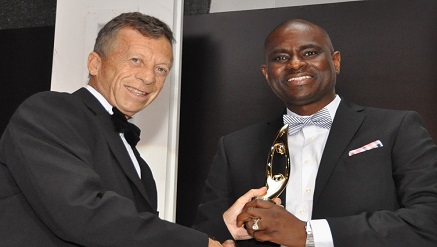
Airtel Nigeria,leading telecoms operator has been adjudged the Best Company in Education CSR by SERAs (Social Enterprise Report Awards) at its 2014 Awards ceremony, in recognition of its laudable CSR initiatives aimed at improving the standard and quality of education in Nigeria
The award presentation to Airtel took place at the 8th edition of SERA which held recently at the Muson Centre, Onikan Lagos.
The SERA awards also known as the Nigeria CSR Awards, is one of Nigeria’s highly acclaimed awards recognized by Industry experts. Other nominees for the awards category include Samsung, Etisalat and Oando.
In a citation by the organizers, Airtel’s Adopt-a-School programme and the Bridge IT project were described as some of the key initiatives of the Telco which have contributed to the development of education in the country.
While receiving the awards, Mr. Segun Ogunsanya, managing director and chief executive officer, Airtel Nigeria,said that supporting programmes which cut across critical areas of societal needs such as education, youth empowerment among many other initiatives are in the DNA of Airtel.
He also commended the commitment and sacrifices of all staff of the company which he said had been pivotal to the successes of the company’s CSR efforts, adding that the company would not relent in its drive towards an improved society.
Ogunsanya said: “At Airtel we place strong emphasis on giving back to the society because we know that government alone cannot continue to shoulder the huge responsibilities. For this reason we prioritize our CSR focus on developing education, health, environment and sports as well as empowering youths in Nigeria.
The MD further commended the organizers of the award for identifying the Telco’s CSR efforts which makes the company exemplary.
Through its Adopt-a-School Initiative, Airtel Nigeria has contributed immensely towards improving education within communities in Nigeria. Under the programme, the Telco collaborates with State Universal Basic Education (SUBEB) in various states to provide primary school pupils in under-served communities with educational materials such as note books, uniforms, classroom furniture and borehole for potable water.
As part of this initiative, new blocks of classrooms have also been built to replace dilapidated structures in some schools across Nigeria, while the teachers receive periodic training as part of efforts aimed at improving teaching quality and standards.
The schools which are currently benefitting from this initiative are Oremeji Primary School II, Ajegunle, Lagos; St. John Primary School, Oke-Agbo, Ijebu-Igbo, Ogun State; Presbyterian Primary School, Ediba, Cross River and Community Primary School, Amumara, Imo State.
Airtel also recently conducted free eye-screening for teachers and pupils of these schools, and those who required corrective glasses were provided with eye-glasses to improve their sight.
In addition, Airtel in 2011 partnered with Nokia and Pearson to create the Bridge IT project, which empowers teachers across Lagos State to adopt innovative and effective teaching practices through the use of mobile technology and student-focused pedagogy.
A total of 132 primary schools in Lagos have so far benefitted from this project.
The Telco also caters for various primary schools across the six geo-political zones in Nigeria through the Goal-for-Education scheme.
The scheme involves giving the participating teams in the Airtel Rising Stars U-17 grassroot football tournament, aggregated monetary value for the number of goals scored during regular match time.
After the competition, the teams are encouraged to donate the money to schools in their home states.
Mr. Ken Egbas, chief responsibility officer and founder of SERAs Awards, maintains that “the annual ceremony has grown to become the epicenter of the corporate social responsibility industry in Nigeria and recognizes the contributions of socially responsible corporate organizations in Nigeria.”
A Social Enterprise Report – compendium of best practices in CSR and Sustainability was also launched at the event.



Mazen Mroue, a non-executive director at MTN Nigeria Communications Plc, has resigned effective February 27, 2026, to prioritise other responsibilities within the MTN Group, the company announced in a Nigerian Exchange Limited (NGX) filing.

MTN Nigeria
The notice, signed by company secretary Uto Ukpanah, stated: “This is to enable Mr. Mroue to focus on other priorities within MTN Group Limited. The Board wishes to express its appreciation to Mr. Mroue for his immense service to MTN Nigeria and wishes him success in his future endeavours.”
Mroue joined MTN Nigeria’s board on June 1, 2022, bringing over 28 years of telecom experience. A veteran MTN executive, he previously served as CEO of MTN Uganda and MTN Liberia, non-executive director at MTN Cyprus, and held leadership roles at MTN Ghana.
Since February 2022, he has been MTN Group’s Chief Technology and Information Officer, overseeing technology strategy and governance. Earlier, as MTN Nigeria’s COO from August 2018 to January 2022, he also sat on the MTN Nigeria Foundation board.
The exit follows MTN Nigeria’s stellar 2025 results, posting a ₦1.70 trillion profit before tax—reversing a ₦550.3 billion loss in 2024 driven by forex woes—marking one of the telco’s strongest rebounds.

Google has rolled out support for Yorùbá and Hausa languages in its AI-powered Search features—AI Overviews and AI Mode—enabling millions of Nigerians to get quick answers, summaries, and conversational web exploration in their mother tongues.

The update forms part of Google’s push to cover 13 African languages, including Afrikaans, Akan, Amharic, Kinyarwanda, Afaan Oromoo, Somali, Sesotho, Kiswahili, Setswana, Wolof, and isiZulu, selected based on high search activity across the continent.
Now, a Kano student can ask complex questions in Hausa, while an Ibadan trader seeks business tips in Yorùbá—both receiving culturally nuanced AI responses via text or voice on Android, iOS, or web.
Taiwo Kola-Ogunlade, Google’s West Africa Communications Manager, said: “Building truly global Search requires nuanced local understanding. With Gemini-powered AI, we’ve made advanced capabilities relevant in Yorùbá and Hausa, so Nigerians converse naturally with Search in their mother tongues.”
To use: Open the Google app, tap AI Mode, and query in Hausa or Yorùbá for personalised guidance—breaking language barriers and making technology reflect Nigeria’s diverse identity.
MultiChoice is closing its continental streaming platform Showmax after 11 years, notifying subscribers Thursday of the board’s decision to discontinue the service in the near future to refocus on sustainable digital offerings.

MultiChoice
The email assured no immediate disruption: “You can continue streaming as usual, and no action is required from you at this time.” Showmax, launched in South Africa in 2015 and expanded across Africa, offered movies, series, documentaries, and sports to rival Netflix and others amid rising online entertainment demand.
The shutdown follows Canal+’s approved takeover of MultiChoice last year, with the French giant offering ZAR 125 per share for remaining stakes.
The deal mandates HDP ownership boosts, local content investment, and splitting MultiChoice’s SA broadcasting arm into an independent entity to meet regulations.
MultiChoice prioritised subscribers during the transition, promising advance notice on timelines.
Showmax’s exit signals consolidation pressures in Africa’s cut-throat streaming market, where global players dominate despite local content strengths.

GCR Affirms Afreximbank’s International Scale Ratings of A, A2

SmartCash Launches ‘No Be Cho Cho Cho’ Campaign to Boost Digital Banking in Nigeria

MTN Nigeria Non-Executive Director Mazen Mroue Quits to Focus on Group Role

Google Adds Yorùbá, Hausa to AI Search, Boosting Access for Millions of Nigerians

MultiChoice Shuts Down Showmax After 11 Years Amid Streaming Wars

Dr. Cairo Ojougboh Foundation Bolsters Nigeria’s Education Drive with ₦2.7m Student Support

Kaspersky Brings more Transparency to Threat Detection with New Hunt Hub

NDPC Commits to Balancing Data Privacy, Protection Information

PwC Reveals AI Scaling Gap Slows Africa’s Digital Transformation

Firm Reviews the Evolution of Phishing Threats in 2025




 E-Financial3 days ago
NRS Targets N40trillion in Tax, Royalty Revenue in 2026

 General News3 days ago
Purple Woman 3.0 Is Back, to Empower Women in Tech this IWD 2026

 E-Financial3 days ago
SEC Revokes Registration of Kensington Agro Trading Limited

 News3 days ago
EFCC Arraigns Two FSDH Bank Officials Over $307k, €50k Fraud

 E-Financial2 days ago
Nigeria’s VAT Jumps 34%, CIT Soars 48% to ₦14trn in 9M’25 – NBS

 Telecom2 days ago
FG Approves GIS-enabled Digital Postcode to Tackle Logistics Gaps, Boost E-commerce
 E-Business3 days ago
NDPC, 60 DPAs Collaborate on Enforcing Privacy Rights in the Use of Al

 Telecom3 days ago
Konga Launches ‘Berekete Sales’ with Up to 50% Discounts Across Major Categories