

E-Business
American Space Connecting Businesses

Several factors combine to make a tech ecosystem formidable. Some of these include good infrastructure and international partnerships.
The last few years have seen the Nigerian tech ecosystem, led by Lagos, attract international investment and partnerships. Last year, Mark Zuckerberg, the Founder of Facebook, was at the Yaba, Lagos tech ecosystem, for instance, to prop them up.
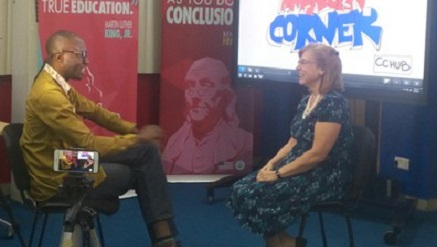
Most recent, is the opening of the new Priority American Space, hosted at Co Creation Hub, CCHUB, in Yaba, Lagos, Nigeria. I had a very interesting chat with Darcy Zotter, the Public Affairs Officer at the United States Consulate in Lagos and she shed more light on the American Space and why Lagos was selected to host one of the few ones around the world.
Darcy stated that the American Space, is the first Priority Space in Nigeria, but it is actually the 11thAmerican Corner. “What, however, makes this one different from the other ones is that, in this Space, we’ve invested in a lot of technology”, she stressed.
She stated that, traditionally, American Corners are designed to provide information about the USA, such as studying in the USA, exchange programs, etc, but what makes the one situated at CCHUB at Yaba, Lagos, different and why it is hoped that everyone will come there, is that, this one is fully stuffed with technological tools. She opined that this is only one out of ten in Africa, but America recognizes that Nigeria, in particular, is a Hub that is very innovative and entrepreneurial. “So, we looked at it and thought, okay, this is sort of a good environment because, we can make it happen. All we have to do is, kind of, give the people the tools”.
Darcy stated that in Nigeria, and Lagos in particular, they saw a lot of sparks and sparky people and CCHUB is a great example, with its focus on social entrepreneurship innovations. She stressed that, American Space wants to assist and provide more tools, carve out a space where people can get together and create ideas and make things happen.
The American Space facility is absolutely free for the users and it is opened from Monday to Friday between 10:00am and 5:00pm and can sit up to 60 people at a time, she stated. Darcy also explained that, although, it is free to those who want to come in to use the facility, or, in a group, coming with an idea, they will need to register.
On the facilities available for use at the American Space, Darcy stated that there are Computers, iPads, Equipment and all kinds of e-resources that those who come over can use.
Stating what informed the choice of CCHUB for the location of the American Space, Darcy said that one of the reasons was that CCHUB actually looked for it and the relationship started about two years ago. “CCHUB wanted a partner that appreciated and also, could facilitate innovation and creativity, hence, they were a perfect choice.
Darcy reeled out some cutting edge technology that are available in the Space such as, a 3D printer, Doodle pens and a whole lot of techy tools that people can use at the facility.
On what she thinks the American Space will contribute to the entire ecosystem, especially, today, when technology rules the world, she stated the American Space will become a gathering place. and people will know that this is a good place they can come to share, roll and realise their ideas. The ecosystem, she said, can also align with CCHUB and leverage on the work that they do.
Darcy is of the view that not-for-profit organisations in America, can work with American businesses to better create more solutions here in Nigeria. This, she sees as happening organically. She stated that techy people in Nigeria, are a sort of force that drives each other together and sort of know each other.
What the US government can do, is to introduce the guys here to the people in USA or help the Americans to come over or get Nigerians to the USA, thus, helping to put the US techy people in contact with the Nigerian techy people.
She stated that the American Space in Nigeria, for instance, is connected to a couple of thousands of American Spaces across the world, hence, if you visit the American Space in Nigeria, you can be connected to, say, an innovative person in Romania, Venezuela, etc. This, she said, is part of a network.
When asked on how often activities, events and programs will be held at the American Space, Darcy made it clear that the facility has a full time Director, who is quite active and, even, before the place was opened, she was already holding programs.
She stated that anyone with an idea should get in touch with the Director of the American Space for her to set it up. The American Space, she concluded, can help to find trainers for such programs but, it will also be cool, if such people have their own trainers, so, the American Space is looking up to Nigerians to come up with ideas.



The African Development Bank Group (AfDB) and the United Nations Development Programme (UNDP) have launched an ambitious $10 billion project to support the adoption of Artificial Intelligence (AI) across the continent.

The 10 Billion Initiative intends to accelerate ethical AI adoption and inclusive digital economic growth in Africa.
The initiative follows the Nairobi AI Forum, which took place earlier this month in Kenya and brought together governments, private sector leaders, development partners, and tech innovators to define pathways for impactful AI adoption.
According to the organisations, the strategy is a co-designed collaboration between the Bank Group, UNDP, and commercial partners that aims to raise up to $10 billion by 2035.
The resources will be used to create up to 40 million new jobs across the continent by 2035, through targeted investments that provide the groundwork for AI and accelerate widespread adoption in everything from entrepreneurship and regional data infrastructure to policy frameworks and skill development.
Nicholas Williams, AfDB Group ICT operations division manager, commented: “As a leading multilateral development institution, the bank is leveraging its comparative advantage to ensure Africa is not left behind in the AI era.
“The AI 10 Billion Initiative paves the way for expanded partnerships and sustained investments that will accelerate AI entrepreneurship, strengthen data and infrastructure ecosystems, and support inclusive growth across the continent.”

Kaspersky Threat Research has revealed its analysis of RenEngine, a malware loader that has recently gained public attention. Kaspersky identified RenEngine samples as early as March 2025, with its solutions already protecting users from the threat at that time.

Beyond the cracked games highlighted in recent reports, Kaspersky researchers discovered that attackers created dozens of websites distributing RenEngine through pirated software, including graphics editors like CorelDRAW. This expands the known attack surface beyond the gaming community to anyone seeking unlicensed software.
Kaspersky has recorded incidents in Russia, Brazil, Turkey, Spain and Germany, among other countries. The distribution pattern indicates opportunistic attacks rather than targeted operations.
When Kaspersky first identified RenEngine, the loader was delivering the Lumma stealer. Current attacks distribute ACR Stealer as the final payload, and Vidar stealer has also been observed in some infection chains.
The campaign exploits modified versions of games built on the Ren’Py visual novel engine. When users launch infected installers, a fake loading screen appears while malicious scripts execute in the background. The scripts include sandbox detection capabilities and decrypt a payload that initiates a multi-stage infection chain using HijackLoader, a modular malware delivery tool.
“This threat extends beyond pirated games — attackers are using the same technique to distribute malware through cracked productivity software, which broadens the potential victim pool significantly,” said Pavel Sinenko, lead malware analyst at Kaspersky Threat Research. “Game archive formats vary by engine and title. If an engine doesn’t check the integrity of its resources, attackers can embed malware that executes the moment you click play.”
Kaspersky solutions detect RenEngine as Trojan.Python.Agent.nb and HEUR:Trojan.Python.Agent.gen. HijackLoader is detected as Trojan.Win32.Penguish and Trojan.Win32.DllHijacker.
Interswitch, a technology company, through its health-tech subsidiary, Interswitch eClat, has taken a major step in advancing Nigeria’s public-sector health digitisation agenda following the conclusion of a high-level stakeholders’ engagement with the Abia State Government.

The engagement took place ahead of the phased deployment of eClinic, Interswitch eClat’s Electronic Medical Records platform, across public health facilities in the state, the firm stated in a statement on Friday.
The engagement, convened by the Abia State Ministry of Health in collaboration with Interswitch and held at the State’s Ministry of Health in Umuahia, brought together senior government officials, health administrators, Interswitch representatives, and key ecosystem stakeholders to align on the scope, implementation framework, and expected outcomes of the proposed eClinic deployment.
The initiative reflects a shared commitment to leveraging digital infrastructure to improve healthcare delivery, operational efficiency, and patient outcomes across Abia State’s public health system.
Discussions focused on deploying Interswitch’s eClinic solution in alignment with Abia State’s broader healthcare reform agenda under the current administration, particularly the transition from fragmented, paper-based systems to secure, interoperable digital platforms across public health facilities.
The proposed kick-off phase will span six public health facilities, including three primary healthcare centres, two secondary facilities, and one tertiary hospital, creating an end-to-end digital care pathway that strengthens patient referrals, supports continuity of care, and enables data-driven decision-making across all levels of service delivery.
The EMR solution is built to reduce patient waiting times, strengthen referral processes, and ensure the secure handling of both clinical and administrative data, supported by a hybrid infrastructure that enables local hosting with cloud-based backup.
Speaking at the engagement, Prof Enoch Uche, the Commissioner for Health, Abia State, described the initiative as a major milestone in the state’s healthcare transformation journey and highlighted the importance of private-sector collaboration in achieving sustainable impact.
“The Ministry of Health in Abia State is excited about the digitisation of health facilities, starting with Interswitch’s eClinic pilot phase involving three primary, two secondary, and one tertiary health centre. This initiative will enhance efficiency, accountability, and patient care by linking records across different levels of care.
“Global evidence shows that digital health improves access, reduces the cost of care, and maximises human resources while personalising services for our people. This partnership with Interswitch represents a key deliverable for this administration and aligns with the Governor’s vision for a modern, technology-driven health system,” he said.
During technical sessions led by Babatunde Fadeyi, Vice President, Health Ecosystem (Public Sector), Interswitch, stakeholders were taken through the core capabilities of Interswitch’s eClinic platform.
These include secure patient record management, ICD-11–compliant diagnosis coding, controlled data update protocols, and integrated billing and reporting tools designed to improve efficiency and accountability across health facilities.
Stakeholders were also briefed on the platform’s governance framework, risk mitigation approach, and phased implementation roadmap. Commenting on the engagement, Fadeyi reaffirmed Interswitch’s commitment to delivering measurable impact through technology-enabled healthcare systems.
“Abia State has demonstrated a strong commitment to innovation and system reform. The alignment of the state’s healthcare priorities with national health digitisation objectives creates a solid foundation for meaningful progress. Interswitch’s eClinic platform is designed to improve hospital operations by automating workflows, securing patient data, and providing healthcare managers with reliable insights to guide decisions.
“Beyond improving patient experience, it supports stronger revenue tracking, operational efficiency, and accountability. Our focus is to ensure the success of this pilot phase and deliver tangible improvements across productivity, service delivery, and patient satisfaction,” he said.
Also speaking at the engagement, Dr Ifeyinwa Blossom Uma-Kalu, the Permanent Secretary of the Ministry of Health, Abia State, highlighted the operational and clinical value of Interswitch’s eClinic initiative, particularly in strengthening referrals, improving revenue management, and expanding access to specialist care.
“This digitisation initiative will help us track our finances and internally generated revenue more accurately while reducing leakages. More importantly, it strengthens our referral system by allowing patient records to move seamlessly from primary to secondary and tertiary care.
“With a digital framework, healthcare workers in remote communities can access specialist support through telemedicine, helping to save lives and improve outcomes. This is a critical tool in our efforts to reduce maternal and infant mortality, and we are eager to see the outcomes of Interswitch’s eClinic,” she noted.
The engagement also addressed key success factors for the project, including power stability, user training, change management, and inter-agency collaboration, with both parties emphasising sustainability and scalability as the project progresses.

SERAP Says Phone Tapping Law Violates Human Rights, Calls for Withdrawal

MultiChoice Suspends Yearly DStv Price Hike as Canal+ Pushes Growth

Microplastics Found in 90 Percent of Prostate Cancer Samples

Lotus Bank, REA Seal N100Bn Deal to Power Rural Nigeria

DG NITDA Reaffirms FG Commitment to Responsible, Inclusive AI
Nigeria’s 9 Top FinTech Firms Valued at $10.6Bn in January 2026

CBN Upgrades Licences of Opay, Moniepoint, Kuda, Palmpay, Paga to National Status

NITDA, NBC Explore Strategic Collaboration on Digital Transformation, Media Regulation

Kaspersky Launches OT Calculator to Align Cybersecurity Investments with Business Goals

Accidental Billionaire Opts for Jail Instead of Returning Money Credited Him by Mistake




 Telecom3 days ago
Cyber Immunity Emerges as Shield for Nigerians Amid Rising Scams

 E-Financial3 days ago
$214Bn Missing, Institutions Silent: Is Accountability Dead in Nigeria?

 E-Business3 days ago
Interswitch Partners Abia to Digitise Public Hospitals

 General News3 days ago
NITDA, Abia Partner on Enterprise Architecture Reform

 News2 days ago
NITDA Urges Stronger State Partnerships as Key to Digital Economy Goals @ South-South Stakeholders Forum

 E-Business3 days ago
WIEG 2026 Summit Shifts to April 22-23 for Maximum Impact

 Telecom2 days ago
GSMA Launches Innovation Fund to Accelerate Green Transition Through Mobile Technology

 E-Business2 days ago
Firm Identifies RenEngine Loader Distributed Through Pirated Games and Software