

News
Bailout Money Scandal: Governor Loses $10m to Mistress

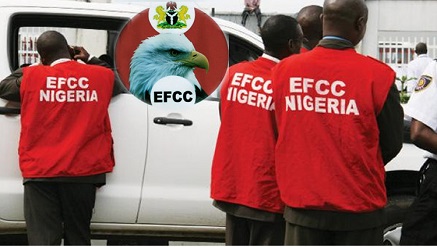
A governor is reportedly in trouble after the sum of $10 million he diverted from the bailout funds allocated to his state was hijacked by his mistress.
The Nation reported that the governor was said to have commissioned his mistress to help him launder the said sum only for the latter to refuse to remit it in the slush accounts the governor provided.
Already, the money in question has been traced to a bank in the United States.
The Nation investigation revealed that the governor resorted to using his US-based mistress to stash the funds abroad in order to avoid monitoring by security agencies.
The cash was allegedly either wired or hauled in tranches in order to beat the nation’s Financial Intelligence Unit (FIU).
In spite of the governor’s tricks, however, security agencies were able to intercept the deal between him and his mistress.
It was gathered that the diversion of the looted $10 million by the mistress created an uproar that triggered the ongoing investigation of the deal between the love birds.
One of the sources involved in the probe said: “A governor from an oil-producing state is in soup and under probe by some security agencies.
“The governor seems to have been duped by his mistress who stays in Texas in the United States.
“The governor is worried after discovering that his girlfriend has defrauded him of $10 million.
“What started as a love affair and promises of good faith has turned sour.
“Yet the governor would not want his wife or the people of the state, who will be disappointed, to know about this ugly transaction.”
The security chief added: “Investigation so far indicated that the governor allegedly diverted part of the bailout funds meant for his state to the mistress.
“All relevant security agencies are already tracking how the cash was wired to the mistress as well as the whereabouts of the funds.
“Very soon, the details of the transaction will be revealed to Nigerians.
“This is why the government has decided to monitor how bailout funds and London-Paris loan refunds were spent.”
The Presidency in 2016 released the sum of N1. 266.44 trillion to 36 states within nine months.
The breakdown includes N713.70 billion special intervention funds to states and London Paris Club loan refunds of N522.74 billion.
The Independent Corrupt Practices and Other Related Offences Commission (ICPC) had said 16 states were yet to disburse about N57, 663, 185, 735 of the bailout funds approved for them by President Muhammadu Buhari.



Citizens Initiative for Safety Awareness (CISA), advocacy group focused on security, data protection, and counter-terrorism, has urged the Nigeria Data Protection Commission (NDPC) to provide an update on a petition alleging a cybersecurity breach and unlawful access to private communications involving officials of the National Institute for Policy and Strategic Studies (NIPSS).

Mr Chidi Omeje, national coordinator, in a letter dated April 10, 2026, observed no response from the commission so far.
Filed on July 1, 2025, by Mr Yushau A. Shuaib, the petition claims unauthorised access, interception, and use of private digital correspondence belonging to him and PRNigeria, his company.
The complaint named Barrister Nima Salman Mann, Rear Admiral Abubakar Abdullahi Mustapha, and Professor Elias Wahab concerning the alleged breach. Such incidents are outlined in the Nigeria Data Protection Act (NDPA) 2023, regarding data privacy, cybersecurity safeguards, and the protection of sensitive information.
CISA said if confirmed, the alleged actions contravene Nigeria’s data protection framework, with implications for data governance, safety of confidential media sources, and public trust in institutions.
It requests the NDPC to clarify the status of the probe, disclose any interim findings, and cite measures to prevent similar breaches.
The organisation believes the matter has evolved beyond an individual complaint, describing it as a test of the government’s commitment to enforcing its data protection laws, especially within ministries, departments, and agencies.
CISA also appealed to Tunji Disu, inspector general of Police, to order an investigation into the alleged cybercrime.
In a statement, Omeje criticised the “prolonged delay” by the Force Criminal Investigation Department (FCID) in acting on a petition submitted since June 2025.
The group said, despite “credible evidence,” the police had yet to invite or question the individuals mentioned. Pointing out that two of the officials share membership in the National Institute (mni) with the former DIG at the FCID, CISA raised concerns about a possible conflict of interest.
Omeje clarified that the petition was different from the civil suit at the Federal High Court over Mr Shuaib’s withdrawal from the NIPSS programme.
“An elementary legal principle holds that a civil suit cannot be a bar to criminal investigation or prosecution,” he noted.
CISA called on the police to act in accordance with due process, advising the authorities to uphold the rule of law and restore public confidence.
It contends that failure to act decisively could erode trust in law enforcement and reinforce perceptions of a two-tier justice system.


A recent Kaspersky survey highlights a considerable gap between consumers’ confidence in identifying online scams and their actual exposure to cyber threats.

According to the findings, more than one-third of respondents (36%) in the Middle East, Turkiye and Africa (META) region reported encountering an online scam or attempted scam within the past 12 months, underscoring the persistent and evolving nature of digital risks.
Worryingly, these threats are far from hypothetical: 37% of surveyed users in the META region have fallen victim to online scams resulting in data compromise or financial loss.
Among those affected, nearly half (49%) experienced scams via social media platforms, while 48% reported investment or financial fraud attempts, 41% – scam associated with fake delivery or postal messages.
Phishing emails remain a significant threat as well, impacting 43% of respondents. These figures point to the increasingly diverse tactics used by cybercriminals to target individuals across multiple channels.
Despite this, confidence levels remain strikingly high: 80% of respondents in META believe they can recognise a scam, with 34% expressing strong certainty in their ability to avoid falling victim. This overconfidence may contribute to risky online behaviour and reduced vigilance.
When it comes to protective measures, respondents demonstrate mixed habits. While 57% report using strong and unique passwords, only 36% consistently check URLs before clicking, and 34% avoid public Wi-Fi for sensitive activities.
Notably, fewer than half (40%) use a dedicated security solution, which means a significant amount of people can face negative effects from cyberthreats. Alarmingly, 6% admit they do not use any specific security measures at all.
Regular maintenance of digital security tools also appears inconsistent. Just 35% of respondents in the META region update passwords and review security settings on a regular basis – at least once a month or more often. Meanwhile, 41% do so only occasionally, 19% rarely, and 5% never take such actions.
“The survey findings highlight a critical need for increased awareness and stronger adoption of comprehensive cybersecurity practices. While individual habits such as password hygiene and cautious browsing are essential, they should be complemented by reliable security solutions and regular security updates to effectively mitigate modern cyber threats,” comments Seifallah Jedidi, Head of Consumer Channel in the Middle East, Turkiye and Africa at Kaspersky.

Against a backdrop of public criticism regarding ongoing tax reform policies, President Bola Tinubu on Tuesday charged the Nigeria Revenue Service to restore public confidence and ensure fairness in the implementation of the national tax system.

Tinubu gave the charge while commissioning the 16-storey head office complex of the revenue service in Abuja.
“No government can demand trust from its citizens when taxation is opaque, inefficient or unjust,” President Tinubu said.
The president commended Nigerians for enduring the economic reforms introduced by his administration, stating that no serious nation can achieve lasting prosperity on a weak and fragmented revenue system.
He stated that tax reform policies must be implemented to earn the confidence of Nigerians at home and abroad. He charged the revenue service to ensure that the policy embodies a new ethos.
“It must not only collect revenue, it must build trust, it must ensure fairness and it must demonstrate that government can be accountable, efficient and responsive,” Tinubu said. “It must become a model institution that earns confidence at home and respect abroad.”
The president thanked the Nigerian people for their resilience and perseverance. He recalled his inauguration day pledge to move Nigerians from the “darkness of uncertainty into the clear light of Renewed Hope”.
“I committed that we would confront structural weaknesses, restore fairness and build an economy anchored on discipline, equity and opportunity,” he said. “Today I stand before you to reaffirm that these words were not rhetoric.”
He described his inauguration pledge as a “contract with the Nigerian people”, adding that the gathering was not merely to commission a building but to mark a milestone in a larger national journey.
Tinubu explained that the administration took the bold decision to embark on far-reaching tax and fiscal reforms to simplify the system, eliminate distortions and create a transparent, investment-friendly environment.
“Our direction is clear,” he said. “A revenue system that rewards enterprise, supports growth and ensures that every contribution to the national cause is matched by value for the people.”
Tinubu described early results as “fantastic”, commending the revenue service for improved fiscal stability, stronger foreign reserves and increased investor confidence.
According to the president, these gains are the product of deliberate policy and a commitment to long-term prosperity. He noted that the new headquarters is a symbol of professionalism, transparency and efficiency.
“It reflects our resolve that institutions must rise to meet the demand of reforms and the expectations of the Nigerian people,” he said.
President Tinubu called for a better future, urging those who follow to build on a history greater than the vision of their forebears.
He noted that the completion of the building is a statement that Nigeria is no longer content with promises. “We are delivering progress,” he said. “History will not judge us by what we say, but by what we do.”
Tinubu stated that the work of national renewal demands consistency, courage and collective resolve. He added that the nation’s future is determined by the choice of reform, discipline and prosperity.
The president assured that his administration will remain focused until the promise to Nigerians is matched by the performance of its institutions and the prosperity of its people.

FG Investigates ‘Sharp Sharp’ Loan Operators over Alleged Privacy Violations

CISA Asks NDPC, Police to Act on Alleged Data Breach by NIPSS

Fela Makes History as First African to be Inducted into Rock and Roll Hall of Fame

Lawmakers Ask CBN to Suspend Payment to ZTE for Failed $460m CCTV Project

Ecobank Delivers Strong Results, Posts $801m in Pre-Tax Profit for 2025

Spotify’s Loud & Clear Report Reveals Over ₦60Bn Revenue for Nigerian Artists in 2025

Kuda MFB Increases Kuda for Her Business Grants to ₦10 Million

Canal+ to Cut Jobs as Part Sweeping Restructuring

Nigeria tops global rankings for USDT, USDC ownership

NBC Boss Urges Content Ceators to Participate in DSO




 Telecom3 days ago
SpaceX Hints at Home‑Built Chip Module for Starlink Mobile

 E-Financial2 days ago
Fidelity Surges Ahead in Recapitalisation Drive with ₦564bn Capital

 General News3 days ago
Teenager Hacks Celebrities Whatsapps, Sells Adult Content in Delta

 Telecom3 days ago
Digital Realty, IXPN Expand Peering Network with New Internet Exchange Point of Presence in Nigeria

 Telecom3 days ago
Elon Musk Accuses South Africa of Racism over Starlink Licence Block

 E-Financial3 days ago
Lawyers Sue CBN over One-Time BVN Phone Number Change

 News3 days ago
Meta Files Appeal over $25,000 Damages Awarded to Falana

 E-Business3 days ago
FG Unveils ePharmacy Platform to Regulate Digital Pharmaceutical Services