

E-Financial
BDC Forex Ban: Banks Will Corner, Hoard Dollars- Mailafia

Dr. Obadiah Mailafia, former deputy governor of the Central Bank of Nigeria (CBN), has said that commercial banks in the country cannot be trusted with forex sales, adding that they will “corner” the dollars and only release whatever that is left after satisfying their interest.

Mailafia was reacting on Wednesday to the recent decision by the CBN to stop the sale of foreign exchange to Bureau de Change (BDC) operators.
The former deputy governor of the Central Bank of Nigeria featured on The Roundtable, a Punch Newspaper online interview programme.
Recall that Godwin Emefiele, governor of CBN hadr on Tuesday, said Bureau de Change Operators in the country are greedy and make abnormal profit from forex sales.
Emefiele also announced the discontinuation of and new licence approval after the Monetary Policy Committee two-day meeting in Abuja.
The CBN had been supplying each licensed BDCs $20,000 per week at the rate of N393 with the instruction that they should sell with a margin of N2 but some of them sell as high as N505, making over N100 on every dollar sold.
According to Emefiele, BDC operators in the country continue to abuse the privilege, hence, the need to stop forex sales to them.
The CBN governor said commercial banks would be monitored to provide forex for the legitimate use of Nigerians.
But Mailafia said commercial banks cannot be trusted and would sell the dollar at any rate they wish.
“How can you totally trust these commercial banks because most of them will want to corner the dollar for themselves and whatever is left, then they can now share with the market at a rate they want?” he queried on PUNCH Roundtable.
The former deputy governor of the apex bank also said, “On the naira, it is not just the underlying economic fundamentals that matters like interest rate, inflation and so on, these things matter and the level of debt affect it but there are the non-quantifiable elements like violence, instability, rural banditry and terrorism, those things undermine the productive capacity of the economy. They also destroy social capital, the trust that holds the community together to do businesses together.

“If we are not careful, that decision will actually worsen the naira value because the BDCs, you could walk into any of them anywhere and within five minutes, they will attend to you but the banks, you have to drive to your nearest bank, you have to queue most of the time.
“The CBN has not told us the rate, the banks will want to make a profit over the official rate, we don’t know whether they will make a decent profit or they will profiteer. Bankers were the biggest experts in round-tripping. Old habits, I don’t think they change. Leopards are very unlikely to change their spots.
“So, we may end up in a scenario where there is scarcity and the simple economics of demand and supply tells you that where there is increase scarcity, price is likely to shoot up.
“If bank bureaucracy makes it difficult for people to access dollar, what it means is that the bureaucracies, obstacles and bottlenecks are likely to put pressure on supply and pressure on supply may mean an increase in demand for the dollar and greater fall of the naira, if we don’t play the cards well.”



Nigeria Data Protection Commission (NDPC) has launched investigation into the activities of so-called ‘sharp sharp’ loan operators over alleged violations of customers’ data privacy.

‘Sharp sharp’ loan operators, also known as loan sharks are illegal, unlicensed moneylenders who operate outside of government regulation.
They typically target individuals who cannot access traditional bank loans due to low income or poor credit history.
Vincent Olatunji, national commissioner of the Nigeria Data Protection Commission, told the News Agency of Nigeria, that some of the violations include accessing borrowers’ phone contact lists and using them to reach their family members and friends, as well as sharing images without consent and sending defamatory or threatening messages.
Olatunji, who spoke on the sidelines of a training for Data Protection Officers in Abuja, said the federal government was aware of some lenders breaching customers’ data privacy in their desperate bid to recover loans.
He emphasised the need for increased public awareness, urging Nigerians to understand their rights and carefully review loan agreements before accepting offers.
Olatunji, however, said unethical data practices by loan operators remained a global concern.
“Many borrowers unknowingly expose their personal data due to failure to read loan agreements. This is not peculiar to Nigeria; it is common in every part of the world.
“Unfortunately, most of the information are from those who obtained loans without going through the agreement they signed before accessing the loans.
“Many operators function solely online, without physical offices. This makes regulations more complex. However, compliance with data protection laws remains mandatory.
“Before any digital loan giver operates in Nigeria, it is mandatory to look at the areas of privacy,” he said.
Olatunji said that Nigeria had several consumer protection entities such as the Federal Competition and Consumer Protection Commission, which takes the lead on consumer protection.
The NDPC boss listed other key agencies involved in regulating the space to include the National Information Technology Development Agency (NITDA), the Nigerian Communications Commission (NCC), the Central Bank of Nigeria (CBN), and the Nigeria Police.
He said that any digital lender must obtain approval and licensing from the FCCPC, with strict requirements to uphold user privacy.
“Part of the requirements is to ensure provisions around privacy are complied with so that they do not infringe on the rights of their customers.
“Any unauthorised access to people’s contacts is an offence and we will come after them,” he warned.
Ecobank Transnational Incorporated delivered one of its strongest performances in years in 2025, posting $801 million in pre-tax profit, up 21% from a year earlier, alongside net revenue of $2.45 billion, a 17% increase.

The results mark a high point since Jeremy Awori, CEO took over in 2022 and offer early validation of the group’s long-criticized Growth, Transformation and Returns strategy.
The improvement is especially clear in operating efficiency.
The cost-to-income ratio dropped to 48.3%, from 52.8% a year earlier and above 70% in the group’s more difficult years before 2018. For a bank operating across more than 33 markets with uneven macroeconomic conditions, the shift is significant: Ecobank now spends less than 49 cents to generate one dollar of revenue.
It also marks a structural change, with revenue growth now outpacing expenses at the group level.
Performance was led by the Corporate and Investment Banking division, which posted $697 million in pre-tax profit, up 40%, driven by trade finance, cash management, and capital markets activity.
The Consumer and Commercial Banking segment followed with $480 million, up 27%, supported by stronger deposit mobilization and a 33% increase in lending.
Customer deposits rose by $4.9 billion to reach $25.3 billion, while total loans stood at $12.8 billion.
Return on tangible equity reached 27.8%, signaling a renewed capacity to generate value.
The board’s recommendation to pay $40 million in dividends, or $0.0016 per share, carries more symbolic weight than financial impact.
Over the nine years leading up to 2022, Ecobank paid dividends only twice, the last time in 2016.
From 2017 to 2021, shareholders saw no payouts as the group focused on repairing its balance sheet, transitioning to Basel III standards, and navigating the pandemic.
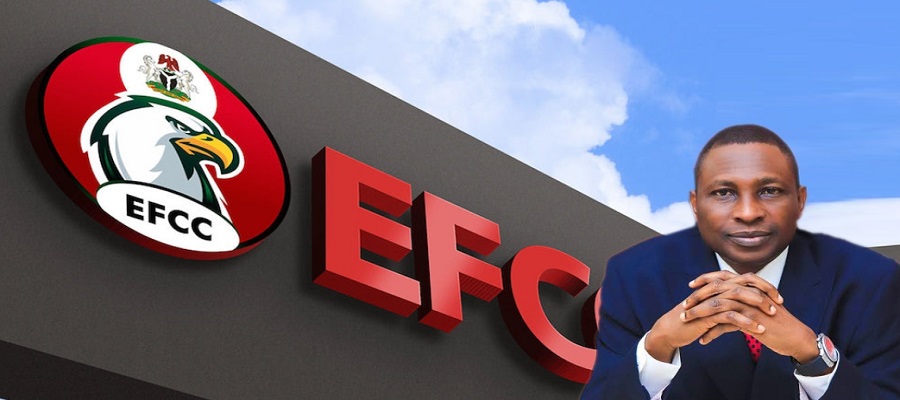
Ola Olukoyede, executive chairman, Economic and Financial Crimes Commission (EFCC), has cautioned Nigerian banks against granting loans without credible collateral, warning that such practices often lead to insider abuse and non-performing loans.

Olukoyede issued the warning recently when he received Mufutau Olawale Abiola, chief audit executive, First Bank Plc, who led a delegation on a courtesy visit to the Lagos Zonal Directorate 2 of the Commission in Ikoyi.
Speaking through Bawa Usman Kaltungo, acting zonal director, Lagos Zonal Directorate 2, Ikoyi, Olukoyede expressed grave concerns over how banks in the country grant loans, noting that loans backed only by personal guarantees, including those of top executives, are inadequate and put depositors’ funds at risk.
He said: “We have issues with banks’ mode of giving loans. The process often shows insider abuse.”
While emphasizing that banks should desist from issuing loans without visible or credible collateral, he added that “Top-down loans are not secured. You cannot give a loan based solely on the personal guarantee of the Chief Executive.
This is not security. Banks must not issue loans without verifiable collateral. If there is proper collateral for loans obtained by bank customers, this will reduce the rate of non-performing loans.”
He further warned that a bank is only a custodian, and that giving loans without adequate collateral “amounts to tampering with depositors’ funds.”
He also urged banks to implement measures, including thorough due diligence on its customers, to prevent loan defaults.
According to him, “Even in situations where you outsource due diligence, there must be a clause of liability,” he said.
Reaffirming the Commission’s commitment to continued cooperation with the bank in tackling financial crimes, he urged the bank to release its staff promptly when invited during investigations of alleged financial crimes.
“When we invite your staff, especially where insider connivance is suspected, you must release them so we can jointly fight economic and financial crimes. We must work together to stay ahead of criminals. Let me add that where money is, that is where people’s hearts are. Most of the time, we escalate issues to foreign security agencies as may be necessary,” he added.
Earlier, Abiola expressed gratitude to the EFCC leadership for the engagement, noting that the visit was intended to strengthen the existing collaboration between the bank and the Commission.
While urging the EFCC to expedite investigations into cases involving its staff and others, Abiola also disclosed that a designated team in his bank handles requests from the EFCC.

FG Investigates ‘Sharp Sharp’ Loan Operators over Alleged Privacy Violations

CISA Asks NDPC, Police to Act on Alleged Data Breach by NIPSS

Fela Makes History as First African to be Inducted into Rock and Roll Hall of Fame

Lawmakers Ask CBN to Suspend Payment to ZTE for Failed $460m CCTV Project

Ecobank Delivers Strong Results, Posts $801m in Pre-Tax Profit for 2025

Spotify’s Loud & Clear Report Reveals Over ₦60Bn Revenue for Nigerian Artists in 2025

Kuda MFB Increases Kuda for Her Business Grants to ₦10 Million

Canal+ to Cut Jobs as Part Sweeping Restructuring

Nigeria tops global rankings for USDT, USDC ownership

NBC Boss Urges Content Ceators to Participate in DSO




 Telecom3 days ago
SpaceX Hints at Home‑Built Chip Module for Starlink Mobile

 E-Financial2 days ago
Fidelity Surges Ahead in Recapitalisation Drive with ₦564bn Capital

 General News3 days ago
Teenager Hacks Celebrities Whatsapps, Sells Adult Content in Delta

 Telecom3 days ago
Digital Realty, IXPN Expand Peering Network with New Internet Exchange Point of Presence in Nigeria

 Telecom3 days ago
Elon Musk Accuses South Africa of Racism over Starlink Licence Block

 E-Financial3 days ago
Lawyers Sue CBN over One-Time BVN Phone Number Change

 News3 days ago
Meta Files Appeal over $25,000 Damages Awarded to Falana

 E-Financial3 days ago
FG Slashes Import Duties on Cars, Rice, Palm Oil in 2026 Fiscal Policy