

Telecom
BES12 Version12.2 Arrives with Enhanced Multi-OS Support


When BlackBerry launched BES12, it introduced a complete, simplified and secure mobility management platform yet.
Since then, the teams have been hard at work developing enhancements such as government and security advancements for BlackBerry 10 devices and an improved administrator experience, and today we’re happy to announce additional BES12 on-premise updates for our EMM customers.
Introducing BES12 version 12.2
Through a single command and control center, BES12 supports any type of deployment model – BYOD, Corporate Owned Personally Enabled (COPE) and Corporate Owned Business Only (COBO) – and all major mobile platforms, including iOS, Android, Windows Phone and BlackBerry.
BES12 also integrates with Samsung KNOX and Android for Work, creating true end-to-end security for Android smartphones and tablets.
In the latest version of BES12, version 12.2, we are further expanding our multi-OS capabilities. Key updates include:
Samsung KNOX Workspace: Samsung KNOX provides comprehensive hardware to software security that is built into Samsung devices like the Galaxy S6 and S6 edge, making them the most secure Android devices.
Customers can now use BES12 to manage devices with Samsung KNOX Workspace, meaning that they can deploy Samsung Galaxy devices in a work and personal mode as well as Workspace-only mode.
This gives organizations even more choice in not only the devices that their employees use, but in the way that they use them – all with the high level of security and privacy they expect from BlackBerry and Samsung.
Android for Work: BES12 supports Android for Work, which enhances security, simplifies management and provides an open platform for innovation on Android devices.
BES12 seamlessly integrates with the Android OS to enable platform-level containerization, creating dedicated profiles for corporate and personal information.
This eliminates the need for app wrapping and provides users with access to any Android application available on Google Play that is permitted by an organization’s IT policies.
BlackBerry Secure Connect Plus: Samsung KNOX Workspace, Android for Work and BlackBerry 10 are now integrated with BlackBerry Secure Connect Plus.
This solution provides secure, behind-the-firewall access to enterprise content without the need for VPN infrastructure, helping enterprises to cut costs and improve the user experience for employees.
Customers can also use the enhanced secure connectivity option to enable secure, behind-the-firewall access for mobile voice and video applications
Apple Device Enrollment Program (DEP): BES12 now supports Apple DEP, which simplifies the enrollment of corporate-issued iOS devices. IT administrators can more quickly, easily and securely manage large deployments of iPhones and iPads by enabling supervised controls over-the-air.
“Enterprises need comprehensive EMM to streamline management of disparate mobile devices, applications and content being deployed across their organizations to meet the diverse needs of users,” Bob Egan, CEO, Sepharim Research Group. “By enhancing its multi-OS capabilities and services with BES12, BlackBerry is creating better user experiences as well as more value for customers that are looking for flexibility in their mobile environments.”
BlackBerry customers rely on BES12 for multi-OS EMM, ease of implementation and the security features it offers them.
Speaking on their experience with BES12, John Mulder, group information technology manager, BMD Group, said, “BMD Group migrated from BES10 to BES12 knowing that we had the flexibility and scalability to add and manage any smartphone or tablet we wanted to – all managed through a single console. Today, our teams use a mixture of BlackBerry 10, iOS and Android devices. Our workforce is happy and more productive with the flexibility of device choice, and management is happy that our security and cost requirements are met, so we can just get on with the job of delivering the best possible service to our clients.”
“BES12 meets my team’s requirements on security, management and ease of use. The migration to BES12 was incredibly painless, and the user interface is far more user-friendly,” said Calvin Fujita, Team Lead, Implementations and Maintenance Services, Descartes
“We chose BlackBerry and BES12 because of the end-to-end security benefits and high level of management and control it affords us. We need to ensure that the GPS is always on, for example, and need the ability to block certain apps from being installed on the device. We can manage all of this through IT policies on BES12,” added Kelly Baechler, Manager of Organization Change, CarePartners.
With the Thursday’s announcement, BlackBerry has shown how it is continuing to expand its multi-OS capabilities while staying committed to the principles of security and simplicity.
In environments with multiple platforms, devices, apps and content, enterprises want a trusted, secure solution that will help them reduce complexity.
BlackBerry delivers this and so much more to our customers with our portfolio of services and world-class support.



African Development Bank (AfDB) has granted a $200 million loan to support Nigeria’s flagship digital infrastructure initiative, Project BRIDGE, which is designed to expand broadband access across the country.

Project BRIDGE, is a Special Purpose Vehicle (SPV) aimed at deploying at least 90,000 km of Fiber Optic cables as Nigeria’s core connectivity Infrastructure and national backbone for universal access to Information and Communication Technology (ICT) across Nigeria, under a Private-Public Partnership (PPP) funding model..
The initiative aims to expand Nigeria’s fibre backbone from roughly 30,000 kilometres to about 120,000 kilometres.
Its objectives include connecting all 774 local government areas and enhancing regional interconnection with neighbouring countries such as Benin, Niger, Chad, and Cameroon.
The project is attracting strong support from international development partners, with the World Bank having already pledged $500 million to the initiative, while the European Bank for Reconstruction and Development (EBRD) is also anticipated to participate in the programme’s execution.
The renewed inflow of funds reflects growing confidence in Nigeria’s digital infrastructure ambitions, particularly as broadband connectivity becomes ever more central to economic growth, job creation, and digital inclusion.
However, despite the fresh funding, the project remains in a heavy preparatory phase just as the Federal Government is spending $6.1 million on consultants covering transaction advisory, legal compliance, and technical planning.
“Procurement and advisory work suggest timelines will depend as much on regulatory alignment and project structuring as on capital availability,” the publication noted.


Qualcomm Incorporated has announced the selection of 10 startups for its fourth year of the Qualcomm® Make in Africa Mentorship Program. This initiative is part of the Qualcomm Africa Innovation Platform, which supports the development of Africa’s deep-technology ecosystem.

It provides mentorship and training programs, with a focus on advanced connectivity and processing technologies such as Edge AI/ML, compute, IoT, and Qualcomm’s AI development platform from Arduino.
Highlights:
- At the program’s Finale, one startup will be awarded a Social Impact Fund grant from Qualcomm for Good.
- All participating startups will be eligible for a $5,000 stipend upon successful completion of program requirements.
- Qualcomm provides the startups with a variety of resources such as product design guidance on Arduino AI platforms, business coaching, access to engineering consultation, and free IP education such as L2Pro Africa.
For this year’s edition of the one-of-a-kind equity-free African mentorship program, 10 early-stage startups were chosen from a record number of over 1,200 applications from over 45 African countries, based on their ability to apply advanced connectivity and processing technologies to innovative end-to-end systems solutions. The industries represented by the startups include agriculture, assistive technology, smart cities and utilities, smart infrastructure, EV transportation, and education.
The 2026 cohort includes the following startups (listed in alphabetical order):
- Amperra Charging Company (Namibia): AI‑driven, grid‑adaptive smart EV charging platform designed to enable scalable electric mobility across Africa
- Anatsor Ltd (Nigeria): Integrated digital poultry management system that improves productivity, health tracking, and farm efficiency
- D-Olivette Labs (Nigeria): Bio‑intelligence platform delivering data‑driven insights for sustainable and efficient agricultural production
- Mindora Corporation (Zimbabwe): Braille keyboard solution that improves digital accessibility for visually impaired users
- MVUTU (Republic of the Congo): Solar‑powered IoT cold storage solution that reduces post‑harvest losses for smallholder farmers
- QualiKeeper Investments Ltd (Zambia): Affordable AIoT livestock monitoring system designed for low‑connectivity rural environments
- SafeSip (Tanzania): Smart water access and monitoring solution that ensures safe, reliable drinking water in urban and peri‑urban areas
- Sesi Technologies Ltd (Ghana): AI‑powered field device that enables early cocoa quality assessment and transparent supply chains
- TWave Ltd (Uganda): Automated, solar‑powered fish feeding system that optimizes aquaculture productivity
- Zerobionic (Kenya): Assistive robotics solutions designed to enhance inclusion and independence for persons with disabilities
“This year’s startups’ achievements are a powerful testament to Africa’s flourishing innovation ecosystem,” said Wassim Chourbaji, President, Middle East and Africa, and Senior Vice President, Government Affairs, Europe, Middle East and Africa at Qualcomm. “Four years into Qualcomm Make in Africa, what stands out is not only the growing number of applications we receive, but the increasing sophistication of the solutions being built.
These startups are pushing the boundaries of what technologies such as Edge AI and 5G can enable, and how they can be deployed at scale across the continent. Qualcomm is proud to support and help guide this next wave of African high-tech innovation, from early design and product development to real-world commercialization, and I look forward to seeing where these startups go next.”
Participants will receive free edge-AI capable platforms from Arduino, alongside 1:1 technical mentorship and business coaching. “Arduino® UNO™ Q and the upcoming Arduino® VENTUNO™ Q give the 2026 Qualcomm Make in Africa cohort a fast path from idea to intelligent machine,” said Fabio Violante, Vice President and General Manager of Arduino, Qualcomm Technologies Inc. “By bringing perception, decision-making, and actuation onto a single, affordable board, founders can prototype and deploy edge‑AI solutions directly where challenges exist — in farms, clinics, factories, and cities.”
They will also access engineering consultations for product development and guidance on protecting intellectual property. This includes patent filing consultation from Adams & Adams, Africa’s leading IP law firm, and free IP courses through L2Pro Africa– an IP e-learning platform designed to empower startups, SMEs, and researchers in Africa to protect, secure, and maximize their innovations.
At the end of the mentorship cycle, startups will be eligible for the Social Impact Fund through Qualcomm for Good, supporting societal and market impact through wireless technology. All participants will also receive a $5,000 stipend upon successful program completion. Finally, those who file patents during the program can claim up to $5,000 in filing fee reimbursements.
Reflecting the program’s relevance across the continent, the African Telecommunications Union (ATU) returns as a partner for the fourth consecutive year. “The ATU’s key mandate is to ensure that Africa’s telecommunications ecosystem serves Africa’s people. Qualcomm Make in Africa embodies that same principle by putting cutting-edge technology directly in the hands of African innovators to solve African challenges.
Having seen firsthand the quality of the startups this program produces, returning as a partner in 2026 was not a question of if, but of how we could deepen our contribution. We look forward to seeing this cohort carry that work forward,” said Secretary General John Omo.
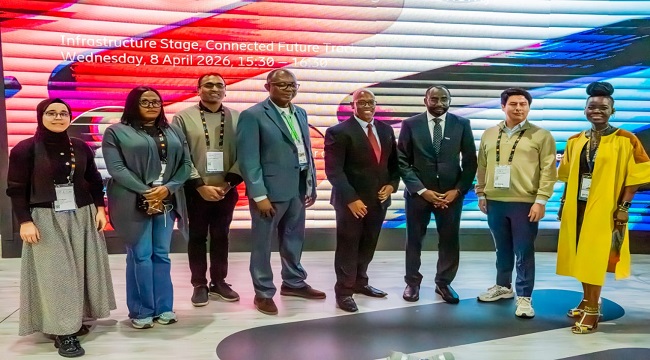
Nigeria is intensifying efforts to strengthen its national software infrastructure and digital governance framework as part of a broader push to secure data sovereignty and build local technological capacity.

The initiative is focused on developing high-standard regulatory policies that will enhance digital integration while ensuring that critical national systems remain under domestic control.
During an engagement with the management of Ericsson at the GITEX Africa in Morocco, Inuwa explained that Nigeria’s digital strategy is focused on safeguarding national interests and securing long-term technological independence, rather than aligning with global rivalries.
“We are building our national software infrastructure. We are coming up with very high-standard regulatory policies that will help us build capacity for digital software integration,” he said. “For me, it is not about politics. It is not about geo-tech politics. It is not about banning China. It is about how we, as a country, have control and are able to shape our digital future.”
He stressed that Nigeria is not pursuing an exclusionary approach toward global technology partners, but rather seeking balanced collaboration that ensures value creation within the country.
“We are not saying we are banning hyperscalers from coming. We want them to come, work with local partners, create value in Africa, and let us capture that value here,” he noted.
The NITDA DG drew parallels with global regulatory trends, pointing to frameworks such as the European Union’s Digital Markets Act, Digital Services Act, and Data Governance Act as examples of regions asserting digital sovereignty through structured policy environments.
He added that Nigeria’s approach aligns with the global shift toward treating digital infrastructure as critical national infrastructure, a move already supported by existing executive orders in the country.
“We already have an executive order that makes all digital infrastructure a national critical infrastructure,” he explained. “But building a fully sovereign digital system takes time. Even the EU did not achieve it overnight.”
A key priority of the policy direction, he said, is ensuring that data generated within Nigeria remains protected and that intellectual capacity and digital intelligence are developed locally rather than exported.
“We want to keep the intelligence in our country. We want to be part of creating value, not just receiving technology,” he said.
He also highlighted concerns about historical imbalances in global industrial development, noting that Africa has often contributed raw materials, labour, and data without fully benefiting from value-added industries.
“We don’t want a repeat of previous industrial revolutions where Africa was left behind. This time, it is about value creation and building our own digital offerings,” he added.
Discussions are also ongoing around data ownership frameworks, particularly in emerging technologies and industrial systems, where questions of who controls machine-generated data remain central to future regulation.
The government is expected to unveil clearer policy direction in the coming months as part of its broader national digital transformation agenda.
On the industry side, Ericsson reaffirmed its long standing involvement in Nigeria’s telecom sector. The company’s Director for Government and Policy Advocacy in Africa, Amos Haddebe, said Ericsson has operated in Nigeria for over five decades, supporting the country’s telecommunications evolution from 2G to 5G.
He noted that Ericsson continues to collaborate closely with operators such as MTN Group, as part of its commitment to advancing Nigeria’s digital transformation agenda.
Haddebe outlined four key pillars of a Memorandum of Understanding signed with the Nigerian government in October 2024, including the establishment of a joint innovation hub, a national hackathon, digital skills development programmes, and exchange of best practices.
He further revealed that the ongoing national hackathon, launched under the supervision of the Vice President, is already underway and will be integrated with broader innovation initiatives.
On broader industry concerns, Haddebe warned of rising competition in Africa’s telecoms space and urged governments to treat ICT infrastructure as a matter of national security. He advocated for a diversified vendor ecosystem to ensure resilience and safeguard critical systems.
The discussions highlight Nigeria’s increasing focus on digital sovereignty, strategic partnerships, and the development of a secure and competitive digital economy.

EFCC Warns Banks against Loans without Credible Collateral

Nigeria Needs Some 480,000 Local DPOs for Data Protection

Air Traffic Controllers Raise Safety Concerns over Failing Systems, Worsening Welfare

AfDB Grants Project BRIDGE $200m Facility for Nationwide Internet Access

Qualcomm Unveils Startup Selection for Qualcomm Make in Africa 2026

Spotify’s Loud & Clear Report Reveals Over ₦60Bn Revenue for Nigerian Artists in 2025

Kuda MFB Increases Kuda for Her Business Grants to ₦10 Million

Canal+ to Cut Jobs as Part Sweeping Restructuring

Nigeria tops global rankings for USDT, USDC ownership

NBC Boss Urges Content Ceators to Participate in DSO




 Telecom2 days ago
Digital Realty, IXPN Expand Peering Network with New Internet Exchange Point of Presence in Nigeria

 General News2 days ago
Teenager Hacks Celebrities Whatsapps, Sells Adult Content in Delta

 Telecom2 days ago
SpaceX Hints at Home‑Built Chip Module for Starlink Mobile

 Telecom2 days ago
Elon Musk Accuses South Africa of Racism over Starlink Licence Block

 E-Financial2 days ago
Lawyers Sue CBN over One-Time BVN Phone Number Change

 News2 days ago
Meta Files Appeal over $25,000 Damages Awarded to Falana

 E-Business2 days ago
FG Unveils ePharmacy Platform to Regulate Digital Pharmaceutical Services

 E-Financial2 days ago
Quest Merchant Bank Unveils New Brand Identity, Signalling Next Phase of Strategic Growth