

/home/kenneth/web/nigeriacommunicationsweek.com.ng/public_html/wp-content/themes/zox-news/parts/post-single.php on line 153
">
Warning: Undefined array key 0 in /home/kenneth/web/nigeriacommunicationsweek.com.ng/public_html/wp-content/themes/zox-news/parts/post-single.php on line 153
Warning: Attempt to read property "cat_name" on null in /home/kenneth/web/nigeriacommunicationsweek.com.ng/public_html/wp-content/themes/zox-news/parts/post-single.php on line 153
Bickersteth, One Network Boss Says Broadband Is Critical in Agent Banking

Sola Bickersteth, chief executive officer, One Network, has described broadband as critical infrastructure in achieving the proposed agent banking of the Central Bank of Nigeria (CBN).
Bickersteth, whose company has been active in the agent banking drives, told Nigeria CommunicationsWeek that the new policy has the potential to capture a large segment of the hitherto unbanked people depends, primarily, on broadband access and affordability.
The CBN in exercise of the powers conferred on it by Section 2 (d) of the Central Bank of Nigeria Act, 2007 and Section 57 (2) of the Banks and Other Financial Institutions Act (BOFIA), Laws of the Federation of Nigeria, 2004 issued guidelines for the maintenance of adequate and reasonable financial services to the public, the Central Bank of Nigeria (CBN).
The objectives of the guidelines are to provide minimum standards and requirements for agent banking operations; enhance financial inclusion; and provide for agent banking as a delivery channel for offering banking services in a cost effective manner.
However, the One Network Boss, said that there is a very direct link between broadband availability and the Agent Banking provisioning.
“Agent banking requires real time transactions; irrespective of the location. That is one of the biggest challenges. It is a very crucial requirement in driving financial inclusion. If broadband do not get to where the Agent is positioned he really can’t provide the service to the customers.
Speaking further on the processes to full Agent Banking launch, he said that critical stakeholders are working round the clock to ensure all Ts and I’s are crossed and doted, respectively.
“We are at a critical stage of the Agent Banking rollout. We are at the Supervisor stage. What I mean by that is; Central Bank’s target by 2020 is to reach 170,000 locations. However, most of the locations will need a supervisor; somebody who has minimum of average experience in banking to support them. Agent Banking is not like a recharge card business.
“Currently, we are concentrating on the Supervising Networks. That is why we started with the Nigeria Postal Service (NIPOST), because it is naturally a supervising organization. Thus, every post office will create 40 new locations around them.
“We are also looking at banks; people do not look at banks as supervisors, but they are the most experienced. For the banks, it is like deploying human Automated Teller Machines (ATMs). We are looking forward to banks starts deploying their agents to drive the moves. Then, we are talking to the microfinance banks. And other critical stakeholders involved in the process.
“We are on the process of nationwide workshop for members of National Association of Microfinance Banks, members of CIBM; we have already signed agreement with NIPOST. Once they are on board they will push the plan further to achieving the 170,000 locations,” he said.
Bickersteth, said he believes that the current moves by the telecom industry led by Mrs. Omobola Johnson, minister of Communication Technology, are on the right path to ensure broadband, as a critical national development infrastructure, is achieved.
“That is why we are very interested in the moves to ensure broadband is unleashed in the country, because it is like the backbone of the entire service,” he said.


Warning: Undefined array key 0 in /home/kenneth/web/nigeriacommunicationsweek.com.ng/public_html/wp-content/themes/zox-news/parts/post-single.php on line 493
Warning: Attempt to read property "cat_ID" on null in /home/kenneth/web/nigeriacommunicationsweek.com.ng/public_html/wp-content/themes/zox-news/parts/post-single.php on line 493
General News
UBA Unveils Diaspora Platform to Connect Global Africans with Investment, Wealth Opportunities

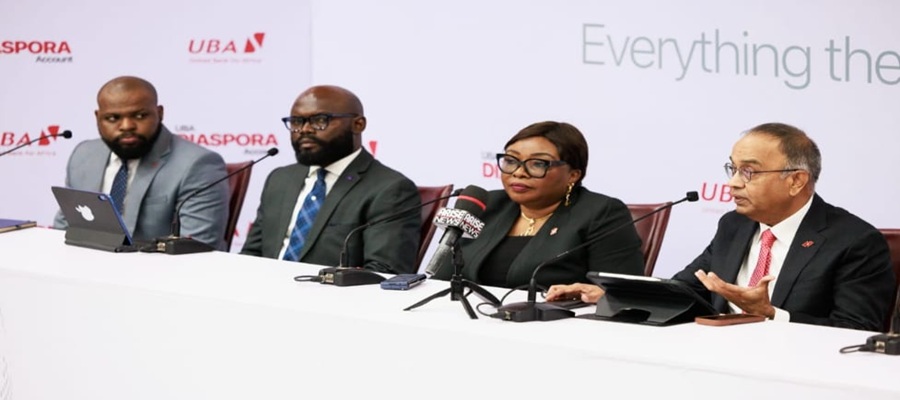
United Bank for Africa (UBA) Plc, Africa’s Global Bank, has unveiled a diaspora banking and investment platform designed to serve Africans living and working across the world and within the continent.

L-R: Head, Strategy, Research & Investor Relations, Africa Prudential, Joshua Omewah; Group Head, Sales, Retention and Growth, AVON, Ajibola Bakare; Managing Director, UBA Pension, Blessing Ogwu and Head, Diaspora Banking, Anant Rao, during UBA’s Panel session, themed: ’Beyond Banking: Powering the Diaspora Lifestyle,’ held at UBA House Marina, in Lagos on Thursday.
The platform, launched in collaboration with leading ecosystem partners including United Capital, Africa Prudential, UBA Pensions, Afriland Properties, Heirs Insurance Group, and Avon Healthcare Limited — represents a major step in redefining diaspora banking beyond remittances toward structured wealth creation and long-term investment.
At the unveiling, which took place at UBA’s global headquarters in Lagos under the theme: “Beyond Banking: Powering the Global African Lifestyle, all the company representatives were on hand to showcase a seamless platform that goes beyond remittances, wealth creation, protection, and long-term prosperity.
Speaking at the event, UBA’s Head of Diaspora Banking, Anant Rao, described the initiative as a strategic shift in how Africa engages its global citizens.
“For decades, Africa’s engagement with its diaspora has focused largely on remittances. Today, we are moving beyond that. This platform represents a transition from simple money transfers to a financial ecosystem where Africans globally can bank, make payments, invest, protect their families, and build long-term wealth seamlessly,” he said.
Rao noted that African diaspora remittance flows exceed $100 billion annually, making them one of the most resilient and consistent sources of capital into the continent.
“Diaspora capital is not just a flow of funds — it is a strategic growth partner for Africa.
Our role is to provide a trusted platform that converts capital into structured investment and shared prosperity across the continent.”
The objective is to provide a platform that brings together offerings across the numerous needs of the Global African, including Banking and payments, Investments, securities services, asset management, Insurance, Pensions, real estate and Pensions.
Through this coordinated ecosystem, diaspora customers can access financial solutions across multiple sectors through a single trusted platform, enabling them to manage their financial lives and family commitments across borders with ease and transparency.
UBA’s Group Head, Marketing and Corporate Communications, Alero Ladipo, emphasised the importance of collaboration in delivering a seamless diaspora experience.
“The modern African is a global citizen — mobile, ambitious, and deeply connected to home. Whether living in Africa, Europe, the Americas, or the Middle East, there must be a structured and secure financial connection back home. This platform ensures that Africans everywhere can remain economically connected to the continent with confidence and transparency.”
Partners within the ecosystem highlighted growing demand among diaspora Africans for structured investment opportunities, secure property ownership, insurance protection, and long-term financial planning.
United Capital showcased globally accessible investment products designed to deliver professionally managed and transparent wealth creation opportunities.
Afriland Properties emphasised structured and well-governed real estate investment pathways for diaspora clients.
Heirs Insurance highlighted protection solutions for life, and assets, while Avon Healthcare Limited demonstrated healthcare access and insurance solutions for families across borders.
Africa Prudential and UBA Pension reinforced digital investment management and long-term pension savings solutions designed to support diaspora participation in African capital markets.
Together, the partners underscored a shared commitment to providing diaspora Africans with credible, transparent, and professionally managed financial pathways.
Rao also reiterated the guiding philosophy of Africapitalism, championed by UBA’s Founder and Chairman, Mr. Tony O. Elumelu, CFR.
He explained that Africapitalism is the belief that Africa’s private sector must play a leading role in the continent’s development by making long-term investments that generate both economic returns and social impact.
As Africa continues to position itself as one of the world’s most dynamic growth frontiers, UBA believes mobilising diaspora capital through trusted financial institutions will be central to shaping the continent’s next phase of development.
“Africa will increasingly be financed by Africans themselves, including Africans abroad,” Rao added.
“Our responsibility is to build the trusted financial infrastructure that makes this possible.”
“When Africa’s global citizens invest back into Africa, growth becomes inevitable,” he concluded.


Bank of Industry (BoI) and the MTN Foundation have signed a memorandum of understanding to establish a N1bn Matching Fund to expand access to finance and capacity building for women-led micro enterprises across the country.

The institutions said the fund, under the Y’ellopreneur 3.0 programme, would operate as a pilot to reach women running viable businesses who remain excluded from formal credit due to collateral and documentation requirements.
Speaking at the signing ceremony held recently in Lagos, Dr Olasupo Olusi, managing director and chief executive officer of BOI, said the initiative goes beyond the continuation of an existing collaboration and targets women at the base of the economic pyramid.
Olusi said the intervention focuses on women who operate viable businesses but remain excluded from structured finance.
He said, “Across Nigeria, women sustain a large share of micro-businesses in the markets and communities, while processing and providing services that support household income and local economic activity.”
Olusi added that despite their contributions, many women cannot access affordable capital because traditional lending models demand documentation, collateral, and financial histories that do not reflect how their businesses operate.
The BoI CEO noted that the partnership aims to bridge that financing gap through a model tailored to women entrepreneurs who need funding the most.
He said, “This partnership is designed to specifically bridge that gap. The programme is structured as a pilot to test, learn and refine the model that works for women entrepreneurs who need financing the most, while building a framework that can be sustainably expanded over time.”
Olusi explained that beyond credit provision, the programme embeds capacity building, business development support, and mentorship. He disclosed that the partners plan to train about 1,000 women entrepreneurs in record-keeping, growth management, and competitiveness.
He stressed that an expanding opportunity at the microenterprise level strengthens productivity, stabilises income, and contributes to broader economic resilience.
“BOI remains committed to working closely with MTN Foundation and all stakeholders to ensure the effective implementation of this programme,” he explained. “Our focus will be on transparency, on sustainability and measuring outcomes so the programme delivers real value and provides a model that can be replicated under other programmes.”
On her part, Odunayo Sanya, executive director of MTN Foundation, said the renewed partnership builds on earlier pilot phases that helped both institutions refine their approach and scale impact in women-led businesses.
Sanya said the new phase seeks to deliver faster and more measurable outcomes for women-owned enterprises. She explained that the foundation aims to build capacity for 30,000 female-led businesses by 2030, up from nearly 6,000 reached so far, while unlocking access to capital for 10,000 women-owned enterprises through the renewed partnership with BOI.
Sanya stated, “This partnership will deepen support for women entrepreneurs, improve business survival rates, and attract additional partners to scale funding for the segment.”
She added that the initiative would combine training, mentorship, and financing and serve as a blueprint for broader public–private cooperation in unlocking new pools of capital for enterprise development and inclusive growth in Nigeria.

Taiwo Oyedele, chairman of the Presidential Fiscal Policy and Tax Reforms Committee, says land, buildings and rent are now fully exempted from Value Added Tax under the Nigeria Tax Act 2025.

He explained that the law, which has commenced, aims to lower housing costs, encourage real estate investment and provide relief for tenants and small businesses nationwide.
According to him, buyers of land or completed buildings will no longer pay VAT on such transactions, while both residential and commercial rent are also exempt.
Oyedele said the measure would reduce property transaction costs and ease financial pressure on Nigerians seeking accommodation.
He added that contractors can now recover VAT paid on certain construction materials and services through input VAT credit, helping developers manage project expenses more efficiently.
Dismissing claims circulating online about new taxes, he wrote on his X platform: “Contrary to the misinformation seeking to create fear, panic and disaffection, the Nigeria Tax Act 2025 has already commenced and does not impose a 25 per cent tax on construction funds, bank balances, or business expenses.”
He said the law does not tax money kept in bank accounts, impose levies on transfers used to buy building materials or introduce any 25 per cent construction or business cost tax, adding that implementation has not been postponed until 2027.
Oyedele stated that the law focuses on making housing affordable and stimulating growth in the property sector.
On construction contracts, he disclosed that Withholding Tax has been reduced to two percent to help developers retain more working capital and reduce reliance on borrowing.
He added: “Mortgage interest is tax-deductible for individuals developing an owner-occupied residential house,” explaining that the provision encourages home ownership.
For landlords, he said rental income earners can deduct expenses such as repairs, insurance and agency fees before tax assessment, which may promote better building maintenance.
He also noted that tenants can claim rent relief of up to N500,000, capped at 20 percent of annual rent, to improve disposable income.
Lease agreements valued below N10 million, or ten times the annual minimum wage, are exempt from stamp duty, reducing the cost of formal tenancy agreements.
Oyedele further said individuals will no longer pay Capital Gains Tax when disposing of a dwelling house or interest in one, while Real Estate Investment Trusts will enjoy Companies Income Tax exemption if they distribute at least 75 percent of dividends or rental income within 12 months.
Companies producing building materials such as iron, steel and domestic appliances may qualify for tax exemptions for up to 10 years under the economic development incentive scheme.
He added that there is also provision to reduce Companies Income Tax for large businesses from 30 percent to 25 percent to improve competitiveness and attract investment.
The chairman said the tax framework protects workers and small businesses, noting that employer-provided accommodation will be taxed only on rental value capped at 20 percent of annual gross income.
Small companies, he added, will benefit from zero percent Companies Income Tax and will not charge VAT or have Withholding Tax deducted from payments.
“Claims suggesting a new tax on building materials or bank funds are false and misrepresent the law,” Oyedele said.
He maintained that the law aims to make housing affordable, support real estate development and strengthen local manufacturing.
Concluding, he said, “Fact not fear, evidence beats emotion. If anyone makes an alarming claim or tries to misinform you, ask them, ‘Where is it in the law?’”
He added that with the reforms in place, housing costs and rent should decline rather than increase.

UBA Unveils Diaspora Platform to Connect Global Africans with Investment, Wealth Opportunities

BOI, MTN Foundation Unveil N1Bn Fund for Women Entrepreneurs

No VAT on Land, Buildings and Rent Under New Tax Law — Oyedele

CBN Slams Up to N10m Fine on Banks and Cheque Printers for Security Breaches

Jumia Targets Break-even in 2026 After Strong Q4 Surge

Firm Detected a Fivefold Surge in QR Code Phishing Attacks in the Second Half of 2025
Nigeria’s 9 Top FinTech Firms Valued at $10.6Bn in January 2026

DG NCC Tasks University Dons on Research Commercialization, IP Management to Build Global Competitive Ecosystems

Firm Detected a Scam Exploiting OpenAI’s Teamwork Features

Kaspersky Launches OT Calculator to Align Cybersecurity Investments with Business Goals




 E-Financial3 days ago
NAICOM Targets Resilient, Global Competition Market in Insurance Sector Consolidation

 News3 days ago
NITDA Explores Partnership with Trust Stamp on Digital Trust and Innovation

 Telecom3 days ago
NCC Orders Telcos Inform Subscribers of Data Breach within 48 Hours

 E-Financial3 days ago
IGP Designates Banks National Security Asset, Orders Crackdown on Cyber Frauds

 General News3 days ago
Cybersecurity Firm Warns Against Gift Card Scams @ Saint Valentine’s Day

 E-Financial3 days ago
Rashidat Adebisi Unveils Strategic Roadmap for Nigeria’s Insurance Sector under NIIRA 2025

 Telecom3 days ago
Globacom Promotes Valentine Gifting with Huge Discounts on Smartphones

 Telecom3 days ago
MTN Backs Bosun Tijani’s Vision for Africa’s AI Leadership