

Telecom
Blackberry’s Android Powered “PRIV™” Coming To Nigeria

BlackBerry Limited, a global leader in secure mobile communications, on Friday announced that PRIV™ by BlackBerry®, the first-ever BlackBerry smartphone powered by Android will be available in Nigeria today through SLOT retail outlets.
Combining the best of BlackBerry’s productivity, security and privacy features with the wide world of Google Play™ store apps, PRIV is the epitome of form and function.
It has been engineered with the world’s finest technology and packaged in an ultra-thin device – including a dual-curved screen, touch and physical keyboards, state-of-the-art 18MP camera, and long-lasting battery – with unique tools that allow users to manage and control their privacy.
A New Standard for the Slider Form Factor
As part of BlackBerry’s cross-platform strategy to provide a greater choice of secure solutions to its customers, users will see a seamless merging of key BlackBerry 10 productivity features like the BlackBerry Hub and BlackBerry Calendar into PRIV.
Additional key features include:
Full Android App and Ecosystem Experience – PRIV brings incredible new features to the Android platform and gives users full access to over one million applications: whether it’s Instagram, Spotify, Uber or BBM®, you’ll find it on Google PlayTM.
Best of Both Keyboards – offers the freedom to choose between a virtual keyboard or a physical keyboard for speed and accuracy.
Tough and Beautiful Screen – A stunning 5.4-inch immersive dual-curve OLED display offers plenty of room to work or play with rich colors, deep black levels and less power consumption.
At a resolution of 2560×1440, it sports an incredible pixel density of 540 PPI – 4x the amount of pixels of a standard HDTV.
Along the screen’s curved edge is the Productivity Tab that provides an “at a glance” view of the most pertinent info from BlackBerry Hub, Calendar, Task, and Contacts.
Full-day Battery Life – PRIV has a 3410 mAh battery with enough power to work up to 22.5 straight hours of mixed usage*.
State-of-the-Art Camera – Engineered to deliver professional looking photos with minimal effort, an 18MP camera, certified by Schneider-Kreuznach®, integrates technologies commonly found in DSLR cameras.
Powerful Performance and Expandable Storage – PRIV is powered by the Qualcomm Snapdragon 808 processor, a premium-tier chipset designed to offer consumers a superior and compelling user experience along with peace of mind with Qualcomm® SecureMSM™ technology and Qualcomm® Snapdragon StudioAccess™ content protection. Plus, with 32 GB of onboard storage and support for micro SD cards up to 2TB, the new PRIV gives users the flexibility to add affordable and hot-swappable storage to download, install, capture and share as their needs evolve.
BlackBerry® Natural Sound – PRIV comes with powerful speakers and a three-microphone system that delivers a high-quality listening experience. BlackBerry® Natural Sound Technology is built in to adapt Wi-Fi and cellular call sound depending upon phone position and background noise, automatically adjusting volume so users don’t have to.
Android™ for Work – PRIV comes ready for work. Android for Work support allows for fast, simple and secure integration with the enterprise environment. Seamless integration with Google Play for Work enables easy access to IT-managed apps.
A New Standard for Security and Privacy
PRIV was designed with security at its core, building on BlackBerry’s legacy of security and keeping private its customers’ data. Security highlights include:
Advanced Privacy Controls: The exclusive DTEK™ by BlackBerry® app for Android™ monitors and reports on application access to the microphone, camera, location and personal information, enabling users to be confident that their personal data is being kept private.
Users can know at a glance when their privacy could be at risk so they can take action to improve it.
Secure Hardware: BlackBerry’s hardware root of trust, a unique manufacturing process, injects cryptographic keys into the device hardware, providing a secure foundation for the entire platform.
Verified Boot and Secure Bootchain: Keys have been embedded to verify every layer of the device from hardware to OS to applications in order to make sure they haven’t been tampered with.
Additionally, thousands of modifications were made to harden the Linux kernel with numerous patches and configuration changes to improve security.
Fully supported on BlackBerry’s EMM Solution: PRIV can be integrated with our leading EMM solution, BES 12, which offers cross-platform management of PRIV and other devices; providing a full end to end security solution and secure collaboration applications for business users like Secusuite for secure voice and WatchDox for secure file sharing.
While PRIV will provide a choice in operating system to new and existing customers, the company remains committed to the BlackBerry 10 operating system, and will continue to release platform updates focused on security and privacy enhancements.


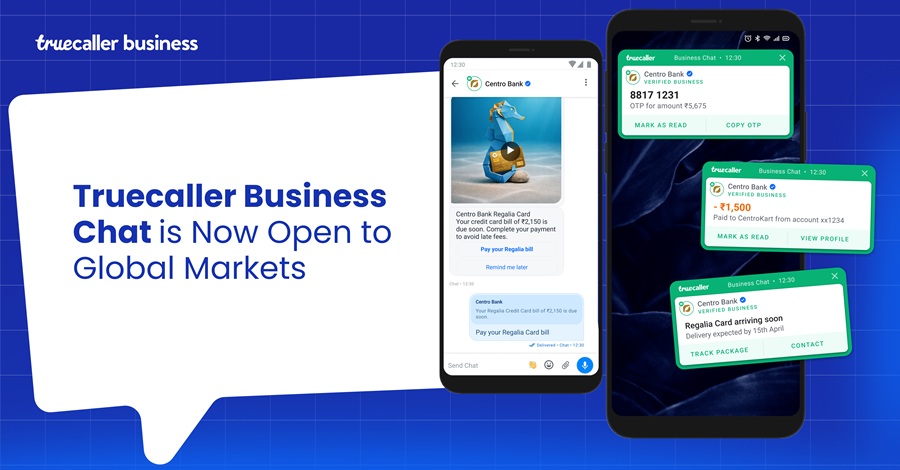
Truecaller, the leading global communications platform, today announced the expansion of its Business Chat platform, making it accessible to global channel partners and enterprise solution providers. By “opening up” market access to its platform, Truecaller is empowering partners to transition their enterprise clients from legacy, low-trust SMS to a verified, smart, media-rich, and conversational communication experience.

Truecaller
Through this partner-led expansion, Truecaller empowers businesses to reclaim customer attention and establish immediate trust and credibility.
“The definition of success for modern enterprises has fundamentally evolved. It’s no longer just about delivery – it’s about earning attention, establishing credibility, and driving meaningful conversion,” said Priyam Bose, Global Head, GTM at Truecaller.
“By opening up market access to our global partners, we’ve created a powerful gateway for brands to engage with over 500 million active users where they already interact daily through communication that is contextual, trusted, free from clutter, and designed to initiate actions. For existing customers, the outreach opportunity extends to an additional high-impact channel, strengthening the overall customer experience journey.”
Truecaller Business Chat enables a clutter-free, high-trust conversational experience between businesses and consumers. The Business Chat platform equips partners with actionable insights, including real-time data and rich engagement metrics. This facilitates a more sophisticated, data-driven communication strategy that adapts at every stage of the customer journey.
Partners, including Gupshup and OneXtel, are already live in India along with Globe Teleservices, Cloudcom, and Sling Africa in other global markets, rapidly scaling the product in their respective regions. Global partners can now leverage Truecaller’s massive footprint to offer their clients a trustworthy engagement channel in an increasingly crowded digital world.
Meta Superintelligence Labs (MSL) unveiled Muse Spark Tuesday, its first large language model in a new Muse series, designed from scratch to deliver “personal superintelligence”—an AI assistant tailored to users’ real-world needs like complex reasoning in science, math and health.

Meta AI
A New Model: Muse Spark
Over the last nine months, Meta Superintelligence Labs rebuilt our AI stack from the ground up, moving faster than any development cycle we have run before. Muse Spark is the first model in our new Muse series — a deliberate and scientific approach to model scaling where each generation validates and builds on the last before we go bigger. This initial model is small and fast by design, yet capable enough to reason through complex questions in science, math, and health. It is a powerful foundation, and the next generation is already in development. Muse Spark now powers the Meta AI assistant in the Meta AI app and meta.ai, built to support complex reasoning and multimodal tasks.
What’s Changed with Meta AI
The Meta AI app and meta.ai are getting an upgrade today, along with a new look. Whether you need a quick answer or help with complex problems that need strong reasoning, Meta AI now handles both. You can switch between modes depending on the task, and Meta AI can launch multiple subagents in parallel to tackle your question. Like planning a family trip to Florida where one agent drafts the itinerary, another compares Orlando vs. the Keys, and a third finds kid-friendly activities — all at the same time, giving you a better answer, faster.
Ask Meta AI: It Understands
The real world moves fast, and most of it does not fit into a text box. That is why we built strong multimodal perception into Muse Spark, so Meta AI can see and understand what you are looking at, not just read what you type. Snap a photo of an airport snack shelf and Meta AI can identify and rank the snacks with the most protein — no label-squinting required. Scan a product and ask how it compares to alternatives. It is the difference between an AI that waits for you to explain the world and one that can simply look at the world with you. And when Meta AI powered by Muse Spark comes to our AI glasses, the assistant will be able to better see and understand the world around you.
Multimodal perception is especially valuable for health. With Muse Spark, Meta AI is now able to help you navigate health questions with more detailed responses, including some questions involving images and charts. Health is one of the top reasons people turn to AI, so we worked with a team of physicians to develop the model’s ability to provide helpful information on common health questions and concerns.
Muse Spark excels at visual coding, letting you create custom websites and mini-games straight from a prompt. Ask Meta AI to build a dashboard for planning a big surprise party, spin up a retro arcade game to chase a high score, or launch a whimsical flight simulator — and share any of them with friends.
Ask Meta AI: It’s Plugged Into What You Care About
Meta AI can now help you discover what to wear, how to style a room, or what to buy for someone you know. Shopping mode draws from the styling inspiration and brand storytelling already happening across our apps, surfacing ideas from the creators and communities people already follow.
And when you are looking up a place to go or a topic that is trending, Meta AI surfaces rich and relevant context right alongside the conversation. Tap into a location and see public posts from locals who know the area. Ask what people are buzzing about and get the full picture, pulled from content and community posts. It is context from your people, right where you need it.
Looking Ahead
The Meta AI app and meta.ai will have the upgraded experience with Instant and Thinking modes everywhere they are available today. The new Meta AI features are starting to roll out in the US on both. In the coming weeks, we will bring these new modes and capabilities to more countries and to the places where people use Meta AI, including Instagram, Facebook, Messenger, WhatsApp, and our AI glasses — where these perception capabilities become even more powerful. We are also opening access to the underlying technology. It will be available in private preview via API to select partners, and we hope to open-source future versions of the model.
This is only the start. As we expand these features, expect richer, more visual results, with Reels, photos, and posts woven directly into your answers, with credit back to the content creators. And as our models improve, we’ll continue to build safeguards for things like safety and privacy, starting with the strengthened risk framework and other protections we’re sharing today.
The future of Meta AI is rooted in the relationships and context already at the center of your life. We are building toward personal superintelligence — an AI that does not just answer your questions but truly understands your world because it is built on it.

The recent escalation in the US-Israel conflict with Iran has delivered a sharp reminder of Nigeria’s economic vulnerability. As oil prices surged past $100 per barrel and fuel costs climbed by 35% at Nigerian pumps, a troubling paradox emerged: Nigeria, a major crude oil producer with Africa’s largest privately-owned refinery now operational, still found itself buffeted by global energy shocks originating thousands of miles away.

Zinox
The closure of the Strait of Hormuz and resulting disruptions to global energy markets exposed the deeper structural challenge facing Nigeria’s economy. Despite domestic crude production and the operational Dangote Refinery, Nigeria has struggled with rising inflation, which reached approximately 27% in 2025. The crisis illuminated an uncomfortable truth: decades of import dependency have left Nigeria’s economy precariously exposed to external shocks, even in sectors where the country possesses natural advantages.
This vulnerability extends beyond energy. Nigeria’s technology sector offers a particularly instructive case study in the costs of import reliance, and the transformative potential of local capacity as the pathway to economic stability and technological sovereignty.
Against this backdrop, Zinox Technologies stands as a compelling counternarrative. Founded in 2001 by technology entrepreneur Leo Stan Ekeh, Zinox operates West Africa’s only computerized digital assembly plant. As Nigeria’s first indigenous computer manufacturer, Zinox demonstrates what becomes possible when vision, investment, and commitment to local capacity converge.
The company’s reach extends beyond traditional computing. Zinox’s innovation spans renewable energy through iPower and home electronics with iTEC, addressing Nigeria’s chronic power challenges with locally-assembled solar solutions and backup systems designed for Nigerian conditions. This diversification reflects sophisticated understanding: true technological sovereignty requires integrated capabilities.
Zinox’s journey offers a clear case study in how indigenous companies can drive transformation. By focusing on local assembly and manufacturing of computer hardware and digital devices, the company has contributed to building a domestic technology ecosystem that supports government institutions, educational systems, and private enterprises. This approach not only reduces reliance on foreign imports but also creates jobs, transfers knowledge, and strengthens national capacity.
The implications are significant. Every locally assembled device represents a step away from foreign exchange exposure. It also signals a shift in mindset — from consumption to production. In a country where demand for technology continues to rise, especially with the acceleration of digital adoption, the importance of local manufacturing cannot be overstated.
Beyond economics, there is also a strategic dimension. Technology is no longer just a commercial tool; it is a defense tool and a national asset. Countries that control their technology supply chains are better positioned to innovate, secure their data, and compete globally. In this context, companies like Zinox are not merely businesses; they are enablers of national development.
Furthermore, local capacity development has a multiplier effect. It stimulates ancillary industries such as logistics, retail, maintenance, and technical services. It also fosters entrepreneurship, as more Nigerians gain access to affordable and reliable technology tools needed to participate in the digital economy.
Yet, while progress has been made, there is still work to be done. Scaling local manufacturing requires sustained policy support, infrastructure investment, and a deliberate focus on skills development. It also calls for stronger collaboration between the public and private sectors to create an environment where indigenous innovation can thrive.
Encouragingly, the momentum is building. There is a growing recognition that Nigeria must move beyond being a consumer market to becoming a production hub. This shift is not only necessary, it is urgent. Global uncertainties will continue to test economies, and only those with strong internal capabilities will remain resilient.
The current global crisis offers clarity. If the Strait of Hormuz is not reopened or supply chains to imports are fractured, only countries with strong domestic manufacturing capacity will weather the storm. Those dependent on imports suffer disproportionately.
The story of Zinox Technologies underscores what is possible. It shows that with the right mix of vision and execution, Nigeria can chart a new course, one defined by self-reliance, innovation, and sustainable growth. As the country navigates an increasingly complex global landscape, the message is clear: the future belongs to economies that build, not just buy.

See Key Changes in BVN Rule from May 1 by CBN

INEC Warns Broadcasters against Misinformation ahead of 2027 Polls

Paga Group Rejigs Leadership as Oviosu, Founder Becomes Group CEO

Reputation: The Real Currency Powering Fintechs

Jumia Expands Nationwide Footprint, Deepens Reach Across Underserved Nigerian Cities

Spotify’s Loud & Clear Report Reveals Over ₦60Bn Revenue for Nigerian Artists in 2025

China Threatens to Shut Nigeria’s Satellite Over $11.44m Unpaid Debt

Why JustMarkets Is a Strong Choice for Gold Trading

Kuda MFB Increases Kuda for Her Business Grants to ₦10 Million

Canal+ to Cut Jobs as Part Sweeping Restructuring




 E-Business2 days ago
Nigeria Cyberattacks: Stronger Collaboration as a Panacea

 Telecom2 days ago
Airtel Becomes World’s Second Largest Telco as Global Customer Base Surpasses 650 Million

 General News2 days ago
NIBSS Says 28 Percent of Nigerians have Registered for BVN

 Telecom2 days ago
From Import Dependency to Local Capacity: Nigeria’s Tech Manufacturing Journey

 General News2 days ago
NITDA DG Urges Stronger Collaboration to Drive Nigeria’s Digital Economy

 E-Business2 days ago
CBN Slams Custodian Investment with N419m Fines over Rule Breaches

 General News2 days ago
Ogun Set for Direct London Flights as Gateway Airport Gains Momentum

 News2 days ago
Lagos Govt Drags Top Firms to Court Over Billion-Naira Tax Debts