

General News
British Airways Unveil Judges for Leaders of Tomorrow

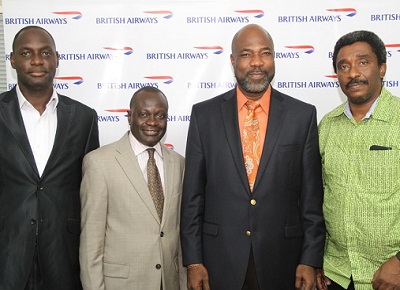
British Airways has announced the panel of judges for its Leaders of Tomorrow initiative aimed at broadening the competencies in the aviation sector.
The three man panel of judges are President of Nigeria Britain Association, Tunde Arogunmati; President of SY&T Communications and aviation specialist, Simon Tumba and aviation journalist, Wale Shadare.
They are expected to select the six best essays from all entries that will be submitted for the competition.
Speaking at event which held in Ikoyi, Lagos on Thursday, Ademola Sanya, British Airways’ trade sales manager, disclosed that the BA was delighted at the progress the initiative has recorded since it was launched.
“We are delighted with the progress that the initiative has recorded thus far and the number of entries that we have received from students of the participating aviation colleges. It is in line with this that we present the panel of judges. We have implicit confidence in their abilities and convinced that we will have a free and fair contest and an unbiased result at the end of the initiative.” stated Sanya.
The British Airways Leaders of Tomorrow initiative opened on 11th of March 2014. It is designed to bridge the gap between the classroom and the actual work environment and provide practical hands on training for the six best participants.
The programme entails a two-week internship platform through which the six winners can learn and gain experience in their chosen fields.
The internship module includes understudying Keith Williams, chief executive officer of British Airways in London as well as visiting other strategic persons and places to get firsthand experience of the workings of a global airline.
Responding on behalf of the judges, Tunde Arogunmati said “We feel honoured to have been selected to be judges of this laudable initiative I believe this initiative that will add value to the aviation industry at large and also enhance the country’s economic system. I must confess that this is a good investment and I will urge the government and public to encourage and support the initiative.”
All of the interns will receive a British Airways accredited certification from the CEO to mark their graduation from the Leaders for Tomorrow Academy.



Delta State Police Command has revealed how a 17-year-old boy allegedly hacked into celebrities’ WhatsApp accounts and sold explicit adult content to classmates.

This was disclosed in a viral video shared by comedian Otaghware Onodjayeke, popularly known as I Go Save, during a security awareness programme where he spoke with Temi Agbede-Zuokumor, divisional police officer (DPO) of Ugborikoko Division, Uvwie Local Government Area of Delta State.
The DPO explained that the case came to light after a routine check of a student’s phone, which first raised suspicion.
Agbede-Zuokumor disclosed that the student’s mother had initially claimed the phone belonged to his sister, but further inspection revealed otherwise.
“The woman looked very modest, so I asked her if she was from Deeper Life. She said no. I then asked why her son took a phone to school, and she claimed it belonged to his sister,” she narrated.
The DPO expressed that the development triggered her suspicion, prompting officers to examine the phone’s contents.
“Something told me to check the phone. When we did, we discovered that everything on the device belonged to the boy,” she said.
She added that the phone contained over 80 foreign numbers, including Australian contacts, alongside numerous explicit materials.
“We saw several foreign numbers, over 80 Australian lines, and the phone was filled with pornographic content,” she said.
The police officer further disclosed that the suspect allegedly sold explicit materials to his classmates, who referred to him as “boss.”
“We also saw chats with his classmates asking if he had explicit content to sell. They were calling him ‘boss’ in school,” she added.
According to her, investigations also revealed that the teenager had hacked into WhatsApp accounts belonging to prominent individuals and used them to solicit money.
“We discovered he had access to WhatsApp accounts of some celebrities, which he used to demand money from unsuspecting victims,” she said.
Speaking during the session, comedian I Go Save recounted a similar experience, describing how he was once contacted by a suspected fraudster impersonating Elon Musk, Forbes world richest man.
“That was how someone impersonating Elon Musk messaged me, saying he was stranded and needed a recharge card,” he said.
“I was surprised and asked which network he used. The person later sent an Opay account,” he added.
The police warned parents and school authorities to be more vigilant, stressing the growing concern of cyber-related crimes among young people.

Socio-Economic Rights and Accountability Project (SERAP) has urged President Bola Tinubu to direct Bosun Tijani, minister of Communications, Innovation and Digital Economy, as well as the management of the Nigerian Communications Satellite Ltd (NIGCOMSAT) and the Nigerian Nuclear Regulatory Authority (NNRA), to account for and explain the whereabouts of an alleged ₦2.9 billion in missing or diverted public funds.

SERAP also called on Lateef Fagbemi (SAN), attorney general of the federation and minister of justice, and relevant anti-corruption agencies to investigate the alleged diversion of funds, including those documented in previous Auditor-General reports.
In a letter dated April 11, 2026, and signed by Kolawole Oluwadare, deputy director SERAP, said: “These allegations, involving critical public institutions, represent a grave violation of the public trust and a fundamental breach of Nigeria’s anti-corruption laws and international obligations.”
The group further urged the Federal Government to direct NIGCOMSAT to disclose the shareholders and beneficial owners of a company that allegedly received ₦465 million in “unauthorised investment” from the agency.
SERAP said, “Anyone suspected to be responsible should face prosecution as appropriate, if there is sufficient admissible evidence, and any missing or diverted public funds should be fully recovered and remitted to the treasury.”
The organisation gave the government seven days to comply, warning that it may initiate legal action if its demands are not met.
It also stated that accountability in both agencies is critical, given their strategic roles, saying: “Accountability in NIGCOMSAT and NNRA is critical given their strategic roles in Nigeria’s digital economy and national safety systems. Mismanagement in these agencies not only wastes scarce public resources but also threatens national development, technological progress, and public safety.”
SERAP added: “Ensuring accountability is therefore essential to protecting both Nigeria’s present and its future.”
It warned that failure to address the allegations would continue to erode public trust, stating: “These allegations, if left unaddressed, will continue to undermine public confidence in government institutions, weaken Nigeria’s anti-corruption framework, and deprive citizens of resources needed for development.”
The allegations were drawn from the Auditor-General’s report published on September 9, 2025, which examined financial activities in NIGCOMSAT and NNRA and raised concerns over possible mismanagement of public funds.
According to the report, NIGCOMSAT failed to account for over ₦465 million used for an “unauthorised investment” in Gicell Wireless Ltd, made without approvals from the Minister of Science and Technology and the Accountant-General of the Federation.
It also noted that “there was also no evidence that a competent Investment Analyst performed investment appraisal,” while the investment agreement raised concerns over valuation and exchange rate assumptions.
The Auditor-General further stated that “NIGCOMSAT made ineligible, irregular and wrong payments of over ₦3 million to staff,” and that “the payment was made without due process and any documents on what the payments were meant for.”
It also flagged an irregular rent payment of over ₦4.3 million, noting that although a refund was requested, “there was no evidence that the consultant refunded the money.”
It added that NIGCOMSAT “failed to remit over ₦507 million of its internally generated revenue to the Consolidated Revenue Fund,” while also failing to account for over ₦6 million for undelivered store items.
The report further stated that “there was also no evidence of how the transferred funds were spent or utilised,” referring to an irregular ₦84.78 million transfer from a Remita account to a special project account.
On NNRA, the report alleged that ₦4.35 million was spent on training without evidence that it took place, while ₦16.7 million was paid for ICT equipment without approval.
It also stated that ₦33.4 million was spent on items that were never supplied, and that “there were no documents to support” several payments for operational activities.
The Auditor-General further noted that NNRA “failed to retire over ₦6.5 million of cash advances granted to staff,” and that ₦2.05 million paid for foreign training had no evidence of participation.
It also stated that ₦1.95 million collected through Remita was not recorded in the agency’s cashbook, leading to concerns of revenue understatement.
SERAP said the findings point to “a systemic pattern of financial mismanagement, opacity, and corruption within an agency entrusted with advancing Nigeria’s digital and communications infrastructure,” adding that NNRA’s lapses also raise serious concerns about compliance with safety and financial regulations.


IHS Nigeria, part of the IHS Holding Limited (“IHS Towers”) group, one of the largest independent owners, operators, and developers of shared communications infrastructure in the world by tower count, has partnered with the National Commission for Museums and Monuments to renovate and upgrade facilities at the National Museum, Lagos.

Commissioned by the Honorable Minister of Art, Culture, Tourism and the Creative Economy, Hannatu Musawa, the project is a significant step towards restoring and improving critical facilities at the museum complex, while supporting the long-term preservation of Nigeria’s cultural assets and heritage.
The project has improved the overall aesthetic appeal of the museum site and featured extensive restoration of the museum’s main gallery. The restored gallery incorporates the installation of modern display and lighting systems, air‑conditioning units, a solar inverter system to enhance energy efficiency, and surveillance cameras to aid safety, security and operational performance across the facility. These renovations and upgrades follow on from IHS Nigeria’s sponsorship of the museum’s efforts to digitize Nigeria’s cultural heritage and launch Nigeria’s first digital museum of antiquities at www.museum.ng.
Mohamad Darwish, CEO, IHS Nigeria, commented, “Having seen the rich historical and cultural heritage housed in this national museum complex, we believed it was important to go a step further after supporting the development of the digital museum, to also improve the aesthetics, security and structural integrity of the main physical complex. This aligns with our broader commitment to sustainable infrastructure development and the preservation of Nigeria’s history.
“I am proud of these renovations and that visitors, including tourists, researchers and art enthusiasts, can visit the museum to be immersed in Nigeria’s rich history in an environment that is safe, beautiful and welcoming.
“The artifacts can also now be better preserved, protected and presented in a way that celebrates the history they represent. I thank the National Commission for Museums and Monuments for this ongoing partnership which continues to exemplify the power of a collaborative effort in driving innovation, fostering national pride, and enhancing the creative economy.”
Olugbile Holloway, Director General, National Commission for Museums and Monuments, commented, “On behalf of the National Commission for Museums and Monuments, I wish to express our deepest gratitude to IHS Nigeria for their generous support of the restoration of the National Museum, Lagos. This landmark gesture goes far beyond bricks and mortar — it is a profound commitment to preserving the soul of our nation.
“The National Museum Lagos is home to some of Nigeria’s most treasured antiquities, from the ancient terracotta of the Nok civilization to the magnificent bronzes of the Benin Kingdom and the classical works of Ife.
“To restore this institution is to restore our collective memory. We thank IHS Nigeria for choosing to renew not just infrastructure, but the heritage, identity, and the hope of our people. Their support ensures that generations of Nigerians yet unborn will walk through these halls and encounter the full greatness of who we are and where we come from.”

Meta Files Appeal over $25,000 Damages Awarded to Falana

Teenager Hacks Celebrities Whatsapps, Sells Adult Content in Delta

FG Unveils ePharmacy Platform to Regulate Digital Pharmaceutical Services

Elon Musk Accuses South Africa of Racism over Starlink Licence Block

SERAP Asks Tinubu to Probe Alleged N2.9Bn Fraud In NIGCOMSAT, NNRA

Spotify’s Loud & Clear Report Reveals Over ₦60Bn Revenue for Nigerian Artists in 2025

Kuda MFB Increases Kuda for Her Business Grants to ₦10 Million

Canal+ to Cut Jobs as Part Sweeping Restructuring

Nigeria tops global rankings for USDT, USDC ownership

NBC Boss Urges Content Ceators to Participate in DSO




 Broadcasting2 days ago
FG to Gift Nigerians over 100 Free TV Channels from May 15

 E-Financial2 days ago
CBN Dismisses Polaris Bank Liquidation Claim

 E-Financial2 days ago
AfDB Okays $200m for Nigeria’s Digital Backbone, Others

 General News2 days ago
FG New Approves Biometric Passenger Verification System for Airports Security

 E-Financial2 days ago
Nigeria’s Growth under Threat as Poverty Deepens, World Bank Warns

 News2 days ago
Experts Reveal a Steady Decline of High-severity Incidents Over the Years

 General News2 days ago
Breaking Barriers: Cassava Technologies Expands Digital Access Across Africa

 E-Business2 days ago
NESREA, ACMTI, Others Launch Carbon Utilisation Initiative in Nigeria