

Telecom
Emergence Communications Centres 5 Years After

Nigeria has poor record of disaster management in spite of the existence of various agencies whose primary responsibility is to effectively respond to disaster whenever and wherever it happens, with the view of assisting the victims.
Among these agencies include the police, fire service, road safety and above all National Emergence Management Agency (Nema), established in 1999 to coordinate activities of all disaster management activities in the country.
Instances are bound which exposes inefficiency of these disaster management agencies, among them are the bomb explosion at the Ikeja military cantonment that resulted in the loss of many lives and Bellview Airline crash at Lisa village in Ogun state.
It is regrettable that greater percentage of Nigerians that died as a result of the explosion at the cantonment were not killed by the exploded bomb but due to fear of uncertainty, as they were not adequately informed about what was going on. Many thought that Nigeria was under attack by external forces and in the process of running for dear life; they met their untimely death by jumping into the canal thinking that it is an escape route.
Observers believe that if people were informed either through radio, television or public address system on the cause of the explosion many lives lost in that disaster would have been saved. Few years after this unfortunate incident, Nigeria’s level of preparedness in disaster management was put to test again when a Bellview Airline crashed at Lisa village in Ogun State. It took more than 24 hours to locate the crashed aircraft, and by the time this was done, all the passengers on board who were alive few hours after the crash had died.
On December 10, 2005, now defunct Sosoliso Airline crashed and went up in flames within the perimeter walls of Port Harcourt airport, consuming 110 passengers including 62 children. The airport fire service was not able to save any passenger from the inferno owing to malfunctioning of the equipment. These few of several instance of the level decay in the country’s emergency management institutions, as well as to strengthen these institutions and to provide a more effective means of emergency management that the federal government through the ministry of information and communications directed Nigerian Communications Commission (NCC) to establish Emergency Communications Centres in the country. It was designed to offer Nigerians in distress situation assistance by them putting a call to through to the centre on its code and the centre will respond with rescue depending on the nature of the distress.
How the centres came about
The ministry of information and communications in august 2005 set up a committee headed by engr. Steven Bello, then executive commissioner in NCC, but now acting executive vice chairman, NCC. Other members of the committee include Mr. F. Y. Daudu from Ministry of Information and Communications who served as secretary, Mr. Balarabe Gambo of National Emergency Management Agency, representatives of the Police, and Nigerian Telecommunications Limited (Nitel), as well as Mr. Chioke Ogugua representing telecommunications operators.
The committee was to determine the organizational framework and administrative structure that will be required to establish and operate a public protection communications system; recommend a suitable telephone number that will be assigned for distressed call all over the country; as well as recommend means of funding for the scheme to ensure that it is self-sustaining and independent of government funding or budgetary allocations. The committee was also to recommend a frequency or frequencies that should be reserved to communicate with the centres; to determine, if there is any legislative enactment required in order to give legal backing to any of the recommendations made; and recommend modalities for its implementation.
The committee was given four weeks to submit its reports to the feral executive council. Upon the rectification of the report, NCC was directed to implement the recommendations on the establishment of the National Emergency Communications Centres.
Implementation Effort
As part of its implementation plans, NCC mapped out four levels of interaction on the establishment of the centres. These include interaction with equipment vendors such as Nokia, Siemens, Huawei among others who will be supplying equipment that will be used in the centres, telecommunication operators, civil society agencies responsible for disaster management as well as state governments that going to provide land for the centres.
At the interactive session with telecommunications service providers held in Lagos, Mr. Steven Bello, explained that the emergency service code is usually an all service number that can be call in any situation where state-run emergency services are needed.
Bello noted that the interaction with operators was to discuss the requirement for the interconnectivity of such centres which is based Geographical Information System (GIS). According to him, the commission wants the operators to be able to send information about the subscriber on their network who is dialing 119 prescribed distress code in case of emergency.
“We want to get where the co-ordinates of the cell site from which the call is coming from, we want to get the telephone number if possible the caller’s state and local government. Once we get this information, we can use it to query our data base which we are about compiling, from there we will be able to get the nearest response agency close to the victim,” he said.
He cited instance of people who get into distress in places where they don’t know anybody or telephone number of closest police station, ambulance and other emergency response agencies. Such people, he said, can dial the three digit number which will direct the person to an emergency communications centre nearest to him, and from there the person will be directed to the nearest response agency that can help him.
Apart from this, each of the centres would have standby ambulance and other infrastructure such as a borehole to take care of fire related disasters. “We will have fuel depot in the emergency communications centres so that the police vehicle or ambulance stationed at the centre will not complain that they don’t have fuel to move when it’s being called,” Bello stated.
“We are going to provide all the necessary infrastructure, in fact, in the emergency communications centres we will also provide helicopter landing park so that the states that have helicopters such as Abuja and Kaduna can make use of them when there is need for the helicopter to go and rescue somebody who is in a place that is not accessible by road.”
He said that all emergency calls to the centre code are going to be toll free from all network operators in the country.
In line with the recommendations of the committee on the method of financing the communications centres so that they won’t be dependent on budgetary allocation, Bello said they are looking at a similar system in United States of America where one percent in every call made is taxed to finance the centre.
Having realized the need to partner relevant agencies in the establishment of these centres, Bello said NCC would collaborate with Nema in the implementation of the scheme.
He said that explained the presence of Mr. Daniel Gambo, deputy director, communications, Nema, at the interaction with telecom operators. Gambo said they intend to engage experts in disaster reduction and management that will assist in the operations of the centres.
Mr. Samuel Uchega, managing director, Mavis Computel Nigeria, the consulting company for the scheme, said there is going to be a legislation that will prescribe penalty for phones identified to have made calls or send short message service that is not meant for emergency situation to the code. The penalty, he said will be to block such phone line.
He explained that they are also going to establish a smooth communications between distress caller and the administrators in the emergency centres. Ucheaga also noted that the emergency communications centres are going to interface with switches of telecommunications operators to ensure that calls are not delayed in anyway.
NCC has so far gotten land allocation from four state governments for the establishment of emergency communications centres in their states; these include Taraba, Kwara, Plateau and Kaduna.
Sequel to this federal executive council early last year approved the release of N2.4billion for the commencement of the Emergency Communications Centres project across the country.
It more than a year after the approval no concrete result has been seen towards the realization of this laudable initiative.
In his first media interaction session after being pronounced acting executive vice chairman, NCC, engr. Bello re-affirmed his commitment to realizing the Emergency Communications Centre project among other projects initiated under the immediate past EVC, Engr. Ernest Ndukwe. With this assurance it is the believe of Nigerians that concerted effort should be made to see that at least the first set the centre where land have been acquired takes off.



Airtel Africa Foundation, through Airtel Nigeria, has marked International Volunteer Day 2025 by celebrating the impact of the Employee Volunteer Programme (EVP), a flagship initiative by which employees volunteer their time, expertise, and personal resources to advancing the Foundation’s mission across 14 African markets.

The celebration brought together volunteers at the Airtel Nigeria Headquarters in Lagos for moments of team bonding activities, testimonials, and volunteer spotlights. The event also served as a call to action, encouraging more employees to register for EVP activities and join the volunteer community.
The EVP has become a cornerstone of Airtel Africa Foundation’s community impact, empowering employees to drive local CSR initiatives and champion causes that promote education, digital skills, environmental responsibility, and youth empowerment. Through the programme, volunteers have contributed significantly to initiatives such as the International Day of Education Essay Competition, Teacher-for-a-Day sessions, beach clean-ups, market sensitisation exercises to reduce plastic waste, and the Airtel-3MTT NextGen Fellowship for young Nigerians.
Speaking about the celebration, Dinesh Balsingh, Airtel Nigeria Chief Executive Officer, said, “International Volunteer Day reminds us that real impact begins with people who are willing to show up and serve. Today we honour the incredible dedication of Airtel employees, whose selfless commitment of time and talent is the engine behind our progress. Their contribution is the backbone of our work and the reason we continue to transform communities across Africa.”
Over the years, the EVP in Nigeria has delivered tangible outcomes through numerous impactful initiatives such as financial donations to the Lagos State Government COVID-19 control efforts. In 2025 alone, volunteers have contributed more than 200 hours of service, reaching over 100,000 beneficiaries.
Commenting on the commitment of Airtel Nigeria’s employees, Femi Adeniran, Director, Corporate Communications & CSR, said, “Volunteering is at the heart of who we are. Behind every empowered learner, every restored environment, and every connected community is an individual who believed in making a difference, and we are thankful for your participation. Our mission remains clear: to use technology, resources, and our collective humanity to build a digitally inclusive, socially responsible, and sustainable Africa.”
International Volunteer Day provides a global moment to honour volunteers whose contributions often go unseen but deliver lasting impact. As its EVP continues to grow, Airtel Africa Foundation remains committed to expanding access to education, digital literacy, environmental care, and opportunities for underserved communities across the continent.


Nigerian creators have emerged dominant at the 2025 TikTok Awards for Sub-Saharan Africa, winning six of the ten categories at the ceremony held in Johannesburg, South Africa.

TikTok Sub-Saharan Africa Awards
The awards, themed “New Era, New Icons”, celebrated outstanding creativity across the continent, with Nigeria’s victories underscoring its growing influence in digital culture and entertainment.
Raja’atu Muhammed Ibrahim, known as @diaryofanortherncook, from Sokoto, won the prestigious Creator of the Year Award, recognised for her cinematic storytelling of Northern Nigerian cuisine. Abuja-based Brian Nwana (@briannwana) clinched Storyteller of the Year, while Izzi Boye (@izziboye) was named Education Creator of the Year.
Other Nigerian winners included Belove Olocha (@beloveolocha) for Entertainment Creator of the Year, Dejoke Ogunbiyi (@noositiwantiwa_) for Social Impact Creator of the Year, and Crown Uzama, popularly known as Shallipopi (@theycallmeshallipopipp), who took home Artist of the Year.
Shallipopi, whose hit track “Laho” dominated African soundwaves in 2025, thanked TikTok for supporting upcoming artists and providing a platform to shine. “When Nigeria creates, the world moves,” he told fans during his acceptance speech.
TikTok’s Head of Content Operations for Sub-Saharan Africa, Boniswa Sidwaba, praised the winners, noting that Nigerian creators had redefined what it means to be a digital storyteller. “Tonight’s ceremony was a gathering of trailblazers who turned short video clips into cultural movements,” she said.
Other winners from across the continent included Tanzania’s Fanuel John Masamaki (@zerobrainer0), who won Video of the Year, Kenya’s @tunero_animations as Rising Star of the Year, South Africa’s @malumfoodie for Food Creator of the Year, and Kenya’s @zozasportscast for Sports Creator of the Year.
The ceremony, supported by brands such as NIVEA, Coca-Cola, PEP, inDrive and Dis-Chem, will be broadcast exclusively on TikTok LIVE on Dec. 11 at 19:00 WAT via the @tiktok.africa account.
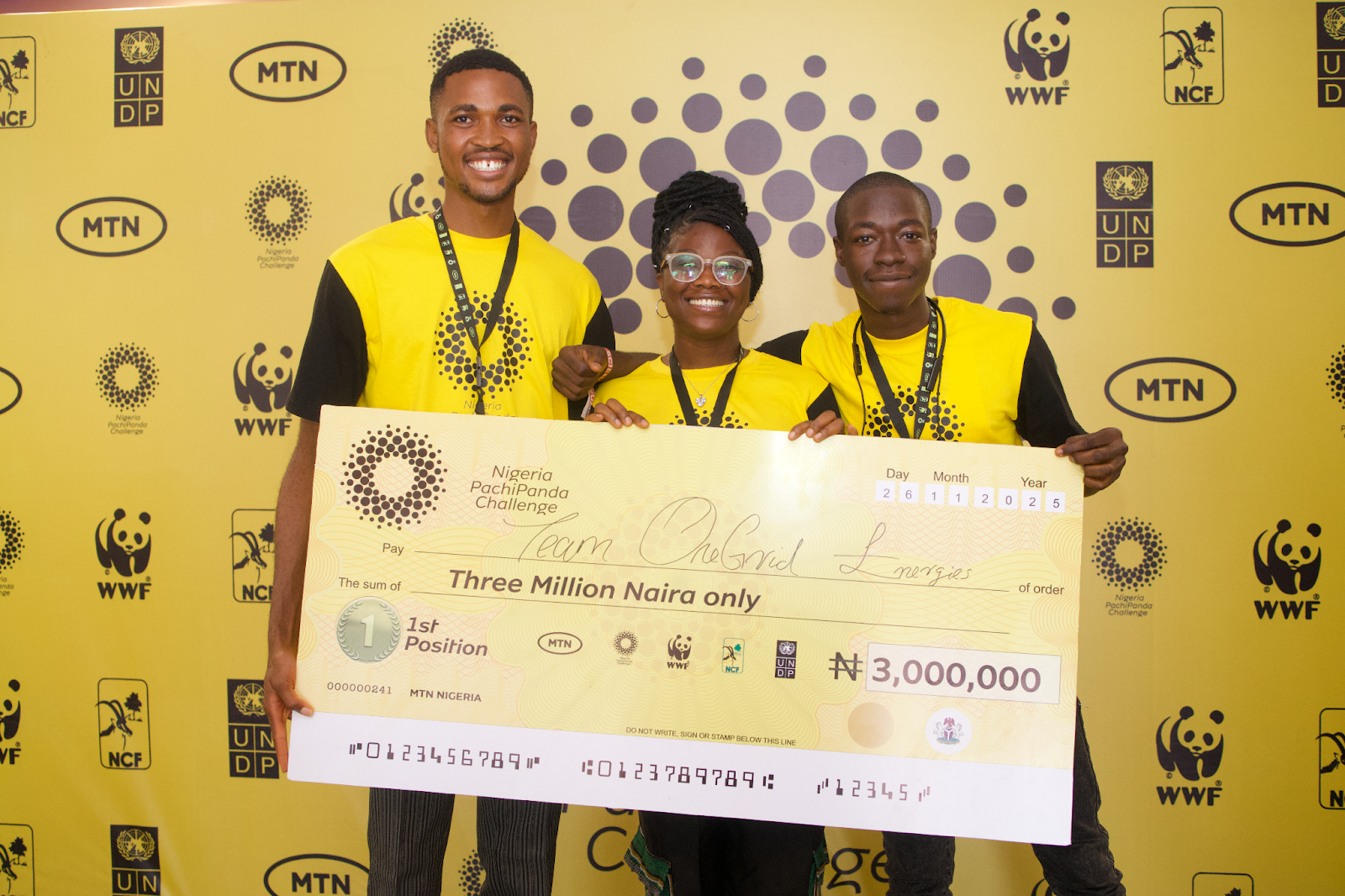
MTN Nigeria has announced the winners of the 2025 Nigeria PachiPanda Challenge, a national innovation programme delivered in partnership with Worldwide Fund for Nature (WWF) through its local partner, the Nigerian Conservation Foundation (NCF), and the United Nations Development Programme (UNDP) Nigeria.

L – R: Promise Ogochukwu, OneGrid Energies; Emmanuel Ezea, OneGrid Energies, Lantana Elhassan, Head of Exploration, Accelerator Lab, UNDP Nigeria; Valentine Nnamani, OneGrid Energies; trio winner of the MTN 2025 Pachipanda Challenge, held at MTN RoofTop Plaza, Ikoyi.
The competition attracted over 2000 applications from young innovators across the country and concluded with a 3-day sprint event that featured masterclasses and pitch presentations at the MTN Rooftop Event Centre, Falomo, Ikoyi, Lagos. Ten finalists, comprising seven individuals and three teams, competed for top honours following a rigorous multi-stage screening process.
Team OneGrid Energies emerged overall winner for its solution that addresses energy access in underserved communities. The team of Emmanuel Ezea, Ogochukwu Ogene, and Valentine Nnamani upcycle plastic bottles and e-waste lithium ion batteries to create affordable lanterns for households without reliable electricity. The team also introduced smart solar-powered charging stations operated by rural women, creating economic opportunities and supporting environmental impact.
Joshua Ndaman secured second place with his innovative solution, BuyScrap, a tech-driven platform that streamlines the collection and recycling of electronic waste. By ensuring that discarded electronics are ethically reused and repurposed, BuyScrap supports a circular economy and provides a reliable link between households and processors in the e-waste value chain.
Divine Peter secured third place with HopeForge Engineering, an initiative that designs and produces affordable recycling equipment for green businesses using recyclable materials. His focus on automating traditional manual equipment aims to increase productivity and make sustainable tools more accessible for small and medium-sized enterpriOlayinkases.
The winners received ₦3,000,000, ₦2,000,000, and ₦1,500,000 respectively. They will now represent Nigeria at the Africa PachiPanda Challenge where they will compete against champions from across the continent.
Tobe Okigbo, Chief Corporate Services and Sustainability Officer at MTN Nigeria, emphasised the importance of youth-led innovation in advancing climate action and community resilience. “Innovation should go beyond solving problems; it should be bankable and sustainable, ensuring long-term value for both society and the innovators themselves,” he noted.
Dr. Joseph Onoja, Director-General of NCF, praised the creativity of the finalists, stating, “Every finalist here is a winner, and we will continue to work with partners like MTN, UNDP, and WWF to nurture these ideas and build a better future for Nigeria.”
Representing UNDP Nigeria, Lantana Elhassan, Head of Exploration, Accelerator Lab, described the potential of the finalists’ solutions to inspire systemic change across Africa’s innovation landscape. She highlighted the role of tech tools in helping participants improve their prototypes and scale their solutions.
During the event week, finalists received tailored training through masterclass sessions that enhance their business skills and strengthened their solutions. Facilitators included Bankole Oloruntoba, CEO, Nigeria Climate Innovation Centre (NCIC); Chinwe Udo-Davis, Founder & CEO, Instollar; Nifemi Oluboyede, Chief Product Officer, Credit Direct; and Uche Aniche, Founder, Rebel Seed Capital & Convener, Startup South.
Judges comprised experts in sustainability and innovation including Dr. Tiwalade Adeniyi, Head of ESG, Solon; Dr. William Tsuma, Chief Innovation Officer, UNDP Nigeria; Maximus Ugwuoke, Country Director, Carbon Craft Africa; Peju Ibekwe, CEO, Sterling One Foundation; Temitope Okunnu, Founder, Fabe International; and Yewande Adeyi, Senior Manager, ESG Advisory Services, KPMG West Africa.
The Africa-wide finals will bring together leading innovators from across the continent to showcase their work to industry experts and investors.
For more information and updates on the winners’ journey, visit https://www.mtn.ng/sustainability or contact [email protected]

FG, SEC, NGX Group Agree on Capital Gains Tax Reform

Airtel Africa Foundation Celebrates International Volunteer Day, Honours Employee Volunteers

Report Reveals Half of 2025’s Compromised Passwords were Already Leaked

EFCC Arik Case: Witness Testifies on Receiver Manager Nominee’s Role in NG Eagle Shareholding

Nigeria Dominates 2025 TikTok Sub-Saharan Africa Awards with Six Wins

Kaspersky Introduces Cyber Pathways to Support Career Development in Cybersecurity

NITDA DG Tasks Youths to Drive Africa’s Digital Transformation

Firm Urges Organizations to Check Protection of their Websites Amid Search Engine Optimisation Attack Schemes

Hackers Breach Phones of Dangote and Otedola, Demand Ransom

FCCPC Sets Deadline for Digital Lending Regulatory Compliance




 Telecom2 days ago
Nigeria Lacks AI-Ready Data Centres, Trails in Capacity – Nnamani

 General News2 days ago
NiDCOM Launches Diaspora Startup Challenge to Boost Nigerian Talent

 E-Financial2 days ago
CAC to Shut Down Unregistered PoS Operators by January 2026

 Telecom2 days ago
Anambra Leads Southeast in Digital Governance Under Soludo’s ICT Agenda

 News1 day ago
Lagos Launches Tele-Vet, Nigeria’s First Veterinary Call Centre

 General News2 days ago
Optimus AI LABS CEO Showcases AI Breakthroughs in Nigeria’s Financial Sector

 General News2 days ago
PromoPrint Rekindles Nigerian Resilience @ 25th Anniversary
 Telecom13 hours ago
Nigeria Dominates 2025 TikTok Sub-Saharan Africa Awards with Six Wins