

E-Financial
Fidelity Bank MD Explains Why Banks don’t Give Long Term Loans

Mr. Nnamdi Okonkwo, managing director, Fidelity Bank Plc, has said that the inability of commercial banks to give long-term credit facilities is due to the non-availability of long-term-deposits by Nigerians.
Okonkwo made the remark at a conference organised by the Finance Correspondents Association of Nigeria (FICAN) in Lagos. The theme of the conference was: ‘’Nigeria beyond Oil, Financing Options for Non-Oil Exports’’.
He said that most depositors who had huge amounts to save, did it on short-term basis because of uncertainties of the economic policies.
Okonkwo wondered why banks were always condemned at every occasion for not lending long-term facilities to businessmen and farmers, whereas they traded mainly with short-term deposits.
The managing director insisted “that commercial banks do not have the kind of huge amount of money to lend out to those in businesses for long-term period’’.
The financial expert also listed lack of the right framework as being responsible for local banks not lending long-term to Small and Medium Scale Enterprises (SMEs).
He said lack of infrastructure, such as power, among others had made the bank to generate private electricity for its operations.
According to him, banks paid full interest on all deposits, while 25 per cent was taken as Cash Reserve Ratio (CRR), leaving banks with only 75 per cent of the amount to trade with.
He said, “If as a bank, I know a secret place where I can get long-term funds to trade with, I will be the number one bank in Nigeria today because I can lend long-term.
“Bring me a depositor that will place N100 million today with me at 10 per cent. “I will then give a loan at 15 per cent and pay the depositor’s interest on N100 million but I have to trade with N75 million because the Cash Reserve Ratio is deducted from the N100 million.
“For me to get access to five per cent of the money, I have to lend to a cocoa farmer. You have to lend for industrial production,’’ Okonkwo said.
The managing director said that banks paid three per cent as premium to Nigerian Deposit Insurance Corporation (NDIC) from all deposits.
“Not only that, the bank will also pay three per cent NDIC premium on the same N100 million deposit. “Remember, I run my own power. In fact if you put together the voltage we produce in 248 branches of Fidelity Bank, it can power the whole of Lagos State,’’ Okonkwo said.
He said that it was difficult to get a Nigerian who will deposit money in the bank for one year, yet, people kept blaming the banks for not lending money for long-term projects.
Okonkwo said that a lot of banks collapsed in the past because of assets mismatch. That is people who matched long-term assets with short-term funds.
“When there is a run in the system, the owners of the short-term funds will come for their money and you have to pay them. “If you pay them, the people you gave long-term loans cannot pay up.
Then you begin to have distress in the system, ‘’ he said. The financial expert, however, said that the Nigerian Export Import Bank (NEXIM Bank) and Fidelity Bank Plc were taking measures to enhance non-oil exports and create wealth for Nigerians.
The managing director said the lender was always at the forefront of financial services solutions and lending, adding that supporting SMEs should go beyond funding.
“This is what informed the Fidelity SME Radio Forum, a programme designed and sponsored by Fidelity Bank to educate, inform, advise and inspire budding entrepreneurs that is aired on Inspiration FM Lagos,” he said.



Providus Bank Limited has dispelled media reports over its compliance with regulatory capital requirements, confirming that it has successfully met and exceeded the recapitalisation threshold set by the Central Bank of Nigeria (CBN).

In a statement, the bank clarified that under the CBN’s recapitalisation framework, regional commercial banks are mandated to maintain a minimum capital base of N50 billion, stating unequivocally that it achieved this benchmark as far back as January 2025 and has since strengthened its financial standing.
According to the bank, its current paid-up capital stands at N65 billion, significantly above the regulatory minimum, underscoring its resilience and commitment to sound financial management.
The bank noted that this strong capital position places it in good stead to support its growth strategy and continue delivering value to customers and stakeholders.
Providus Bank emphasied that any suggestion implying non-compliance with the CBN’s recapitalisation requirement was inaccurate and does not reflect its current regulatory status.
The bank reiterated its dedication to maintaining robust governance standards and aligning with all prudential guidelines set by the apex regulator.
It explained: Providus Bank Limited notes recent media reports regarding the recapitalisation status of certain banks and considers it important to provide factual clarification as it relates to the Bank. Under the CBN recapitalisation framework, regional commercial banks are required to maintain a minimum capital base of N50 billion.
“Providus Bank confirms that it had met its capital requirement since January 2025 and currently has a capital base of N65 billiom which is in excess of its capital requirement.
Accordingly, any suggestion that Providus Bank has not met the applicable recapitalisation threshold is not consistent with its current regulatory standing.”
The Olayemi Cardoso-led Central Bank of Nigeria (CBN) had, on March 28, 2024, announced a two-year bank recapitalisation exercise which commenced on April 1, 2024.
The 24-month timeline for compliance ends on March 31, 2026. The upward capital revision is expected to ensure that Nigerian banks have the capacity to take on bigger risks and stay afloat amid both domestic and external shocks.
Specifically, the recapitalisation exercise requires a minimum capital of N500 billion, N200 billion, and N50 billion for commercial banks with international, national, and regional licences, respectively.

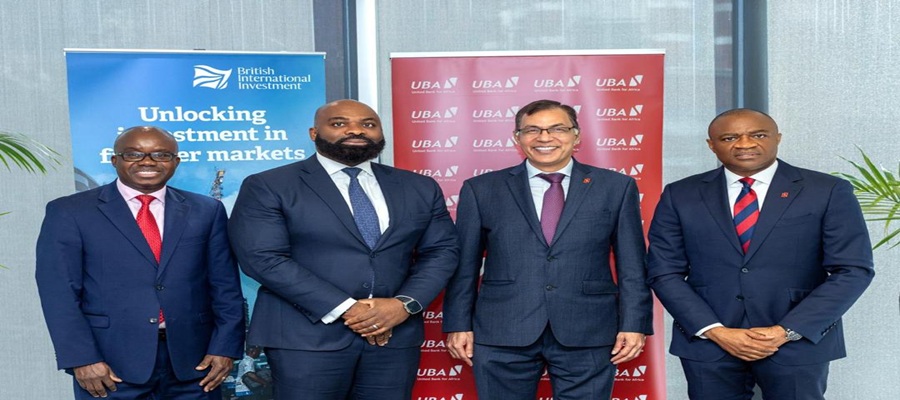
United Bank for Africa (UK) Limited (“UBA UK”) and British International Investment plc (“BII”), the UK’s development finance institution and impact investor, today announced that they have signed a letter of intent to develop trade finance collaboration opportunities. The proposed initiative aims to expand access to trade and working capital facilities for businesses operating across Africa.

L-r: West Africa Director and Head of Office Africa Coverage, BII West Africa, Benson Adenuga; Managing Director and Head of Africa, BII, Chris Chijiutomi; Lok Mishra, Chief Executive Officer, UBA UK, Loknath Mishra; Group Managing Director, United Bank for Africa (Plc) during the signing of letter of intent to develop trade finance collaboration opportunities.
Access to trade finance remains one of the most significant structural constraints on African trade. Businesses – particularly small and medium-sized enterprises – are frequently unable to secure letters of credit, guarantees, and supply chain finance on commercially viable terms, limiting their capacity to export and import competitively. This trade finance gap is estimated by the African Development Bank to be over USD 80 billion annually.
To help close this gap, UBA UK, the London subsidiary of UBA Group, Africa’s Global Bank, will leverage its deep relationships across the Group’s 20-country African network to originate and structure trade finance transactions. While BII, with a mandate to support productive, sustainable, and inclusive growth across Africa, can support transactions that might otherwise fall outside conventional commercial appetite.
Lok Mishra, Chief Executive Officer, UBA UK, said: “The signing of this letter with BII represents a landmark moment for UBA UK and for the UBA Group’s global ambitions. As the Group’s hub for Trade Operations, UBA UK is uniquely positioned to connect African businesses with the international financial system.
“Working alongside BII, we can extend that capability further — mobilising capital where it matters most and helping to close the trade finance gap that holds back so much African potential.”
Chris Chijiuitomi, Managing Director and Head of Africa, said: “British International Investment is committed to catalysing private sector growth across Africa, and trade finance is a critical enabler of that growth.
“We welcome the opportunity to collaborate with UBA Group, whose pan-African network and deep institutional relationships can help advance our ambition to expand access to trade and working capital finance, particularly in frontier markets.”
The announcement builds on growing momentum around intra-African trade facilitated by the African Continental Free Trade Area (AfCFTA), which entered into force in 2021 and represents one of the world’s most ignificant trade integration initiatives.
Both institutions have identified the operationalisation of AfCFTA as a priority catalyst for a trade finance facility, with UBA UK’s network across major AfCFTA economies offering a basis for supporting businesses navigating the emerging continental market.
This also complements the UK Government’s broader engagement with African economic development, including commitments made at the UK-Africa Investment Summit, and reinforces the City of London’s role as a leading international finance centre for Africa-focused capital mobilisation.
Future cooperation remains subject to further assessment, due diligence and the completion of internal approvals by both parties.


Central Bank of Nigeria (CBN) has introduced stricter rules guiding the use and management of the Bank Verification Number (BVN) as part of efforts to reduce fraudulent transactions within the financial system.The revised framework, which takes effect from May 1, includes tighter controls on BVN enrolment, data access and customer information updates.

The apex bank said the measures are aimed at strengthening identity management, improving fraud monitoring and safeguarding the integrity of banking transactions.
Under the new guidelines, BVN enrolment is now restricted to individuals aged 18 and above, while customers will only be allowed to change the phone number linked to their BVN once.
The restriction is designed to curb identity manipulation often exploited by fraudsters through repeated updates of personal information.
The CBN also directed financial institutions to maintain a temporary watchlist for BVNs linked to suspicious transactions.
Affected BVNs may be flagged for up to 24 hours, during which customers are expected to verify or clarify flagged transactions before further action is taken.
In addition, access to BVN data has been tightened, with the apex bank retaining exclusive control over the database while granting access only to licensed financial institutions under defined conditions.
The move, according to the CBN, is expected to enhance data security and support a more resilient financial system as BVN enrolment continues to grow.

Court Jails ‘Colonel’, ‘Major’ of Global Money-Laundering Ring

Court Bans Kenyan Telcos from Recycling SIM Cards

Providus Bank Fully Meets CBN Capital Requirement, Sets Record Straight

African Tech Start-ups to Receive $46m of Speedinvest Africa Fund

U.S. Charges Three in $2.5 Billion Plot to Smuggle Nvidia AI Chips to China

Kaspersky Discovers New Phishing Campaign Exploiting Google Tasks Notifications to Steal Corporate Credentials

esentry 2025 Report Shows Healthcare, Financial Services and Telecoms as Staging Grounds for Increased Cyberattacks in Africa

AfDB, UNDP Launch $10Bn AI Initiative for Africa

Mutual Benefits Assurance Settles ₦5.9bn Claims in January 2026

MultiChoice Suspends Yearly DStv Price Hike as Canal+ Pushes Growth




 E-Financial2 days ago
CBN Introduces Stricter BVN Rules to Curb Fraudulent Transactions

 E-Financial2 days ago
Binance is Missing from Ghana’s Crypto Sandbox

 E-Financial2 days ago
World Bank Debars 3 PwC Subsidiaries for 21 Months over Alleged Project Fraud

 News2 days ago
Nigeria, UK Sign £746M Landmark Ports Deal

 E-Financial2 days ago
Quest Merchant Bank Named Transaction Advisor for Nigeria’s Landmark Project BRIDGE Digital Infrastructure Initiative

 Broadcasting2 days ago
Canal+ to Cut Jobs as Part Sweeping Restructuring

 General News2 days ago
Gartner Forecasts Surge in AI-powered Public Services

 E-Business2 days ago
Study Reveals 83% of Employees Stay Connected to Work During Time Off, Fuelling Digital Anxiety