

E-Financial
FXTM Analysis: Brexit Bill Strikes Again

FXTM Research Analyst Lukman Otunuga comments on the Sterling ahead of official Brexit negotiations, and today’s Federal Reserve meeting.
Sterling was unsettled during Wednesday’s trading session with prices violently swinging between losses and gains after reports of Brussels bolstering the Brexit bill to up to $100 billion, which reinforced speculations of the EU playing hardball.
Official negotiations of the UK leaving the European Union have yet to begin, but financial heavyweights have already started their battle of words on the Brexit topic.
With Theresa May vowing on Tuesday that she will be a “bloody difficult woman” in Brexit talks adding to anxiety, a rocky road filled with obstacles may lie ahead. Sterling could find itself exposed to downside shocks amid the uncertainty, with recent reports of the European Union warning that May could be barred from the negotiations terms, fueling hard Brexit fears.
Focusing on the macro fundamentals, UK construction PMI accelerated in April to 53.1, but this did little to inspire Sterling bulls with prices eventually descending back towards 1.2900.
The growing uncertainty around Brexit negotiations, coupled with political instability ahead of the UK general election could create a scenario where markets slightly overlook fundamentals with much of the focus directed towards ongoing Brexit developments.
From a technical standpoint, the GBPUSD could come under renewed selling pressure if bears are able to break below 1.2875. A breakdown below 1.2875 may encourage a further decline towards 1.2775. In an alternative scenario, an intraday breakout above 1.2940 could pave the way to 1.3000.
Fed meeting and ADP in focus
The main event on Wednesday that could rattle financial markets is the Federal Reserve meeting which is widely expected to conclude with interest rates left unchanged. With economic data from the US mostly mixed since the previous Fed meeting and first quarter growth in 2017 cooling at 0.7%, investors may heavily scrutinize the statement to see if there is a change in rhetoric.
The Dollar could be at risk of depreciating further if “doves” exploit the softening economic outlook to make a guest appearance today.
On the other hand, if the Federal Reserve maintains its hawkish bias and offers clarity on US rate hike timing, Dollar bulls could be given enough confidence to challenge 99.50.
Some attention may also be directed towards the pending ADP Nonfarm data, which could be treated with some skepticism after it reported a mammoth gain in March jobs, while NFP tumbled well below expectations under 100,000.
Euro searches for direction
The Euro has been on cruise control this week with investors observing the currency from a distance ahead of the second round of the French Presidential election voting on 7 May. With the current polls showing that Emmanuel Macron is holding a solid 20 point lead over Marine Le Pen, markets may have already priced in a Macron victory.
Although the Macron outcome on Sunday has the ability to elevate the Euro higher, an unexpected Marine Le Pen victory could still rattle the financial markets with parity on the EURUSD becoming a possibility. From a technical standpoint, a failure for bulls to secure control above 1.0900 may open a path towards 1.0800.
WTI Crude dips below $48
WTI Crude was exposed to heavy losses this week as anxiety over the rising output in Libya and Canada, coupled with concerns of a dip in compliance with OPEC’s production cuts enticed sellers to attack.
It is becoming increasingly clear that oil prices remain gripped by the oversupply fears with confidence rapidly diminishing over OPEC’s ability to stabilize the saturated oil markets. Although some still remain cautiously optimistic that an extension of the production cut deal may limit the global glut, the incessant pumping of US Shale has left most investors skeptical, questioning whether prices will ever balance out.
Much attention may be directed towards the pending crude oil inventory report which may pressure oil markets further if there is a build in US crude inventories. From a technical standpoint, WTI Crude is heavily bearish on the daily charts and a breakdown below $47.50 could open a path towards $44.00.



Kuda Microfinance Bank partnered with Lovers & Frnds for a Valentine’s edition event on Sunday, February 15, at Space Hub Lekki, Lagos, redefining celebrations around love, friendship, and social connections beyond romance.

Kuda Bank
The R&B-themed gathering drew couples, friend groups, and solo attendees with music sets from DJs like TGarbs, games, gift exchanges, and colour-coded tags—red for relationships, yellow for mingling singles, orange for non-minglers—to spark easy interactions.
Kuda activated a branded photo booth, merchandise giveaways, prize activities, and complimentary drinks for Premium loyalty tier customers, while vendors used Kuda Business POS terminals for seamless cashless payments.
Senior Brand Manager Emmanuel Femi-Adejobi said: “We partner with experiences matching our customers’ lifestyles in music and entertainment, creating spaces they genuinely connect with—we’ll keep supporting how they live and celebrate.”
By Mathew Anthony, Market Analyst at FXTM
In another positive development for Nigeria, the CBN has proceeded with 50-basis points rate cut.

FXTM Logo
With favourable fundamental forces at play, it was always a question of how much rather than if rates will be cut in February.
Although some were expecting a hefty 100-basis point cut, this was still a positive move by the CBN, mirroring the dovish strategy of other major banks on the continent.
Interest rates were slashed thanks to cooling inflationary pressures, a stronger Naira and rising FX reserves.
This move is likely to boost confidence over the economic outlook ahead of the Q4 GDP report scheduled for release later this month.
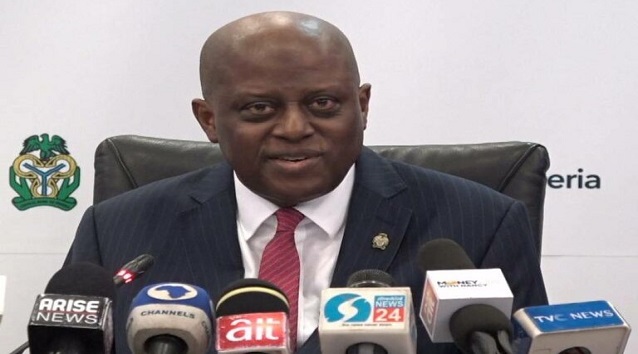
Central Bank of Nigeria (CBN) has lowered its Monetary Policy Rate (MPR) by 50 basis points to 26.50 percent from 27 percent, a unanimous decision announced by Governor Olayemi Cardoso at the end of the 304th Monetary Policy Committee (MPC) meeting in Abuja on Tuesday.

CBN
Cardoso cited 11 straight months of decelerating headline inflation—reaching 15.10 percent in January 2026 per National Bureau of Statistics—as key, driven by prior tightening lags, naira stability, food supply gains, steady petroleum prices, export earnings, remittances, and balance of payments strength.
Liquidity ratio stays at 30 percent, CRR unchanged at 45 percent for commercial banks (16 percent merchant banks) and 75 percent non-TSA public deposits; standing facilities corridor now +50/-450 basis points around MPR.
The MPC retained other parameters, welcoming Executive Order 09 redirecting oil/gas revenues to the federation account for fiscal boost, last cutting rates in September 2025 after November’s hold.

SERAP Says Phone Tapping Law Violates Human Rights, Calls for Withdrawal

MultiChoice Suspends Yearly DStv Price Hike as Canal+ Pushes Growth

Microplastics Found in 90 Percent of Prostate Cancer Samples

Lotus Bank, REA Seal N100Bn Deal to Power Rural Nigeria

DG NITDA Reaffirms FG Commitment to Responsible, Inclusive AI
Nigeria’s 9 Top FinTech Firms Valued at $10.6Bn in January 2026

CBN Upgrades Licences of Opay, Moniepoint, Kuda, Palmpay, Paga to National Status

NITDA, NBC Explore Strategic Collaboration on Digital Transformation, Media Regulation

Kaspersky Launches OT Calculator to Align Cybersecurity Investments with Business Goals

Accidental Billionaire Opts for Jail Instead of Returning Money Credited Him by Mistake




 Telecom3 days ago
Cyber Immunity Emerges as Shield for Nigerians Amid Rising Scams

 E-Financial3 days ago
$214Bn Missing, Institutions Silent: Is Accountability Dead in Nigeria?

 E-Business3 days ago
Interswitch Partners Abia to Digitise Public Hospitals

 General News3 days ago
NITDA, Abia Partner on Enterprise Architecture Reform

 News2 days ago
NITDA Urges Stronger State Partnerships as Key to Digital Economy Goals @ South-South Stakeholders Forum

 E-Business3 days ago
WIEG 2026 Summit Shifts to April 22-23 for Maximum Impact

 Telecom2 days ago
GSMA Launches Innovation Fund to Accelerate Green Transition Through Mobile Technology

 E-Business2 days ago
Firm Identifies RenEngine Loader Distributed Through Pirated Games and Software