

E-Business
Google CEO in Nigeria Says “We’re Making Internet Work for Everyone in Africa”

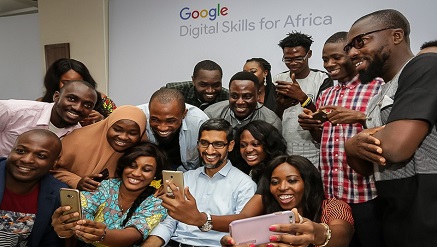
By 2034 Africa is expected to have the world’s largest working-age population of 1.1 billion—yet only 3 to 4 million jobs are created annually.
That means there’s an urgent need to create opportunities for the millions of people on the continent who are creative, smart and driven to succeed.
The internet, and technology as a whole, offer great opportunities for creating jobs, growing businesses and boosting economies, said Sundar Pichai, chief executive officer of Google, a multinational technology company that specializes in Internet-related services and products.
Pichai who was at the Google For Nigeria event held in Lagos on Thursday, said that people need the right skills, tools and products to navigate the digital world and to make it work for them, their businesses and their communities.
Google at the event announced progress they have in products and features for users in Nigeria, including YouTube, Search and Maps.
The Company also announced initiatives focused on digital skills training, education and economic opportunity, and support for African startups and developers.
Digital Skills for Africa
“Last year we set out to help bridge the digital skills gap in Africa when we pledged to train one million young people in the region—and we’ve exceeded this target. Through either in-person or online trainings, we help people learn to build a web presence, use Search to find jobs, get tips to enhance their CV, use social media, and so on.
“Now we’re expanding this program, and committing to prepare another 10 million people for jobs of the future in the next five years. We’ll also be providing mobile developer training to 100,000 Africans to develop world-class apps, with an initial focus on Nigeria, Kenya and South Africa,” the CEO said.
Launchpad Accelerator Africa
Earlier, Juliet Ehimuan-Chiazor, Google country manager in Nigeria, said they wanted to do more to support African entrepreneurs in building successful technology companies and products.
“Based on our global Launchpad Accelerator program, this initiative will provide more than $3 million in equity-free funding, mentorship, working space and access to expert advisers to more than 60 African startups over three years. Intensive three-month programs, held twice per year, will run out of a new Google Launchpad Space in Lagos—the program’s first location outside of the United States.
“For people to take advantage of digital opportunities, acquiring the right skills and tools is only part of the equation. Online products and services—including ours—also need to work better in Africa. Today, we’re sharing news about how we’re making YouTube, Search and Maps more useful and relevant for Nigerian users”, she said.
YouTube Go
Also, Johanna Wright, vice president, Product Management, YouTube, said that the platform has witnessed tremendous increase in Nigeria due to the country’s diverse culture captured in movies, entertainment and other digital contents.
For better viewing experience, YouTubeGo, designed from the ground up, was also launched at the event to now allow YouTube viewers discover, save and share videos they love in a way that’s transparent about the size of downloads.
“Designed to be ‘offline’ first, the app improves the experience of watching videos on a slower network and gives control over the amount of data used streaming or saving videos.
“It’s a full YouTube experience, with fresh and relevant video recommendations tailored to your preferences and the ability to share videos quickly and easily with friends nearby. In June, Nigeria became the second country where we started actively testing YouTube Go. Later this year, we’ll be expanding this to a beta launch of the app, available to all Nigerian users”, Wright said.
Lagos Now on Street View in Google Maps
On his part, Suren Ruhela, director, Google Map, said that in the last few months, the team has improved “address search” experience in Lagos, by adding thousands of new addresses and streets.
According to him, Google has now included outlines of more than a million buildings in commercial and residential areas, and more than 100,000 additional Nigerian small businesses on Google Maps.
“Today we’re launching Lagos on Street View, with 10,000 kilometers of imagery, including the most important historic roads in the city. You can virtually drive along the Carter Bridge to the National Stadium or across the Eko Bridge, down to the Marina—all on your smartphone”, he said.
Faster web results
On web search, Tamar Yehoshua, vice president, Product Management Search at Google, said that access to information is increasing. She said that with the prediction that 6Billion plus smartphone subscription by 2022, people want to know what is happening at their local communities with Nigeria among the leading countries in Google Search.
Yehoshua said, “When you’re on a 2G-like connection or using a low storage device, pages can take a long time to load. We previously launched a feature that streamlines search results so they load with less data and at high speed. Today we’re extending that feature to streamline websites you reach from search results, so that they load with 90 percent less data and five times faster, even on low storage devices”.
More local information in Search: Google Partner With University of Ibadan
She added, “We’ve also made several updates to Search to bring more useful, relevant answers and information to people in Nigeria:
Knowledge Panels: We’re connecting people with easy access to the answers to things they care about, displaying knowledge cards for everything from local football teams to Nigerian musicians and actors.
With this, Google will make available “Health Cards” later this year for more than 800 knowledge cards detailing common symptoms and treatments for the most prevalent health conditions in Nigeria.
“We’ve partnered with the University of Ibadan to ensure that answers have been reviewed by Nigerian doctors for local relevance and accuracy. Nigeria is one of the first countries where we’re providing locally tailored health answers on Search.
“Posts on Google: Posts makes it possible for musicians, entertainers and other public figures to share updates, images and videos directly on Google, for people to see while they explore on the web. Nigeria is the third country where we’ve made this feature available and some of the country’s popular musicians are already using it.
“The things we’re announcing today are what drive us—building platforms and products that are relevant and useful for billions, not just the few, and helping people to succeed in the digital economy. That’s why we hope to equip more people, in Africa and elsewhere, with digital skills and tools. We’re excited to be part of Africa’s evolving digital story”, she added.


Africa’s financial services sector is entering a new era of artificial general intelligence (AGI), as the adoption of artificial intelligence (AI) on the continent evolves to boost economic growth.

This was the word from Lavina Ramkissoon, ambassador representing the African Union for the East, North and South of the continent, speaking last week during the Financial Sector Conduct Authority Conference 2026.
As AI rapidly evolves beyond current frameworks, Africa faces a narrowing window to define its role in what could become a radically different global economic order, she said.
Ramkissoon co-chairs the African Union’s Science, Research, Technology and Innovation Council and leads its “sixth region” diaspora portfolio.
AGI refers to AI that matches human intelligence, capable of learning, reasoning and applying knowledge across diverse domains, while ASI is a theoretical, future AI that surpasses human intelligence across all fields.
Ramkissoon cautioned the global AI trajectory is already shifting beyond human and machine collaboration toward far more advanced forms of intelligence.
“In my opinion, we’ve quickly moved away from human agency, we’ve moved away from AI agency, and we’re getting into a space where we’re going to see AGI unfold − but not really know that it’s unfolding.”
She noted that this transition could be subtle at first, with only limited signals before a more dramatic leap.
“There’s going to be one or two key signs… and then all of a sudden, we’re going to wake up and see ASI around in terms of superintelligence.”
This progression, she suggested, raises fundamental questions about control and governance.
Rather than focusing purely on technological capability, Ramkissoon argued that societies must confront how much decision-making power they are willing to relinquish.
“From a human perspective, we’re going to have to dig deep in terms of understanding where to next and what sort of control we are willing to give away or negotiate going forward.”
Beyond the technological shift, she emphasised that Africa’s response must be grounded in structural readiness. Responsible AI at scale, she said, depends on three core pillars: infrastructure, computational capacity and a broader understanding of intelligence itself.
On infrastructure, Ramkissoon highlighted the need for interoperability rather than isolated systems, noting that Africa’s financial and digital ecosystems remain fragmented.
“For some reason, we haven’t been able to orchestrate it in a unified manner. This is probably our last opportunity to utilise AI to gauge that.”
She also challenged assumptions around compute capacity, arguing that the continent does not yet require widespread investment in large-scale data centres.
“Our utilisation of AI isn’t at that capacity yet. Running things like language models or robo-advisors are still relatively menial when we talk about the larger capacity required.”
More fundamentally, Ramkissoon pointed to a shift in how intelligence itself is defined and used in the digital economy.
“Intelligence is intelligence. Distinctions between human and artificial intelligence are becoming less relevant as the two increasingly converge.”
This shift is already reshaping economic thinking. Ramkissoon described the emergence of what she called a “new age economy”, where traditional drivers are being replaced.
“It no longer functions on the cost of capital, but is moving towards the cost of energy, the cost of data and the cost of intelligence.”
She also pointed to growing divergence in how global technology players are approaching AI, with some pushing for rapid expansion of capabilities, while others advocate for constraint.
Within the African continent, more than 60% of countries had adopted some form of AI policy or regulatory framework as of 18 months ago, with different regions beginning to take distinct approaches.
However, the continent risks falling behind if it fails to articulate a unified vision and take advantage of the full potential of AI, she stated.
“As much as we understand the opportunity, what are we actually tangibly doing on the ground to unlock that?” she asked, pointing to persistent challenges such as unemployment and low economic growth.
While AI is already reshaping labour markets globally, Ramkissoon cautioned against framing the issue purely in terms of job losses.
“We focus on fear more than optimism. AI is creating jobs and removing jobs at the same time.”
Instead, she called for a broader, long-term perspective that moves beyond short-term disruption toward strategic positioning.
“We really need to zone out and have a macro view. Without that, Africa risks missing a critical moment in shaping its digital and economic future as AI capabilities accelerate toward increasingly autonomous and potentially uncontrollable systems.”

A new global Kaspersky study has identified the lack of qualified IT security workers and the need for global organisations to prioritise various security tasks to mitigate the risk of supply chain and trusted relationship attacks. Both factors are cited by nearly half (42%) of the respondents.

Kaspersky’s recent study* on supply chain and trusted relationship risks showed that supply chain attacks have emerged as a top threat for businesses, with every third organisation hit by such an attack over the past year.
The severity and frequency of supply chain attacks necessitate uncovering the key reasons preventing them from addressing the risks successfully.
According to the survey, one of the key barriers to reducing supply chain and trusted relationship risks is the lack of a qualified workforce. This shortage leaves organisations without the capacity to consistently access and monitor possible third-party vulnerabilities across their ecosystems.
Among other primary obstacles, respondents noted the need to juggle multiple cybersecurity priorities. This reflects the fact that security teams are stretched across too many tasks at once, which might leave supply chain threats unaddressed.
Beyond resource constraints, respondents also point to structural issues: 39% say their contracts lack clear IT security obligations for contractors. Further 32% note that non‑IT security staff often do not fully understand these risks.
Globally, according to the survey, an overwhelming 85% of businesses admit their organisations need to upgrade protection against supply chain and trusted relationship risks, with only 15% of enterprises considering their current security measures effective.
At the same time, the results of the survey showed that current mitigation practices for third-party risks remain fragmented, with no way of protection getting more than 40% of current adopters. Even the most common protective measure, two-factor authentication, is used by only 38% of respondents.
In addition, only 35% of organisations conduct regular reviews of contractors’ cybersecurity postures. As a result, nearly two thirds of businesses lack ongoing visibility into the security of their partners, leaving them exposed to evolving vulnerabilities across their ecosystems.
It’s noteworthy that companies that have already experienced supply chain and trusted relationship attacks tend to adopt stronger security habits. Those hit by supply chain incidents are more likely to request penetration test results (56%), while victims of trusted relationship breaches prioritise checks on compliance with industry standards (56%) and their contractors’ own supply chain policies (53%).
“When security teams are overstretched, understaffed and have to prioritise urgent tasks over long term resilience priorities, organisations are left exposed to threats that can move silently through their provider ecosystem.
“To break this cycle, the industry needs to adopt more unified and consistent mitigation strategies, from standardised contractor assessments to stronger cross‑team awareness. Supply chain security should become a shared, enforceable responsibility across the entire business network,” comments Sergey Soldatov, Head of Security Operations Center at Kaspersky.
Only by implementing preventive measures across the organisation and approaching partnerships with suppliers and contractors strategically can companies reduce supply chain risks and ensure the resilience of their business.
E-Business
Study Reveals 83% of Employees Stay Connected to Work During Time Off, Fuelling Digital Anxiety

A new Kaspersky survey undertaken in the Middle East, Turkiye and Africa (META) region reveals that digital anxiety is becoming a defining feature of modern work culture, as employees don’t disconnect even during their free time and vacations.

According to the findings, 83% of respondents keep an eye on work tasks outside working hours. An overwhelming 85% reply to all work-related messages in instant messaging apps, while the same share (85%) check work emails during their time off – and 81% admit they are responding to work emails while on vacation or in their personal time.
The pressure to remain constantly available is contributing to heightened stress levels in the workplace. Other sources of stress include work issues, for example, 43% experience anxiety after accidentally sending a random message to a work chat.
Interestingly, not all digital mishaps are perceived equally: 40% report that they take it calmly when they send an unfinished email, proving that some mistakes are considered less damaging than others.
Blurred boundaries between professional and personal life, combined with instant communication tools, are intensifying feelings of constant monitoring and fear of making digital errors.
More than a third (36%) of respondents say they feel extremely uncomfortable or even scared if their boss notices them scrolling through social media at work instead of working. The “always-on” culture may undermine employee well-being, increase burnout risks, and reduce overall productivity in the long term.
“Digital anxiety doesn’t just affect employee well-being – it can also increase cybersecurity risks for organisations. When people feel constant pressure to respond immediately to messages and emails, they are more likely to act impulsively, without carefully verifying links, attachments, or sender identities.
This urgency can make employees more vulnerable to phishing, and other scams using social engineering techniques,” comments Brandon Muller, Technical Expert at Kaspersky.
Kaspersky recommends employees to follow the below tips to avoid digital anxiety and associated cyber risks:
- Slow down before clicking or replying. Digital anxiety can trigger automatic reactions. A short pause to check sender details, URLs, or attachments can prevent security breaches.
- Treat urgency as a red flag. Cybercriminals often exploit pressure and fear. Always verify unexpected or urgent requests before responding.
- Avoid handling sensitive information on unsecured networks. Public Wi-Fi, often used when working outside regular hours, increases exposure to cyber threats. Mobile network and VPN should be applied in such cases.
- Use technologies that will help reduce risks. For example, Kaspersky Premium offers AI-powered anti-phishing features designed to help warn of potential threats.
Businesses can reduce cybersecurity risks related to employees’ digital anxiety by providing regular cybersecurity training that helps staff recognise threats and respond correctly even under stress.
At the same time, organisations should use robust cybersecurity solutions to minimise the impact of human error. Kaspersky Next’s adaptable and robust cloud-native protection, underpinned by an unequalled cybersecurity track record, is one of such products.
Protection solutions for mail servers, such as Kaspersky Security for Mail Server, with anti-phishing capabilities, help to additionally decrease the chance of infection through a phishing email.

Court Remands Hacker for Allegedly Stealing N3.09Bn from FCMB

CBN Directs IMTOs to Open Naira Settlement Accounts

Nigerians Lose N12.5Bn to AI-Driven Scams- PwC

SEDC Launches SEVCP to Expand Access to Capital for Startups

Kaspersky, AFRIPOL Conduct Joint Cybersecurity Training for African law Enforcement

Kaspersky Discovers New Phishing Campaign Exploiting Google Tasks Notifications to Steal Corporate Credentials

esentry 2025 Report Shows Healthcare, Financial Services and Telecoms as Staging Grounds for Increased Cyberattacks in Africa

AfDB, UNDP Launch $10Bn AI Initiative for Africa

MultiChoice Suspends Yearly DStv Price Hike as Canal+ Pushes Growth

MTN Nigeria Posts Record N1.70 Trillion Pre‑Tax Profit, Declares N20 Dividend for 2025




 E-Financial1 day ago
DLM SPV PLC Lists ₦9.00bn AAA-Rated Medium-Term Notes on FMDQ Exchange, Sets Benchmark in Corporate Bond Market

 E-Financial2 days ago
CBN Wins Central Bank of the Year Title @13th Global Awards

 General News2 days ago
Tech Firms Sack over 45,000 so Far in 2026

 News2 days ago
Morney Launches in Nigeria as E-invoicing Drives Finance Digitisation

 General News2 days ago
Jury Finds Elon Musk Liable for Misleading Twitter Investors

 Telecom2 days ago
FG Taps Quest Merchant Bank for Advisory on 90,000km Fibre Project

 General News2 days ago
Rockefeller, Global Energy Alliance Cross $100 million Mark in Africa Electrification Push

 News1 day ago
Metaverse Collapses, Horizon Worlds Shuts Down on Quest