

E-Business
Google Took Down 1.7Bn ‘Crooked’ Ads in 2016

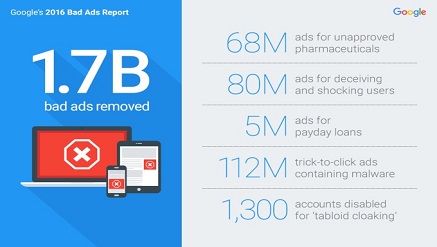
Google, the super-power in internet ad has stepped up its approach to removing nefarious ads too.
The Company on Wednesday published its latest update on how its fighting spam, bots and other problematic “ads” on its network, and said that in 2016 it took down 1.7 billion ads that violated its policies.
As a point of context, this is more than double what Google took down the year before, it said.
Google is no stranger to the issue of fake news that has swept the internet and likely influenced a lot of what people view as “fact” that may not, in fact, be true, according to the report published by TechCrunch.
In addition to accusations that its news-optimised search format elevated dodgy sites to the same level as legit news sources, the search giant was also compelled to update its policy after its ad network got used by iffy “news” sites to promote their stories and give them a lot more visibility.
The company in 2016 changed its policies in terms of how it’s been tracking ads that are misleading or predatory.
That’s included a policy introduced in July to ban payday loan ads, which led to five million ads being banned from its network.
Google said it also has been improving its tech to spot and disable dodgy ads faster. You may have noticed, for example, that “Trick to click” ads now come with system warnings before you go to the site they are linked to, as they can lead to malware links. Why these ads are not just removed altogether is another question, but in any case Google said that in 2016, its systems “detected and disabled a total of 112 million ads for ‘trick to click,’” six times as many as the year before.
Aside from tackling unethical ads such as unapproved pharmaceuticals — an issue that massively impacted Baidu in China — payday loans and counterfeit goods, and deceptive products, Google said it focused its efforts on clickbait advertising.
The company refers to clickbait as ‘tabloid cloaking,’ in other words dressing an ad up as shocking news akin to a tabloid newspaper to get attention. It really isn’t hard to find examples of that across the world.
The search giant claims it took down 1,300 accounts that were performing such scams. That doesn’t seem like a huge number, but it just takes a few bad actors to do a lot of damage. Case in point, the 22 “cloakers” it nabbed in December were responsible for serving up ads that were viewed over 20 million times online in a single week.
Bad news though, that fight is very much ongoing. Google explained that tabloid cloaking is “gaining in popularity” because it is such an effective method to grab attention online, in much the same way that some websites have risen on the back of viral/shock news.
“While we took down more bad ads in 2016 than ever before, the battle doesn’t end here,” Google said addressing the threat broadly.
“As we invest in better detection, the scammers invest in more elaborate attempts to trick our systems. Continuing to find and fight them is essential for creating a sustainable, open web from which we all enjoy.”



Mr Uche Ifeanyi, commissioner of Police in charge of the Nigeria Police Force National Cyber Crime Centre (NPF-NCCC), said on Friday that most cyber attacks occur because victims act out of ignorance.

He spoke in Abuja at the opening of an online cybercrime awareness campaign themed “Odogwu No Dey Hide Him Face,” organised to educate and empower communities about online safety and cyber hygiene.
“Studies reveal that the majority of cyber attacks are initiated or enabled by victims due to lack of knowledge.
“Personal information is invaluable and must be protected at all times.
“Just as we maintain physical health, we must also maintain a healthy digital lifestyle,” he added, stressing that simple cyber hygiene practices could greatly reduce the risk of becoming a victim.
He urged the public not to disclose confidential information to unauthorised persons and to use strong, unique passwords, enable multi-factor authentication, and apply security safeguards on digital devices.
“Keep personal information private, avoid suspicious links, and regularly update software or system patches,” he said, adding that antivirus programmes and firewalls were essential for online safety.
Ifeanyi warned against falling for “free gifts” online.
“If it sounds too good to be true, it most likely is fraud,” he said, advising caution with urgent or suspicious messages.
He also urged internet users to verify information before sharing to avoid spreading fake news, emphasising that cybercriminals could exploit everyone regardless of age, occupation, or social class.
Vincent Olatunji, director-general, National Data Protection Commission (NDPC), commended NPF-NCCC for its efforts and said the campaign theme was commendable.
He noted the importance of educating people on legitimate wealth and safe internet use.
Olatunji said that the fight against cybercrime required collective effort, warning that the risks were increasing daily as more people connected to the internet across Nigeria.


Kaspersky has introduced an update to its Automated Security Awareness Platform, adding full support for PDF and SCORM (Sharable Content Object Reference Model) – the industry-standard protocol for deploying and managing e-learning content.

The enhancement enables organisations to build fully customised cybersecurity training programmes that reflect their infrastructure, risk profile, and internal policies, while continuing to benefit from Kaspersky’s expert-driven security content and phishing simulations.
According to the Kaspersky report titled “Redefining the Human Factor in Cybersecurity”, employees responding to phishing attacks was one of the main causes of cyber incidents in companies worldwide, accounting for 21% of cases among other reasons.
At the same time, additional Kaspersky research reveals that social engineering attacks are predicted to increase more than any other type in the nearest future, with 87% of respondents believing that social engineering attacks will become even more effective due to the use of AI tools.
The new Kaspersky Automated Security Awareness Platform (Kaspersky ASAP) update directly addresses several persistent challenges such as reducing the number of human-related incidents, cutting time spent on managing training programmes, decreasing regulatory and compliance risks, and minimising potential legal or reputational damage stemming from cybersecurity breaches.
With the new SCORM support, the platform becomes even more flexible: companies can now upload, track, and manage their own SCORM-based learning materials directly within the system. In addition, companies can accelerate their programmes by using easier-to-create PDF-formats.
This allows organisations to tailor training to their specific technology stacks and emerging threats targeting their industry or region. Businesses that have already invested in third-party SCORM courses or internal learning development can now seamlessly reuse their existing modules, protecting their prior investments while strengthening their cybersecurity posture.
The combination of Kaspersky’s embedded content built on real cases uncovered by the company’s world-class experts with customers’ PDF materials or SCORM modules enables a true best-of-breed approach to human risk management.
Organisations can supplement Kaspersky’s up-to-date cyberattack scenarios with internal policies, unique workflows, and industry-specific lessons, ensuring training resonates with employees and reflects real operational challenges.
“Human behaviour remains one of the most unpredictable elements in cybersecurity and also one of the easiest for attackers to exploit. By adding SCORM support to Kaspersky Automated Security Awareness Platform, we’re giving organisations the flexibility to build training programmes that truly match their internal realities.
“Combined with Kaspersky’s expert-driven content and real-world attack data, this update empowers companies to create more adaptive, relevant, and impactful awareness programmes than ever before,” comments Svetlana Kalashnikova, Security Awareness expert at Kaspersky.

Nigeria Data Protection Commission (NDPC) has joined sixty (60) other Data Protection Authorities (DPAs) in endorsing the “Joint Statement on Al-Generated Imagery and the Protection of Privacy.”

NDPC
The Joint Statement was coordinated by the International Enforcement Cooperation Working Group (IEWG) of the Global Privacy Assembly.
This underscores the growing concerns regarding the privacy risks posed by Artificial Intelligence tools capable of generating realistic images and videos of identifiable individuals.
The Joint Statement highlights concerns over the misuse of Al-powered tools to create non-consensual imagery, defamatory content, and other harmful materials, particularly affecting children and vulnerable groups.
It calls on organisations to implement strong safeguards, ensure transparency, provide effective content removal mechanisms, and comply fully with applicable data protection laws.
The current effort forms part of a continuum of steps being taken by Nigeria to ensure the responsible use of Al. It will be recalled that the Honourable Minister of Communications, Innovation and Digital Economy, Dr ‘Bosun Tijani, led the initiative for the development of the National Al Strategy.
The NDPC also issued the General Application and Implementation Directive (GAID), which, amongst others, mandates privacy by design and privacy by default in the development and deployment of Al tools.
The National Commissioner/CEO of the NDPC, Dr Vincent Olatunji, has directed that the Nigeria Data Protection Act (NDP Act) Compliance Audit Returns (CAR) by data controllers and processors of major importance will serve as a yardstick for monitoring and evaluating responsible use of Al for data processing in Nigeria.

Police Says Victims Enable Cyber Attacks Out of Ignorance

Bank Accuses Magistrate, Lawyer of Using Fake Order to Steal N3.5m from Account

FG Launches NERD to Combat Certificate Fraud

NCDC Issues Public Advisory on Cerebrospinal Meningitis

Goodnews Naija Launches ‘Building in Nigeria’ Series on Entrepreneurs, Real Sector Builders

Dr. Cairo Ojougboh Foundation Bolsters Nigeria’s Education Drive with ₦2.7m Student Support

Kaspersky Brings more Transparency to Threat Detection with New Hunt Hub

PwC Reveals AI Scaling Gap Slows Africa’s Digital Transformation

Kaspersky Discovers New Phishing Campaign Exploiting Google Tasks Notifications to Steal Corporate Credentials

esentry 2025 Report Shows Healthcare, Financial Services and Telecoms as Staging Grounds for Increased Cyberattacks in Africa




 Telecom3 days ago
FG Approves GIS-enabled Digital Postcode to Tackle Logistics Gaps, Boost E-commerce

 E-Financial2 days ago
Senate Targets Fintech Overreach, Vows Ponzi Crackdown After ₦1.3trn CBEX Scam

 E-Financial3 days ago
NAICOM Signs MoU with BPP to Deepen Insurance Compliance in Public Procurement

 General News2 days ago
FCCPC Bans Lagos ‘No Refund’ Policy, Vows Fines and Shutdowns for Traders

 Telecom2 days ago
Google Adds Yorùbá, Hausa to AI Search, Boosting Access for Millions of Nigerians

 E-Financial2 days ago
SmartCash Launches ‘No Be Cho Cho Cho’ Campaign to Boost Digital Banking in Nigeria

 Telecom2 days ago
MTN Nigeria Non-Executive Director Mazen Mroue Quits to Focus on Group Role

 Telecom2 days ago
NativeID Launches Free Digital Identity Platform to Shield Nigerian SMEs from Scammers