

Telecom
Group Applauds Pantami, NBP 2020-2025 Committee on timely delivery

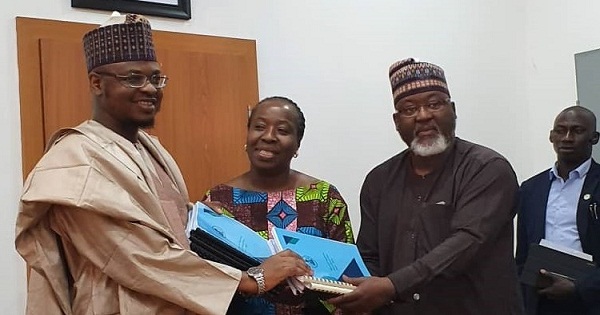
Digital Economy Media Support Volunteers ‘DEMS Volunteers’, a non-governmental group leading nationwide awareness/campaigns on Digital Economy, has commended the Minister of Communications and Digital Economy, Dr Isa Ali Ibrahim (Pantami), for the vigour and zeal he has shown towards achieving a digital Nigeria.
In December 2019, to foster the growth of a Digital Economy and to achieve broadband penetration by the year 2025, the Nigerian Government inaugurated the Nigerian National Broadband Plan (NBP) Committee for the Development of the 2020-2025 National Broadband Plan for Nigeria.
Prince Stan Okenwa, director general, DEMS Volunteers, in a Press Statement at the weekend, noted that the recent submission of the National Broadband Plan 2020-2025 report in less than three months the steering committee was inaugurated is another confirmation that Dr. Pantami is on a fast lane hence the industry should rally round him to achieve the goals.
DEMS Volunteers also lauded the Committee Chaired by Ms Funke Opeke, managing director/ceo, MainOne, and Co-Chaired by Dr. Bashir Gwandu, former Executive Commissioner Technical Services at NCC, while NCC’s Executive Commissioner Technical Services, Engr. Ubale Maska, served as the Secretary of the Committee.
Prince Okenwa said that the Committee proved themselves worthy of the national assignment by ensuring the report was not delayed but delivered on record time.
“We followed up the progress report while the NBP Committee was on course for two months; deliberating on issues as they relate to the national broadband, with focus on how to penetrate the underserved and unserved areas in the country and drive the Nigerian digital economy.
“At some points, the Minister, out of his tight schedules, paid them visit, and took notes of progresses and areas of concerned raised. This is commendable.
Recall that the Minister was at the 2020 – 2025 National Broadband Planning Committee Meeting, which held on the 5th of February 2020 and on the 18th February 2020, the Committee submitted its draft report.
“This is commendable and shows that the Minister is not operating as an armed-chair executive, but a determined achiever.
“The NBP holds a critical place in the nation’s economic drives. Without adequate broadband, telemedicine won’t happen, smart transportation, seamless fintech, eLearning, ecommerce, eGovernance, and other multiplier effects would become mere thoughts on paper.
“Therefore, we call on the Minister not to relent, but to ensure immediate critical study of the recommendation for swift implementation. By doing that, we would have solved enormous challenges faced by the economy and further unleash new windows for multiple job creation and revenue generation in the country.



Users of satellite internet service provider Starlink in Nigeria are being required to complete a biometric Know Your Customer (KYC) process as a precondition to continue enjoying their services, according to .biometricupdate.

According to local reports, more than 66,000 Starlink subscribers in the country had a December 31 ultimatum from the Nigerian Communications Commission (NCC) to complete the biometric verification or have their connection discontinued.
The process essentially entails linking a Starlkink account with the subscriber’s national digital ID.
The NCC, which is Nigeria’s telecoms industry regulator, is said to have first issued the directive in August last year, setting a three-month deadline which was to elapse on November 19, TechCabal reports.
The body however later extended it to December 31 after consultations with industry stakeholders. The internet account-NIN linkage, the NCC said, is to enhance identity verification and strengthen security within the country’s telecoms space.
Just a few days to the December 31 deadline, Starlink’s Nigeria office sent an email to its subscribers reminding them of the KYC requirement, and warned that all those who fail to comply would be disconnected.
And that once disconnected, reconnection would depend on network capacity in the concerned area.
The service provider said in its email that the process takes less than two minutes and users can complete it by logging in to their account via an app.
One user, quoted by TechCabal, said one needs to upload their selfie biometrics, provide their national identification number (NIN) and then give their consent for the account to be linked to their ID information.
Starlink’s internet service is present in about 155 countries with nine million users, as of 2025. Its growth in Nigeria is said to be rapid, making it the second largest internet service provider in the country, according to The Traffic.
Biometric identification for Starlink subscribers could become a continent-wide trend given that some countries have expressed reservations in opening up their internet space to the company over security concerns.
There’ve been fears that jihadists in countries like Mali and Nigeria may have exploited Starlink terminals to coordinate terror operations, and cybersecurity experts have also warned of risks related to weak regulation, digital sovereignty and data breaches.
The requirement for Starlink internet users to have their accounts linked with the NIN is similar to the SIM-NIN linkage policy which the Nigerian government battled to implement for many years, with many deadline extensions.
In October last year, the NCC, which is was at the forefront of the policy implementation, announced that all active SIM cards across all network providers had complied with the directive which was issued in 2020.
The idea, the federal government argued, was to strengthen security and curb criminality such as kidnappings which are aided and abetted by improperly identified mobile phone numbers.

Mr. Kashifu Inuwa, Director General of the National Information Technology Development Agency (NITDA), has urged Northern Nigeria to pivot urgently from traditional commerce to an innovation-driven digital economy for sustainable growth.

NITDA
Inuwa issued the call at the Future Map Foundation Roundtable 1.0 (North-West Edition) in Kano, attributing the region’s sluggish digital adoption not to talent deficits but to the lack of deliberate, coordinated strategies.
He stressed deeper collaboration across academia, private sector players, entrepreneurs, and government, positioning the private sector as the primary innovation engine while government supplies robust policies and an enabling ecosystem.
Inuwa advocated for people-focused, locally tailored innovations that tackle regional challenges head-on, enabling global competitiveness by transitioning from mere technology users to creators of homegrown solutions.
The roundtable convened policymakers, tech founders, and ecosystem stakeholders to forge a comprehensive roadmap for North-West digital transformation, yielding firm commitments to bolster regional innovation policies and public-private synergies.
Inuwa’s push dovetails seamlessly with the Federal Government’s Renewed Hope Agenda, which sets an ambitious target of 95 per cent nationwide digital literacy by 2030, fostering inclusive economic empowerment.
Participants hailed the forum as a pivotal step toward unlocking Northern Nigeria’s tech potential, with NITDA poised to lead implementation through strategic interventions and partnerships.

Samsung Electronics plans to double this year the number of its mobile devices with “Galaxy AI” features largely powered by Google’s Gemini, its co-CEO said, which would give the U.S. firm an edge over rivals as the global race in artificial intelligence heats up.

The South Korean company, which had rolled out Gemini-backed AI features to about 400 million mobile products, including smartphones and tablets, by last year, plans to boost that figure to 800 million in 2026.
“We will apply AI to all products, all functions, and all services as quickly as possible,” T M Roh told Reuters in his first interview since becoming Samsung Electronics co-CEO in November.
The plan by the world’s largest backer of Google’s Android mobile platform is set to give a major boost to its developer Google, which is locked in a race with OpenAI and others to attract more consumer users to their AI model.
Samsung seeks to reclaim its lost crown from Apple in the smartphone market and fend off competition from Chinese rivals not only in mobile telephones, but televisions and home appliances, all overseen by Roh.
It will offer integrated AI services across consumer products to widen its lead over Apple in such features, though the latter was set to be the top smartphone maker last year, according to market researcher Counterpoint.
AI Race
Alphabet’s Google launched the latest version of Gemini in November, highlighting Gemini 3’s lead on several popular industry measures of AI model performance.
In response to Gemini 3, OpenAI CEO Sam Altman reportedly issued an internal “code red,” pausing non-core projects and redirecting teams to accelerate development. The ChatGPT maker launched its GPT-5.2 AI model a few weeks later.
Roh expects the adoption of AI to accelerate, as Samsung’s surveys on awareness of its Galaxy AI brand jumped to a level of 80% from about 30% in just one year.
“Even though the AI technology might seem a bit doubtful right now, within six months to a year, these technologies will become more widespread,” he said.

NAHCO Signs New Ground Handling Deals

Firm Identifies Global Scam Activity Linked to the Release of Avatar 3

Showmax Unlocks Easier Payments for Nigerian Subscribers via Baxi

Mandatory Biometric Verification for Starlink Users in Nigeria Begins

Ecobank Offsets Repayment of $300m Eurobond Notes

Banks quietly move to enforce new ₦50 transfer levy from Jan. 1

FIRS says NIN, CAC Numbers to Serve as Tax IDs from 2026

Financial Sector Faced AI, Blockchain and Organised Crime Threats in 2025 – Report

PalmPay Launches N400 Million World Travel Carnival, Rewarding Users with Free Global Trips

Minister Claims Bandits Exploit Poor Network, Bounce Calls Off Multiple Towers




 News2 days ago
Court Sends Faleti, Ex-Lagos Director to Jail for Stealing ₦48.9m from Access Bank

 E-Financial2 days ago
Remita Powers over ₦100 Trillion in Payments as Nigeria’s Digital Economy Expands

 News3 days ago
974 Nigerians Face Imminent Deportation from Canada Amid Enforcement Surge

 E-Financial2 days ago
Why 2026 Must Be the Year Nigeria’s Economy Works for All

 General News3 days ago
House of Reps Releases Certified Copies of Tax Reform Acts amid Gazette Discrepancy Claims

 E-Financial2 days ago
Flutterwave Acquires Nigeria’s Mono in $25m-$40m All-Stock Deal

 E-Financial2 days ago
2026: SEC to Review Rules to Incentivise SME Listings

 General News2 days ago
Nigeria Targets Satellite-to-Mobile Services in Draft Spectrum Roadmap