

Broadcasting
HASG Rejects FG’s Order on Adverts on Foreign Media Channels

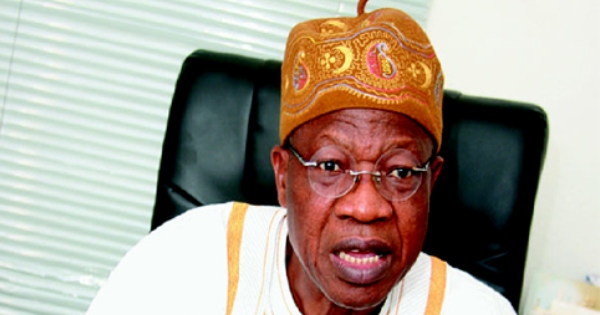
Heads of Advertising Sectoral Groups (HASG) have rejected the federal government’s fine for advertisements placed on foreign owned media channels and production of content abroad by advertisers.

Lai Mohammed
This was stated via a press release signed by the HASG on Wednesday.
The statement on the fine was attributed to Alhaji Lai Mohammed, minister of Information and Culture, , which was reported widely on many leading newspaper channels on Monday.
In the minister’s comment during discussions on the NTA Good Morning Nigeria show, he stated that Nigerian brands that run adverts during foreign matches must compulsorily advertise during Nigerian Premier Football League games.
The minister also stated that brands that produce their advertising materials abroad will pay a fine of N100, 000, each time such adverts are run, adding that advertising materials promoting Nigerian brands must be directed and authored by Nigerians inside the country.
In response to the minister’s statement, the HASG explained that advertisers put their advertising investment where the eyeballs of Nigerians are.
“The media decisions are driven by the consumers’ interest, passion, inspiration and aspirations. CNN and other international news channels are watched by Nigerians locally and internationally, the world is now a global village and Nigerians do not only live within our physical boundaries. Nigeria based news channels and contents developed locally are also consumed across many countries beyond our borders, with no special fines and levies imposed on companies who place adverts within them” they stated.
While understanding the merits of supporting the local industries, the HASG still urged the Minister to allow the support for locally produced content develop organically sighting the example of the Nigerian music and entertainment industry, as well as the movie industry, which only developed through organic growth and creativity of the practitioners and not by forced legislative fiats.
They stated that the government can support the growth of the industry by funding it in the areas of technical infrastructure, content development grants, and investment in tools of measurement of advertising effectiveness and efficiency.
The HASG further urged the Minister as well as the National Assembly to engage and involve the industry players and practitioners more, especially in formulation and development of policies that will affect the industry.
The HASG as a body is made up of Advertisers: Advertising Agencies, Media Agencies, Marketing Activation Agencies, Out-of-home Media Agencies and Broadcasting Company groups.


Dr.Shaibu Husseini, the Executive Director/Chief Executive Officer of the National Film and Video Censors Board (NFVCB), has called for stronger distribution frameworks within Nigeria’s film industry to ensure that locally produced content achieves global visibility.

He urged film festivals across the country to evolve beyond networking platforms into active marketplaces where filmmakers could secure distribution deals. He stressed that festivals must attract distributors, exhibitors, streaming platforms, and marketers to create tangible opportunities for filmmakers.
Husseini made this call while delivering the keynote address at the opening ceremony of the 2026 edition of the Coal City Film Festival held in Enugu.
“Film festivals must become gateways to distribution where filmmakers leave not just with applause, but with real opportunities,” he said.
Husseini expressed personal delight at hosting the event in Enugu, his birth state, noting the city’s rich cultural heritage and longstanding contribution to Nigeria’s creative landscape.
He commended the festival organisers, particularly the Festival Director, Uche Agbo, for their resilience and commitment in sustaining the
initiative. According to him, the Coal City Film Festival has grown into a significant cultural platform and a must-attend cinematic event in South East Nigeria.
Speaking on the festival’s theme, “Local Stories, Global Screens,” Husseini emphasised the importance of authenticity in storytelling. He noted that films rooted in local realities, languages, and cultural truth often resonate more strongly with global audiences.
He cited notable Nigerian productions such as King of Boys by Kemi Adetiba, The Wedding Party by Mo Abudu, Anikulapo by Kunle Afolayan,
“Black Book” by Editi Effiong, and “Lionheart” by Genevieve Nnaji as examples of culturally grounded stories that have gained international recognition on platforms such as Netflix and at global film festivals.
While acknowledging the growth in film production across Nigeria, the NFVCB boss identified distribution as a major bottleneck in the industry. He observed that many high-quality films struggle to reach audiences both locally and internationally due to limited distribution channels.
Reaffirming the Board’s commitment to industry development, Husseini stated that the NFVCB has continued to reposition itself as a partner in progress by engaging stakeholders, improving classification processes, and promoting a balance between creative freedom and social responsibility.
However, he raised concerns over increasing non-compliance with regulatory requirements, noting that some filmmakers bypass the Board by releasing unclassified films or operating without proper licensing.
He said all films and video works must be submitted to the NFVCB for classification and registration before being released on any platform, including digital platforms such as YouTube.
“This is a legal obligation, and the Board will not hesitate to take decisive action against defaulters,” he warned, adding that regulation is essential for protecting the industry, audiences, and national values.
Looking ahead, Husseini assured stakeholders of the Board’s continued collaboration with filmmakers and festival organisers to build a structured, sustainable, and globally competitive Nigerian film industry.
He concluded by commending the organisers of the Coal City Film Festival for their vision and contribution to Nigeria’s cultural economy, urging filmmakers to continue telling authentic stories that can resonate across global screens.

Mr. Charles Ebuebu, director General of the National Broadcasting Commission (NBC), has called on Nigerian content creators to actively participate in the country’s Digital Switchover (DSO), describing the transition as a major opportunity for visibility, revenue growth, and industry collaboration.

Mr. Charles Ebuebu, DG, NBC
Speaking as Special Guest of Honour at the induction ceremony of the Electronic Media Content Owners Association of Nigeria (EMCOAN) in Lagos, Ebuebu stressed that the success of the DSO depends on engaging content to populate the nation’s new digital channels.
“Without content, the DSO’s success would be incomplete. We are urging content owners to collaborate with the Commission to ensure Nigeria’s digital future is rich, diverse, and sustainable,” he said.
The NBC boss highlighted that the upcoming FreeTV Direct-to-Home (DTH) platform, along with its mobile applications, would provide content creators with nationwide reach, advanced analytics, and brand partnership opportunities.
Nigeria’s DSO, which marks the shift from analogue to digital broadcasting, is being implemented by the NBC using the Nigcomsat satellite infrastructure. The programme aims to deliver over 100 nationwide channels and expand access to Nigerians in remote areas via hybrid decoders, addressing long-standing infrastructure and funding challenges. The project, which has experienced delays since 2012, now has strong government backing and is scheduled for launch in April 2026.
Ebuebu commended EMCOAN members for their contributions to strengthening Nigeria’s creative economy and encouraged them to leverage the opportunities offered by the DSO to promote local stories, culture, and creativity on both national and global stages.
During the ceremony, EMCOAN honoured its distinguished members, naming Wale Adenuga, MFR, as Grand Patron and Mr. Yinka Adebayo as Patron.
Prominent figures in the broadcasting content industry, including Wale Adenuga, Opa Williams, Agatha Amata, Jibe Ologeh, High Chief Emeka Ossai, Debbie Odetayo, Amina Mohammed, and Frank Elaboya, attended the event.
Representing the NBC at the event was Mr. Ralph Akpan, director of the Lagos Zone, while EMCOAN president, Mr. Adeniji Omirin, MD of ADNOM Media, urged members to fully engage in the digital switchover.
Canal+ is to cut jobs at MultiChoice as part of a sweeping restructuring plan aimed at stabilising the African pay-TV operator, following years of operational and financial pressure.

The move comes alongside a planned $115 million capital injection, underscoring the urgency of efforts to revive the business after the French media group took control.
The planned layoffs are expected to form a core element of a broader cost-cutting and efficiency drive, as Canal+ seeks to streamline MultiChoice’s operations and improve profitability.
The restructuring signals a shift toward leaner operations, with a focus on eliminating redundancies and optimising the company’s cost base.
MultiChoice has struggled in recent years with declining subscriber numbers across key African markets, weighed down by macroeconomic pressures, currency volatility, and changing consumer behaviour.
The rise of global streaming platforms has intensified competition, chipping away at the company’s traditional pay-TV dominance.
Canal+’s intervention marks a pivotal moment for MultiChoice, reflecting a more aggressive approach to repositioning the business.
By combining fresh capital with structural reforms, the new owners are aiming to both stabilise short-term performance and lay the groundwork for longer-term growth.
The $115 million injection is expected to provide immediate financial relief, supporting operations and potential strategic initiatives.
However, the accompanying job cuts highlight the depth of the challenges facing the company and the scale of transformation required to restore competitiveness.

ARN Rejects Medical Bill over Attempt to ‘Scrap’ Profession

Meningitis Kills a Quarter Million People a Year -Study

NIGCOMSAT Supports Startups Growth with the Launch of Accelerator 3.0

Stakeholder says AI is Crucial to Nigerian Data Centres Amid Persistent Grid Collapse

NFVCB Boss Urges Stronger Distribution Channels @ Coal City Film Festival 2026

Spotify’s Loud & Clear Report Reveals Over ₦60Bn Revenue for Nigerian Artists in 2025

Madonna University Taps Tech Guru Adote for Strategic Board Role

China Threatens to Shut Nigeria’s Satellite Over $11.44m Unpaid Debt

Jumia Tech Week 2026 Begins with Tech Deals on Smartphones, Electronics, and Everyday Technology

FCCPC Bans Lagos ‘No Refund’ Policy, Vows Fines and Shutdowns for Traders




 E-Financial2 days ago
Breaking…..Kuda Lays Off Many Employees in Broad Restructuring

 Telecom2 days ago
Google Rolls Out Search Live AI to 200+ Countries, Including Nigeria

 E-Financial2 days ago
CBN Bars Chronic Loan Defaulters from Accessing Loans

 E-Financial2 days ago
NDIC Insures 99 Percent of Bank Customers

 E-Business2 days ago
FG Shifting Focus to “Meaningful Connectivity” to Drive Inclusion – Minister

 General News2 days ago
Anti Graft Agencies Raise Alarm over Rising Crypto-Linked Financial Crimes

 E-Business2 days ago
NITDA Takes Over National Digital Architecture System

 E-Financial2 hours ago
CBN bars large‑ticket loan defaulters from banking services in tough new crackdown