

Telecom
ICT Stakeholders @ PIAFO Conference Harps on Benefits of ‘Dig Once Policy’

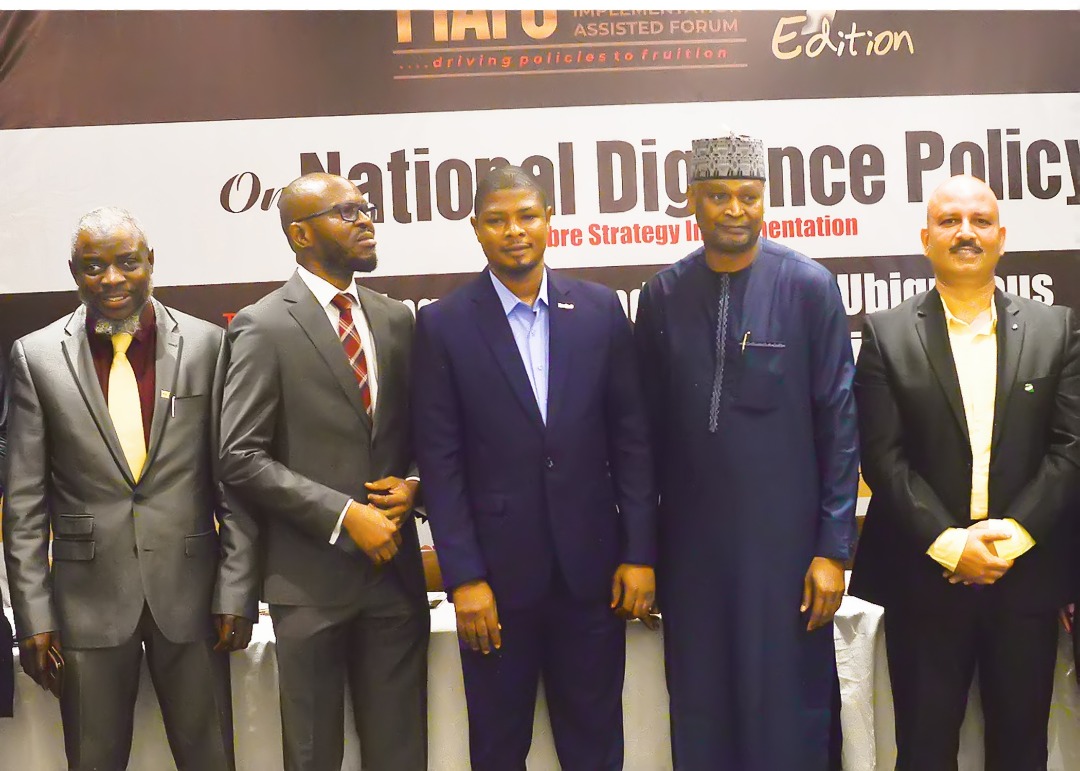
Stakeholders in the Information and Communications Technology (ICT) sector on Tuesday highlighted the benefits of Dig Once Policy to the economy, saying that it would promote and ensure ubiquitous broadband penetration across the country.

L-R: Adewale Sulaiman, GM, Network Enterprise Services, MTN Nigeria; Chidi Ajuzie, Group Chief Operating Officer, WTES Projects Limited; Omobayo Azeez, Convener PIAFo and Publisher, Business Metrics Nigeria; Engr Usman Aliyu, Sec. BISC and Head, Wireless Network, NCC, (Rep. Minister of Communications and Digital Economy) and Ashwani Mishra, Director of ICT Strategy and Marketing, Huawei Technologies at the fourth edition of PIAFo held in Lagos.
Prof Isa Ali Pantami, Minister of Communications and Digital Economy, speaking at the 4th edition of Policy Implementation Assisted Forum(PIAFO) on National Dig Once Policy, said the policy would promote and encourage collaboration between the private and public sectors.
Pantami who was represented by Engr Usman Ali, Deputy Director, Technical and Network Integrity, Nigeria Communication Commission (NCC) stated this in his keynote address with the theme ‘Laying the Foundation for Ubiquitous Broadband for Nigeria’s Economic Breakthrough’.
He said that Dig Once Policy would promote synergy and collaboration among private partners participation.
The minister said that the synergy would encourage infrastructure sharing and joint installation of fibre duct to avoid future digging.
He said that the Dig Once Policy which is still in the draft form would promote installation of fibre duct for effective broadband, reduce the barriers for Internet Service Providers.
According to him, Dig Once Policy promotes safety of citizens reduces traffic congestion on line, promotes comprehensive planning and inclusion of all telecoms infrastructure.
Prof Umar Danbatta, Executive Vice Chairman, NCC, also represented by Engr Usman Ali in his keynote address ‘Unlocking the Full Potential of the Telecoms Sector as an Economic Enabler with Dig Once Policy ‘.
The EVC said that NCC as a coordinating agency to will foresee the Dig Once Implementation Council (DOIC) and ensure that the policy is obeyed to the later.
Danbatta said that hopefully, by the end of the year, the Dig Once Policy which is in the draft form would be unveiled.
Mr Olabode Ojo, Director, Fiber Operations, IHS Nigeria said that the many benefits of Dig once cannot be overemphasized.
Ojo said that a Dig Once approach that encourages cooperation but does not prevent excavation when needed is most recommended for federal, state, and local agencies.
He said that Operators’ participation should also be non-exclusive thereby enabling the desired rapid broadband penetration for the country.
According to him, the benefits of Dig once policies include protecting newly and recently paved roads and sidewalks and enhancing the uniformity of construction.
He said that the benefit of Dig Once Policy also includes ensuring efficient, non-duplicative placement of infrastructure in the Public Right of Way (Row).
According to him, the benefits also includes environmentally friendly and enhances a greener planet, partnership in capacity building programmes such as training of contractors, skilled construction workers and site supervisor.
Also speaking at the occasion, Mr Chidi Ajuzie, Group Chief Operating Officer, WTES Project Limited in his paper presentation Public -Private Collaboration as a catalyst for Dig Once Policy Implementation emphasized on public private vector Collaboration.
Ajuzie said that the collaboration develops an ecosystem of trust with connectivity providers considering them as partners in improving the lives and livelihoods of citizens in line with commercial sensitivity.
He said that Dig Once Policy support digital inclusion initiative, internet speed increases, price per data unit decreases, increase data traffic competition.
Also, in his opening remarks, Mr Omobayo Azeez, Lead Executive, PIAFO said that the summit was considered a necessity to boosting Nigeria’s digital economy drive.
Azeez said which would ride on availability of high-speed internet to the nooks and crannies of the country.
He said this explains the choice of the Theme of this Summit which is: Laying the Foundation for Ubiquitous Broadband for Nigeria’s Economic Breakthrough.
It may interest you to know that the National Dig Once Policy that forms the central point of this summit is not yet operational in Nigeria.
‘’In fact we are setting the pace with this summit as the Pioneer stakeholder consultative forum dedicated to Dig Once in Nigeria.
‘’This speaks volume to the enormity of the task ahead of us today.’’
According to him, “we have positioned this forum to make invaluable contributions for proper formulation of the policy and its effective implementation after it is drafted.
He said in a simple term, Dig Once” policies include being alert to the potential to install or obtain fiber and conduit along rights-of-way on major infrastructure such as roads.
Azeez said that the Policy is imperative to deal with the bitter reality of telecoms sector anywhere in the world, the reality is that network expansion is often constrained by high cost of deploying infrastructure;
He said that fiber optic is the backbone infrastructure for network expansion and high Quality of Service (QoS).
He noted that achieving these and the ultimate 70 per cent broadband penetration targets by 2025 requires an ecosystem of willing and united stakeholders.
Azeez said that the stakeholders including various agencies of governments, operators, equipment manufacturers, and internet service providers.
He said that it is believed that all relevant stakeholders should be part of formulating this policy to ensure that the implementation is seamless.
According to him, it should be prevented from being revolted against in some quarters, just as the case with Right of Ways Charges in some states.
According to him, PIAFo is committed to building a strong midpoint platform for policy dialogue between the public and private divides of our ecosystem.
He said that this initiative is built on the three pillars of Policy Advocacy, Policy Implementation and Policy Assessment.
According to him, “we believe in more dialogue that leads to clear policy direction which is a prerequisite for seamless policy execution”.
Mr Ashwani Mishra, Director, ICT Strategy and Marketing, Huawei, enumerated important recommendations for Dig Once implementation in Nigeria.
According to him, “DOIC (Dig Once Implementation Council) as SPV should clarify the fiber strategy, boundary and scope of work of each stakeholder and publish quarterly progress reports. A mechanism description clarifying the cooperation between DOIC and NGF in adopting the policy in different states.
“Stimulate demand by making provision of ICT infrastructure a standard requirement for new building to drive extension of fiber everywhere in the country.
“Make Duct a standard specification for road reconstruction and new buildings.
” Uniform RoW charges and have SLA’s for each department / Ministry who are involved in the process of approval or else penalty.
“Protection of telecoms infrastructure by law enforcement agencies. Standard and specifications Redundancy and protection mechanisms should be unpacked, considered and included, especially with relation to national and regional routes.
“Imposition of penalties on construction companies for any arbitrary damage of fiber infrastructure. Establish a normative, technical and institutional framework for the pre-cabling of buildings in fiber optics for access to very high-speed broadband.
“Clearly define the property rights, and right of use of the new ducts/ conduits in the implementation of the policy, especially to those within the buildings and private sectors.
“Promote shared Fiber Infrastructure to avoid duplication of asset and CAPEX by each Player.
“Allow state utility like electrical poles to be used for the fiber rollout to expedite same.”


In the wake of increasing geopolitical tension, Cassava Technologies has unveiled its National Sovereign Cloud offering for African governments.

The solution, the company claims, will help the continent’s governments ensure data is kept on infrastructure that remains under local legal and operational jurisdiction.
According to the official announcement, made yesterday, the solution provides “secure, locally-governed digital infrastructure that enables the deployment of AI-enabled public services”.
The overarching solution encompasses cloud, cyber security, AI computing infrastructure, as well as local language AI models and skills support for governments.
The announcement comes amid increasing uncertainty over the hosting of sensitive national data on cloud services operated by foreign hyperscalers, which are subject to legal frameworks, such as the U.S. CLOUD Act. The CLOUD Act opens the door to allow American authorities to access data stored on the servers of US hyperscalers, wherever those servers are physically located.
Cassava has claimed separately that currently, “approximately 33% to 45% of the world’s data is hosted in the USA”.
The company added: “A sovereign cloud reduces exposure to extraterritorial laws, improves cyber resilience, and ensures that model weights and training data for public AI remain under national custody.”
The Africa Data Centres Association’s 2026 Economic Report states that “data sovereignty has evolved from a legal aspiration into a strategic policy lever”.
Ahmed El Beheiry, Group COO and Group Chief Technology and AI Officer, Cassava Technologies said: “Across Africa, governments are accelerating their digital transformation agendas and are increasingly focused on ensuring that data and digital infrastructure remain secure and sovereign.”
Announced at the Mobile Word Congress in Barcelona, this week, the Sovereign Cloud offering launch accompanied the launch of Cassava’s Cloud Partner programme.
The partner programme targets mobile network operators and system integrators across Africa to resell and distribute AI, cloud, and other digital services using Cassava’s infrastructure and technology platforms.
El Beheiry added: “We are expanding Africa’s sovereign AI ecosystem to build solutions that address the continent’s unique challenges while creating new opportunities for growth and digital inclusion.”
The programme offers partners access to NVIDIA Cloud Partner solutions, Cassava’s AI Factory, its own native AI solutions and its AI Multi-Model Exchange, which supports both Anthropic’s Claude and Google’s Gemini models.

Mazen Mroue, a non-executive director at MTN Nigeria Communications Plc, has resigned effective February 27, 2026, to prioritise other responsibilities within the MTN Group, the company announced in a Nigerian Exchange Limited (NGX) filing.

MTN Nigeria
The notice, signed by company secretary Uto Ukpanah, stated: “This is to enable Mr. Mroue to focus on other priorities within MTN Group Limited. The Board wishes to express its appreciation to Mr. Mroue for his immense service to MTN Nigeria and wishes him success in his future endeavours.”
Mroue joined MTN Nigeria’s board on June 1, 2022, bringing over 28 years of telecom experience. A veteran MTN executive, he previously served as CEO of MTN Uganda and MTN Liberia, non-executive director at MTN Cyprus, and held leadership roles at MTN Ghana.
Since February 2022, he has been MTN Group’s Chief Technology and Information Officer, overseeing technology strategy and governance. Earlier, as MTN Nigeria’s COO from August 2018 to January 2022, he also sat on the MTN Nigeria Foundation board.
The exit follows MTN Nigeria’s stellar 2025 results, posting a ₦1.70 trillion profit before tax—reversing a ₦550.3 billion loss in 2024 driven by forex woes—marking one of the telco’s strongest rebounds.

Google has rolled out support for Yorùbá and Hausa languages in its AI-powered Search features—AI Overviews and AI Mode—enabling millions of Nigerians to get quick answers, summaries, and conversational web exploration in their mother tongues.

The update forms part of Google’s push to cover 13 African languages, including Afrikaans, Akan, Amharic, Kinyarwanda, Afaan Oromoo, Somali, Sesotho, Kiswahili, Setswana, Wolof, and isiZulu, selected based on high search activity across the continent.
Now, a Kano student can ask complex questions in Hausa, while an Ibadan trader seeks business tips in Yorùbá—both receiving culturally nuanced AI responses via text or voice on Android, iOS, or web.
Taiwo Kola-Ogunlade, Google’s West Africa Communications Manager, said: “Building truly global Search requires nuanced local understanding. With Gemini-powered AI, we’ve made advanced capabilities relevant in Yorùbá and Hausa, so Nigerians converse naturally with Search in their mother tongues.”
To use: Open the Google app, tap AI Mode, and query in Hausa or Yorùbá for personalised guidance—breaking language barriers and making technology reflect Nigeria’s diverse identity.

Police Says Victims Enable Cyber Attacks Out of Ignorance

Bank Accuses Magistrate, Lawyer of Using Fake Order to Steal N3.5m from Account

FG Launches NERD to Combat Certificate Fraud

NCDC Issues Public Advisory on Cerebrospinal Meningitis

Goodnews Naija Launches ‘Building in Nigeria’ Series on Entrepreneurs, Real Sector Builders

Dr. Cairo Ojougboh Foundation Bolsters Nigeria’s Education Drive with ₦2.7m Student Support

Kaspersky Brings more Transparency to Threat Detection with New Hunt Hub

PwC Reveals AI Scaling Gap Slows Africa’s Digital Transformation

Kaspersky Discovers New Phishing Campaign Exploiting Google Tasks Notifications to Steal Corporate Credentials

esentry 2025 Report Shows Healthcare, Financial Services and Telecoms as Staging Grounds for Increased Cyberattacks in Africa




 General News2 days ago
FCCPC Bans Lagos ‘No Refund’ Policy, Vows Fines and Shutdowns for Traders

 E-Financial2 days ago
Senate Targets Fintech Overreach, Vows Ponzi Crackdown After ₦1.3trn CBEX Scam
 E-Business1 day ago
Police Says Victims Enable Cyber Attacks Out of Ignorance

 Telecom2 days ago
Google Adds Yorùbá, Hausa to AI Search, Boosting Access for Millions of Nigerians

 E-Financial2 days ago
SmartCash Launches ‘No Be Cho Cho Cho’ Campaign to Boost Digital Banking in Nigeria

 E-Financial1 day ago
Quest Merchant Bank Achieves CBN Regulatory Recapitalisation Milestone

 Telecom2 days ago
MTN Nigeria Non-Executive Director Mazen Mroue Quits to Focus on Group Role

 Telecom2 days ago
NativeID Launches Free Digital Identity Platform to Shield Nigerian SMEs from Scammers