

Telecom
ISPs Decry Poor Service, High Rentals by Tower Owners


Internet Service Providers (ISPs) in the country have expressed their reservations over poor services delivered by telecommunications tower operators as well as high cost of renting towers that houses their base stations.
Satis Kumar, chief operating officer, Direct On Data, said ISPs are saddled with harsh business condition, which include high base station rentage, inefficiency of tower management that have forced them into deploying batteries at their base stations to ensure improved service quality among other challenges.
“Most times our base stations go down apparently because the attendant is not around to put on the generator when public power supply goes off, sometimes there are diesel issues. Some of our clients are providing critical services that don’t need their internet to go down even for a second. How do you explain this situation?”
Kumar said that ISPs are charged between N3.6million to N4million per tower for a year. This cost depends on the type of the equipment being hang on the tower as some equipment consume more power than others and some take space more than others.
David Venn, chief executive officer, Spectranet, a 4G LTE internet service provider, said that before now, their biggest cost outlay was cost of national and international bandwidth, “but today the cost of bandwidth is coming down which leaves cost of tower rental our biggest cost of operation. Though the cost of tower rental in Nigeria is high compared to other countries I have worked, considering operational cost in this environment in terms of maintenance of the towers, it is reasonable. But in Zambia where there is also power challenge, there is no need for operators to provide security at towers as security challenge is not serious,” he said.
Sunday Folayan, president, Internet Service Providers Association of Nigeria (ISPAN) said that tower rental cost in the country will not be cheap as it is determined by some factors which include number of users on the tower as well as power and security provided at the towers.
“I’m not surprise that tower rental cost is high because the cost of powering base stations with generators is high. If we fix power problem in this country every other thing will take shape,” he added.
Lanre Ajayi, immediate past president, Association of Telecommunications Companies of Nigeria (ATCON), identified two factors as responsible for high cost of tower rental in the country, which are competition and service cost.
According to him, ‘competition in the co-location business is not deep enough to bring about reduced cost and efficient management. Presently, there are few companies providing co-location facilities in the country’.
He added that high cost of tower rental is also occasioned by service cost provided at the base stations such as power and security. “Most base stations are powered by generators and the cost of gas is high, they provide security at the towers. These are outside the control of co-location operators,” he said.
He however, urged government to set up an intervention fund to support the growth of ICT in the country just as she did in the entertainment industry, from where small operators could borrow to expand their network.


Telecom
Digital Encode Sponsors PAFON 3.0 as CVO Prof. Adewale Set to Deliver Keynote on Cybersecurity and Trust

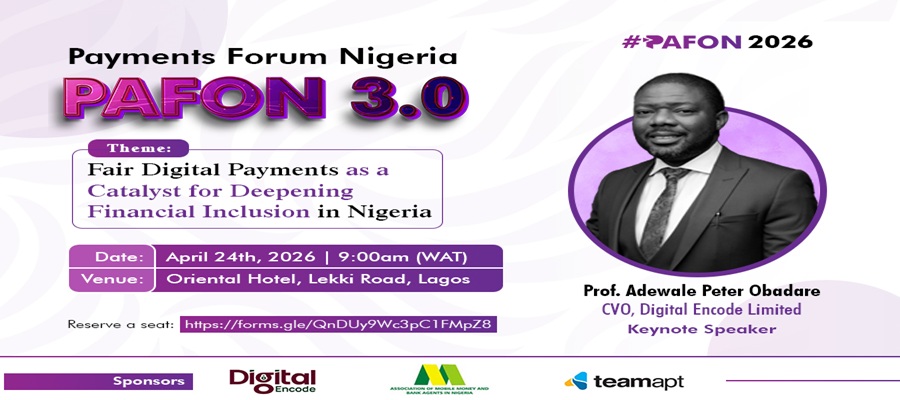
Digital Encode Limited has emerged the lead sponsor of the upcoming third edition of the forum (PAFON 3.0), the organisers have announced.

PAFON 3.0
PAFON 3.0 is scheduled to take place on Friday, April 24, 2026, at the Oriental Hotel, Lekki Road, Lagos, from 9:00 AM to 1:00 PM.
Themed “Fair Digital Payments as a Catalyst for Deepening Financial Inclusion in Nigeria,” PAFON 3.0 serves as a strategic platform for senior executives from banks, fintechs, regulatory agencies, and technology innovators to address the evolving digital payment landscape.
As Nigeria transitions toward a cash-light economy, the forum will focus on critical pillars of sustainability, including transparency, pricing integrity, and system resilience.
Bridging Cybersecurity and Financial Inclusion
Professor Adewale Peter Obadare, the Founder/chief visionary officer of Digital Encode will deliver a cybersecurity-focused keynote address that connects trust, resilience, fraud prevention, and consumer protection to financial inclusion.
His session will provide a specialized perspective on how information security serves as the bedrock of financial inclusion; exploring the vital links between building infrastructure that consumers can rely on, protecting the ecosystem to allow inclusion to scale, and ensuring equitable and secure access for all Nigerians.
Prof. Obadare is arguably the most Credentialed PAN-African Digital Trust Leader, CyberSecurity Strategist, GRC Thought Leader & Global Technopreneur.
He is a seasoned Multi-Award Cybersecurity & GRC expert with over 58 (Fifty-Eight) international professional certifications to his credit, Master of Science in Cybersecurity, Liverpool Unversity, UK, was awarded Honorarary Doctorate Degree in Cybersecurity from Trinity International University of Ambassadors Atlanta Georgia, United State of America and First Professor of Practice – Cybersecurity at Miva Open University, Abuja, Nigeria.
Prof. Obadare is a well-recognized subject matter expert with numerous successful engagements to his credit in Africa and the world. His skills and experience spans Data Privacy, Data Protection, CyberSecurity, Information Security, Vulnerability Management, Penetration Testing, Computer Forensics, Business Continuity, I T Governance, Risk Management and Compliance.
He is a Cybersecurity Advisory Board Member for Lagos State Government, a Platinum Team Member of Open-Source Security Testing Methodology Manual (OSSTMM), as well as a lifetime member of the Open Worldwide Application Security Project (OWASP). He is an alumnus of FATE Foundation and US Department of State Exchange program.
He is also a distinguished alumnus of executive education at Harvard Business School, Harvard School of Government, MIT Sloan School of Management, MIT Professional Education and Oxford University – Said Business School.
“Without trust in the security of digital payments, inclusion cannot scale. And we are happy to welcome Digital Encode as our Lead Sponsor this year. With what the company stands for and the personality of the CVO on a global scale, we have no doubt that attendees at this year’s PAFON will go home with lots of insights.”
“The theme for PAFON 3.0 was carefully selected because if digital payments are affordable, transparent, accessible, and trustworthy, more Nigerians, especially the underserved, will participate in the financial system”, Mr. Chike Onwuegbuchi, the co-convener of Payments Forum Nigeria, noted, highlighting Digital Encode distinguished leadership in Nigeria’s cybersecurity ecosystem.
Other Confirmed speakers: Dr. Jameelah Sharrieff-Ayedun, Vice President, Fintech Association of Nigeria (FintechNGR) & CEO, Credit Registry; Uche Uzoebo, MD/CEO, Shared Agent Network Expansion Facilities (SANEF Limited): Special Guest of Honour; Mojeed Abayomi Agboola, National President, Financial Inclusion Agents Multipurpose Cooperative Society (FIAMCS); Dr. Obioha Otti, National President, Association of Mobile Money and Bank Agents in Nigeria (AMMBAN); Chukwuemeka Enoch, Founder, Lagos Blockchain Week, and Sarafadeen Fasasi, National President, Association of Financial Inclusion Agents of Nigeria (AFiAN), amongst others.
The forum will feature speakers from across the financial spectrum, including mobile money operators, payment processors, and development institutions, to shape policy dialogue and industry standards.
PAFON is a premier industry gathering that aligns brand positioning with trust and innovation in Nigeria’s digital payments ecosystem. It provides a unique space for thought leadership, regulatory engagement, and market expansion within the payment infrastructure sector.

The era of treating cybersecurity as a mere IT problem is over. As AI-powered digital threats become more elusive and destructive, Nigeria is shifting its strategy toward “Total Resilience”—a multi-dimensional defense involving every level of society.

NITDA
At the 2026 GITEX Africa summit, NITDA DG, Kashifu Inuwa sounded the alarm on the changing nature of digital warfare, asserting that technology alone is no longer enough. Instead, Nigeria’s survival in the digital age now hinges on a strategic blend of policy, people, and proactive defense.
Speaking during a panel session on Cyber Resilience, Inuwa described the current global digital environment as being at a “critical turning point.”
He warned that emerging technologies are not only transforming industries and economies but are also reshaping the nature of cyber threats, demanding a proactive and multi-dimensional response from governments, institutions, and citizens alike.
“Cybersecurity is no longer just a technical issue. It is a strategic imperative for national development,” Inuwa stated. “We must think beyond technology alone and build resilience through people, processes, regulations, and infrastructure.”
Inuwa revealed that the focus of Nigeria’s cyber strategy is shifting from high-tech software to the people behind the screens. Pointing to data showing that 95% of all digital breaches stem from simple human mistakes, Inuwa argued that the world’s most advanced encryption is useless if the user is compromised.
“The most sophisticated technology cannot protect us if the human element is overlooked,” he noted. By prioritising human capacity and digital literacy, NITDA aims to turn every citizen into a “human firewall”, the first and most critical line of defense in a world where AI-driven attacks are the new normal.
In response, the Nigerian government has launched a comprehensive National Digital Literacy Programme aimed at achieving 95 percent digital literacy by 2030, with an interim target of 70 percent by 2027.
The programme emphasizes digital safety and cybersecurity awareness, equipping citizens with the knowledge to navigate an increasingly online world responsibly.
Inuwa highlighted initiatives such as the “3 Million Tech Talent” programme, designed to develop Nigerian expertise across key technology domains, including cybersecurity, data science, and AI.
The programme also leverages hackathons, innovation challenges, and mentorship schemes to channel young people’s skills into productive, lawful, and globally competitive ventures.
He argued that nurturing local talent is essential not just for national security but also for economic growth. “We want to create an environment where young Nigerians are innovators, not just consumers of technology,” he said.
Addressing concerns about Nigeria’s ranking in global cybercrime indices, Inuwa urged contextual understanding. “Countries with the most advanced digital economies also rank high in cybercrime because of the scale of their online activity,” he explained.
“Our focus is on redirecting talent towards innovation and solutions that protect our citizens while contributing to global digital advancement.”
On the legal and regulatory front, Nigeria continues to review and enhance the Cybercrime Act of 2015 to keep pace with the rapidly evolving threat landscape. The law underpins a structured National Cybersecurity Architecture coordinated by the Office of the National Security Adviser.
In addition, the country operates a 24-hour cybersecurity operations centre tasked with monitoring threats, issuing advisories, and providing real-time support to government institutions, businesses, and citizens. Advanced technologies, including dark web monitoring and AI-enabled threat detection, are being deployed to enhance situational awareness and improve response times.
Inuwa emphasized that effective cyber resilience requires collaboration between public and private sectors. NITDA is working closely with ministries, departments, agencies, and private sector stakeholders to secure critical infrastructure and strengthen national resilience.
“Cyber resilience is not a solo effort; it is a collective responsibility. By integrating people, technology, and regulation, we can build a secure, globally competitive digital economy,” he added.
As Nigeria navigates a digital-first future, initiatives such as the National Digital Literacy Programme, 3 Million Tech Talent, and strengthened legal frameworks underscore a commitment to turning cybersecurity challenges into opportunities for innovation and growth.
The country’s strategy reflects a broader understanding that in an era of AI-driven threats, preparedness is as much about people and processes as it is about technology.

Truecaller, the leading global communications platform, today announced the expansion of its Business Chat platform, making it accessible to global channel partners and enterprise solution providers. By “opening up” market access to its platform, Truecaller is empowering partners to transition their enterprise clients from legacy, low-trust SMS to a verified, smart, media-rich, and conversational communication experience.

Truecaller
Through this partner-led expansion, Truecaller empowers businesses to reclaim customer attention and establish immediate trust and credibility.
“The definition of success for modern enterprises has fundamentally evolved. It’s no longer just about delivery – it’s about earning attention, establishing credibility, and driving meaningful conversion,” said Priyam Bose, Global Head, GTM at Truecaller.
“By opening up market access to our global partners, we’ve created a powerful gateway for brands to engage with over 500 million active users where they already interact daily through communication that is contextual, trusted, free from clutter, and designed to initiate actions. For existing customers, the outreach opportunity extends to an additional high-impact channel, strengthening the overall customer experience journey.”
Truecaller Business Chat enables a clutter-free, high-trust conversational experience between businesses and consumers. The Business Chat platform equips partners with actionable insights, including real-time data and rich engagement metrics. This facilitates a more sophisticated, data-driven communication strategy that adapts at every stage of the customer journey.
Partners, including Gupshup and OneXtel, are already live in India along with Globe Teleservices, Cloudcom, and Sling Africa in other global markets, rapidly scaling the product in their respective regions. Global partners can now leverage Truecaller’s massive footprint to offer their clients a trustworthy engagement channel in an increasingly crowded digital world.

FG to Gift Nigerians over 100 Free TV Channels from May 15

FG New Approves Biometric Passenger Verification System for Airports Security

STBMAN, NBC Bicker over Alleged Due Process Breaches

CBN Dismisses Polaris Bank Liquidation Claim

AfDB Okays $200m for Nigeria’s Digital Backbone, Others

Spotify’s Loud & Clear Report Reveals Over ₦60Bn Revenue for Nigerian Artists in 2025

Kuda MFB Increases Kuda for Her Business Grants to ₦10 Million

Why JustMarkets Is a Strong Choice for Gold Trading

Canal+ to Cut Jobs as Part Sweeping Restructuring

Nigeria tops global rankings for USDT, USDC ownership




 E-Business2 days ago
Nigeria Demands Cloud Sovereignty to Anchor Africa’s Digital Independence

 Telecom2 days ago
Digital Encode Sponsors PAFON 3.0 as CVO Prof. Adewale Set to Deliver Keynote on Cybersecurity and Trust

 Telecom2 days ago
NITDA Boss Warns of AI Threat Shift @ GITEX Africa

 E-Business2 days ago
As Nigerians Struggle to Save, Mutual Benefits Highlights Power of Structured Financial Planning

 E-Financial2 days ago
Polaris Bank Targets Youth with Financial Literacy Drive

 Broadcasting2 days ago
What Adekunle Gold’s Support Means for ‘The Gathering on 100
 Broadcasting1 day ago
FG to Gift Nigerians over 100 Free TV Channels from May 15
 E-Financial1 day ago
AfDB Okays $200m for Nigeria’s Digital Backbone, Others