

News
Lift ban on radio station, Falz’s ‘This is Nigeria’; SERAP urges NBC

Socio-Economic Rights and Accountability Project (SERAP) has called on the National Broadcasting Commission (NBC) “to immediately lift the ban on Jay FM 101.9 Jos, stopping the radio station from playing songs such as Falz’s ‘This is Nigeria’, Wande Coal’s ‘Iskaba’ and Olamide’s ‘See Mary, See Jesus’, and rescind the unlawful fine of N100,000 imposed on the station.”
The organization said the action by the NBC “amounts to illegal restrictions on media freedom, the right to freedom of opinion and expression and free information and ideas.”
The NBC had in a letter dated August 6th, 2018 and addressed to the Chief Executive Officer, JODAJ Global Communications Limited, Jos, owners of Jay FM 101.9 stated varying reasons for the ban and fine ranging from ‘vulgar and indecent lyrics’ in contravention of the body’s regulations.
But in a statement on Sunday signed by SERAP’s Deputy Director, Timothy Adewale, the organization expressed “Concern about the censorship of the media and songs deemed ‘vulgar and indecent’ by the NBC, as such action risks undermining legitimate expression and independent voices.
“The NBC must immediately lift the ban on the radio station and rescind the arbitrary fine.”
The organization said, “The right to freedom of expression, information and ideas is applicable not only to comfortable, inoffensive or politically correct opinions, but also to ideas that offend, shock and disturb.
The constant confrontation of ideas, even controversial ones, is a stepping stone to achieving a vibrant democratic society, transparency, accountability and respect for the rule of law.”
The statement read in part: “Vague rules on vulgarity and indecency should not be used subjectively to ban or fine independent media outlets, particularly radio and television channels.
“The action by the NBC can create an uncertain environment for radio and television stations and media professionals in general and lead to fostering self-censorship and shunning any meaningful criticism of public policies and authorities.

“The NBC is adopting vague rules vulgarity and indecency to undermine freedom of expression, right to information and opinion.
“By banning the radio station from playing the songs, the NBC is not only undermining and harming the station, but also undermining everyone’s right to information, public participation and open and democratic governance”
“Article 19 of the International Covenant on Civil and Political Rights to which Nigeria is a state party includes the right of individuals to criticize or openly and publicly evaluate their Governments without fear of interference or punishment.
“It is important for the NBC to strive to promote diversity of views, and the media’s importance as a platform for public debate about important matters of public interest and ideas.
“Censorship or impermissible restrictions in the exercise of media freedom and freedom of expression can restrict free circulation of ideas and opinions and impose obstacles to the free flow of information.
“Freedom of the press and other news media afford the public one of the best means of discovering and forming an opinion of the ideas on political and social issues and other issues of public interest.
“Not only does the NBC have the task of ensuring that radio stations and other media organizations can function effectively to impart such information and ideas: the public also has a right to receive them.
“SERAP notes that three clear-cut conditions must be respected for any limitation on the right to freedom of expression and free information: (a) restrictions must be established in law; (b) they should pursue an aim recognized as lawful, and (c) they must be proportional to the accomplishment of that aim.
“SERAP considers the action by the NBC against the radio station to be inconsistent with the principle of proportionality and therefore impairing the free exercise of the right both to impart and to receive information and ideas.”
It would be recalled that the NBC had cited the radio station’s airing of a song by Falz titled “This is Nigeria” saying the song was laced with vulgar lyrics, ‘this is Nigeria, look how we living now, everybody be criminal.’
Also, the NBC cited the airing of a song by Wande Coal titled, ”Iskaba” as laced with vulgar lyrics, ”Girl you de make me kolo, shaking the ass like kolo” in contravention of Section 3.6.1 and 3.13.2.2c.’
The NBC also cited Jay FM airing a song by Olamide titled “See Mary, See Jesus” which it claimed was laced with casual use of the names of “Mary” and “Jesus” regarded as sacred by the Christian faith which contravenes Section, 4.3.1e.


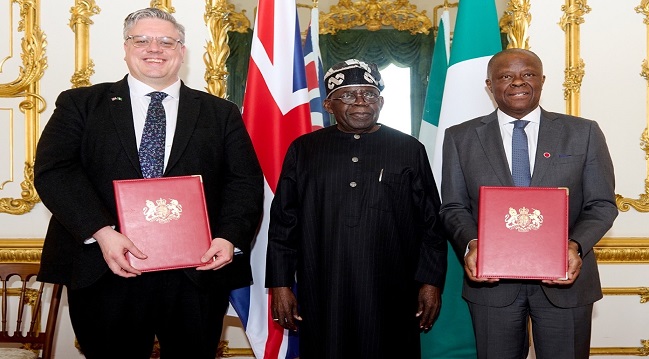
Thousands of skilled UK and Nigerian jobs will be supported and hundreds of millions invested into the economy as a historic financing deal was signed yesterday between the UK and Nigeria.

The £746 million sum will be used to support the refurbishment of two of Nigeria’s major national maritime infrastructure facilities located in Lagos, the Lagos Port Complex (Apapa Quays) and the TinCan Island Port Complex. It will be delivered through UKEF’s Buyer Credit Facility, coordinated and arranged by Citibank, N.A London Branch (“Citi”). Island Port Complex.
The agreement between UK Export Finance, the UK government’s export credit agency (UKEF), the Nigerian Ports Authority (NPA) and the Federal Ministry of Finance, will deliver significant benefits for British businesses, with at least £236 million of supplier contracts directed to British companies.
British Steel will supply 120,000 tonnes of steel billets to construction companies Hitech Nigeria and ITB Nigeria for the ports deal, amounting to a £70 million contract that represents British Steel’s largest export order backed by UKEF. It follows from the Government’s newly announced Steel Strategy which seeks to revitalise the steel sector.
Peter Kyle, Buisness and Trade Secretary said: “Hot on the heels of our landmark Steel Strategy, this is a major win for British Steel made possible by UK Export Finance which is testament to the quality of UK-made steel and the booming UK-Nigeria relationship.
“Through our new Strategy we’re backing British steelmakers for long-term success at home and abroad, and this contract will reinforce British Steel’s world-class expertise while supporting jobs and growth in Scunthorpe.”
Dr. Adegboyega Oyetola, Nigerian Minister of Marine and Blue Economy said: “The modernisation and upgrading of Nigeria’s ports represents a major step forward for the country and aligns closely with the Federal Government’s commitment to unlocking the full potential of the marine and blue economy.
“Through strategic partnerships such as this with the United Kingdom, we are laying the foundation for a new era of efficiency, transparency and competitiveness in Nigeria’s port system.
“Modern infrastructure, supported by digitalised and automated processes, will transform the way our ports operate and strengthen Nigeria’s position as a leading maritime hub in West and Central Africa.
“Nigeria’s port operations will be transformative. Turnaround times for vessels and cargo dwell times within the ports are projected to fall sharply as automated processes replace paperwork-heavy procedures and as expanded capacity removes longstanding bottlenecks.
“The modernised infrastructure will enable faster clearance of imports and exports, reduce demurrage and logistics costs for businesses, significantly improve the predictability and transparency of cargo movement and generate more revenue for national development.”
Alongside the NPA deal announcement, the UK and Nigeria will sign a Memorandum of Understanding (MOU) establishing a framework for potential future collaboration.
The MOU sets out Nigeria’s priority project pipeline, seeking UKEF finance and support, with the UK set to benefit directly through substantial supply chain participation. The signing signals a clear commitment from both governments to deepen their long-term partnership on trade, infrastructure and sustainable growth.
Hitech Nigeria and ITB Nigeria have been at the forefront of some of Nigeria’s most transformative infrastructure projects and advanced engineering.
The Steel Strategy highlights one of many initiatives that the Government is already doing including those on energy prices, skills, procurement and financing support of projects such as the Scrap Metal Taskforce and the new Trade Defence Measures.
Allan Bell , British Steel CEO said: “This is a record-breaking contract for British Steel and a major boost to our 4,000 employees and many more people in our supply chains.
“After government intervention last April, everyone at British Steel has worked hard to stabilise the company. This deal represents us moving from stabilisation to building long-term sustainability for the business.
“As one of the largest ever orders for billet in the history of this company, it marks a tremendous vote of confidence in British Steel and UK manufacturing. And as the biggest order we have ever secured with UK Export Finance, it demonstrates how we are working with the UK Government to meet the global demand for our products.
“We thank the government for its support and look forward to working with Hitech Construction Africa Ltd on this transformative project.”
Richard Hodder, Global Head of Export & Agency Financing at Citi said: “Citi has been present in Nigeria for over 40 years and is delighted to support NPA and the Federal Government of Nigeria in the financing of this critical infrastructure project which will deliver significant economic benefits to the Nigerian economy over the coming years. As the Coordinator of the transaction, we are pleased to have worked in close partnership with the team at UKEF to deliver one of the largest Export Credit Agency supported Buyer Credit Facilities ever seen in West Africa.”
Today’s milestones represent UKEF’s growing presence in the region. Since 2018, UKEF support for West and Central Africa has grown by over £3 billion, reflecting the region’s appetite for diversified trade partnerships and the UK’s commitment to being a trusted partner for long-term investment.
Tim Reid, CEO at UK Export Finance said: “This deal represents a milestone for UK-Nigeria trade relations and demonstrates the full capacity of UK Export Finance to unlock transformational opportunities for British businesses, while supporting sustainable economic growth in key markets.
“With over £200 million feeding back to British companies, including one of the largest steel billet contracts in British Steel’s history and our new Memorandum of Understanding, UKEF are laying the foundations for a deeper, long-term relationship with Nigeria, that will open doors for British exporters across the entire region.”
Together, these announcements signal to international markets that Nigeria is open for trade and investment, demonstrating credible government-to-government delivery and building wider investor confidence around Nigeria’s trade infrastructure and growth agenda.

Bank of Industry (BoI) and MTN Nigeria Foundation have launched a N1 billion Y’ellopreneur 3.0 Matching Fund to support women-owned businesses across Nigeria.

The fund was launched at the official unveiling of the BOI–MTN Foundation Y’ellopreneur 3.0 Matching Fund held in Lagos.
Dr Olasupo Olusi, managing director of BoI, said the initiative reflects a shared commitment to entrepreneurship and women’s empowerment.
Represented by Oluwatoyin Edu, executive director, MSMEs, Olusi, said the partnership has grown from a N100 million youth programme in 2018 to a N1 billion fund, financed equally by both institutions.
“Today, we are pleased to deepen this collaboration with the launch of the N1 billion Y’ellopreneur 3.0 Matching Fund.
“This programme aligns strongly with BoI’s 2025–2027 strategy for enterprise development and economic transformation,” he said.
Olusi said 1,000 women entrepreneurs would receive structured training, while 200 women-led MSMEs would access loans of up to N5 million each.
The BoI boss added that the programme targets sectors including agro-processing, light manufacturing, fashion, energy, waste management and digital services.
Mrs Mosun Belo-Olusoga, chairman of MTN Nigeria Foundation, said the initiative highlighted women’s critical role in economic development.
According to her, the foundation now treats women’s empowerment as central to nation-building, rather than a corporate social responsibility obligation.
Belo-Olusoga said over 5,700 women had been trained, with the programme designed to bridge economic gaps limiting women’s participation.
“This fund provides equipment financing, enabling women to transition from small-scale operations to industrial-level businesses,” she said.
She stressed the need for greater awareness, especially in rural communities, to ensure inclusiveness.
Mrs Odunayo Sanya, executive director of the foundation, said the initiative combined capacity building with access to capital.
Sanya said beneficiaries would undergo a five-week training programme by Pan-Atlantic University Enterprise Development Centre, ending with business growth plans.
She said the foundation aimed to build 30,000 female-led businesses in five years, with 10,000 expected to receive funding.
“We believe this partnership with BoI opens the door to scaling women-owned businesses through working capital and equipment financing,” she said.
Mrs Ibijoke Sanwo-Olu, wife of Lagos State governor, described the initiative as timely in tackling unemployment and unlocking women’s economic potential.
Represented by Mrs Oyinlola Agoro, she said equipping women with skills, mentorship and planning tools is vital for resilient enterprises.
Sanwo-Olu commended earlier phases, which trained over 5,700 women and supported 122 beneficiaries with equipment.
“This shows that when women are empowered, families thrive, communities prosper and the economy grows stronger.
“The N1 billion matching fund will deepen financial inclusion and promote women-led enterprises,” she said.
She reaffirmed her commitment to initiatives promoting women’s empowerment, economic independence and inclusive development.
News
NSIA Sign MoU with UK’s Asset Green Ltd to Develop $496M Integrated Dairy Livestock Production Platform in Nigeria

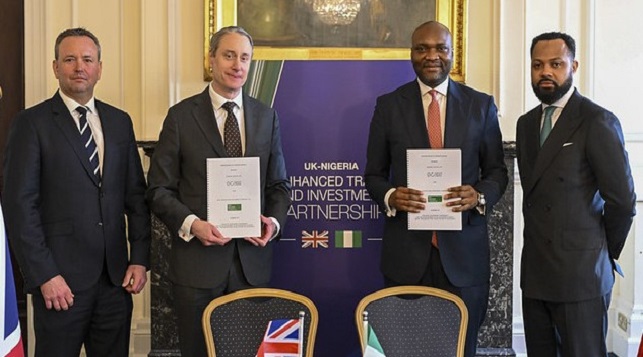
The Nigeria Sovereign Investment Authority (NSIA) has signed a Memorandum of Understanding (MoU) with UK‑based Asset Green Ltd to advance the development of a large‑scale integrated dairy livestock production and processing platform set to transform Nigeria’s dairy industry and strengthen national food security.

Signed on Tuesday in London ahead of the State Visit, the MoU outlines the framework for collaboration and the project‑development cost commitments leading up to the formal shareholders’ agreement.
This initiative represents one of the most ambitious integrated dairy investments ever undertaken in Nigeria. It will combine 20,000 hectares of climate‑smart, regenerative crop and forage production with a modern 10,000‑milking cow dairy operation, supported by a state‑of‑the‑art processing plant capable of producing fresh milk, milk powders, butter, cream, and up to 15,000 metric tonnes of infant formula annually.
Designed to reduce Nigeria’s reliance on imported milk powder, the project will modernise agricultural practices, improve nutrition, and integrate up to 10,000 rural households into the supply chain through inclusive out‑grower schemes. Once operational, the platform is expected to generate over US$620 million annually and create 2,500 direct and 5,000 indirect jobs nationwide.
British Deputy High Commissioner, Jonny Baxter, said: “Over a decade ago, the UK provided pivotal support to Nigeria in establishing the NSIA, offering legal and financial expertise that helped lay the foundation for its successful launch and strengthening its governance and credibility.
“That early institutional investment has paid dividends, helping to build a resilient Nigerian institution capable of creating jobs and driving transformational, long‑term development.
“The NSIA and Asset Green partnership is a powerful example of how that groundwork continues to deliver impact – a full‑circle moment that reflects the long-term economic cooperation between the UK and Nigeria and the shared commitment to deepening sustainable, private‑sector‑driven growth.”
NSIA Managing Director & CEO, Aminu Umar‑Sadiq, said: “NSIA is pleased to partner with Asset Green on this transformative investment. With a project size of almost US$500 million, this is one of the most ambitious initiatives aimed at strengthening Nigeria’s food and nutrition security in a generation.
“By combining climate‑smart farming, advanced processing capacity, and inclusive out‑grower participation, we are laying the foundation for a modern, competitive dairy sector that reduces import dependence, creates meaningful jobs, and delivers long‑term value for Nigerians.”
Asset Green Ltd Director & Agrium Capital Ltd CEO, Rod Bassett, said: “This partnership between NSIA and Asset Green is the business and investment innovation required to unlock the potential of the agriculture sector in Nigeria, with the development of such a future (dairy) food system.
“The foundation of the approach is one of collaborating with NSIA and their shared vision and purpose to establish a platform to catalyse the development of such a national strategic priority. We are incredibly proud to partner with Nigeria’s premier investment institution.
“The development of greenfield projects have consistently played a major role in our history, establishing industries or nurturing young businesses that are able to deliver catalytic transformation.
This US$500 million greenfield investment in Nigeria’s dairy industry allows for the development of advanced and necessary infrastructure spanning the full production and supply system to enhance local production, reduce the reliance on the huge imports of dairy goods into Nigeria, deliver environmental services and strengthen national food sovereignty and nutritional resilience.”

CBN Introduces Stricter BVN Rules to Curb Fraudulent Transactions

Binance is Missing from Ghana’s Crypto Sandbox

Canal+ to Cut Jobs as Part Sweeping Restructuring

Activist Warns against Rising Junk Food Culture in Nigeria

World Bank Debars 3 PwC Subsidiaries for 21 Months over Alleged Project Fraud

Kaspersky Discovers New Phishing Campaign Exploiting Google Tasks Notifications to Steal Corporate Credentials

esentry 2025 Report Shows Healthcare, Financial Services and Telecoms as Staging Grounds for Increased Cyberattacks in Africa

AfDB, UNDP Launch $10Bn AI Initiative for Africa

Mutual Benefits Assurance Settles ₦5.9bn Claims in January 2026

MultiChoice Suspends Yearly DStv Price Hike as Canal+ Pushes Growth




 E-Financial2 days ago
Kuda MFB Increases Kuda for Her Business Grants to ₦10 Million

 News3 days ago
Kaspersky Discovers Infostealers Mimicking Claude Code, OpenClaw and Other AI Developer Tools

 General News3 days ago
Banks, Offices to Close for Thursday and Friday for Eid-el-Fitr

 Telecom3 days ago
Nigeria, Ghana Trigger Stunning 45 Percent Surge in MTN Dividends

 E-Financial3 days ago
SEC Shuts Over 400 Fraudulent Investment Schemes, Arrests Operators

 Telecom3 days ago
ATCIS Urges FG to Ensure Safety of Consumers Data

 Telecom2 days ago
Vitel Wireless Lures Subscribers with “Data that Never Expires” Campaign

 News2 days ago
BoI, MTN Foundation Launch N1Bn Fund for Women Entrepreneurs