

E-Financial
Majority of Nigerians do not Trust Govt with Tax Revenue – SBM

Majority Nigerians do not trust the government to properly utilise their tax payments for good use, according to a survey by SBM Intelligence across nine cities.

The survey highlighted why recent tax reforms have triggered widespread anxiety and resistance.
“Survey data from 200 respondents across nine cities indicate that 68.5 percent of Nigerians completely distrust the government’s use of tax revenues, whereas only 27.5 percent view the reforms as beneficial to the country, ” SBM intelligence said in its recent report titled Taxing Patience.
Nigeria’s 2025 Tax Reform Acts took effect in January, introducing the most comprehensive overhaul of the tax framework in decades. The reform has created more awareness among Nigerians than ever before, increasing their further distrust in the government’s use of tax revenues.
The distrust reflects years of poor service delivery and weak accountability, shaping public doubt toward the new tax system despite assurances that the reforms are designed to ease burdens and improve fairness.
“In the past, people avoided tax because they felt the government wouldn’t provide basic amenities,” businessday quoted Okanlawon Hakeem, a Lagos-based businessman, as saying.
“You drill boreholes yourself, pay for public transport yourself, and sometimes fix your local road yourself. So, you ask yourself what the government is doing with the tax money.”
The SBM Intelligence report noted that access to reliable electricity, improved security and better roads were the clearest signals that would make tax compliance worthwhile.
“46 percent of participants identified improvements in roads and security as their primary motivation for tax compliance,” SBM Intelligence noted, explaining that service delivery, rather than enforcement alone, is likely to shape taxpayer behaviour.
Government officials have defended the changes as necessary to improve public finances and reduce Nigeria’s dependence on oil revenue, pointing to the country’s historically low tax-to-GDP ratio.
With a tax-to-GDP ratio of less than 10 percent, Nigeria has lagged behind regional peers such as Ghana and Kenya. Taiwo Oyedele, chairman presidential fiscal policy and tax committee, hopes the reforms will lift the ratio toward 18 percent over the medium term.
Public sentiment, however, has not moved in step with these fiscal ambitions. According to the report, only 27.5 percent of people believe that the new tax laws are good for the country.
The report also suggests that greater awareness of the reforms often coincides with stronger skepticism rather than acceptance.
Distrust cuts across regions and occupations but is especially pronounced in major commercial centres.
The report mentioned that people in Lagos and parts of the Northeast have the strongest resistance and protest sentiment, reflecting concerns about enforcement, fairness and legislative integrity.
In its Year Ahead 2026 outlook, SBM Intelligence projects that protests are likely as the real impact of the new framework becomes clearer. The report points to the June 2024 youth-led protests in Kenya, which resulted in a reversal of the policy.
In Nigeria, where inflation is only just beginning to show signs of easing, the tolerance for perceived government excesses, including lavish convoys and budget padding, is at an all-time low.
Business owners, traders and informal workers expressed particular unease, fearing the reforms could deepen the problem of double taxation. Many worry that government levies will exist alongside rather than replace the fees already collected by unions and non-state actors.
“ Nearly a third of business respondents said they expect to pay both official taxes and union fees,” the report stated.
For informal workers such as market traders, drivers and artisans, this fear is grounded in experience. Many already make daily payments to unions or associations, often under pressure.
Without a clear plan to eliminate these parallel charges, new government taxes are widely viewed as an additional burden rather than a simplification of the system.
In Lagos, Kano and Onitsha, constant electricity emerged as the strongest trigger for compliance. In Abuja, Port Harcourt and Bauchi, respondents prioritized roads and security. Across cities, the message was consistent: willingness to pay is conditional on visible outcomes.
Analysts warn that without clear improvements in service delivery, stronger enforcement could harden resistance rather than improve compliance.
The report stated that without rapid, visible improvements in public services, the government risks collecting more money while winning.



Providus Bank Limited has dispelled media reports over its compliance with regulatory capital requirements, confirming that it has successfully met and exceeded the recapitalisation threshold set by the Central Bank of Nigeria (CBN).

In a statement, the bank clarified that under the CBN’s recapitalisation framework, regional commercial banks are mandated to maintain a minimum capital base of N50 billion, stating unequivocally that it achieved this benchmark as far back as January 2025 and has since strengthened its financial standing.
According to the bank, its current paid-up capital stands at N65 billion, significantly above the regulatory minimum, underscoring its resilience and commitment to sound financial management.
The bank noted that this strong capital position places it in good stead to support its growth strategy and continue delivering value to customers and stakeholders.
Providus Bank emphasied that any suggestion implying non-compliance with the CBN’s recapitalisation requirement was inaccurate and does not reflect its current regulatory status.
The bank reiterated its dedication to maintaining robust governance standards and aligning with all prudential guidelines set by the apex regulator.
It explained: Providus Bank Limited notes recent media reports regarding the recapitalisation status of certain banks and considers it important to provide factual clarification as it relates to the Bank. Under the CBN recapitalisation framework, regional commercial banks are required to maintain a minimum capital base of N50 billion.
“Providus Bank confirms that it had met its capital requirement since January 2025 and currently has a capital base of N65 billiom which is in excess of its capital requirement.
Accordingly, any suggestion that Providus Bank has not met the applicable recapitalisation threshold is not consistent with its current regulatory standing.”
The Olayemi Cardoso-led Central Bank of Nigeria (CBN) had, on March 28, 2024, announced a two-year bank recapitalisation exercise which commenced on April 1, 2024.
The 24-month timeline for compliance ends on March 31, 2026. The upward capital revision is expected to ensure that Nigerian banks have the capacity to take on bigger risks and stay afloat amid both domestic and external shocks.
Specifically, the recapitalisation exercise requires a minimum capital of N500 billion, N200 billion, and N50 billion for commercial banks with international, national, and regional licences, respectively.

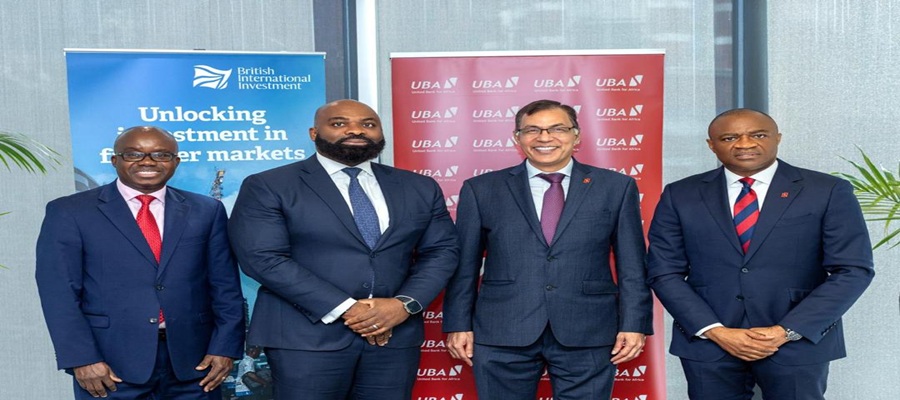
United Bank for Africa (UK) Limited (“UBA UK”) and British International Investment plc (“BII”), the UK’s development finance institution and impact investor, today announced that they have signed a letter of intent to develop trade finance collaboration opportunities. The proposed initiative aims to expand access to trade and working capital facilities for businesses operating across Africa.

L-r: West Africa Director and Head of Office Africa Coverage, BII West Africa, Benson Adenuga; Managing Director and Head of Africa, BII, Chris Chijiutomi; Lok Mishra, Chief Executive Officer, UBA UK, Loknath Mishra; Group Managing Director, United Bank for Africa (Plc) during the signing of letter of intent to develop trade finance collaboration opportunities.
Access to trade finance remains one of the most significant structural constraints on African trade. Businesses – particularly small and medium-sized enterprises – are frequently unable to secure letters of credit, guarantees, and supply chain finance on commercially viable terms, limiting their capacity to export and import competitively. This trade finance gap is estimated by the African Development Bank to be over USD 80 billion annually.
To help close this gap, UBA UK, the London subsidiary of UBA Group, Africa’s Global Bank, will leverage its deep relationships across the Group’s 20-country African network to originate and structure trade finance transactions. While BII, with a mandate to support productive, sustainable, and inclusive growth across Africa, can support transactions that might otherwise fall outside conventional commercial appetite.
Lok Mishra, Chief Executive Officer, UBA UK, said: “The signing of this letter with BII represents a landmark moment for UBA UK and for the UBA Group’s global ambitions. As the Group’s hub for Trade Operations, UBA UK is uniquely positioned to connect African businesses with the international financial system.
“Working alongside BII, we can extend that capability further — mobilising capital where it matters most and helping to close the trade finance gap that holds back so much African potential.”
Chris Chijiuitomi, Managing Director and Head of Africa, said: “British International Investment is committed to catalysing private sector growth across Africa, and trade finance is a critical enabler of that growth.
“We welcome the opportunity to collaborate with UBA Group, whose pan-African network and deep institutional relationships can help advance our ambition to expand access to trade and working capital finance, particularly in frontier markets.”
The announcement builds on growing momentum around intra-African trade facilitated by the African Continental Free Trade Area (AfCFTA), which entered into force in 2021 and represents one of the world’s most ignificant trade integration initiatives.
Both institutions have identified the operationalisation of AfCFTA as a priority catalyst for a trade finance facility, with UBA UK’s network across major AfCFTA economies offering a basis for supporting businesses navigating the emerging continental market.
This also complements the UK Government’s broader engagement with African economic development, including commitments made at the UK-Africa Investment Summit, and reinforces the City of London’s role as a leading international finance centre for Africa-focused capital mobilisation.
Future cooperation remains subject to further assessment, due diligence and the completion of internal approvals by both parties.

Central Bank of Nigeria (CBN) has introduced stricter rules guiding the use and management of the Bank Verification Number (BVN) as part of efforts to reduce fraudulent transactions within the financial system.The revised framework, which takes effect from May 1, includes tighter controls on BVN enrolment, data access and customer information updates.

The apex bank said the measures are aimed at strengthening identity management, improving fraud monitoring and safeguarding the integrity of banking transactions.
Under the new guidelines, BVN enrolment is now restricted to individuals aged 18 and above, while customers will only be allowed to change the phone number linked to their BVN once.
The restriction is designed to curb identity manipulation often exploited by fraudsters through repeated updates of personal information.
The CBN also directed financial institutions to maintain a temporary watchlist for BVNs linked to suspicious transactions.
Affected BVNs may be flagged for up to 24 hours, during which customers are expected to verify or clarify flagged transactions before further action is taken.
In addition, access to BVN data has been tightened, with the apex bank retaining exclusive control over the database while granting access only to licensed financial institutions under defined conditions.
The move, according to the CBN, is expected to enhance data security and support a more resilient financial system as BVN enrolment continues to grow.

Court Jails ‘Colonel’, ‘Major’ of Global Money-Laundering Ring

Court Bans Kenyan Telcos from Recycling SIM Cards

Providus Bank Fully Meets CBN Capital Requirement, Sets Record Straight

African Tech Start-ups to Receive $46m of Speedinvest Africa Fund

U.S. Charges Three in $2.5 Billion Plot to Smuggle Nvidia AI Chips to China

Kaspersky Discovers New Phishing Campaign Exploiting Google Tasks Notifications to Steal Corporate Credentials

esentry 2025 Report Shows Healthcare, Financial Services and Telecoms as Staging Grounds for Increased Cyberattacks in Africa

AfDB, UNDP Launch $10Bn AI Initiative for Africa

Mutual Benefits Assurance Settles ₦5.9bn Claims in January 2026

MultiChoice Suspends Yearly DStv Price Hike as Canal+ Pushes Growth




 E-Financial3 days ago
CBN Introduces Stricter BVN Rules to Curb Fraudulent Transactions

 E-Financial3 days ago
Binance is Missing from Ghana’s Crypto Sandbox
 News2 days ago
African Tech Start-ups to Receive $46m of Speedinvest Africa Fund
 Telecom2 days ago
Court Bans Kenyan Telcos from Recycling SIM Cards

 News3 days ago
Nigeria, UK Sign £746M Landmark Ports Deal

 E-Financial3 days ago
World Bank Debars 3 PwC Subsidiaries for 21 Months over Alleged Project Fraud
 E-Financial2 days ago
Providus Bank Fully Meets CBN Capital Requirement, Sets Record Straight

 E-Financial2 days ago
UBA UK, BII Sign Letter of Intent to Slash Africa’s $80Bn Trade Finance Gap