

News
MTN Employees Battle Firms in Court over Alleged Land Fraud

MTN Employees Cooperative Society, through its prosecution witness, Cyril Ilok, has sued two of its former staff; Primavera Engineering and Construction Limited and Mabo Dredging Limited; for allegedly defrauding them of some hectares of land, purportedly meant for the development of Yellow Estate Project, Okun Ajah, Lagos.
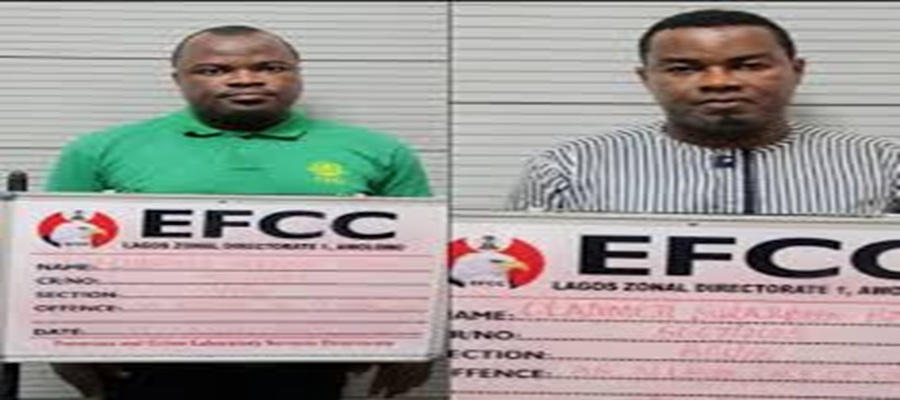
The defendants in the case include: Victor Akintunde, Gani Mustapha, Mutairu Babatunde, Primavera Engineering and Construction Limited and Mabo Dredging Limited, who are being prosecuted on an 18-count-charge by the anti-graft agency, Economic and Financial Crimes Commission (EFCC), for defrauding MTN Employees Co-Operative Society (MEMCOM) members of the sum of N1.4Billion in the guise of buying 39 hectares of land located at Okun Ajah, Lagos.
Ilok, the General Manager with the Business Risk Management Unit of MTN Nigeria narrated to the court, how the defendants stole the money meant to buy landed property to build the proposed “Yellow Estate” for members of the Co-Operative.
Victor Akintunde, according to the prosecution witness, was the president of MEMCOS and Gani Mustapha, the 2nd a treasurer, jointly conspired to steal the money contributed by members of the Co-Operative for the construction of the proposed Yellow Estate.
In the words of Ilok, the 1st and 2nd defendants signed a Memorandum of Understanding (MOU) with the land owner and the total of 26.5 hectares was signed at the cost of N1, 501,902,666.00. But it was later discovered that only N963.3, 000,000.00, was paid, leaving a difference of N373, 500,000.
“MEMCOS through the 1st and 2nd defendants acquired 39 hectares of land for real estate development but the defendants did not pay for the said numbers of hectares. The defendants only paid for 13 hectares. We later discovered that the 1st and 2nd defendants mismanaged the sum of N1, 357,764,414.
“1st and 2nd defendants were former staff of MTN while the 3rd defendant, Mutairu Babatunde, is the owner of the 4th defendant, Primavera Engineering and Construction Limited. It was discovered that there were a lot of irregularities in the expenses. The total sum of N3.2billion had been collected by the executive of the Corporative led by Akintunde and Mustapha for the purpose of building houses for members of the cooperatives.”
The prosecution witness disclosed that when the irregularities were realized, the new management, appointed KPMG, a professional auditing and accounting firm, to investigate the account of the cooperative for the period between 2008 and 2011.
During this period, he (Ilok) worked with KPMG on the investigation and was also interfacing with the firm and the defendants, after which the report of KPMG was submitted to him to help summarise the issue. Ilok told the court that it was thereafter that a petition on unpaid monies was written to the EFCC.
“There were 13 hectares of land and 5 hectares which were encumbered. The sum of N427, 114,414,00 was supposed to have been refunded by Primavera Engineering to MEMCOS. A cheque was however written by Primavera which was returned unpaid. The company however issued another cheque of N300million to MEMCOS and it was cleared. The difference between the amount that was cleared and the one, which was returned, was N127, 114,414.
“The amount said to have been mismanaged is N1,357,764,414.00. It was also discovered that there were un-receipted payments and excess payment documents on five hectares of land which were also defective among the hectares supposedly bought.”
Under cross-examination by the defence counsel, the witness stated that MEMCOS had insisted that the 1st and 2nd defendants refund the defective 5 hectares of land.
He further included that the defendants did not account for what they did with N50million from the money given to them, adding that he was not aware that the 4th defendant was engaged to do other things which include perfection of documents, layout and building approval but that monies were paid to the company through the 1st and 2nd defendants to that effect.
Even the registration of the land, presently, is said to be in contention and ineffective.
“The grouse of the MEMCOS is the failure of the defendants to have the money paid for 5 hectares refunded. The titled document was used by MEMCOS to obtained loan from Federal Mortgage Bank in respect of Yellow Estate project.
“I did not know the amount of loan MEMCOS got from the bank. I was not present at the negotiation between owners of the 39 hectares of land and MEMCOS acting through the 1st and 2nd defendant. They did not account for what they did with the money. But MEMCOS insisted that the over payment should be refunded”, he remarked
The trial judge, Justice Lateef Lawal-Akapo, has fixed June 1 for continuation of trial at a Igbosere High Court, Lagos.



EFCC


The African Development Bank Group last week approved an investment of €6.5 million in the Saviu II fund in order to support technology start-ups through their seed phase and first institutional fundraising, mainly in French-speaking Central and West Africa.

The Bank will invest €4.5 million as equity and €2 million as a first-loss hedging tranche on behalf of the European Commission, under the Boost Africa Programme.
This participation of the Bank Group will enable the Saviu II fund to give priority to companies with a strong technological or digital component.
Saviu II, the second investment vehicle of Saviu Partners, plans to invest between €500,000 and €3 million in about 20 technology or technology-oriented business-to-business start-ups in the seed phase or carrying out first institutional fundraising.
The Saviu II venture capital fund aims to make at least 60% of its commitments in the French-speaking countries of West and Central Africa: Côte d ‘Ivoire, Cameroon, Benin, Senegal, Togo, Burkina Faso and Mali.
The fund can also co-invest in promising technology companies in East Africa that have a strong team and business model, and whose strategy includes entering the market in French-speaking West African countries and establishing a strong presence there.
In addition, the fund will devote a dedicated envelope to pre-seed investments, focusing on minority equity investments, usually in co-investment with studios, incubators or other ecosystem partners.

Nigerian Government has signed a $1.3 billion Memorandum of Understanding (MoU) with Africa Finance Corporation (AFC) via the Solid Minerals Development Fund (SMDF) to fund an alumina refinery, national geoscience mapping, and a strategic investment vehicle for mining growth.

Special Assistant to the Minister of Solid Minerals Development, Segun Tomori, said the refinery will process one million tonnes of bauxite yearly using a modern Bayer process, powered by an on-site gas-fired cogeneration plant.
Minister Dele Alake called it a transformative milestone boosting GDP, aligning with reforms that improve investment climate, regulations, and licensing to attract private capital. He directed agencies to fast-track permits.
The 20-year project at 95% utilization eyes 19 million tonnes total output, $1.2 billion annual GDP addition, $25 billion economic impact, and $8 billion forex earnings, per feasibility studies.
SMDF Executive Secretary Fatima Shinkafi termed it the agency’s biggest funding deal, supporting value-addition policy.
The partnership extends to geoscience mapping for mineral data, de-risking exploration, and a joint vehicle for mining assets.
Permanent Secretary Engr. Farouk Yabo praised the reforms. Shinkafi signed for government; AFC’s Franklin Edochie for the corporation, witnessed by AFC CEO Samaila Zubairu.
Tomori positioned it as Nigeria’s largest private mining investment and FDI magnet.

GCR Affirms Afreximbank’s International Scale Ratings of A, A2

SmartCash Launches ‘No Be Cho Cho Cho’ Campaign to Boost Digital Banking in Nigeria

MTN Nigeria Non-Executive Director Mazen Mroue Quits to Focus on Group Role

Google Adds Yorùbá, Hausa to AI Search, Boosting Access for Millions of Nigerians

MultiChoice Shuts Down Showmax After 11 Years Amid Streaming Wars

Dr. Cairo Ojougboh Foundation Bolsters Nigeria’s Education Drive with ₦2.7m Student Support

Kaspersky Brings more Transparency to Threat Detection with New Hunt Hub

NDPC Commits to Balancing Data Privacy, Protection Information

PwC Reveals AI Scaling Gap Slows Africa’s Digital Transformation

Firm Reviews the Evolution of Phishing Threats in 2025




 E-Financial3 days ago
NRS Targets N40trillion in Tax, Royalty Revenue in 2026

 E-Financial3 days ago
SEC Revokes Registration of Kensington Agro Trading Limited

 General News3 days ago
Purple Woman 3.0 Is Back, to Empower Women in Tech this IWD 2026

 News3 days ago
EFCC Arraigns Two FSDH Bank Officials Over $307k, €50k Fraud

 E-Financial2 days ago
Nigeria’s VAT Jumps 34%, CIT Soars 48% to ₦14trn in 9M’25 – NBS

 Telecom2 days ago
FG Approves GIS-enabled Digital Postcode to Tackle Logistics Gaps, Boost E-commerce
 E-Business3 days ago
NDPC, 60 DPAs Collaborate on Enforcing Privacy Rights in the Use of Al

 Telecom3 days ago
Konga Launches ‘Berekete Sales’ with Up to 50% Discounts Across Major Categories