

Telecom
MTN Faces R4.6Bn Repatriation Problem

MTN faces the risk of not being able to repatriate about R4.6billion from Iran if US President Donald Trump persuades his allies in Europe to reimpose sanctions on the Middle Eastern nation, according to Business Day SA
MTN has been in discussions with Iran’s central bank to repatriate the remaining €300m in legacy cash that is stuck in that country, though those efforts could be scuppered if the US, UK and Europe pull out of the 2015 Iran nuclear deal. A decision is due to be announced on May 12.
If the US withdraws but does not convince the EU to do the same, MTN will still be able to repatriate Iranian funds by exchanging them for euros and then rands.
But a “worst-case scenario” would be for MTN’s Iranian business to be shut off from both European and US financial institutions as this would lock in MTN’s funding, MTN chief financial officer Ralph Mupita told investors on Thursday.
“But we think there will be something less than that negotiated in and around the twelfth [May 12],” Mupita said.
In April the Iranian government announced a single currency rate of 42,000 rials to the US dollar, an effective 11.4% decline in the central bank rate.
“Any transaction we do now would be at the 42,000 [rials] level and we did move some money last week at 42,000 [rials],” Mupita said. MTN Irancell moved €30m back to the group in the first quarter.
Mergence Investment Managers portfolio manager Peter Takaendesa said concern about Iran, which had already dented MTN’s share price, had been partly tempered by the fact that MTN would receive funds from the listings of its businesses in Ghana and Nigeria.
Sanctions on Iran would lift the oil price, which would be a boon for MTN’s largest business, its Nigerian operation, Takaendesa said.
Excelsia Capital analyst Mark Narramore said Iran “is probably the biggest foreign exchange risk across the group”.
If Irancell’s dividends were trapped in that country that could weigh on MTN’s dividends at a group level, though the dividend would be partly protected by a recovery in Nigeria, Narramore said.
It appeared as though “the worst is over in Nigeria”, where the local currency had stabilised with the oil price, he added.
Partly because of that, Narramore said: “MTN’s earnings growth profile is probably looking better than most of its emerging market telco peers”.
MTN said on Thursday its service revenue in Nigeria grew faster than inflation in the three months to March — the first time in a number of reporting periods. MTN Nigeria’s service revenues rose 14.4% compared with that of a year before, and margins also rose.
Group service revenue increased 9.1%.
MTN CEO Rob Shuter said the group had largely resolved a dispute with Benin.
MTN had agreed to pay frequency fees for 2016 and 2017 of $126m and extended its licence by five years. Further, a fibre-in-the-loop agreement had been added to MTN’s licence conditions. “I think that it is a decent resolution to a difficult situation,” Shuter said. (Business Day SA)



Cyber immunity is gaining traction as essential defence for everyday Nigerians facing surging online scams, phishing attacks, and SIM swap fraud that now target ordinary smartphone users.

Once limited to corporations, threats like fake bank alerts, WhatsApp investment links, and account takeovers have infiltrated daily digital life, outpacing basic antivirus and passwords.
Digital Immune System for Resilience
Cyber immunity integrates devices, apps, and user habits to prevent, detect, and recover from breaches, mimicking a body’s immune response rather than relying solely on firewalls.
Modern smartphones exemplify this with instant app restrictions, suspicious site warnings, and secure hardware for payments and biometrics, curbing damage from human errors like clicking bad links.
In Nigeria’s fintech-driven economy—banking, shopping, education online—individuals lag behind banks in security, making consistent vigilance critical.
Practical Steps Build Personal Defences
Key actions include password managers with 2FA and biometrics, automatic updates for vulnerability patches, cautious browsing (verify URLs, shun urgent requests), and routine data backups to cloud or external drives.
Ignoring updates to save data heightens risks on dominant Android devices, while messaging app scams demand wariness.
Technology aids via OS behaviour detection and isolation, reducing third-party app reliance for safer defaults.
As Nigeria’s digital expansion accelerates, cyber immunity shifts security from one-off setups to ongoing habits, averting minor scares from escalating to major losses.

Renowned digital innovation expert, Prof. Chris Uwaje, has celebrated Leo Stan Ekeh as a visionary “digital anticipator” and pioneer on the occasion of his 70th birthday.

Leo Stan Ekeh
In a heartfelt tribute, Uwaje hailed Ekeh as the “Saint Leo of all Stars from the Ekeh Universe,” saluting his masterclass contributions to human innovation, development, and global youth empowerment.
Visionary Impact on Africa, World
Uwaje praised Ekeh’s foresight, emotional intelligence, and resilience in transforming digital entrepreneurship, creating millions of jobs, billions in economic value, and expanded education access worldwide.
The encomium spotlighted Ekeh’s trailblazing solutions driving sustainable development, employment, and economic growth across Africa and beyond.
“Your legacy continues to shape a brighter future,” Uwaje noted, adding that Ekeh’s “extraordinary best is yet to come” as the “Field-Marshall of ANTICIPATORS.”
Cheers to More Foresighted Legacy
Uwaje declared: “From the gaze into the digital cloud: ‘the world ain’t seen nothing yet’!” while toasting Ekeh as the “true digital Conqueror of Africa and the world.”
The tribute underscores Ekeh’s enduring influence in digital disruption, innovation, and youth-focused initiatives that continue to inspire global progress.

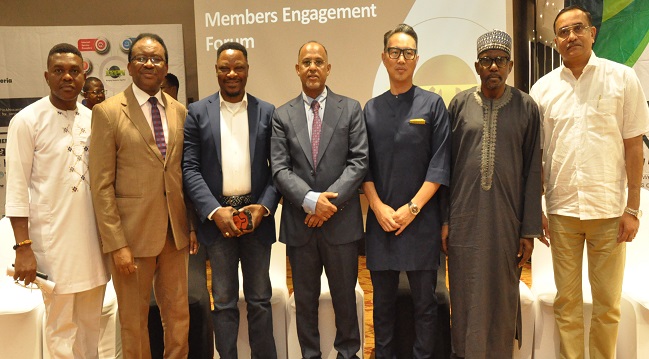
Internet Exchange Point of Nigeria is positioning as a regional Internet Exchange hub for West Africa in terms of infrastructure and traffic. Muhammed Rudman, chief executive officer, IXPN, stated this at its 2026 members engagement forum held in Lagos. He noted some of the major milestone IXPN achieved last year to include one terabit of traffic recorded in March 2025.

“At that time, we became the 63rd internet exchange point in the world. Among all the exchanges in Europe and America and in the entire world, we become the number 63 in the world. To achieve that one terabit of traffic. Again, we were able to achieve two terabits of traffic within seven, eight months of the year.
“We achieve this by ensuring that we push for members to upgrade, those that were on 1 Gig to 10 Gig, those on 10 Gig to 100 Gig. We had a strategic infrastructure upgrade across our networks, put 400 Gig enable switches, increase our fiber links to all the data centers and we onboarded 17 new members last year. All the trainings and the operational excellence ensured that our network is up and running 24/7,” he said.
Industry Impact
The impact of that one terabit traffic is data sovereignty. “We were able to domesticate. Based on the survey we conducted, 54% of our members said that they are exchanging 50% of their traffic and above locally, which is really, significant one.
“We are also setting up a benchmark for other African IXPs. I can assure you that in all the community driven internet exchange points in Africa, we are the number one. There’s a community driven internet exchange point in South Africa that was established 10 years before IXPN. There is one in Kenya that was established 6 years before IXPN, but we are way ahead of them when it comes to internet traffic.
“We are also promoting intra African connectivity. As at today, we have customers from Niger, from, Burkina Faso, trying to reach to Nigeria. Recently, we onboarded a very large company in Ivory Coast, to connect to Nigeria.
“Gradually, Nigeria is tilting towards becoming the regional hub for West Africa, where you see Internet Service Providers coming to achieve that. And in terms of the traffic, in 2015 we were at four Gigabits per second. It moves to 21 in 2017 and 52 gigabits per second.
“But by the year 2023 it has reached 540 gigabits. By 2024 we have reached 900 gigabits. But by the end of 2025 we have achieved the two terabits of traffic”.
Network Infrastructure Development
Some of the technical feet IXPN achieved includes, deployment of sFlow; which is a peer to peer traffic analysis. “We’re able to see what members are exchanging between themselves and between the data centers, not the actual content or information, but rather the volume of traffic, and also between our data centers. And based on this, we’re able to do the upgrades.
“We did a multiple link upgrades from 300 Gigabits last year from Digital Realty to Equinix. It was 300 Gig as at the end of 2024, and by 2025, we’ve increased that to 500 gigabits per second. Digital Realty to Rack Center, it was 200 Gigabits per second. We also upgraded that to 500 Gigabits per second.
Open Access Data Centre to Equinix. We’ve upgraded from 20 Gigabits per second to 200 Gigabits per second. We always monitor the ports, and based on that, we increase immediately we reach the threshold of 80%.
“We did an upgrade on the IXP manager. This allows each member to have a login portal to see the traffic they are exchanging and other details, the port as well as to do their own configuration,” he added.
Technical Project Milestones
Microsoft connected cache. “We deployed Microsoft content cache and that has been deployed in Lagos. It was 25 Gigabits per second as of 2024 by 2025 we had to upgrade the infrastructure to 75 Gigabits per second servers, that will be able to accommodate all the Microsoft updates they are doing, exports, download and among others.
“This is part of the content that Microsoft is not providing locally, but we got those servers deployed, and our intention is by next year to see how we can replicate this across the country. Last year, we also deployed the same server in Abuja so that the Abuja people and the Kano people can reach that content without coming back to Lagos.
The Google Global Cache (GGC); “We are hosting all these at IXPN. We also upgraded from 53 Gigabits per second servers in 2024 to 153 Gigabits per second. And this is a huge traffic of YouTube. And as we speak, we are also working towards upgrading those servers,” he explained.
Strategic Partnerships
“We signed an MoU last year between us and an IXP in Senegal, when we went for West African peering forum. A lot of African ISPs are looking to us to see how we can guide them and support them.
“For example, internet exchange point from Gabon, internet exchange point from Rwanda and ISPs in Africa are looking at us as a model to copy, and we tend to support them. We also had a strategic partnership with CIRA, the Canada Internet Registry Association, which is similar to Nira, the Nigerian Internet Registration Association, to have their secondary authoritative servers into Nigeria as an anycast instance. And when they are hosting that, they are hosting other top-level domains as well, like alibaba.info.org.ca, are also hosted with us.
“Since they launched last year, we have seen a traffic of over 1000 DNS responses per second. Presently, there are 13 global root servers in the world, and those 13 servers are the ones that translate your IP address into a domain name. Any website you browse, you put a domain name, it translates into an IP address and its chain of referrals, Nigeria has.ng as a country, called Top Level Domain”.
Earlier in his welcome address, Charles Nmeregini, Business Development Manager, IXPN, said that the members engagement forum is more than an annual country. “Today, we pause to celebrate the milestone, the milestone that we have reached together, the milestone that have bolstered our local traffic exchange, reduce latency and significantly lower the cost of Internet access across the nations and beyond.
“However, today is equally about the horizon. It is a strategic moment as we unveil our 2026 service road map, a forward-looking rubbing designed to deepen interconnection, enhance service delivery and unlock new value across the ecosystem. In an era defined by rapid technological shift, standing still is not an option.
“This forum will spotlight exclusive, strategic business opportunities, new avenues for growth, enhanced pairing capabilities and innovative service model tailored to give your organization a competitive edge. We are not just exchanging data, we are exchanging ideas that will drive the next wave of Nigeria digital economy,” he added.

NITDA, Abia Partner on Enterprise Architecture Reform

Interswitch Partners Abia to Digitise Public Hospitals

Cyber Immunity Emerges as Shield for Nigerians Amid Rising Scams

WIEG 2026 Summit Shifts to April 22-23 for Maximum Impact

$214Bn Missing, Institutions Silent: Is Accountability Dead in Nigeria?
Nigeria’s 9 Top FinTech Firms Valued at $10.6Bn in January 2026

Kaspersky Launches OT Calculator to Align Cybersecurity Investments with Business Goals

CBN Upgrades Licences of Opay, Moniepoint, Kuda, Palmpay, Paga to National Status

NITDA, NBC Explore Strategic Collaboration on Digital Transformation, Media Regulation

Accidental Billionaire Opts for Jail Instead of Returning Money Credited Him by Mistake




 Telecom2 days ago
Group Condemns Gabon’s Social Media Shutdown Amid Protests

 E-Financial3 days ago
ACAMB Educates Content Creator to Curb Misinformation on Bank Recapitalisation

 General News2 days ago
How JustMarkets Is Empowering African Traders with Global Market Access

 Telecom2 days ago
IXPN Positions as the Regional Internet Exchange Hub for West Africa

 E-Business2 days ago
Mutual Benefits Assurance Settles ₦5.9bn Claims in January 2026

 Telecom2 days ago
Menxtt NG Emerges as Nigeria’s Virtual IT Hub for Premium Devices, Solutions

 Broadcasting2 days ago
Pheelz Shares His Journey on Glo-Sponsored African Voices

 E-Business2 days ago
NITDA DG Reaffirms FG Commitment to Responsible and Inclusive AI