

News
NigComSat: FG Disclaims Autonomy, Commits to 100% Privatization


Ministry of Communications Technology, the ministry supervising Nigeria Communications Satellite Limited, (NigComSat) at the weekend said it was not aware of any bill seeking to grant NigComSat autonomy.
The ministry said that its first intention was to privatize Nigeria Communications Satellite Limited for better performance.
The ministry was reacting to against the backdrop of the clamor for autonomy by the Company through NigComSat Corporation bill that seeks to free the company from government control.
Mr. Ola Ogunleye, special assistant on Information Technology to Minister of Communications Technology, told Nigeria CommunicationsWeek that the ministry is only interested in making NigComSat play its role in making internet truly ubiquitous, affordable and accessible in the country.
It would be recalled that NigComSat’s bill to make the state satellite operator an independent corporation has stirred mixed reactions with huge opposition.
Critics urged the national assembly to exercise caution to prevent the company from going the the way of Nitel.
But Timasaniyu Ahmed-Rufai, chief executive officer of the company said that the bill will allow NigComSat to raise additional financing and pursue strategic partnerships.
Nodding in agreement, Victor Nwakesi , representative of Olisa Agbakoba & Associates, the law firm responsible for the drafting of the NigComSat bill, explained that the bill is much desired and that passage will aid Nigeria’s emerging development issue.
According to him, the contents of the NigComSat bill have been developed to align with what the laws allow. “NigComsat should be protected in the best interest of the citizens,” he said.
Support has also come from Yele Okeremi , member, Executive Committee of Institute of Software Practitioners of Nigeria (Ispon) who said that: “We must perceive satellite communication as critical national infrastructure which requires everything to protect including legislation and we must sit down to see that we do everything to see that this bill become a law.”
He listed technology, social perception and legislation as the tripod that must be present before a revolution can happen.
Bayo Banjo, president, Nigeria Internet Group, however argued that the bill will transform NigComSat to a fully-owned government company.
“I do not see a reason for this bill because the company is already a limited liability. The bill is not in the interest of Nigeria. It will not serve the purpose of Nigerians.” Banjo noted.
He submitted that rather than having the NigComSat bill passed, it should be jettisoned with the best option to have it privatised.
Dr. Emmanuel Ekuwem, chairman Teledom Group cautioned that the bill, when passed, might give NigComSat the autonomy to operate as a business venture and as a regulator.
He noted that government has no business in doing business, but to create enabling environment for businesses to thrive.
Eng. Lanre Ajayi, president, Association of Telecoms Companies of Nigeria and chairman of the occasion, noted that there was a need to guide the Senate, as citizens, to let them know the need for Satellite Company to be able to run businesses on its own with less government bureaucracy.
Ajayi noted that satellite technology is a very desirable technology in Nigeria, noting however, that this was not to say that other terrestrial technologies are not very relevant but they are complementary.
“The major advantage of satellite is its ubiquity. In a country like ours, where we have many rural communities, satellite becomes an option. If we must progress, we cannot run away from developing satellite technology and government must support this.” Ajayi
He, however, expressed the view that NigComSat might go the way of Nigerian Telecommunications Limited, “because with the Act, it appears we are now putting it in the hands of the law makers.”



EFCC


The African Development Bank Group last week approved an investment of €6.5 million in the Saviu II fund in order to support technology start-ups through their seed phase and first institutional fundraising, mainly in French-speaking Central and West Africa.

The Bank will invest €4.5 million as equity and €2 million as a first-loss hedging tranche on behalf of the European Commission, under the Boost Africa Programme.
This participation of the Bank Group will enable the Saviu II fund to give priority to companies with a strong technological or digital component.
Saviu II, the second investment vehicle of Saviu Partners, plans to invest between €500,000 and €3 million in about 20 technology or technology-oriented business-to-business start-ups in the seed phase or carrying out first institutional fundraising.
The Saviu II venture capital fund aims to make at least 60% of its commitments in the French-speaking countries of West and Central Africa: Côte d ‘Ivoire, Cameroon, Benin, Senegal, Togo, Burkina Faso and Mali.
The fund can also co-invest in promising technology companies in East Africa that have a strong team and business model, and whose strategy includes entering the market in French-speaking West African countries and establishing a strong presence there.
In addition, the fund will devote a dedicated envelope to pre-seed investments, focusing on minority equity investments, usually in co-investment with studios, incubators or other ecosystem partners.
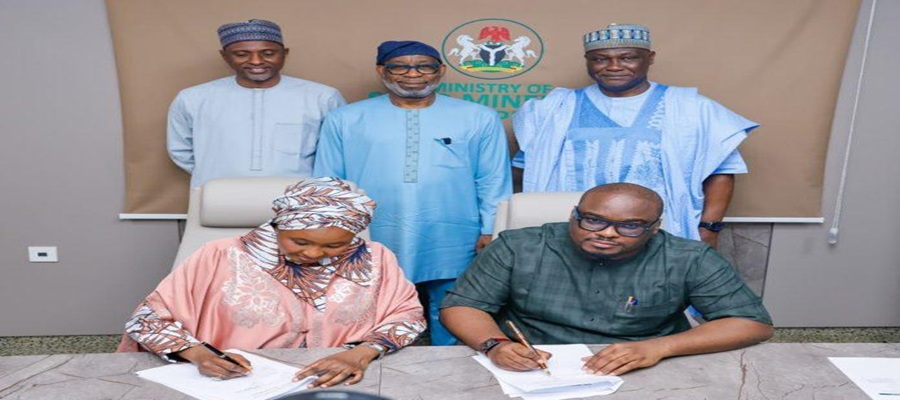
Nigerian Government has signed a $1.3 billion Memorandum of Understanding (MoU) with Africa Finance Corporation (AFC) via the Solid Minerals Development Fund (SMDF) to fund an alumina refinery, national geoscience mapping, and a strategic investment vehicle for mining growth.

Special Assistant to the Minister of Solid Minerals Development, Segun Tomori, said the refinery will process one million tonnes of bauxite yearly using a modern Bayer process, powered by an on-site gas-fired cogeneration plant.
Minister Dele Alake called it a transformative milestone boosting GDP, aligning with reforms that improve investment climate, regulations, and licensing to attract private capital. He directed agencies to fast-track permits.
The 20-year project at 95% utilization eyes 19 million tonnes total output, $1.2 billion annual GDP addition, $25 billion economic impact, and $8 billion forex earnings, per feasibility studies.
SMDF Executive Secretary Fatima Shinkafi termed it the agency’s biggest funding deal, supporting value-addition policy.
The partnership extends to geoscience mapping for mineral data, de-risking exploration, and a joint vehicle for mining assets.
Permanent Secretary Engr. Farouk Yabo praised the reforms. Shinkafi signed for government; AFC’s Franklin Edochie for the corporation, witnessed by AFC CEO Samaila Zubairu.
Tomori positioned it as Nigeria’s largest private mining investment and FDI magnet.

GCR Affirms Afreximbank’s International Scale Ratings of A, A2

SmartCash Launches ‘No Be Cho Cho Cho’ Campaign to Boost Digital Banking in Nigeria

MTN Nigeria Non-Executive Director Mazen Mroue Quits to Focus on Group Role

Google Adds Yorùbá, Hausa to AI Search, Boosting Access for Millions of Nigerians

MultiChoice Shuts Down Showmax After 11 Years Amid Streaming Wars

Dr. Cairo Ojougboh Foundation Bolsters Nigeria’s Education Drive with ₦2.7m Student Support

Kaspersky Brings more Transparency to Threat Detection with New Hunt Hub

NDPC Commits to Balancing Data Privacy, Protection Information

PwC Reveals AI Scaling Gap Slows Africa’s Digital Transformation

Firm Reviews the Evolution of Phishing Threats in 2025




 E-Financial2 days ago
NRS Targets N40trillion in Tax, Royalty Revenue in 2026

 General News2 days ago
Purple Woman 3.0 Is Back, to Empower Women in Tech this IWD 2026

 E-Financial2 days ago
SEC Revokes Registration of Kensington Agro Trading Limited

 News2 days ago
EFCC Arraigns Two FSDH Bank Officials Over $307k, €50k Fraud

 Telecom2 days ago
Konga Launches ‘Berekete Sales’ with Up to 50% Discounts Across Major Categories
 E-Business2 days ago
NDPC, 60 DPAs Collaborate on Enforcing Privacy Rights in the Use of Al

 General News2 days ago
NCDC Raises Alarm over Lassa Fever Ravaging 18 States in Nigeria

 E-Financial1 day ago
Nigeria’s VAT Jumps 34%, CIT Soars 48% to ₦14trn in 9M’25 – NBS