

News
Nigerian, South African Changemakers Share Secrets of Success

Choreographer and actor, Seyi Oluyole, will be sharing her perspective on how to inspire African children to succeed in the latest episode of the popular television magazine, CNN African Voices Changemakers, sponsored by telecommunications giant, Globacom.
The edition features Oluyole and a South African choreographer, Gcina Mhlophe, two Africans doing very well in the field of creative dancing and storytelling.
Oluyole, 27, who is also a film director, will showcase how she has used her love for choreography to positively influence street kids and rechannel their energies towards positive ends.
Oluyole, a graduate of English and Literary Studies from Covenant University, founded a non-governmental organisation named The Dream Nurture Foundation to cater for poor children and adults in need of mentoring.
She also provides educational opportunities for them through the NGO. Similarly, her dance academy, Dream Catchers, uses dance as a major tool in getting indigent children back to school in line with her belief that “every child deserves to succeed irrespective of their background”.
Aside from this, Oluwole has also been involved in screenwriting for first-rate television series such as Tinsel, Hustle and Gbera, a short film which she directed. Her commitment to the cause of children has attracted the attention of world music star, Rihanna, who recently tipped Oluyole’s mentees for stardom.
The other guest in the edition is the 60-year-old Nokugcina Elsie Mhlophe, a South African dancer, actress, storyteller, poet, playwright, director and author.
Mhlophe uses storytelling as a means of recounting the tales of subjugation during the apartheid years and the gains of freedom which the Rainbow Nation currently enjoys.
Mhlophe was born in KwaZulu Natal into a humble background, working as a domestic servant in the early part of her working life. She later progressed to a newsreader at the Press Trust and BBC Radio, and subsequently became a writer for Learn and Teach, a magazine for newly-literate post-apartheid South Africans.
Mhlophe has performed in theatres in Soweto and London. A good number of her works have been translated into German, French, Italian, Swahili and Japanese. She has won the Obie Award for Performance as well as the Astrid Lindgren Memorial Award.
She continues to traverse Africa and other parts of the globe, giving storytelling workshops on folklore, historical information, current affairs, songs and idioms.
Catch CNN African Voices Changemakers on DSTV on Friday at 9.30 a.m. and on Saturday at 12.30 a.m., 4.30 p.m. and 8.30 p.m. Other repeat broadcasts come up on Sunday at 5.00 a.m., 9.30 a.m. and 8.30 p.m. with more repeats on Monday and Tuesday at 5.30 a.m. and 6.30 p.m. respectively.



EFCC

The African Development Bank Group last week approved an investment of €6.5 million in the Saviu II fund in order to support technology start-ups through their seed phase and first institutional fundraising, mainly in French-speaking Central and West Africa.

The Bank will invest €4.5 million as equity and €2 million as a first-loss hedging tranche on behalf of the European Commission, under the Boost Africa Programme.
This participation of the Bank Group will enable the Saviu II fund to give priority to companies with a strong technological or digital component.
Saviu II, the second investment vehicle of Saviu Partners, plans to invest between €500,000 and €3 million in about 20 technology or technology-oriented business-to-business start-ups in the seed phase or carrying out first institutional fundraising.
The Saviu II venture capital fund aims to make at least 60% of its commitments in the French-speaking countries of West and Central Africa: Côte d ‘Ivoire, Cameroon, Benin, Senegal, Togo, Burkina Faso and Mali.
The fund can also co-invest in promising technology companies in East Africa that have a strong team and business model, and whose strategy includes entering the market in French-speaking West African countries and establishing a strong presence there.
In addition, the fund will devote a dedicated envelope to pre-seed investments, focusing on minority equity investments, usually in co-investment with studios, incubators or other ecosystem partners.
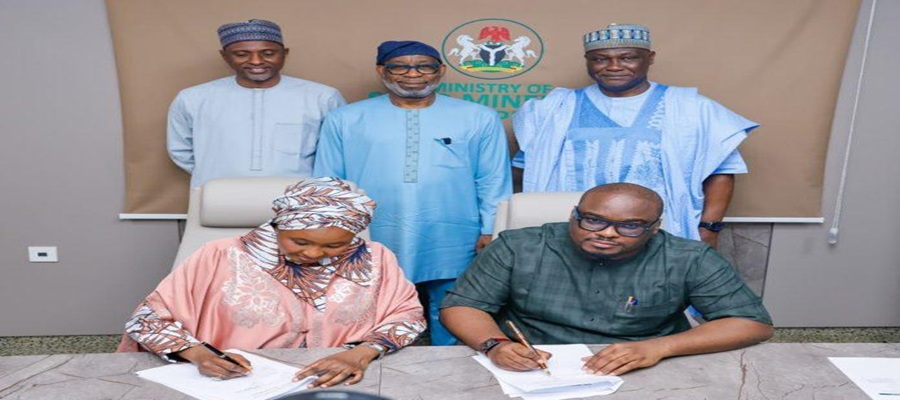
Nigerian Government has signed a $1.3 billion Memorandum of Understanding (MoU) with Africa Finance Corporation (AFC) via the Solid Minerals Development Fund (SMDF) to fund an alumina refinery, national geoscience mapping, and a strategic investment vehicle for mining growth.

Special Assistant to the Minister of Solid Minerals Development, Segun Tomori, said the refinery will process one million tonnes of bauxite yearly using a modern Bayer process, powered by an on-site gas-fired cogeneration plant.
Minister Dele Alake called it a transformative milestone boosting GDP, aligning with reforms that improve investment climate, regulations, and licensing to attract private capital. He directed agencies to fast-track permits.
The 20-year project at 95% utilization eyes 19 million tonnes total output, $1.2 billion annual GDP addition, $25 billion economic impact, and $8 billion forex earnings, per feasibility studies.
SMDF Executive Secretary Fatima Shinkafi termed it the agency’s biggest funding deal, supporting value-addition policy.
The partnership extends to geoscience mapping for mineral data, de-risking exploration, and a joint vehicle for mining assets.
Permanent Secretary Engr. Farouk Yabo praised the reforms. Shinkafi signed for government; AFC’s Franklin Edochie for the corporation, witnessed by AFC CEO Samaila Zubairu.
Tomori positioned it as Nigeria’s largest private mining investment and FDI magnet.

GCR Affirms Afreximbank’s International Scale Ratings of A, A2

SmartCash Launches ‘No Be Cho Cho Cho’ Campaign to Boost Digital Banking in Nigeria

MTN Nigeria Non-Executive Director Mazen Mroue Quits to Focus on Group Role

Google Adds Yorùbá, Hausa to AI Search, Boosting Access for Millions of Nigerians

MultiChoice Shuts Down Showmax After 11 Years Amid Streaming Wars

Dr. Cairo Ojougboh Foundation Bolsters Nigeria’s Education Drive with ₦2.7m Student Support

Kaspersky Brings more Transparency to Threat Detection with New Hunt Hub

NDPC Commits to Balancing Data Privacy, Protection Information

PwC Reveals AI Scaling Gap Slows Africa’s Digital Transformation

Firm Reviews the Evolution of Phishing Threats in 2025




 E-Financial3 days ago
NRS Targets N40trillion in Tax, Royalty Revenue in 2026

 General News3 days ago
Purple Woman 3.0 Is Back, to Empower Women in Tech this IWD 2026

 E-Financial3 days ago
SEC Revokes Registration of Kensington Agro Trading Limited

 News3 days ago
EFCC Arraigns Two FSDH Bank Officials Over $307k, €50k Fraud
 E-Business3 days ago
NDPC, 60 DPAs Collaborate on Enforcing Privacy Rights in the Use of Al

 Telecom3 days ago
Konga Launches ‘Berekete Sales’ with Up to 50% Discounts Across Major Categories

 E-Financial2 days ago
Nigeria’s VAT Jumps 34%, CIT Soars 48% to ₦14trn in 9M’25 – NBS

 Telecom2 days ago
FG Approves GIS-enabled Digital Postcode to Tackle Logistics Gaps, Boost E-commerce