

News
Nigerian, Team Mates Win £15,000 at SWIFT Fintech Competition

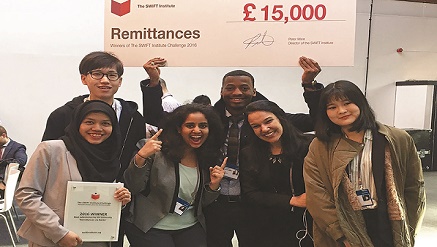
Nigerian Mohammed Dankwambo will share £15,000 with five other university students after their Fintech idea wowed judges at the SWIFT Business Forum London.
The team called HADU from the UK’s Warwick Business School (WBS) beat six other teams – including three more from WBS – in the final to win the inaugural SWIFT Institute Challenge.
Mohammed, of Gombe, Nigeria, and team-mates Fiza Hussain, Sneha Sunkara, Yunjing Li, Yat Hung To and Qotrun Nada Haroen, were presented with the cheque by Harriett Baldwin, Economic Secretary to the Treasury, and they also won a trip to Sibos, the annual financial services event held in Geneva this September by SWIFT (Society for Worldwide Interbank Financial Telecommunication) – the global network that enables financial institutions to send and receive information about financial transactions.
Tasked with identifying a solution to address the challenge of remittances via banks in the UK, HADU presented a solution that focused on using near sound data technology to deliver mobile money and a network of branded high-security buses to do the ‘last mile’ and deliver the cash in Indonesia.
Mohammed said: “We were so excited when we heard our name on stage, even after one day, we still can’t believe it. We are very happy and really looking forward to further develop our idea.”
“This is a great win for WBS and the University that reflects the quality of the research and teaching at Warwick,” said Markos Zachariadis, Assistant Professor of Information Systems Management & Innovation and co-author of The Society for Worldwide Interbank Financial Telecommunication (SWIFT): Cooperative governance for network innovation, standards, and community.
“The SWIFT Institute Challenge has provided a great opportunity for students to work on real issues from the financial industry. Congratulations to all the finalists and to the winning team. We are very proud of the students.
“Our Fintech module at the school is part of our MSc in Information Systems Management & Innovation course and has been going for three years now, with our graduates landing jobs in major financial institutions and already making an impact.
“We will seek to develop more Fintech initiatives in the coming years.”
The 2016 Challenge was open to any UK-based recognised university, or centre of learning, with an interest in banking and asked students for a solution that would enable someone to send money from their UK bank account to an individual in a country where there is little or no banking infrastructure.
Held at the Tobacco Dock in London, each team was given 10 minutes to pitch their idea to the judges who came from across the financial services industry.
They took on teams from King’s College London, Queen Mary University of London and London School of Economics and Politics, with HADU coming out on top.
HADU will have their travel and expenses paid for to attend SWIFT’s annual financial services event, Sibos, and the opportunity to pitch their developed solution at the conference in Switzerland.
Commenting on the Challenge, Ms Baldwin said: “Innovation in payments solves real-world problems and has the ability to change how we, as consumers, interact with our money. That’s why it’s so exciting to see the projects from today’s SWIFT competition teams looking at how we can make remittances easier, cheaper and more efficient for people in the UK and around the world.
“Financial technology plays a vital role in stimulating greater competition, improving access and helping to drive transaction costs down. That’s just one of the many reasons the Government is doing all it can to support the UK’s dynamic Fintech sector.”
Peter Ware, Director at SWIFT Institute, said: “This is the first year for the Challenge, and we have been very impressed by the quality of the submissions and presentations from the UK Universities involved.
“An interest in banking is important but equally, so is an enthusiasm for devising new and cutting-edge ideas that could really make a difference. They all understand important world issues and are able to think outside the barriers that can exist in a corporate mindset.”


Lotus bank has strengthened its push for inclusive and sustainable development through a strategic partnership with the Rural Electrification Agency (REA) to widen access to renewable energy solutions in underserved communities nationwide.

The collaboration was formalised on Monday in Abuja with the signing of a Memorandum of Understanding (MoU), under which LOTUS Bank will make available up to N100 billion in accessible financing to certified Renewable Energy Service Companies (RESCOs). The funding is expected to ease capital constraints that have slowed the pace of off-grid electrification projects across rural Nigeria.
Speaking at the signing ceremony, Managing Director/Chief Executive Officer of LOTUS Bank, Dr. Isiaka Ajani-Lawal, described the partnership as a practical demonstration of the Bank’s founding philosophy.
“LOTUS Bank was established to redefine the impact that financial institutions can have on the society we serve – not simply through financing, but through partnership, empowerment, and shared prosperity,” he said.
Ajani-Lawal stressed that the initiative aligns with the Bank’s broader mission of deploying ethical, non-interest finance to address pressing national development priorities.
“Our involvement with REA and the DARES program underscores our commitment to supporting sustainable development goals, while driving financial inclusion across Nigeria. We believe non-interest finance must go beyond innovation — it must deliver tangible socio-economic value to all segments of society,” Ajani-Lawal assured.
On his part, REA Managing Director/Chief Executive Officer, Abba Abubakar Aliyu, underscored the urgency of tackling financing gaps confronting renewable energy developers, particularly in the off-grid segment.
“While Nigeria has made strides in expanding energy access, financing remains a key constraint for RESCOs. Collaborations like this are essential in unlocking private sector investment and delivering sustainable energy solutions at scale,” Aliyu said.
Industry observers note that the partnership is poised to accelerate clean energy deployment, reduce financing bottlenecks, and catalyse private sector participation in Nigeria’s electrification drive.
It also aligns with the country’s National Electrification Strategy and Implementation Plan (NESIP) and advances Sustainable Development Goal 7 (SDG7), which seeks to ensure access to affordable, reliable and clean energy for all.
Since commencing operations in 2021, LOTUS Bank has carved a niche as a non-interest lender focused on financial inclusion. The Bank has rolled out innovative products tailored to individuals, women, youth and micro, small and medium enterprises (MSMEs), while investing in digital platforms to broaden access to ethical banking services across urban and rural communities.
Its interventions span community empowerment initiatives, corporate social responsibility programmes, and financial literacy campaigns designed to deepen understanding and adoption of non-interest banking principles.
In recognition of its expanding footprint in ethical finance, LOTUS Bank was recently named “Best Ethical and Financial Inclusion Bank of the Year” at the 2025 BusinessDay BAFI Awards, further cementing its reputation as a leading advocate of impact-driven banking in Nigeria.

The Federal Government of Nigeria has reaffirmed its commitment to building a responsible, inclusive, and sovereign artificial intelligence ecosystem to enable Nigeria to transition from being a passive consumer of AI technologies to an architect and builder of indigenous AI systems.

This was said by the Director General of the National Information Technology Development Agency (NITDA), Kashifu Inuwa Abdullahi CCIE, while delivering a virtual address at the InnovateAI Conference held in Lagos.
The conference brought together policymakers, technology leaders, innovators, and stakeholders to discuss the future of artificial intelligence and its role in driving Nigeria’s digital economy and national development agenda.
Inuwa outlined Nigeria’s ambition to transition from being a consumer of artificial intelligence technologies to becoming a builder and owner of AI systems that reflect national values and priorities, in line with the National AI Strategy.
“Our goal is not just to use AI, but to architect and build our own AI systems in Nigeria,” he said, stressing that the country must take ownership of its AI future.
He noted that Nigeria’s approach to artificial intelligence extends beyond innovation to include governance, infrastructure, data sovereignty, and policy evolution.
According to him, “Responsible AI is never a finished job; it is an iterative journey. Our policies must evolve as the technology evolves, and we must avoid frozen laws by adopting living policies that adapt over time.”
He cited the implementation of the Digital Economy and E-Governance Bill as a key mechanism for generating insights that will help refine AI regulations and governance frameworks.
Inuwa also highlighted the challenge of data representation in global AI systems, noting that most models are trained on non-African datasets, which often results in bias against local dialects, cultures, and demographics.
“If a model shows bias against a local dialect or demographic, we cannot just patch it. We must reinvest in infrastructure to retrain it with inclusive and representative local datasets,” he stated.
He added that building national AI infrastructure is critical to achieving data sovereignty and ensuring that Nigeria is not merely an end user of foreign AI systems.
He further called for strategic partnerships with global technology companies and hyperscalers to build AI infrastructure in Nigeria while aligning with local values and national priorities.
“The world today is a global village. We need to work with global players, but they must understand our local nuances and help us build the infrastructure to retrain and develop AI models that reflect our context,” he said.
The NITDA Director General explained that adopting a comprehensive AI lifecycle approach, from responsible data collection and governance to deployment and continuous feedback, will enable Nigeria to move from reacting to AI developments to proactively designing indigenous AI systems.
“Without understanding how AI models are trained, how decisions are made, and how models are retrained, it will be difficult to build a responsible and trustworthy AI system,” he warned.
He reaffirmed that the Federal Government is intentional about promoting responsible AI and is working closely with the technology ecosystem to co-design national AI guardrails. He described platforms such as the InnovateAI Conference and other national AI dialogues as critical to shaping Nigeria’s AI future.

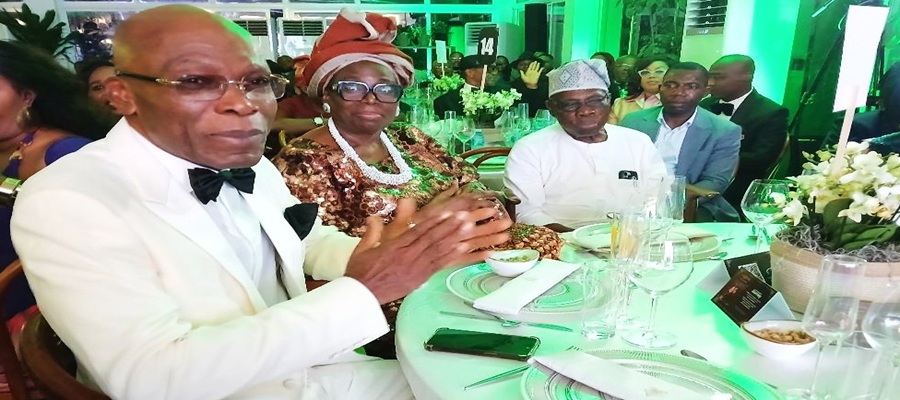
African statesman and former Nigeria President, Chief Olusegun Obasanjo, on Sunday night, joined several distinguished Nigerians including Mr Sam Amuka, media icon and Publisher of Vanguard newspaper, to pray for Leo Stan Ekeh, Chairman of Zinox Group, on his 70th birthday.

R-L President Olusegun Obasanjo, his wife Chief Mrs Bola Obasanjo and Mr. Leo Stan Ekeh at the event
Obasanjo who graced the thanksgiving meeting with his wife among other dignitaries prayed for more years on earth for Ekeh, whom he described as an “achiever and a very kind man who deserves to be celebrated.” The meeting which held in Ekeh’s residence was organised by his wife and children with opening prayer said by Reverend Father Francis Ike, of the Church of Assumption Falomo, Ikoyi.
Obasanjo who was President of Nigeria from 1999 to 2007 described Ekeh as “one of the people who made it possible for people to say the good things they say about me and about my period in government.”
President Obasanjo who never hid his admiration and love for Ekeh showered praises on the tech billionaire for taking advantage of the opportunities he created during his eight years as President.
He said: “Leo Stan Ekeh is a very kind man, an achiever. People have been celebrating you but I particularly have to celebrate you because of what you mean to me. Wherever I go in Nigeria and outside Nigeria, people say to me, you did this and that especially in enhancing both local and foreign investments. An African President, five months ago, even invited me to his country to show him how I was able to create many billionaires in Nigeria during my tenure.
“I celebrate Leo Stan because it is one thing to create an opportunity, it is another thing to find people who will even see that as opportunity and take advantage of it and achieve success with those opportunities. Leo Stan is one of the people who made it possible for people to say the good things they say about me and about my period in government.
“That’s why I have to join your family and every other person in identifying those qualities in you that made you a great achiever that you have been. The lesson for all of us is that in spite of the hardship, there are still opportunities. The challenge is how to identify those opportunities and take advantage of them and individually and collectively turn our poverty into prosperity just as Leo Stan has done.”
Obasanjo while thanking God for the gift of long life told Ekeh: “Today, you are celebrating 70 and I am here with you at your invitation. You will celebrate 80, whether you invite me or not, I will be there. You will celebrate 90, you will celebrate 100 and I don’t pray to be there,” he said wittily, eliciting laughter from guests.
Aside Obasanjo and Amuka, others who joined in honouring Ekeh were former Lagos state governor, Babatunde Raji Fashola and his wife, former INEC Chairman, Professor Maurice Iwu and his wife, Chairman of MTN, Dr. Ernest Ndukwe and his wife; Mr. Atedo Peterside, Founder of Stanbic IBTC Bank and his wife; Chairman of Fidelity Bank, Mrs Amaka Onwughalu; Managing Director Fidelity Bank, Dr. Nneka Onyeali-Ikpe; Mr. Udoma Udo-Udoma, Chairman Seplat Energy and his wife; secondary school mates of Ekeh including Charles Oputa (Charly Boy) who came with his wife; Leo Stan’s elder brother HRM Eze George Ekeh (aka Saint George), the traditional ruler Ishi Ubomiri Autonomous Community in Imo state who performed the traditional rites to usher Leo Stan into the traditional club of Elders of Ubomiri; representatives of multinationals with whom he has partnered all through the years; among other distinguished Nigerians and foreigners.
Ekeh in his response thanked Obasanjo for adopting him as his son and trusting him. He attributed his success to the prayers and blessings of Obasanjo, describing him as the President who made most of the billionaires in Nigeria.
The Zinox boss who recalled his little beginning as a mass servant and chorister, said he chose his path early in life, refusing to drink alcohol and smoke cigarette, and keeping to it till this day.
“I am a promoter of trust economy and I believe that trust must define everything you do if you want to succeed,” he said.
He recalled how he woke his parents one night to tell them he was going to start a tech business which sounded strange to them because technology was non-existent in his state at that time.
He acknowledged the role of his wife in his life. “My wife is my strength. I was very clear I was going to marry an intelligent woman. My wife ticked all the boxes for me,” he told the audience.
“I started my business with my school fees and I have been able to build myself and my companies as collateral. People trust me and trust my companies because I was intentional about building trust and integrity in all we do,” he said.

MultiChoice Suspends Yearly DStv Price Hike as Canal+ Pushes Growth

Lotus Bank, REA Seal N100Bn Deal to Power Rural Nigeria

DG NITDA Reaffirms FG Commitment to Responsible, Inclusive AI

AfDB, UNDP Launch $10Bn AI Initiative for Africa

Kaspersky Enhances Network Detection and Response Capabilities with KATA 8.0 Release
Nigeria’s 9 Top FinTech Firms Valued at $10.6Bn in January 2026

CBN Upgrades Licences of Opay, Moniepoint, Kuda, Palmpay, Paga to National Status

NITDA, NBC Explore Strategic Collaboration on Digital Transformation, Media Regulation

Kaspersky Launches OT Calculator to Align Cybersecurity Investments with Business Goals

Accidental Billionaire Opts for Jail Instead of Returning Money Credited Him by Mistake




 General News3 days ago
Zinox Technologies and TD Africa Forge Strategic Partnership to Revolutionize African Tech Ecosystem

 Telecom3 days ago
Uwaje Pays Tribute to Leo Stan Ekeh @70

 Telecom2 days ago
Cyber Immunity Emerges as Shield for Nigerians Amid Rising Scams

 E-Financial2 days ago
$214Bn Missing, Institutions Silent: Is Accountability Dead in Nigeria?

 General News2 days ago
NITDA, Abia Partner on Enterprise Architecture Reform

 E-Business2 days ago
Interswitch Partners Abia to Digitise Public Hospitals

 E-Business2 days ago
WIEG 2026 Summit Shifts to April 22-23 for Maximum Impact

 News1 day ago
NITDA Urges Stronger State Partnerships as Key to Digital Economy Goals @ South-South Stakeholders Forum