

News
NITDA Flags Off TIES Scheme in Six Geopolitical Zones

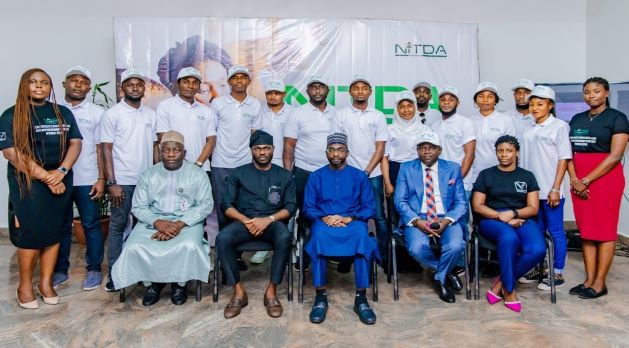
In furtherance to the delivery of the President Muhammadu Buhari, GCFR, administrative ambitious policy of uplifting 100 million Nigerians out of poverty, the National Information Technology Development Agency (NITDA) is harnessing the innovative talent of the nation’s youths and providing them with the necessary support to build the required digital skills and viable tech businesses to significantly contribute to job creation and economic prosperity for Nigeria through the Technology Innovation and Entrepreneurship Support (TIES) Scheme.

Kashifu Inuwa CCIE, the Director General and CEO of NITDA officially flagged off the TIES Scheme during a hybrid session that took place live at the Venture Park Hub in Abuja while other locations like Lagos, Port Harcourt, Katsina, Kano, and Enugu joined virtually.
While applauding the startups stride towards the pursuit of providing solution to identified gaps in the society, he gave a brief narrative of the impact of the startup community on the Nation’s economy within the last two years.
He said, “Nigeria’s flourishing startup ecosystem has continued to attract global attention as evidenced by a total investment of $2.9 billion between 2021 and 2022 as reported by Africa: The Big Deal; the highest raised by any startup ecosystem in Africa. Additionally, Nigeria is home to 5 unicorn startups out of the 7 in Africa. These and other significant milestones point to the enormous potential of the ecosystem in contributing to creating wealth and economic growth for Nigeria’’.
Kashifu additionally noted that, President Buhari’s administration had recently enacted the Nigeria Startup Act (NSA), which is aimed at, among others: to provide a legal and institutional framework for the development of startups; to provide an enabling environment for establishment and operation of startups; to provide opportunities for the development and growth of tech-related talents; and to position Nigeria’s startup ecosystem as the leading digital technology center in Africa.
He affirmed that the NSA was the outcome of the collaborative efforts of the ecosystem and the Presidency, as spearheaded by the Federal Ministry of Communications and Digital Economy, under the leadership of the Honourable Minister, Professor Isa Ali Ibrahim (Pantami), and a clear pointer to the government’s commitment to developing a more successful and thriving tech ecosystem for the development of Nigeria’s digital economy into a knowledge-based and IT-driven economy.
He further disclosed how NITDA had conceptualised and designed the TIES Scheme during the COVID-19 pandemic, as a capacity building programme targeted at addressing the digital skills gaps through trainings for hub managers, provision of incubation work to ensure massive creation of entrepreneurs and jobs within the ecosystem for young Nigerians.
“As an Agency, we noticed that most of the young talented people who have ideas lack mentorship.” He added that “innovative solutions are needed to tackle the problems in the country which NITDA is helping by creating the avenue that would provide a balance between the innovators and the markets,” he added.
He was optimistic that the TIES Scheme would accelerate the prosperity of the country, while enabling NITDA on delivering the target of achieving 95% digital literacy by the year 2030.
The Chairman of the TIES committee Dr. Abdullahi Usman Gambo, Director of Information Technology Infrastructure Solutions (ITIS) NITDA expressed his optimism about the success of the program through the support of the industry partners.
He said that NITDA is expecting the partners to help achieve the target number of trainers within the stipulated time frame through the train-the-trainer method.
Mr. Jayeola Okuazun, the General Manager of Venture Park Hub in his remarks expressed his gratitude to the Federal government for providing a bridging the gap for your young talented entrepreneurs.
“Our mission is very clear, we are here to build the future of Africa and to be able to do that in my language we speak a lot of proverbs, there is one that says one hand cannot lift a load on one’s head”, indicating that collaborative measures between the Federal Government and the various Hubs would enhance the development of the nation.
Other Tech partners include Quantum Business, Blue Saphire Hub, Venture Park, Young Innovators, and Cherish Enterprise Institute.
Mr. Okuazun later took the NITDA team on a tour of the facility, showcasing the various opportunities available to young digital natives.



Board and management of Communication Week Media Limited, publishers of Nigeria CommunicationsWeek, at the weekend announced that this year’s Africa’s Beacon of ICT Merit and Leadership lecture will focus on Impact of AI and IoT on business operational efficiency.

Africa’s Beacon of ICT Merit and Leadership lecture, widely regarded as the most prestigious annual event available in the ICT industry in Nigeria is in its 17th year.
The lecture holds on May 30, 2026 at Oriental Hotel Lekki, Lagos, according Ken Nwogbo, editor-in-chief of
Nigeria CommunicationsWeek the organizers of the event.
He said that this year’s event “is digital transformation edition” to recognise and celebrate organizations and individuals in the ICT industry that have impacted in digital transformation of the economy.
“Most of these organizations and individuals have consistently being voted by our readers as leaders in their areas of operations and we have decided to reward them in this special edition, tag: ‘Digital Transformation Edition 2026’ he said,”.
He added that, Digital transformation, driven by AI and IoT, will fundamentally boosts business operational efficiency by automating complex tasks, enabling real-time data analysis, and reducing costs.
“IoT technology optimizes resources, predict maintenance needs, and enhance decision- making, allowing companies to streamline workflows and improve productivity across sectors like manufacturing and logistics.
“It is an emerging technology that has impacted lifestyles and has changed the way we think and act, and the way we interact with each other.
It has also changed the way we work as it enables very large-scale monitoring, control, and automation, and has impacted the digital transformation of organizations in different industries”, he said.
According to him, “the transformative power of Artificial Intelligence exists as a bringing force in organizational communication. AI tools perform repetitive jobs, deliver simultaneous translations, and register team communication patterns, which lead to better understanding of group interactions. AI chatbots help manage customer support inquiries thus enabling staff members to dedicate their efforts toward complex work activities”.
The Africa’s Beacon of ICT Merit and Leadership Distinguished (ABoICT Lecture 2026) is designed to explore efforts to put Nigeria on the global Information and Communications Technologies map.
The lecture series however is reserved for distinguished achievers in the ICT sector.
Past lecturers included Dr. Ernest Ndukwe, then executive vice chairman, Nigeria Communications Commission (NCC); Uche Orji, managing director/chief executive officer, Nigeria Sovereign Investment Authority (NSIA); Biodu Omoniyi, Managing Director/CEO, VDT Communications; Ayotunde Coker, former Managing Director, Rack Centre Limited; Prof. Adewale Obadare, chief visionary officer, Digital Encode; Dr. Oluseyi Akindeinde, founder,
Hyperspace & NeuraL AI and John Obaro, CEO and founder of Systemspecs; Prof. Isa Pantanmi, former minister of Communications and Digital Economy; among others.

Global technology markets are entering a new phase of strain as surging memory chip prices intensify the ongoing semiconductor shortage. For Nigeria, the ripple effects could translate into a 15 – 20 per cent increase in phone price levels if supply pressures persist into the next quarter.

While attention has largely focused on advanced AI processors, the sharpest escalation is occurring in memory chips, specifically DRAM (Dynamic Random Access Memory) and NAND (Flash Memory), which are essential to smartphones, PCs, and vehicles.
According to Bloomberg data, spot prices for DRAM have surged more than 600 percent in recent months. NAND prices have also climbed as artificial intelligence infrastructure expands global storage demand.
This shift reflects a structural realignment rather than a short-term disruption.
Massive AI infrastructure investments led by hyperscalers such as Amazon have redirected fabrication capacity toward high-bandwidth memory (HBM), a critical component for AI accelerators. This shift has tightened supply for conventional memory used in consumer devices.
Market analysts now describe the situation as a memory “supercycle,” breaking the industry’s traditional boom-and-bust pattern. Historically, memory cycles lasted three to four years. According to Jian Shi Cortesi of GAM Investment Management, the current cycle has already exceeded previous ones “both in length and magnitude,” with little evidence of demand momentum softening.
Financial markets reflect the divide. A Bloomberg gauge of global consumer electronics makers has fallen roughly 10 per cent since late September, while a basket of memory manufacturers has surged about 160 per cent over the same period. Shares of SK Hynix, a key high-bandwidth memory supplier to Nvidia, have climbed more than 150 per cent.
By contrast, downstream manufacturers reliant on affordable memory supplies are under pressure. Nintendo has warned of margin compression linked to shortages. Qualcomm shares declined after signaling memory constraints that could limit phone production. PC makers such as Lenovo and Dell have also retreated from recent peaks amid concerns that rising chip costs could dampen demand.
The divergence underscores a widening gap between component producers and device assemblers.
Memory is central to modern smartphone performance. Higher DRAM and NAND capacities power AI-enabled features, high-resolution imaging, and multitasking capabilities. Rising memory costs, therefore, feed directly into the bill of materials.
Even in a moderate demand environment, a constrained memory supply can limit production volumes. Qualcomm’s recent indication that memory shortages may restrict handset output highlights the risk of scarcity extending beyond price increases into availability challenges.
Compounding the issue, a foundry such as TSMC is prioritising higher-margin AI-related contracts at advanced nodes. Combined with the reallocation of capacity toward high-bandwidth memory, this limits flexibility in supplying traditional mobile processors and storage components.
For Nigeria, the likely outcome is not immediate widespread stockouts, but gradual upward revisions in retail pricing.
Nigeria’s electronics market remains heavily import-dependent, with minimal semiconductor manufacturing capacity. Retailers are therefore exposed to global cost shifts and supply volatility.
Distributors in major commercial hubs such as Lagos’ Computer Village are closely monitoring global trends. Some are securing inventory ahead of anticipated adjustments, while others are maintaining leaner procurement cycles to manage uncertainty.
Duration risk remains a key concern. Fidelity International’s Vivian Pai recently observed that while markets may be pricing in normalization within one to two quarters, industry tightness could persist through the rest of the year. If that proves accurate, manufacturers will have limited room to absorb higher component costs without passing them through to consumers.
Mid-tier smartphones, especially those balancing affordability with competitive performance, are likely to face the greatest pressure. Manufacturers may respond by offering lower base storage variants, delaying feature upgrades, or raising prices incrementally across product lines.
Parallel imports could increase if global scarcity intensifies, potentially raising concerns about warranty coverage and after-sales support.
Globally, firms are attempting to mitigate exposure by locking in long-term supply contracts, raising product prices, or redesigning devices to use less memory. However, semiconductor fabrication is capital-intensive and slow to scale. New fabrication plants require years to build, and expanding high-bandwidth memory output involves complex processes that cannot be rapidly accelerated.
For Nigeria, the episode underscores the importance of strengthening digital resilience. While domestic chip fabrication remains unlikely in the near term, expanding local device assembly, promoting repair ecosystems, and supporting component recycling could help cushion future supply shocks.
If projections hold, Nigerian buyers may begin seeing incremental price adjustments within weeks. Mid-range Android devices are likely to record the most noticeable changes, while premium models, already positioned at higher price points, may see more measured increases.
As it stands, AI’s explosive growth is reshaping semiconductor allocation patterns, and memory, once viewed as a product with prices that rise and fall in cycles, is behaving like a sustained constraint.
The widening gap between stock market winners and losers reflects the magnitude of this transition. As AI infrastructure spending accelerates globally, consumer electronics markets, including Nigeria’s, must adjust to a new cost environment.
Whether the squeeze proves temporary or evolves into a prolonged recalibration will depend on how quickly semiconductor capacity expands. For now, the trajectory suggests continued upward pressure on global electronics pricing, and Nigeria’s phone price expectations may have to adjust accordingly.

African law enforcement agencies arrested 651 suspects and recovered over $4.3 million in a joint operation targeting investment fraud, mobile money scams, and fake loan applications.

As INTERPOL revealed on Wednesday, Operation Red Card 2.0 identified 1,247 victims between December 8 and January 30 while targeting cybercrime operations linked to over $45 million in financial losses.
Authorities across 16 countries also seized 2,341 devices and took down 1,442 malicious websites, domains, and servers during this joint action coordinated by the African Joint Operation against Cybercrime (AFJOC).
In Nigeria, police officers dismantled an investment fraud ring that was recruiting young people to run phishing, identity theft, and fake investment schemes, taking down over 1,000 fraudulent social media accounts in the process.
They also arrested six members of a Nigerian cybercrime gang that used stolen employee credentials to breach a major telecom provider.
Kenyan investigators also apprehended 27 suspects while investigating fraud networks that used social media and messaging platforms to lure victims into fake investment schemes.
In Côte d’Ivoire, 58 suspects were arrested as part of a crackdown on predatory mobile loan apps that targeted victims with hidden fees and abusive debt-collection practices.
“These organized cybercriminal syndicates inflict devastating financial and psychological harm on individuals, businesses and entire communities with their false promises,” said Neal Jetton, the head of INTERPOL’s Cybercrime Directorate.
“Operation Red Card highlights the importance of collaboration when combatting transnational cybercrime. I encourage all victims of cybercrime to reach out to law enforcement for help.”
One year ago, African law enforcement arrested another 306 suspects in the first stage of this INTERPOL-led operation targeting cross-border cybercriminal networks.
This is the latest INTERPOL operation targeting African cybercrime, with thousands of arrests and multiple multimillion-dollar operations disrupted or dismantled in recent years, following Operation Serengeti and Operation Africa Cyber Surge.

NITDA, Abia Partner on Enterprise Architecture Reform

Interswitch Partners Abia to Digitise Public Hospitals

Cyber Immunity Emerges as Shield for Nigerians Amid Rising Scams

WIEG 2026 Summit Shifts to April 22-23 for Maximum Impact

$214Bn Missing, Institutions Silent: Is Accountability Dead in Nigeria?
Nigeria’s 9 Top FinTech Firms Valued at $10.6Bn in January 2026

Kaspersky Launches OT Calculator to Align Cybersecurity Investments with Business Goals

CBN Upgrades Licences of Opay, Moniepoint, Kuda, Palmpay, Paga to National Status

NITDA, NBC Explore Strategic Collaboration on Digital Transformation, Media Regulation

Accidental Billionaire Opts for Jail Instead of Returning Money Credited Him by Mistake




 Telecom3 days ago
Group Condemns Gabon’s Social Media Shutdown Amid Protests

 General News3 days ago
How JustMarkets Is Empowering African Traders with Global Market Access

 Telecom3 days ago
IXPN Positions as the Regional Internet Exchange Hub for West Africa

 E-Business3 days ago
Mutual Benefits Assurance Settles ₦5.9bn Claims in January 2026

 Telecom3 days ago
Menxtt NG Emerges as Nigeria’s Virtual IT Hub for Premium Devices, Solutions

 Broadcasting3 days ago
Pheelz Shares His Journey on Glo-Sponsored African Voices

 E-Business3 days ago
NITDA DG Reaffirms FG Commitment to Responsible and Inclusive AI

 News3 days ago
AI-Driven Memory Chip Fuels Global Phone Price Surge