

News
NITEC & Tech Start-up Financing for National Development


An inspired Facebook post by Chukwuemeka Fred Agbata jr. (CFA) recently got me thinking. He said, “We will keep playing our role for a better Nigeria…. Entertainment, Music, Fashion and Sports does not build a Nation. There is an over emphasis on them and corporate Nigeria is most guilty”.
As a tech-activist CFA is, I dare to say he felt like being in a wilderness owing to the insignificant support technologies companies, mostly, startups get from multinationals. The conspiracy might have been induced by fears of the unknown: if we support or invest on them, they might grow big and send us packing. But, whether we like it or not, technology is winning.
Essentially, we must not hide under the undeniable fact that the success of an entrepreneur`s search for capital depends partly on the nature and mix of the operational and capital needs of the firm relative to the investment preferences of venture capitalist or fund providers, then, we can’t continue to dole out millions of dollars, sponsoring ‘anyhow’ ‘emotional inducing’ events while our supposed blue-chip companies in making are sulking!
Suffice to say, we are quick to recognise the critical roles entrepreneurs play in the development of economy, but few are committed to the task to understanding what constrains them from taking effective entrepreneurship and investment decisions.
Virtually every government/ dispensation in Nigeria takes the forefront efforts to modernise and improve the ailing economy through a “focus on macroeconomic stabilisation, and the pursuance of a massive trade and investment liberalisation programme to encourage foreign direct investment in the country”. (Un)interestingly, the country usually pursue this agenda by relaxing most restrictions on current and capital transfers, introduced tax relief for those multi-nationals willing to invest in the country, and improved access to foreign exchange at near market rates, while the start-ups are left with like children in the street with bowls to beg for arms. Yes, billions of naira, at one time or the others, were ‘stacked’ in CBN for SMEs in Nigeria (generally to referred to firms with less than 250 employees) to access and grow their fortunes, but with strictest conditions.
Even, a recent study by the Federal Office of Statistics shows that 97% of businesses in Nigeria employ less than 100 employees.
By implication, 97% of all businesses in Nigeria are, to use the umbrella term, “small businesses”, which no government can afford to ignore such a high contributor to the economy.
Thus, the Entertainment, Music, Fashion and Sports ‘gems’ CFA was referring, seemingly, fall under the SMEs. Nevertheless, the penchant for technology SMEs cannot be over emphasized. They are the builders of disruptive technologies that spark creativity in other industries. The longevity of an innovation relies on the superiority of technology behind it.
Both the International Data Corporation (IDC), Gartner, Microsoft and other research consultancies, are projecting that worldwide spending on public cloud services (alone) will grow at a 19.4% compound annual growth rate (CAGR) from nearly $70B in 2015 to more than $141B in 2019. Today, the global video gaming revenue is worth $101.62. While the world are still at awe over the driverless cars, ‘gas-free’ cars are on the verge. What is Nigeria and Africa in general doing to be part of the Internet of Things (IoTs)? Shall we continue to applaud and savoury the juicy, infiltrations of Silicon Valley applications, that capitals flights abound…technology startups must say, God forbid! A stitch in time can only save nine when you recognize that global village appreciates only continents and countries alike with fondness for productivity. Less stress less of download and start uploading.
What is needed? A platform for both parties: startups and investors to bare, share ideas and arrive at workable indices. Permit me to say, we have several fora meshed with inspiring discussions. However, it’s high time we embraced a paradigm shift from tiger-paper & conference communiques to hands-on template, which Nigeria International Technology Exhibition & Conference (www.nitec.com.ng) entails. NITEC wants to teach people the flexible, easy-going and ‘economic-friendly’ ways to finance technology startup. You may wish to call it, Start-Up Financing With Tears.
It is actually going to be a win-win for intending technology investors and start-ups, especially with the later sharing in the blames aforementioned. How? Our start-ups need to sharpen their marketing and presentation skills. There are many talents, chasing few ‘dollars’, in the pocket of the investor.
Therefore, NITEC 2016 and forward, will serve as a catalyst to achieve this goal. This is why the slogan for what will become an annual conference and exhibition is “Trending Technologies”, a slogan that will ensure each year’s edition captures all the trending issues in technology around the world.
To this end, NITEC 2016 is positioned to bridge the gap between the private and public sectors and the international technology community in re-engineering the African technological ecosystem for greater impact on the continent’s GDP.
Top reasons to exhibit at NITEC 2016 include exposure of products & services to thousands of attendees; exhibition booth (2 days); placement of brand logo on event brochure and website; complimentary wifi, place web banners and share branded gifts at booths. See you there!




EFCC

The African Development Bank Group last week approved an investment of €6.5 million in the Saviu II fund in order to support technology start-ups through their seed phase and first institutional fundraising, mainly in French-speaking Central and West Africa.

The Bank will invest €4.5 million as equity and €2 million as a first-loss hedging tranche on behalf of the European Commission, under the Boost Africa Programme.
This participation of the Bank Group will enable the Saviu II fund to give priority to companies with a strong technological or digital component.
Saviu II, the second investment vehicle of Saviu Partners, plans to invest between €500,000 and €3 million in about 20 technology or technology-oriented business-to-business start-ups in the seed phase or carrying out first institutional fundraising.
The Saviu II venture capital fund aims to make at least 60% of its commitments in the French-speaking countries of West and Central Africa: Côte d ‘Ivoire, Cameroon, Benin, Senegal, Togo, Burkina Faso and Mali.
The fund can also co-invest in promising technology companies in East Africa that have a strong team and business model, and whose strategy includes entering the market in French-speaking West African countries and establishing a strong presence there.
In addition, the fund will devote a dedicated envelope to pre-seed investments, focusing on minority equity investments, usually in co-investment with studios, incubators or other ecosystem partners.
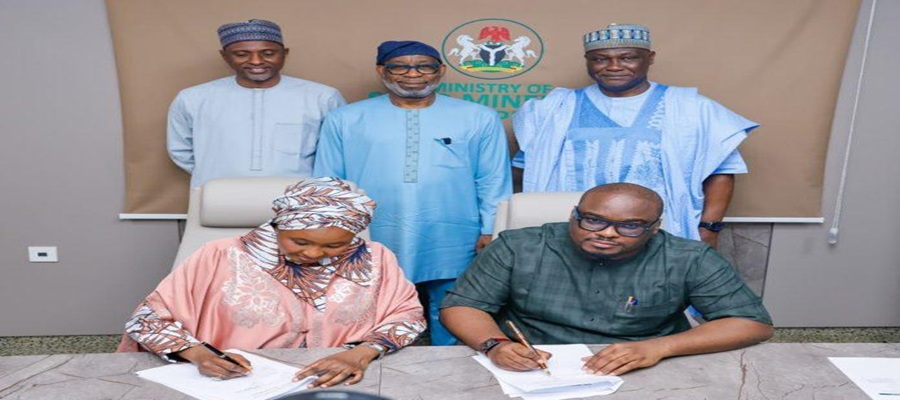
Nigerian Government has signed a $1.3 billion Memorandum of Understanding (MoU) with Africa Finance Corporation (AFC) via the Solid Minerals Development Fund (SMDF) to fund an alumina refinery, national geoscience mapping, and a strategic investment vehicle for mining growth.

Special Assistant to the Minister of Solid Minerals Development, Segun Tomori, said the refinery will process one million tonnes of bauxite yearly using a modern Bayer process, powered by an on-site gas-fired cogeneration plant.
Minister Dele Alake called it a transformative milestone boosting GDP, aligning with reforms that improve investment climate, regulations, and licensing to attract private capital. He directed agencies to fast-track permits.
The 20-year project at 95% utilization eyes 19 million tonnes total output, $1.2 billion annual GDP addition, $25 billion economic impact, and $8 billion forex earnings, per feasibility studies.
SMDF Executive Secretary Fatima Shinkafi termed it the agency’s biggest funding deal, supporting value-addition policy.
The partnership extends to geoscience mapping for mineral data, de-risking exploration, and a joint vehicle for mining assets.
Permanent Secretary Engr. Farouk Yabo praised the reforms. Shinkafi signed for government; AFC’s Franklin Edochie for the corporation, witnessed by AFC CEO Samaila Zubairu.
Tomori positioned it as Nigeria’s largest private mining investment and FDI magnet.

GCR Affirms Afreximbank’s International Scale Ratings of A, A2

SmartCash Launches ‘No Be Cho Cho Cho’ Campaign to Boost Digital Banking in Nigeria

MTN Nigeria Non-Executive Director Mazen Mroue Quits to Focus on Group Role

Google Adds Yorùbá, Hausa to AI Search, Boosting Access for Millions of Nigerians

MultiChoice Shuts Down Showmax After 11 Years Amid Streaming Wars

Dr. Cairo Ojougboh Foundation Bolsters Nigeria’s Education Drive with ₦2.7m Student Support

Kaspersky Brings more Transparency to Threat Detection with New Hunt Hub

NDPC Commits to Balancing Data Privacy, Protection Information

PwC Reveals AI Scaling Gap Slows Africa’s Digital Transformation

Firm Reviews the Evolution of Phishing Threats in 2025




 E-Financial3 days ago
NRS Targets N40trillion in Tax, Royalty Revenue in 2026

 E-Financial3 days ago
SEC Revokes Registration of Kensington Agro Trading Limited

 General News3 days ago
Purple Woman 3.0 Is Back, to Empower Women in Tech this IWD 2026

 News3 days ago
EFCC Arraigns Two FSDH Bank Officials Over $307k, €50k Fraud

 E-Financial2 days ago
Nigeria’s VAT Jumps 34%, CIT Soars 48% to ₦14trn in 9M’25 – NBS

 Telecom2 days ago
FG Approves GIS-enabled Digital Postcode to Tackle Logistics Gaps, Boost E-commerce
 E-Business3 days ago
NDPC, 60 DPAs Collaborate on Enforcing Privacy Rights in the Use of Al

 Telecom3 days ago
Konga Launches ‘Berekete Sales’ with Up to 50% Discounts Across Major Categories