

General News
Philips Hue with 200 Apps Leads Connected Lighting System


Philips Hue has assumed world’s leading, versatile connected home lighting system following the creation of over 200 third-party apps that transform the way people experience and interact with light.
Last year Royal Philips, the global leader in lighting, took the pioneering step of granting open access to Philips Hue software, and encouraging developers to find creative new ways of integrating digitized light into the home.
Presently, the number of third-party apps for Philips Hue connected home lighting system has passed the 200-mark, enabling people to experience light in new and innovative ways:
Movies and music are immersed into the living room through matching light to a scene or the beat of a song;
Ambience at home can now reflect a personal mood or occasion through personalized light settings;
Mornings are more energized thorough the gradual brightening of light to awake you and staying connected to your friends and family is easier through ‘light notifications’ for incoming emails and social media updates
“This milestone in apps confirms that Philips Hue has redefined the purpose of what light can do in people’s homes,” said Jeroen de Waal, general manager of Connected Lighting for the Home at Philips Lighting. “Looking towards the future where many aspects of a home will be connected with Internet of Things, we are eager to continue leading the way in connected lighting for the home. With this in mind, we welcome further collaborations with developers to deliver the best possible lighting experience.”
Philips Hue sits at the center of the Internet of Things and is a driving force in collaboration between like-minded innovative companies such as Apple and Logitech.
Through partnerships such as these, Philips Hue will be able to communicate with appliances, heating, blinds and much more, delivering innovations that impact on people’s lives everyday.
The diverse applications of Philips Hue are set to grow further still following the launch of a new, dedicated site for its active developer community.
David Pewzner, developer for popular app OnSwitch, said, “Philips Hue’s open API has unlocked possibilities that were only previously available with expensive professional hardware. We’re now able to give this professional functionality, and more, to consumers with each developer able to bring their own vision for connected lighting to the market. With every new app the consumer wins again, as they can get a different functionality to suit their needs.”
Philips Hue’s developer platform makes it easy to create new applications and business models for light, and just last month Philips Hue was awarded ‘Top API for the Internet of Things’ at the annual ‘I Love APIs Conference’.
Top third-party apps for Philips Hue create the most immersive entertainment you’ll ever have at home.
Washing the walls with the dominant on-screen colors, Syfy Sync allows viewers of its movies from the cult Sharknado franchise a heightened cinematic experience.
The Philips Hue-enabled app listens to a specially-designed ‘light-track’ to take its cues and adjust the connected lighting to make you feel part of the action.
Alternatively, turn your room into a light effect for your TV with Huebilight, setting your lighting to mimic your favorite program or sporting event, among other effects.



Federal Government has said it will conduct a comprehensive review of the proposed $6.2bn acquisition of IHS Holding Limited by MTN Group, citing the strategic importance of telecommunications infrastructure to Nigeria’s economy and national security.

The move follows an earlier announcement that MTN Group had agreed to acquire IHS Holding Limited in an all-cash transaction valued at $6.2bn, a deal that would see the tower company delisted and become a wholly owned subsidiary of the mobile network operator.
In a statement issued on Tuesday, Bosun Tijani, minister of Communications, Innovation and Digital Economy,said the government was closely monitoring developments.
“The Federal Ministry of Communications, Innovation and Digital Economy notes recent developments in the Nigerian telecommunications sector regarding the acquisition of IHS Towers by MTN Group,” the statement signed by the minister partly read.
“The Federal Ministry of Communications, Innovation and Digital Economy notes recent developments in the Nigerian telecommunications sector regarding the acquisition of IHS Towers by MTN Group,” the statement signed by the minister partly read.
The proposed transaction would consolidate ownership of critical passive infrastructure under the continent’s largest mobile operator by subscribers.
Tijani acknowledged recent improvements in the industry’s financial health, noting that “recent financial results announced by key operators indicate a return to improved profitability, increased investment in telecoms infrastructure and operational stability across the sector.”
“This progress reflects the resilience of the industry and the impact of reforms aimed at ensuring its viability and capacity to continue delivering meaningful connectivity to Nigerians,” he added.
However, he stressed that the government would not treat the transaction as routine, given the sensitivity of telecoms assets.
“Given the strategic importance of telecommunications infrastructure to national security, economic growth, financial services, innovation, and social inclusion, and to ensure strategic actions by private sector operators are in line with the market development agenda under the Renewed Hope policy directions of the President, the ministry will undertake a thorough assessment of this development in collaboration with the relevant regulatory authorities to review its impact on the sector,” the minister stated.
The minister made the government’s position clear. “Our objective is clear to ensure that any market consolidation or structural changes protect consumers, safeguard investments, and preserve the long-term sustainability of the sector.”
He added that the administration remained committed to maintaining “a stable, transparent, and forward-looking policy environment that keeps Nigeria’s telecommunications industry on a strong and sustainable path, in alignment with our broader vision of building a robust digital economy.”
The review is expected to involve relevant regulators, including the Nigerian Communications Commission and competition authorities, as part of standard merger control processes.
If approved, the deal would mark one of the largest telecom infrastructure transactions in Africa in recent years, signalling a shift in strategy by MTN from asset-light tower outsourcing to direct infrastructure ownership

In Shenzhen, widely regarded as one of the world’s leading technology and manufacturing hubs, Nigerian technology expert Francis Okafor is gaining recognition for his contributions to artificial intelligence and advanced engineering within China’s innovation ecosystem.

Okafor, who hails from Anambra State, has been based in China for eight years. “I’m based in China, and I’ve been here for about eight years now,” he said. “What I do full-time is tech, real, deep tech.”
He currently serves as a Tech Lead at IDEMIA, a multinational company known for its work in identity security, biometrics, cryptography, secure financial systems, and expanding interests in quantum computing.
From China, Okafor coordinates DevOps operations, software development, artificial intelligence systems, and robotics-enabled manufacturing tools across global hubs in China, India, France, Brazil, and the United States.
Despite his leadership position, he maintains an active engineering role. “Even though I’m a tech lead, I still write the core code,” he said. “My work is about 70 per cent tech and 30 per cent managerial. I’m still a full-fledged tech guy.”
Okafor said operating in China’s advanced technology sector has exposed him to stereotypes about Africans. “In China, Africans are usually seen as being good at sports or music,” he said. “When you say you’re an engineer or working in AI, people don’t really associate that with Africans.”
He added that his experience in elite engineering and hacker communities revealed a lack of African representation. “What pained me the most was that Africa had zero representation in these serious tech spaces,” he said. “Not Nigeria, but Africa.”
Beyond his corporate responsibilities, Okafor is involved in technology advocacy and community building. He chairs the Shenzhen Afrotech Community and co-founded the Shenzhen–Hong Kong Afrotech Network. He is also active in French and German technology communities and international AI business platforms.
Through conferences, hackathons, and policy dialogues, he has advocated greater African participation in global innovation. “China is many steps ahead in manufacturing, hardware, and AI,” he said. “Africa has always been the last to receive innovation. We don’t have a say in development, and that’s the problem I wanted to address.”
Speaking on China’s industrial ecosystem, he said, “This is where Apple, IBM, everybody comes to manufacture. So I asked myself, how do I use my position here to benefit Africa?”
Okafor has also been invited by Shenzhen authorities to speak on artificial intelligence and innovation. He attended the opening ceremony of the 2025 China National Games following an official invitation. “That event is not open to the public,” he said. “Only people selected by the government attend, and the President was there.”
On China’s technology model, Okafor said deliberate localisation and strong government commitment have been key. “The Chinese don’t just adopt technology,” he said. “They take the idea, block it, improve it, and build their own.”
Comparing this with Nigeria, he added: “In Nigeria, we accept and consume. Instead of copying and localising, we remain users.”
Addressing concerns about artificial intelligence and job displacement, Okafor said similar fears accompanied the emergence of the internet. “When the internet came, people were scared,” he said. “But new jobs emerged: web designers, content creators, digital assistants.”
He acknowledged that AI could displace some roles but said it would also create new opportunities. “If you don’t upskill, then yes, AI will replace you,” he said. “But if you use AI as an assistant, it will empower you.”
He urged Nigerians to take personal responsibility for adapting to technological change. “Don’t wait for the government,” he advised. “Every Nigerian has a responsibility to understand AI and apply it in their own field.”
Highlighting the broader scope of artificial intelligence, he said, “AI is beyond ChatGPT. It’s computer vision, prediction, automation, and it can work even without the internet.”
Okafor said he is exploring ways to formally connect Nigerian and China-based technology ecosystems.
“She told me it wasn’t good that I was contributing so much in China and nothing back home,” he said of a conversation with Ambassador Nini Okey-Uche, a minister at the Nigerian Embassy in Beijing. “That conversation changed my thinking.”
He added: “I’m on ground here. I see new technologies every day, and Africa needs access to that knowledge.”
Expressing his broader vision, Okafor said, “I want to change the narrative. Africans are not just entertainers. We are very good engineers too.”
General News
First Trustees Advocates Stronger Frameworks in Advancing Structured Islamic Inheritance Practices

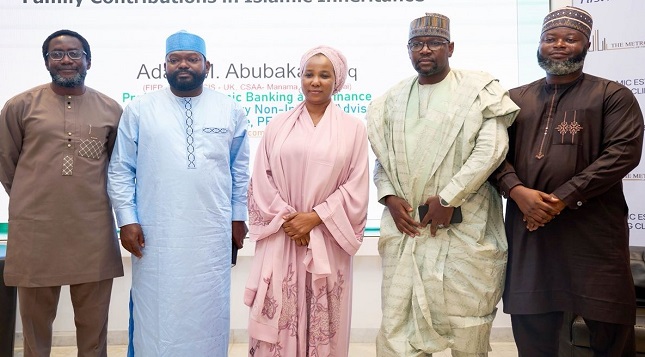
First Trustees Limited, a subsidiary of First HoldCo Plc., and a leading provider of trust solutions to individuals, corporates, and government institutions, partners with The Metropolitan Law Firm and Al-Ameen Trustees to host the 8th Annual Islamic Estate Planning Clinic in Abuja, bringing together leading Islamic legal, financial, and policy experts.

With the theme “From Informality to Legacy: Structuring Islamic Wealth Transfer,” the highly anticipated forum underscored the urgent need for Nigerian families to transition from informal inheritance practices to professionally structured, Sharia-compliant estate planning frameworks as a tool to seamlessly transfer and protect wealth, prevent family conflicts, and ensure legacies endure for future generations
Speakers emphasized the need to adopt a structured Islamic estate planning framework to ensure wealth preservation, reduces legal disputes, and ensures compliance with both Shari’ah principles and the Nigerian statutory law.
Stating that the transition from informal arrangements to a structured legacy is not merely a financial decision; it is a profound act of stewardship. By documenting and formalising intentions today, we replace potential family discord with clarity and peace of mind.
Rotimi Obende, representing the Managing Director of First Trustees Limited, highlighted estate planning as a sacred duty. “Estate planning is more than documentation—it is stewardship. Informal arrangements expose families to avoidable risks. Structured, Sharia-compliant plans provide clarity, transparency, and true generational protection,” he said.
He noted that regulated trustees play a crucial role in ensuring proper execution of wills and trusts, reinforcing public trust and accountability.
Delivering the keynote address, Professor Isa Ali Pantami, former Minister of Communications and Digital Economy, cautioned against relying on verbal inheritance promises, which frequently lead to conflict and asset loss.
He also urged the integration of modern technology, including blockchain, to securely store and have seamless access to wills and estate documents and also bridging traditional Islamic principles with cutting-edge innovation.
Ummahani Amin, Managing Partner at The Metropolitan Law Firm, added that Islamic inheritance law offers both structure and flexibility.
“Individuals can allocate up to one-third of their estate through properly documented wills and trusts. Too many families suffer because intentions were never formally recorded,” she explained.
As discussions progressed, a consistent message resonated clearly: with today’s increasingly complex and diverse assets, from digital holdings, cross-border investments and complex business interest, informal inheritance practices are no longer sufficient.
Participants agreed that structured Islamic estate planning delivers clear advantages, including legal certainty, tax efficiency, family unity, and long-term wealth preservation.

Danjuma, Taj Bank Staff Jailed for 5 Years over N22m Fraud

Chianugo, Nigerian $150m suit Against Google, GoDaddy.com Stalled due Judge’s Absence

FG to Review MTN’s $6.2Bn IHS Acquisition — Tijani

KPMG Outlook Reveals Financial Services CEOs Double down on AI, Resilience and Growth in 2026

Terra Moves to Expand in African Drone Sector, Secures $22m Funding

Firm Detected a Fivefold Surge in QR Code Phishing Attacks in the Second Half of 2025
Nigeria’s 9 Top FinTech Firms Valued at $10.6Bn in January 2026

DG NCC Tasks University Dons on Research Commercialization, IP Management to Build Global Competitive Ecosystems

Kaspersky Launches OT Calculator to Align Cybersecurity Investments with Business Goals

Firm Detected a Scam Exploiting OpenAI’s Teamwork Features




 General News3 days ago
Jumia Targets Break-even in 2026 After Strong Q4 Surge

 General News3 days ago
Nigeria’s Banks Race to Meet CBN Recapitalisation Deadline Amid Verification Push

 General News3 days ago
BOI, MTN Foundation Unveil N1Bn Fund for Women Entrepreneurs

 News2 days ago
African Leaders Highlight Africa’s AI Ambitions

 General News3 days ago
UBA Unveils Diaspora Platform to Connect Global Africans with Investment, Wealth Opportunities

 E-Financial3 days ago
No VAT on Land, Buildings and Rent Under New Tax Law — Oyedele

 E-Financial3 days ago
CBN Slams Up to N10m Fine on Banks and Cheque Printers for Security Breaches

 General News2 days ago
NDPC Orders Probe into Temu over Alleged Data Privacy Breaches