

News
PlungeSmile, Powered by Reliance Infosystem, Targets 1m School Children Across Africa in its CSR Initiative


Reliance Infosystem Group, through its Corporate Social Responsibility (CSR) arm, PlungeSmile Foundation, over the weekend in Lagos, reached out to corporate bodies for support in its drive to reach out to a target one million less-privileged school children across Africa in the next five years.

The event, which turned out to be a double as it also marked the Group Managing Director’s Golden Jubilee Celebration, further highlighted the first 20 years of the Foundation’s activities and its vision.
Speaking on the objectives of PlungeSmile Foundation, the Group Managing Director at Reliance Infosystems, Mr. Olayemi Popoola noted that the Foundation seeks to give young ones opportunities to achieve their goals as they are seen as the future leaders.
In his words: “When we set up our business, the Reliance Group, we felt like we shouldn’t just be focused on making money and making our employees happy. We also want to impart happiness to the people all around us, especially the younger ones who we see as the leaders of tomorrow.”
He explained that this informed setting up the Foundation 20 years ago.
Mr. Popoola, who disclosed that the Foundation has a 50-year ambitious plan to impact 30 million students across Africa with its mission, noted: “20 years down the line, we have only adopted 7 or 8 schools.
“Today we feed 1000 students on a daily basis. So long they go to school, they are sure of one meal, which we provide today. We are hopeful that we will be able to extend this to other schools all across Nigeria, with the help and support of corporate bodies and well-meaning Nigerians.
We are building our first model in Kwara State. This is because we have limited funding for now. And we are doing public schools because that is where the impact will be felt the most.”
He further solicited the support of corporate bodies and individuals. “What we are trying to do today is to canvass support from well-meaning Nigerians and corporate bodies, to join force with us. It is also an opportunity for them to extend social good to their own businesses as well.
“So, we want to find a way to get as many corporate bodies and well-meaning individuals, to join force with us to extend this good work we are doing.”
Andy Eberechukwu Akukwe, Vice President, PlungeSmile Foundation, in a media chat, said that PlungeSmile has actually transformed the lifestyle of thousands of individuals.
“Our programmes are carried out in public secondary schools, and some of the people that we actually impacted are now graduates in their rights, and doing very well in the society, and some of them are even supporting the charitable works of PlungeSmile, that is speaking to transformation.”
Backed by Reliance Infosystems and its sister companies – DigiTanks, Cloudway Africa and Reliance Datatech, PlungeSmile Foundation is an educational and welfare nonprofit seeking to holistically educate and empower individuals to reach their full potential and become self-reliant.
The Foundation, which empowers and uplifts marginalised individuals and communities by providing comprehensive support and resources, through collaboration, advocacy, and innovative solutions, aims to breach the cycle of poverty and inequality, fostering sustainable development and long-term positive change. Its interventions cross into Education, Infrastructure, Health & Nutrition, among others.
Under its intervention in education, PlungeSmile Foundation has initiated School Feeding Programme (SFP) for some public schools; Kit-Up-a-Child scheme designed to provide complete school clothing attire, including uniforms, socks, shoes, and bags, for pupils in public schools, thereby providing a sense of belonging to the child; and the Audiovisual Learning programme, which creates and serves as an enlightening platform for students in underserved rural areas, helping them realise the importance of learning, and dedication to work.
According to Bukky Shonibare, Technical Assistant at PlungeSmile, the programmes of the Foundation, which has a Co-Creation element to it, supports the Renewed Hope agenda of the President Bola Tinubu administration.


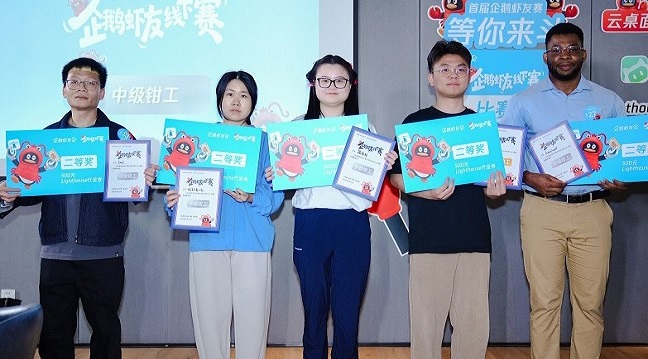
In a striking moment of global recognition for African talent in artificial intelligence, Shenzhen-based Nigerian technologist, Francis Okafor has emerged as the second-place winner at the 2026 Tencent OpenClaw Hackathon, a fiercely contested competition hosted by Chinese tech giant Tencent.

The achievement places the Nigerian engineer among the top innovators in one of the world’s most competitive technology hubs, Shenzhen, often described as China’s Silicon Valley.
Okafor’s journey to the podium was anything but scripted. Walking into Tencent’s facility on the day of the contest, he found a room already buzzing with elite programmers deep in preparation.
“Laptops open. Heads down. Some people setting up their system before the challenges even dropped,” he recalled, contrasting the scene with his own uncertainty at that moment. “And then there is me — a Nigerian looking around like, okay Francis, what exactly are you doing here?”
Rather than confidence, his first reaction was raw nerves. “I won’t lie, I had goose bumps. Not the inspirational kind,” he admitted, describing a quiet internal debate about whether he had wandered into territory far beyond his league. Yet that hesitation quickly gave way to experimentation, a hallmark of the hackathon spirit.
Earlier that same week, Tencent had rolled out OpenClaw integration into WeChat (known domestically as Weixin), exposing its massive user base to AI agent capabilities.
Okafor, a senior technology lead, artificial intelligence advocate, and global community organiser, had already been stress-testing the system and decided, on the spot, to build his entry around it. “I had been pushing it hard all week just to see what it could do… so when the challenges dropped I thought, you know what, let me use this thing as my weapon.”
That decision proved decisive. Competing against some of the most accomplished engineers in China’s hyper-competitive tech ecosystem, Okafor’s solution stood out for both ingenuity and execution. “It went far enough apparently,” he said with understated pride after securing second place.
Remarkably, he had entered without a grand plan. “I didn’t go in with a strategy. I went in for the thrill of it… Honestly I thought I would learn a few things and go home with a good story.” Instead, he left with a trophy, and a narrative that has resonated far beyond the competition hall.
Beyond personal triumph, Okafor emphasized the broader technological significance of the moment. Tencent released the WeChat OpenClaw plugin on the very morning of the event, effectively putting advanced AI agent tools into the hands of an estimated 1.4 billion users.
In his view, this signals a profound shift in how artificial intelligence will reach the public. The company, he observed, is “not just making AI accessible to developers… they are bridging it to everyone,” while using hackathons to identify innovators capable of pushing the technology forward, regardless of origin.
Okafor was acutely aware of his uniqueness in the room. “I was definitely the only African there and for sure stood out,” he noted. Yet what mattered was not nationality but capability. “Nobody cared about where I was from. They cared about what I built.”
His message to aspiring technologists, particularly those from underrepresented regions, is both simple and powerful: show up. “Enter things you think you have no business entering,” he urged. “The worst case is you learn something. The best case is you shock yourself.”
In an industry often defined by geography, capital, and institutional advantage, Okafor’s victory offers a compelling counter-narrative. Talent, preparation, and courage can still disrupt expectations, even in rooms that seem designed for someone else.
As he concluded in a line that has since captured widespread attention: Black excellence, he said, “doesn’t need a geography.”


Economic and Financial Crimes Commission (EFCC) has urged the Central Bank of Nigeria (CBN) to deepen collaboration and provide faster operational support in Enugu State.

Zonal Director of the EFCC Enugu Zonal Directorate, Commander Daniel Isei, made the call during a courtesy visit to the CBN Branch Controller in Enugu, Mr Otutubuike Justice Agbaeze, on Tuesday.
The engagement forms part of ongoing efforts to boost inter-agency ties, enhance financial sector accountability, and fortify anti-money laundering initiatives nationwide.
Isei described the CBN as “our most critical partner in the fight against economic and financial crimes,” highlighting years of joint operations and the bank’s role in securing recovered assets.
“The CBN naturally stands out as one of our most critical partners… it serves as a secure repository for valuables recovered by the EFCC and it has greatly enhanced our operations,” he stated.
While commending past cooperation, Isei appealed for quicker responses to the EFCC’s frequent investigative requests from its Enugu office.
“We understand that these requests may be demanding, but timely responses are crucial, as time is of the essence in financial investigations. We therefore seek your continued indulgence in ensuring that our letters receive expeditious attention,” he added.
In response, Agbaeze reaffirmed CBN’s dedication to the partnership, pledging expert support and improved synergy “in the interest of financial system stability and national development.”

As smart devices with artificial intelligence (AI) tools, and always-on services become part of everyday life, the cybersecurity habits many people formed a few years ago may no longer be enough.

From AI-powered scams to social media trends that encourage users to upload personal details, the way people interact online is changing quickly. Ensuring that you stay secure now requires small, deliberate actions in your daily digital behaviour. Experts from Kaspersky, a global cybersecurity and digital privacy company, share the below advice to stay safe online.
- Be cautious with verification requests. Many scams now mimic legitimate verification processes, asking users to confirm accounts, update payment details, or approve login attempts. Because people are used to frequent security prompts, it is easy to respond automatically. Pause before sharing verification codes or personal information and independently verify requests through official websites or by contacting service providers directly.
- Cultivate healthy AI usage habits. AI agents, chatbots and multimedia-generating apps can be convenient and entertaining, but uploading high-resolution photos or personal information carries privacy implications. Facial images can function as biometric identifiers, and once shared with an online service, be it AI or a social network, control over how that data is stored or reused may be limited. Before using AI tools, review privacy policies, minimise the personal information they provide, and avoid uploading sensitive documents or confidential content.
- Do your homework on AI. For parents, the rise of AI assistants introduces another dimension. While AI tools can help in making education interactive and gamified, children may turn to AI tools for homework support or entertainment without fully understanding how their data is used or how to evaluate responses critically.
Open conversations about responsible AI use, privacy awareness, and the importance of not oversharing personal information can help children build safe digital habits from an early age.
- Audit your online subscriptions. Reducing digital exposure is another simple but often overlooked step. Over time, unused subscriptions, dormant accounts, and forgotten apps accumulate personal data and payment details. Regularly reviewing subscriptions, deleting unused accounts, and checking which apps have access to personal information can significantly reduce risks of this data being leaked.
- Secure your devices and home. Device longevity and smart home security also play an important role. Older devices that no longer receive security updates may contain unpatched vulnerabilities.
Ensure that smartphones, laptops, routers, and smart home devices are running the latest firmware and are protected with strong passwords and multi-factor authentication. Changing default passwords on connected devices and securing home Wi-Fi networks are essential steps in protecting both personal data and physical spaces.
As technology and AI becomes more integrated into daily life, security is less about dramatic measures and more about consistent, informed habits.
“Technology evolves quickly, and our online behaviour should keep pace,” says Brandon Muller, Technical Expert for the Middle East and Africa region at Kaspersky. “Take time to review privacy settings, app permissions, and connected third-party services, removing anything that is no longer needed. By being more deliberate about what we share, how we verify requests, and how we manage our devices, we can significantly reduce exposure to modern cyber risks while enjoying all the benefits of new technologies.”

Anti Graft Agencies Raise Alarm over Rising Crypto-Linked Financial Crimes

NITDA Takes Over National Digital Architecture System

NDIC Insures 99 Percent of Bank Customers

FG Shifting Focus to “Meaningful Connectivity” to Drive Inclusion – Minister

CBN Bars Chronic Loan Defaulters from Accessing Loans

Spotify’s Loud & Clear Report Reveals Over ₦60Bn Revenue for Nigerian Artists in 2025

Madonna University Taps Tech Guru Adote for Strategic Board Role

China Threatens to Shut Nigeria’s Satellite Over $11.44m Unpaid Debt

MTN Nigeria Posts Record N1.70 Trillion Pre‑Tax Profit, Declares N20 Dividend for 2025

Jumia Tech Week 2026 Begins with Tech Deals on Smartphones, Electronics, and Everyday Technology




 General News2 days ago
NCC to Curb SIM Fraud, Strengthen Digital Security with New Platform

 Telecom3 days ago
Mobile Money Transactions Accounted for $2 trillion in 2025

 General News2 days ago
Kidnappers Now Use Banks to Collect Ransoms — Expert

 Broadcasting2 days ago
NBC Boss Urges Content Ceators to Participate in DSO

 E-Financial3 days ago
MoneyMaster Enhances App, Rewards Users with Data and Airtime Bonuses

 E-Financial2 days ago
CBN Says Bank Customers Won’t Lose Deposits because of Recapitalisation

 News2 days ago
Francis Okafor Stuns China, Emerges Second-Place Winner @ Tencent OpenClaw Hackathon

 E-Business2 days ago
Jury Finds Meta, Google Liable for Woman’s Social Media Addiction