

Broadcasting
Quantum Xchange, Spire Solutions Partner to Bring Advanced Quantum-Safe Network Security and Data Protection to MEA

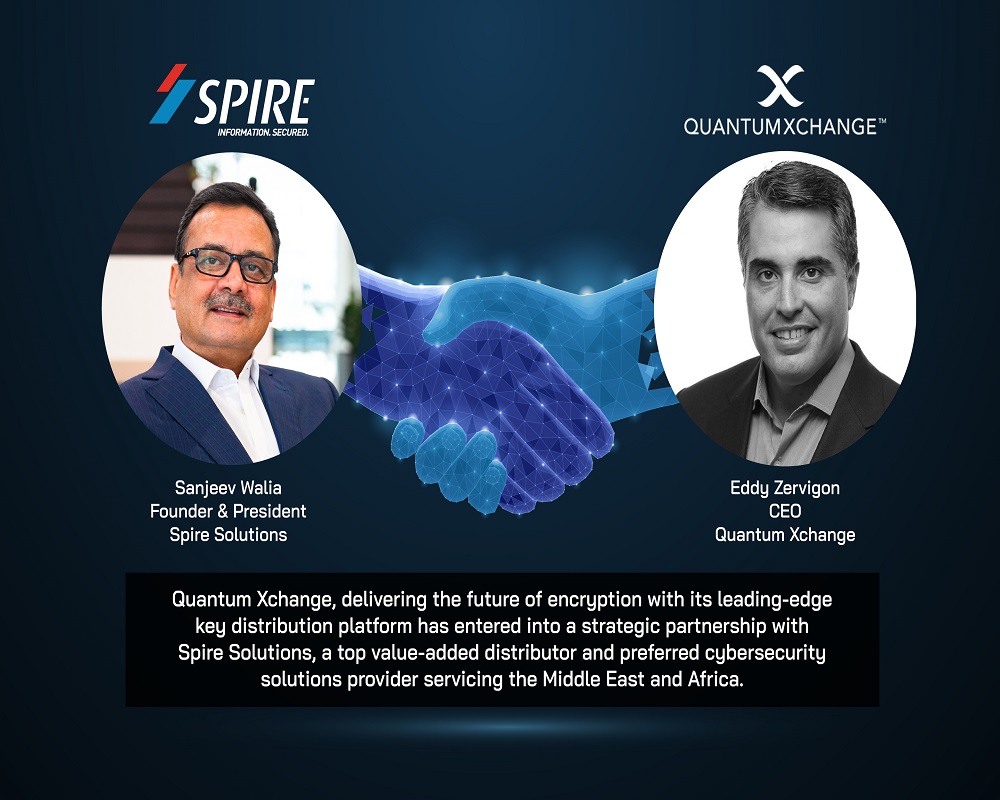
Quantum Xchange, delivering the future of encryption with its leading-edge key distribution platform has entered into a strategic partnership with Spire Solutions, a top value-added distributor and preferred cybersecurity solutions provider servicing the Middle East and Africa.

Spire customers, partners, and prospects will benefit from access to Phio Trusted Xchange (TX), Quantum Xchange’s out-of-band key delivery system that enables users to future-proof the security of their data and communications networks; overcome the vulnerabilities of present-day encryption techniques, e.g., keys and data traveling together; and protect against man-in-the-middle, harvesting, and future quantum attacks.
Phio TX from Quantum Xchange acts as a simple architecture overlay that works in tandem with conventional encryption systems and any TCP/IP connection (wireless, copper, satellite, fiber) to decouple key generation and delivery from data transmissions. With Phio TX a second, quantum-enhanced encryption key is sent out-of-band down a separate quantum-protected tunnel and mesh network to multiple transmission points. Continuous key rotation takes place on every transfer, further heightening the system’s security.
“We are in the early stages of the greatest migration in the history of computing as nearly every organization in the world will need to update and transition their legacy encryption to new quantum-safe standards,” said Sanjeev Walia, Founder and President of Spire Solutions.
“Quantum Xchange’s unique technology greatly eases this burden, offering an affordable and dynamic next-generation key delivery architecture for stronger data security today and quantum-safe protection from future threats.
“We are pleased to have QXC as a partner and to add Phio TX to our portfolio of the world’s best security products and services.”
Phio TX embraces crypto agility, supporting quantum keys generated from any source, i.e., Quantum Random Number Generator (QRNG), Quantum Key Distribution (QKD), or a combination, and all Post-Quantum Cryptographic (PQC) key encapsulation candidate algorithms being evaluated by the National Institute of Standards and Technology (NIST) scheduled for standardization in 2022.
The FIPS-validated network security appliance also meets the European Telecommunication Standards Institute (ETSI) protocol for QKD. With Phio TX, users can start with PQC, then easily scale to QKD protection levels with no interruptions to their underlying infrastructure and no network downtime.
“Spire Solutions has a proven track record successfully introducing new cybersecurity solutions to more than 15 countries in its region, making them an ideal partner for Quantum Xchange as we look to expand our global visibility and reach,” said Eddy Zervigon, CEO of Quantum Xchange.
“Spire’s dedicated division focusing on cyber threat intelligence, comprehensive risk protection, and response complements our mission to protect and preserve the digital infrastructure that runs our global economy by bringing to market a standards-based, quantum-ready solution that can easily meet the risk mitigation needs of a business at any time while delivering an infinitely stronger cybersecurity posture to any network environment.”
Quantum Xchange will join Spire Solutions stand H1 A120 at #LEAP22, the inaugural global platform for the most disruptive technology professionals taking place at the Riyadh Front Expo Centre in Saudi Arabia from Feb. 1-3, 2022.



Canal+ is to cut jobs at MultiChoice as part of a sweeping restructuring plan aimed at stabilising the African pay-TV operator, following years of operational and financial pressure.

The move comes alongside a planned $115 million capital injection, underscoring the urgency of efforts to revive the business after the French media group took control.
The planned layoffs are expected to form a core element of a broader cost-cutting and efficiency drive, as Canal+ seeks to streamline MultiChoice’s operations and improve profitability.
The restructuring signals a shift toward leaner operations, with a focus on eliminating redundancies and optimising the company’s cost base.
MultiChoice has struggled in recent years with declining subscriber numbers across key African markets, weighed down by macroeconomic pressures, currency volatility, and changing consumer behaviour.
The rise of global streaming platforms has intensified competition, chipping away at the company’s traditional pay-TV dominance.
Canal+’s intervention marks a pivotal moment for MultiChoice, reflecting a more aggressive approach to repositioning the business.
By combining fresh capital with structural reforms, the new owners are aiming to both stabilise short-term performance and lay the groundwork for longer-term growth.
The $115 million injection is expected to provide immediate financial relief, supporting operations and potential strategic initiatives.
However, the accompanying job cuts highlight the depth of the challenges facing the company and the scale of transformation required to restore competitiveness.

Nigeria has ranked first globally in the ownership of the two largest stablecoins, Tether (USDT) and USD Coin (USDC), reflecting the country’s growing reliance on dollar-linked digital assets.

USDT, USDC
Stablecoins such as USDT and USDC are designed to maintain a fixed value against the U.S. dollar, allowing users to store money digitally while avoiding the price volatility associated with cryptocurrencies like Bitcoin.
According to the 2026 Stablecoin Utility Report released by BVNK, about 59 percent of Nigerian crypto users hold USDT, while 48 percent own USDC, giving the country the highest combined ownership rate among all nations surveyed.
The report placed Nigeria ahead of several major economies, including Australia and India, highlighting the country’s strong adoption of dollar-denominated digital assets. Australia ranked second with 34 percent USDT ownership and 29 percent USDC, while India placed third with 30 percent USDT and 27 percent USDC holdings.
The study also examined adoption levels across other regions. Countries such as Colombia and Singapore showed strong usage of both stablecoins, while adoption levels were also notable in South Africa and the United States.
Other markets included in the analysis were Philippines, Thailand and Argentina, where stablecoin ownership has also increased significantly. Among European economies, the report said France and Germany showed moderate levels of adoption, while Latin American markets such as Mexico and Brazil recorded smaller but growing usage rates.
The United Kingdom also appeared in the ranking with modest levels of stablecoin ownership. The report noted that USDT ownership exceeds USDC in many countries, including Nigeria, Australia, India, Singapore, the Philippines, Thailand, Argentina and France.
However, USDC is often viewed as a more compliance-focused stablecoin because of its stronger transparency and regulatory alignment. In some markets, including South Africa, Colombia, Germany and Brazil, the report found that USDC adoption slightly exceeds USDT.
More broadly, the data suggests that stablecoin adoption is being driven largely by emerging economies rather than advanced financial markets. According to the report, countries such as Nigeria, Argentina and the Philippines are among the biggest users of stablecoins, where people increasingly rely on dollar-pegged digital assets to protect savings from currency volatility and facilitate cross-border payments.

Spotify has unveiled Nigeria-specific data from its annual Loud & Clear report, highlighting how Nigerian artists generated more than ₦60 billion in revenue from the platform alone last year, amid explosive growth in streams, local consumption, and global discovery.

The report, which analyzes millions of data points to illuminate music streaming economics, shows Nigerian artists’ revenue surged over 140% in the past two years.
This boom stems from rising global appeal and stronger domestic engagement, with 30.3 billion streams and 1.6 billion listening hours on Spotify in 2025. First-time discoveries of Nigerian music hit 1.3 billion, up 26% from 2024.
Locally, Nigerian tracks dominated Spotify Nigeria’s Daily Top 50, accounting for over 80% of features, while consumption of homegrown artists jumped 170% year-on-year.
“Nigeria’s music scene thrives on creativity, innovation, and global influence,” said Jocelyne Muhutu-Remy, Spotify’s Managing Director for Africa. “Loud & Clear spotlights how artists are forging sustainable careers and deepening local ties.”
Key highlights include:
55% year-on-year growth in local streams for Nigerian female artists.
75% surge in streams for independent Nigerian artists.
Independents and indie labels earning 58% of all royalties from Nigerian artists on Spotify.
Spotify’s editorial playlists featured nearly 2,000 Nigerian artists in 2025, boosting visibility. Nigerian music appeared in 320 million global user playlists and over 12 million in Nigeria, totaling more than 60 million playlists worldwide.
The report also notes evolving tastes, with top-growing genres in Nigeria over five years including pop urbaine, alternative pop, anime, emo, and drill.
For full details, visit spotify.com/loudandclear.

CBN Introduces Stricter BVN Rules to Curb Fraudulent Transactions

Binance is Missing from Ghana’s Crypto Sandbox

Canal+ to Cut Jobs as Part Sweeping Restructuring

Activist Warns against Rising Junk Food Culture in Nigeria

World Bank Debars 3 PwC Subsidiaries for 21 Months over Alleged Project Fraud

Kaspersky Discovers New Phishing Campaign Exploiting Google Tasks Notifications to Steal Corporate Credentials

esentry 2025 Report Shows Healthcare, Financial Services and Telecoms as Staging Grounds for Increased Cyberattacks in Africa

AfDB, UNDP Launch $10Bn AI Initiative for Africa

Mutual Benefits Assurance Settles ₦5.9bn Claims in January 2026

MultiChoice Suspends Yearly DStv Price Hike as Canal+ Pushes Growth




 E-Financial2 days ago
Kuda MFB Increases Kuda for Her Business Grants to ₦10 Million

 News3 days ago
Kaspersky Discovers Infostealers Mimicking Claude Code, OpenClaw and Other AI Developer Tools

 General News3 days ago
Banks, Offices to Close for Thursday and Friday for Eid-el-Fitr

 Telecom3 days ago
Nigeria, Ghana Trigger Stunning 45 Percent Surge in MTN Dividends

 E-Financial3 days ago
SEC Shuts Over 400 Fraudulent Investment Schemes, Arrests Operators

 Telecom2 days ago
Vitel Wireless Lures Subscribers with “Data that Never Expires” Campaign

 Telecom3 days ago
ATCIS Urges FG to Ensure Safety of Consumers Data

 News2 days ago
BoI, MTN Foundation Launch N1Bn Fund for Women Entrepreneurs