

E-Financial
Reps Order Banks to Refund COT or Face Penalties

Central Bank of Nigeria (CBN) has been mandated to order deposit money banks to refund all Commission on Turnover (COT) charges this year or face severe penalties.
House of Representatives which urged compliance within 30 days, further tasked the financial regulator to ensure full implementation of the zero COT by commercial banks.
The resolution followed the adoption of a motion brought to the floor yesterday by Hon. Edward Gyang Pwajok (PDP-Plateau) who noted CBN buildingthat the CBN, in 2013, released the guidelines tagged “Guide to Bank charges” which gradually phased out COT in Nigeria. Leading the debate on the motion, Pwajok said, according to the guidelines, “COT was reduced to N3 per N1,000 in 2013, N2 per N1,000 in 2014 and N1 per N1,000 in 2015 while it will be phased out in 2016.”
He said the zero COT policy, which is meant to alleviate the suffering of citizens, boost the economy by encouraging transactions through the banks, is not being implemented to the detriment of the economy.
The lawmakers further told his colleagues that the CBN zero COT policy, which according to him, is in tandem with international best practices, is not being implemented by commercial banks because the apex bank has not issued any formal circular directing implementation of the zero COT.
Pwajok stated that findings showed some banks have continued to charge above N1 per N1,000 turnover that was effective from January this year.
“It was learnt that in some banks, the amount charged as COT depends on the customers’ relationship with the banks,” he said. He further lamented that the laudable policy by the CBN, which was wellreceived by the public, is being flagrantly ignored and undermined by commercial banks with attendant costs on ordinary citizens who are bank customers.
The motion was unanimously adopted by members when Speaker Yakubu Dogara, who presided over the session yesterday, put the question for a voice vote. Meanwhile, the speaker has made case for a review of the CBN policy on foreign exchange.
Dogara noted that “recent monetary and fiscal policies aimed at preventing money laundering and protecting our currency, though no doubt well intentioned, have resulted in avoidable hiccups in our international financial transactions with multifaceted counterproductive implications for both commerce, foreign investor promotion and diaspora Nigerians including students.”
“This is a matter of urgent national importance requiring all hands on deck. Accordingly, the House Committees on Banking and Currency; Finance; Diaspora and both Basic and Tertiary Education are hereby directed to quickly put their heads together and collaborate with the relevant executive agencies to expeditiously resolve the prevailing bottlenecks in our foreign exchange regime,” the speaker said.


E-Financial
Alawuba Advocates Security, Bankable Projects, Infrastructure Development to Promote South-East Vision


Oliver Alawuba, Group Managing Director/Chief Executive Officer, United Bank for Africa (UBA) Plc, has called on leaders and key stakeholders in the South-East to prioritise security and peace, infrastructure development and the delivery of bankable, investment-ready projects.

Oliver Alawuba, Group Managing Director/Chief Executive Officer, United Bank for Africa (UBA) Plc,
This, according to him, is critical if the South Eastern region of the country is to unlock its long-term development agenda under the South-East Vision 2050 (S8V2050).
Alawuba made the call while delivering a goodwill remark at the South-East Vision 2050 Regional Stakeholder Forum which was held at the International Conference Centre, Enugu on Wednesday.
The multi-day forum was convened by the South-East Development Commission (SEDC) in collaboration with the Office of the Vice President, the Ministry of Regional Development and the South-East State Governments, to build consensus around a shared development pathway for the region and advance implementation-ready interventions aligned with national priorities.
Speaking in his capacity as GMD/CEO as well as the Chairman of the Body of Banks’ CEOs and on behalf of Corporate Nigeria, Alawuba identified peace and security as the most urgent requirement for attracting investment into the region, noting that safety remains the first signal investors assess before committing capital.
“The first thing the South-East needs is peace. It is an established fact, world over, that investments flow in the direction of safety,” Alawuba stated, urging state governments and regional leaders to sustain coordinated efforts to secure lives, assets and infrastructure.
He also challenged stakeholders to adopt a results-driven partnership model between government and the private sector; just as he noted that the success of the South-East Vision 2050 will largely depend on the region’s ability to articulate and package clear, measurable and value-adding projects capable of attracting long-term capital.
“Vision alone is not enough. The South-East must present specific, bankable projects with defined impact – projects that can unlock investment, create jobs and deliver real improvements in the lives of our people,” Alawuba stated.
The Forum brought together prominent Nigerians from across government and the private sector, including His Excellency, Senator Kashim Shettima, GCON, Vice President of the Federal Republic of Nigeria, Governors of the South-East States (Imo, Abia, Anambra, Ebonyi and Enugu), Distinguished Senators and Honourable Members of the House of Representatives.
Other key participants included the Honourable Minister of Regional Development, the Chairman, Board Members and Management of SEDC, Royal Fathers and members of the clergy, members of the Diplomatic Corps, captains of industry, and development partners.
The UBA CEO took time to commend the South-East Governors for visible progress in road construction and other critical facilities across the region, while calling for accelerated delivery at scale.
He said, “Infrastructure is the bedrock of development,” he said. “We have seen improvements, but a little bit more is required such as reliable power, motorable roads, rail, water and connectivity to remove the bottlenecks that limit productivity and competitiveness.”
While stressing the importance of creating a truly investor-friendly business environment and unlocking diaspora capital to drive inclusive growth, he added that “Capital will always respond to predictability, ease of doing business and confidence. If we get the fundamentals right, Corporate Nigeria and the banking industry will rally round to finance viable projects, support SMEs, create jobs for our youth and mobilize long-term capital to make South-East Vision 2050 a reality.”
He seized the opportunity to reaffirm UBA’s readiness to partner the SEDC and South-East State Governments, as he noted that the Vision 2050 framework will be strengthened by private-sector participation and long-term capital mobilization to ensure it remains credible and investable.
United Bank for Africa is one of the largest employers in the financial sector on the African continent, with 25,000 employees group-wide and serving over 45 million customers globally. Operating in twenty African countries, the United Kingdom, the United States of America, France and the United Arab Emirates, UBA provides retail, commercial and institutional banking services, leading financial inclusion and implementing cutting-edge technology.


Ecobank Transnational Incorporated has reported a 29 per cent rise in profit after tax to N950.0bn for the financial year ended December 31, 2025, driven by growth in interest income and non-interest revenue.

This was indicated in the Condensed Consolidated Unaudited Financial Statements for the year ended December 2025 filed on the Nigerian Exchange Limited on Friday.
According to the report, the pan-African banking group’s gross earnings rose 14 per cent to N4.82tn, while total revenue increased 18 per cent to N3.67tn.
Profit before tax climbed 30 per cent to N1.28tn, up from N986.7bn in 2024. Operating profit before impairment charges rose 29 per cent to N1.89tn.
In the period under review, net interest income grew 22 per cent year on year to N2.14tn, supported by a 15 per cent increase in interest income to N3.18tn.
Interest expense rose modestly by four per cent to N1.04tn.
Non-interest revenue also strengthened, rising 13 per cent to N1.53tn, buoyed by a 17 per cent increase in fee and commission income to N1.03tn, and a 14 per cent growth in trading income and foreign exchange gains to N559.36bn.
However, other operating income declined 22 per cent to N68.6bn, while net losses on investment securities widened to N10.98bn.
Impairment charges on financial assets rose 28 per cent to N613.26bn, reflecting higher credit risk provisioning during the period.
Despite this, operating profit after impairment increased 30 per cent to N1.28tn.
Total profit stood at N950.0bn, compared to N735.9bn in 2024. Total assets expanded 14 per cent to N49.44tn, up from N43.30tn in 2024.
Loans and advances to customers increased 11 per cent to N17.09tn, while deposits from customers rose 15 per cent to N36.45tn, reinforcing the bank’s funding base. Total equity strengthened significantly, rising 50 per cent to N4.17tn, driven largely by retained earnings growth.
Equity attributable to ordinary shareholders stood at N2.91tn, up from N1.75tn. Total liabilities increased to N45.27tn, from N40.52tn in the previous year.
Ecobank operates in 34 African countries and several international financial centres, serving more than 32 million customers across consumer, commercial, corporate, and investment banking segments.
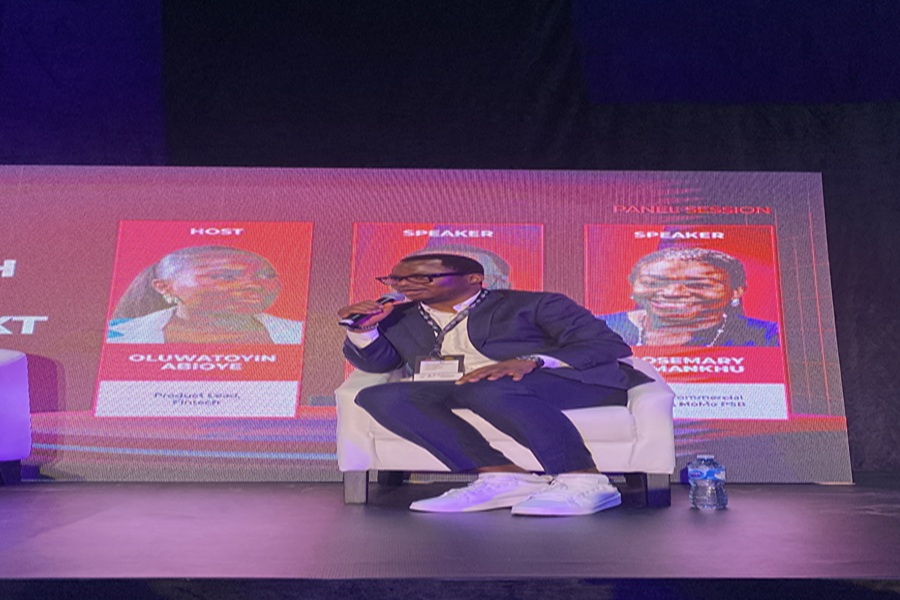
African fintechs hoping to sign up the continent’s next billion users will need to rethink the industry’s long-running growth playbook, according to Musty Mustapha, Managing Director of Kuda Microfinance Bank, who says cashbacks and incentives may drive downloads but rarely help build sustainable businesses.

Kuda MFB MD
Speaking at a fintech panel discussion on scaling digital financial services across Africa at Tech Revolution Africa, a gathering of tech leaders, investors, operators, and professionals which was held at Landmark Event Center on January 31, 2026, Mustapha objected to what he described as the “growth at all costs” culture which has defined much of African fintech so far. While incentives can quickly inflate user numbers, he said they often fail to create the kind of trust and consistent usage that keeps customers long term.
“It is easy to buy users,” he said. “But if you grow without creating real value, you’re only solving for today’s numbers and ignoring whether the business survives tomorrow.”
His comments come at a time when many startups are under pressure to demonstrate stronger unit economics as venture funding tightens and investors shift attention from rapid acquisition to profitability and retention. In that environment, Mustapha argues that reliability, not marketing spend, will determine which fintechs endure.
Contrary to common assumptions, he said African consumers are not resistant to technology but cautious, shaped by years of unreliable services and weak infrastructure. Products that work seamlessly elsewhere often struggle locally because they fail to account for that trust deficit.
“They’re not digitally naïve,” he said. “They’ve just operated in low-trust environments. If something fails even once or twice, you lose them.”
That focus on trust has influenced how Kuda Microfinance Bank has approached its growth. Launched in 2019 as a digital-first bank, it expanded from roughly 100,000 customers within its first year to nearly 300,000 the next, before surging past 2 million customers in 2021. Today, the microfinance bank serves more than 7 million Nigerians, Mustapha said, describing the journey as less predictable than the numbers suggest.
“The reality is, you can’t forecast scale neatly,” he said. “You can wake up and suddenly have a huge spike in users. If your systems and people aren’t ready, you crumble.”
In his view, the strain on a fintech typically shows up first behind the scenes, not on its app. As volume increases, back-office functions such as reconciliation, chargebacks and customer support can quickly become chokepoints, eroding the trust that fintechs are trying to build. Founders, he said, often underestimate these operational demands in the early days while prioritising product development.
“Anything you don’t pay attention to in your first six months will come back to hurt you at scale,” he said.
External constraints add more complexity. Payment rails, power supply, and connectivity remain outside the control of most fintechs, making outages and delays inevitable. Rather than trying to outspend those limitations, Mustapha said companies must design around them by building redundancies and multiple pathways for critical services.
“You don’t assume perfection,” he said. “If one channel fails, there must be another. That’s how you stay reliable.”
As traditional banks, telcos, and startups increasingly compete for the same mass-market customers, Mustapha expects the winners to combine the strengths of each group — the capital base of banks, the distribution reach of telcos, and the speed of fintechs. But regardless of the model that dominates, he believes the fundamentals will remain the same.
For millions of first-time or underserved users, the deciding factor is simple: whether the service works every time.
“There’s this idea that the average customer can’t use sophisticated products,” he said. “That’s not the issue. What they want is something they can trust.”
As fintech chases its next phase of growth, trust, rather than incentives, may prove to be the sector’s most valuable currency.

Alawuba Advocates Security, Bankable Projects, Infrastructure Development to Promote South-East Vision

Ecobank Profit Jumps 29 Percent to N950Bn

Trump Says He Made no Mistake Sharing Video Depicting Obamas as Apes

Orya, Ex-NEXIM MD Jailed 490 Years for N2.4Bn Fraud

Airtel Nigeria Commits to Upgrade of its Network Infrastructure for Improved Quality of Service

19 Nigerian Banks Meet CBN Recapitalization Targets Ahead of March Deadline

Nigerian Terra Industries Secures $11.8m for Expansion

US invests $115m in counter-drone tech for World Cup security

Firm Detected a Fivefold Surge in QR Code Phishing Attacks in the Second Half of 2025

Firm Detected a Scam Exploiting OpenAI’s Teamwork Features




 General News2 days ago
Globacom Donates ₦1Bn to Lagos State Security Trust Fund

 Telecom3 days ago
MTN Guns for $2.76bn IHS Towers Buyout in African Telecom Power Grab

 E-Financial3 days ago
Incentives alone won’t win over Africa’s next billion fintech users — Kuda MFB MD
 Telecom2 days ago
Airtel Nigeria Commits to Upgrade of its Network Infrastructure for Improved Quality of Service

 Telecom3 days ago
Google Calls on Africa’s AI Trailblazers for 10th Startup Accelerator Cohort
 E-Business3 days ago
Firm Reviews the Evolution of Phishing Threats in 2025

 E-Business2 days ago
PwC Reveals AI Scaling Gap Slows Africa’s Digital Transformation

 General News3 days ago
EdTech Platform Unveils over 5,000 Self-Paced Courses for Skills, Knowledge, and Literacy