

News
Scammers Turn to SMSes, Dupe Nigerians

Taking undue advantage of Nigeria’s profile as the largest mobile market in Africa, scam artists have turned to SMS technologies to bait phone users leaving tales of woes and losses in their wake, Nigeria CommunicationsWeek can now reveal.
Like the infamous 419-scams, unsolicited short text messages (SMSes) are arriving in torrents in millions of mobile phones held by Nigerians with promises of non-existing rewards.
The sheer numbers of SMSes sent every day threaten to negate the marketing purposes of this increasingly popular advertising medium.
It is so bad that it is now difficult to spot a legitimate SMSes from scam and Nigerians unwillingness to come forward after falling victims’ serve to fuel the illegal business.
Increasingly, reckless communication practices by phone users play into the hands of fraudsters who request personal details like bank account PIN with which they use to wipe victims’ accounts in minutes.
Nigeria CommunicationsWeek gathered that most of the scam SMSes assumes corporate identities of high street banks, telecom companies or any blue chip company to cheat an individual out of their money.
According to Dr Pieter Streicher, managing director, BulkSMS, as a show of good faith, the sender (scammer) asks for a deposit of a certain value to be made into another account. The scammers typically get several payments out of victims, who never receive the funds.
“The more the victims give, the more they’ve already committed, and the more they keep giving.” He added.
Unsolicited short text message is not illegal yet in Nigeria and it is very easy to send.
All the scam artist need to do is to select a network number prefix and use a software programme to calculate all the permutations.
Lists of phone numbers are also available for sale by some unscrupulous employees of telecom companies.
John Owubokiri, Nigeria CommunicationsWeek in-house legal analyst, however said that a mobile phone user can invoke some legal protection in case of repeated text messages.
“Luckily, the recent landmark judgment in the country said that computer evidence is now admissible in court but the problem would be proving the origin of the SMS” he also said.
Unsolicited text messages can be very annoying and could pose a great privacy risk to the recipient. With advancements in technology that supports sending SMS messages over Internet to any user across the globe poses a higher risk to the mobile users.
Nigeria CommunicationsWeek gathered that SMS remains the most viable method for an attacker or spammer to get their message into some unsuspecting user’s inbox.
Detecting scam SMS is however easy by simply checking the message centre number where the SMS was sent from.
Most scam text messages come from +447….but if it is genuine it will start with Nigeria’s country code followed by telecom operator’s message centre.
For instance, any text message from any operator in Nigeria will have to start with +234 then followed by the operator message centre.
Emmanuel Okoegwale, mobile money and applications experts advised Nigerians to simply ignore any suspicious SMS.
Also, businesses and IT professionals should install anti-phishing tools alongside anti-virus protection.
Okoegwale urged the Nigeria Communications Commission (NCC) to mandate network providers to implement solutions that would block fraudulent SMSes and empower its Consumer Affairs Bureau to open contact centres to take report of abuse.


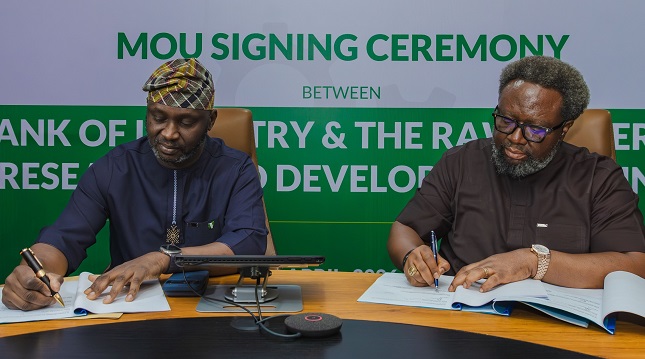
Bank of Industry (BOI), Nigeria’s foremost Development finance institution and the Raw Materials Research and Development Council (RMRDC) have sealed a strategic partnership agreement to strengthen Nigeria’s agricultural value-chain and boost country’s Gross Domestic Product (GDP) value.

The agreement was formalised on Friday, April 17, 2026 with the signing of a Memorandum of Understanding (MoU) between both organisations.
The agreement was the culmination of extensive engagements between key stakeholders of both institutions and seeks to enhance the value addition of key agricultural commodities and raw materials, addressing challenges in critical areas such as value chain development, harvesting, post-harvest losses, seedlings, cultivation, storage, processing, packaging, logistics, and marketing.
The initiative aligns with BOI’s mission to boost the Nigerian economy, entrench national goals of reducing post-harvest losses, drive promotion of import substitution, improve the nation’s GDP, enhance wealth sustainability through job creation, and foster entrepreneurship and industrial capacity in the country.
To ensure the sustainability of the MoU, BOI has established a Joint Steering Committee to oversee the implementation of the objectives which include: the development of a comprehensive strategy for minerals value-chain, agricultural value-chain development, covering seed development, cultivation, post-harvest management, processing, packaging, and market access, and facilitate the adoption and scaling of RMRDC’s locally developed machinery for raw materials value-chain development.
To address the challenges of post-harvest losses, the agreement ensures the development of a framework that improves storage, processing, logistics, and undertakes joint feasibility studies and pilot projects for key commodities such as onions, cassava, kenaf, leather, kaolin, and other industrial raw materials.
Speaking at the signing of the MoU, the Managing Director/CEO of Bank of Industry, Dr. Olasupo Olusi said, “This partnership brings together two institutions with complementary strengths: RMRDC’s deep expertise in raw materials research and development, and BOI’s capacity to translate viable projects into financed, executable industrial investments. Together, we can do what each institution cannot do as effectively on its own. We can convert research into bankable projects that add value, create jobs, and retain wealth within our economy.
“In practical terms, this means identifying and developing raw material-based opportunities across agro-processing, solid minerals, and industrial inputs, and channeling BOI financing to the entrepreneurs and enterprises ready to process local resources into finished and semi-finished goods. Nigeria’s raw materials should not be leaving our shores as commodities. They should be leaving as products.
“At BOI, we are ready. Ready to co-identify opportunities, structure financing, and support the enterprises that will turn this framework into concrete industrial outcomes. Let this be the beginning of a collaboration that Nigerians will feel, in the factories that open, the jobs that are created, and the value that stays here at home.”
In his remarks, the Director General/CEO, Raw Materials Research Development Council (RMRDC), Prof. Nnanyelugo Martin Ike-Muonso, said, “We, at the Raw Material Research and Development Council, deeply appreciate this relationship, and we are thrilled to initiate the formalisation process. We are uniting on key aspects, primarily focusing on value exchange development and promoting the advancement of process technologies.
“These elements serve as the foundation for industrialisation, the creation of prosperity, and the generation of employment, along with all the indicators that guarantee that people live the kind of lives that they deserve.
“The future, the prosperity, the happiness of this country, partially lies in your hands (BOI). So, by accepting to work with us to finance this, we are very grateful. We are also grateful that you’re taking us in to work together in co-designing, in co-sharing, data sharing, co-service programmess, and joint implementation of these programmes, as well as joint efforts on advocacy.
“So, by coming up strongly to say you are going to finance and work with us on this, it gives hope, and then it gives hope to the country and all the people who believe that this project will work.”


Federal Ministry of Finance has dismissed claims that a significant portion of Nigeria’s federation revenue is being diverted or concealed, describing such reports as a misinterpretation of the latest Nigeria Development Update released by the World Bank.

The World Bank recently said fuel prices in Nigeria have risen by more than 50 percent since the outbreak of the Iran conflict, a situation it said has intensified inflationary pressures and raising concerns over household welfare.
Speaking at the Nigeria Development Update (NDU) presentation in Abuja, Fiseha Haile, World Bank’s Lead Economist for Nigeria, noted that the sharp increase in fuel prices has significantly increased transportation, food, and production costs across the economy.
Elsewhere, International Monetary Fund (IMF) advised Nigeria to focus on debt sustainability over the choice between external and domestic borrowing, as the country grapples with mounting fiscal pressures and global economic uncertainty.
In a statement on Sunday, Taiwo Oyedele, minister of State for Finance, , said media reports suggesting “hidden spending” and diversion of funds do not reflect the actual findings of the World Bank.
He explained that deductions by the Federation Account Allocation Committee (FAAC) have been wrongly portrayed as waste or missing funds, stressing that such deductions are legitimate and form part of established fiscal processes.
“FAAC deductions, as presented in the World Bank report, include:
“Statutory transfers,
Savings and investments,
Security-related expenditures,
Cost-of-collection charges,
Refunds to Ministries, Departments and Agencies (MDAs),
Transfers and interventions benefiting subnational governments.
“It is important to emphasise that refunds and transfers to states and other tiers of government are not leakages. They represent legitimate fiscal flows, including repayments of obligations and statutorily backed allocations.” he said.
The ministry also faulted what it described as the selective use of outdated data in some commentaries, noting that recent reforms highlighted in the World Bank report were ignored.
“The World Bank explicitly notes that reforms implemented in early 2026, including the recently signed Executive Order to safeguard remittance of petroleum revenues, are already addressing concerns around deductions, and are expected to improve transparency while increasing revenues available to all tiers of government by about 0.4% of GDP annually.
“Misinterpreting one aspect of the analysis without acknowledging the progressive reforms and measures already introduced to enhance distributable federation revenues gives a distorted picture.”
The statement further said the broader message of the World Bank report presents a positive outlook for Nigeria’s economy, citing more broad-based economic growth, declining inflation, improved external reserves, and a current account surplus.
It also noted an improvement in debt indicators, including a reduction in the debt-to-GDP ratio, which, the Ministry claimed, was the first recorded in over a decade.
The ministry stressed that the World Bank did not conclude that Nigeria’s fiscal system is failing, but rather indicated that ongoing reforms are yielding results and should be sustained.
The statement added, “The Federal Government remains committed to strengthening fiscal transparency, improving revenue mobilisation, ensuring efficient public spending, and deepening reforms to support inclusive economic growth.
“An accurate understanding and responsible reporting of fiscal information are critical to maintaining confidence in Nigeria’s reform trajectory and economic outlook.”
The ministry urged media organisations and stakeholders to ensure accurate reporting of fiscal issues, warning that misrepresentation could undermine public confidence and ongoing reform efforts.

Federal government has recorded a N100 billion borrowing from unclaimed dividends and dormant bank accounts, as new data from the Debt Management Office (DMO) showed that funds warehoused under the Unclaimed Funds Trust Fund have been converted into government securities.

The latest figures from the Debt Management Office’s domestic debt stock report showed that “UFTF FGN Security” stood at N100bn as of December 31, 2025, representing about 0.12 per cent of the Bola Tinubu-led government’s total domestic debt.
The UFTF refers to the Unclaimed Funds Trust Fund, a pool created under the Finance Act 2020 to warehouse idle financial assets. According to the National Debt Management Framework 2023–2027, unclaimed dividends of quoted companies and balances in dormant bank accounts that have remained inactive for at least six years are transferred into the fund.
The document further explained that the Debt Management Office manages the fund in collaboration with the Central Bank of Nigeria (CBN) and the Securities and Exchange Commission (SEC), and that any investment of the fund in Federal Government securities is recognised as part of public debt.
This means that the N100bn recorded under “UFTF FGN Security” reflects funds sourced from unclaimed private assets but deployed by the Bola Tinubu-led government as part of its borrowing programme.
The Finance Act 2020 had earlier provided the legal basis for the arrangement, explicitly allowing the government to utilise the funds. It stated that such unclaimed dividends transferred to the Unclaimed Funds Trust Fund shall be a special debt owed by the Federal Government to the shareholders and shall be available for claim by the shareholder at any time, pursuant to the perpetual trust.
The development comes amid a steady rise in Nigeria’s debt profile, driven largely by persistent fiscal deficits and increasing reliance on domestic borrowing.
Data from the same DMO report showed that total Federal Government domestic debt stood at about N80.49tn as of December 2025, with FGN bonds accounting for the bulk at over 79 per cent, followed by Treasury bills at about 17 per cent.
Despite its small size, the use of unclaimed funds has continued to attract criticism from stakeholders, particularly since the policy was introduced.
The Socio-Economic Rights and Accountability Project (SERAP) earlier asked the government to drop its plan of borrowing about N895bn from unclaimed dividends and funds in dormant accounts.
In July 2024, The Punch reported that the Central Bank of Nigeria directed all banks and other financial institutions to transfer all dormant accounts, unclaimed balances, and other financial assets to its dedicated account.
The apex bank made this known in a circular released on Friday and signed by John Onojah, acting director of the Financial Policy and Banking Regulation Department,.
According to the CBN, all dormant accounts and unclaimed balances with banks for at least 10 years will be warehoused in a dedicated account known as the Unclaimed Balances Trust Fund Pool Account.
The CBN added that the funds from dormant accounts and unclaimed balances may be invested in Nigerian Treasury Bills and other government securities.
The CBN, however, said the new guidelines, which are a review of the guidelines issued in October 2015, exempted dormant accounts and unclaimed balances under litigation and investigation.
The guideline reads: “CBN shall treat unclaimed balances (dormant accounts and financial assets) as follows: Open and maintain the ‘UBTF Pool Account’, maintain records of the beneficiaries of the unclaimed balances warehoused in the UBTF Pool Account.
“Invest the funds in Nigerian treasury bills (NTBs) and other securities as may be approved by the ‘Unclaimed Balances Management Committee.
“Refund the principal and interest (if any) on the invested funds to the beneficiaries not later than 10 working days from the date of receipt of the request, and where it is imperative to extend the timeline, a notice of extension shall be communicated to the requesting FI stating reasons for the extension.”
The CBN also directed all banks and financial institutions to publicly disclose details of dormant accounts, unclaimed balances, and other financial assets on their official websites.

Nnaji, Former Minister Seeks Out-of-court Settlement over Certificate Forgery Allegations

Nigeria @ Risks Losing Digital Control- NiRA

CIBN Allegedly Hit by 250GB Data Breach

NUJ Accuses NBC of Attempting to Gag Media, Demands Dialogue

BOI, RMRDC Seal MoU to Address Agric Value Chain Challenges, Boost Nigeria’s GDP

NBC Boss Urges Content Ceators to Participate in DSO

NITDA Takes Over National Digital Architecture System

DLM SPV PLC Lists ₦9.00bn AAA-Rated Medium-Term Notes on FMDQ Exchange, Sets Benchmark in Corporate Bond Market

FG Shifting Focus to “Meaningful Connectivity” to Drive Inclusion – Minister

Jury Finds Meta, Google Liable for Woman’s Social Media Addiction




 E-Business2 days ago
Lagos Unveils Cybersecurity Guidelines to Tackle Rising Digital Threats

 Telecom2 days ago
NBC Warns Broadcasters Against Bullying Guests, Passing Opinions as Facts

 E-Financial2 days ago
CitiTrust Heads to Appeal Court over Alleged Ponzi Scheme

 Telecom2 days ago
WATRA Secretary sees Resilience as a Critical Link in West Africa’s Digital Economy

 News2 days ago
FG Borrows N100Bn from Unclaimed Dividends, Dormant Bank Accounts

 Telecom2 days ago
Tech Shake-Up: Snap Cuts Hundreds as AI Drives Efficiency Push

 Telecom2 days ago
Why Nigeria Must Embrace .ng Now – NiRA Reveals Five Critical Steps

 News2 days ago
FG Carpets W/Bank, Denies Alleged Diversion of Federation Revenue