

Telecom
Smile Unveils More Affordable & Value Added Data Plans


Smile Communications LTD, Nigeria’s leading 4G LTE broadband service provider is now offering double the value (100% increase in data volume) on their existing 30 days data plans at more affordable prices. This is in a bid to help cushion the biting effect of the inclement economic times,
Courtesy of the new Value Plus data offerings, new and existing customers are assured of the best bargains; in service quality and rendition.
Customers on the Smile network will instead of the old offer of 2GB at N2,000 will now have 5GB at N3,000. For 3GB that was priced at N3,000 consumers will now get 7GB at N4,000.
Similarly, instead of 5GB at N4,000 customers will now get 11 GB at N5,000 and in place of 7GB at N5,000 Smile now offers 15GB at N6,000.
There are also other packages that have transformed the old 10GB at N7,500 to 21GB at N8,000 as well as 15GB at N10,000 to 31GB at N11,000.
The main objective of the Value Plus data plans is to give double value at more affordable prices to its customers.

A cross section of the Marketing Team of Smile Nigeria at the launch of “More Value And More Affordable Data Plans” Campaign by Smile
According to Akin Alayoku, Ag managing director, Smile Nigeria, the offerings are unprecedented in the range of the data plans on offer and unsurpassed in the value that will accrue to the customers who will take advantage of the offerings.
Applauding the initiative, Alayoku explained that the new improved data plans as a package are as robust as they are versatile. Each of the offering is tailor-made for both the individual and corporate users.
He urged forward-looking customers and prospects alike to embrace any of their preferred offerings and savor the benefits of double value.
Alayoku assured that Smile is continuously innovating to beat existing market benchmark all in a bid to provide products that will serve their customer’s best interest in the present turbulent market landscape.
He restated that Smile’s vision and mission is to be the broadband provider of choice and to enable its customers to benefit fully from the Internet world for data and voice.
“Smile will continue to bring value to its users as a long term strategy and bring explosive growth in mobile data usage.
“We will continue to innovate to meet the demands of users where mobile data is becoming a must-have that impact our daily lives and continuously exceed their expectations,” he averred.



Elon Musk, CEO of SpaceX and owner of X, on Sunday criticised his birth country’s government, claiming that Starlink is being denied an operating licence on the basis that he is not black.

In a series of posts on his X handle, the South Africa-born billionaire referenced ongoing regulatory hurdles tied to the country’s Broad-Based Black Economic Empowerment policies.
He claimed the post-apartheid rules require telecommunications licensees to have at least 30 per cent ownership by historically disadvantaged groups, primarily Black South Africans, women, and people with disabilities.
He wrote, “South Africa won’t allow Starlink to be licensed, even though I was born there, simply because I am not black!
“We were offered many times the opportunity to bribe our way to a license by pretending that a black guy runs Starlink SA, but I have refused to do so on principle.
“Racism should not be rewarded no matter to which race it is applied. Shame on the racist politicians in South Africa.
“They should be shown no respect whatsoever anywhere in the world and shunned for being unashamedly racists!”
The dispute centres on licensing requirements enforced by the Independent Communications Authority of South Africa.
Starlink has not formally received a licence and has argued that current telecom regulations do not fully recognise Equity Equivalent Investment Programmes, alternatives to direct ownership transfers that allow companies to invest in skills development, infrastructure, or community projects instead.
South African officials have, over the years, repeatedly dismissed claims of racism, citing other foreign investors operating in the country.
They argued that the company has not submitted a complete formal application compliant with existing rules.
“Sir, that’s not true and you know it! It’s got nothing to do with your skin colour. Starlink is welcome to operate in South Africa provided there’s compliance with local laws.
“This is a global international trade and investment principle. There are over 600 USA companies investing and operating in #SouthAfrica…all complying and thriving! @Microsoft just announced additional investments yesterday,” South Africa’s Head of Public Diplomacy, Clayson Monyela, said in March 2025, when Musk initially raised the allegation.
Replying again via X on Sunday, he wrote, “@elonmusk watching the more than 600 USA companies investing more in, complying with #SouthAfrican laws and thriving. Zero drama!!.”
Telecom
Digital Realty, IXPN Expand Peering Network with New Internet Exchange Point of Presence in Nigeria


Digital Realty, the world’s largest cloud and carrier-neutral data center platform, today announced the activation of a new internet exchange point of presence (PoP) for the Internet Exchange Point of Nigeria (IXPN) at its newly commissioned data center in Ibeju-Lekki, Lagos.

This development marks a significant milestone in strengthening Nigeria’s digital infrastructure and elevating West Africa’s connectivity.
Building on IXPN’s existing PoP at Digital Realty’s campus located in Victoria Island, the newly activated PoP at the company’s Lekki data center extends IXPN’s reach, offering access from 12 data centers across Nigeria. IXPN is now uniquely available in all major data centers in Lagos, further positioning Lagos as a hub for local and regional interconnectivity.
Strategically located, Digital Realty’s Lekki data center serves as the landing point for the 2Africa subsea cable system, one of the world’s most expansive subsea cable projects, linking over 46 locations throughout Africa, Europe, the Middle East, and Asia.
This can deliver reliable, high-speed connectivity and can help enhance Nigeria’s role in the global digital economy. With the opening of Digital Realty’s Lekki data center alongside its campus in Victoria Island, Digital Realty became the first carrier-neutral data center provider in Lagos to operate two campuses, offering enhanced resilience and disaster recovery options for the industry.
With improved access to IXPN at the Digital Realty’s Lekki campus, networks and service providers can benefit from expanded, resilient public peering options. These enhancements can reduce latency, improve efficiency, support robust data exchange for content providers and cloud platforms, and enable enterprises to meet growing demands both locally and internationally.
This activation at our Lekki campus represents a deepening of Digital Realty commitment to connecting the local and regional digital economy to global networks,” said Ike Nnamani, Managing Director, Digital Realty in Nigeria. “By integrating IXPN’s exchange point, we are delivering resilient peering that enables lower latency and can increase operational efficiency for our customers.”
For IXPN, the move supports its expanding community of over 130 peering members – spanning ISPs, global content, and cloud operators – delivering greater resilience and more efficient local internet traffic exchange.
“Expanding IXPN to Digital Realty’s Lekki campus is a significant step in our journey to enhance connectivity across Nigeria,” said Muhammed Rudman, CEO, IXPN. “Our members are expected to benefit from faster, low-latency pathways, allowing broader digital inclusion and fueling Nigeria’s digital economy,” Rudman continued.
IXPN continues to play a pivotal role in localising internet traffic, a key factor in performance improvements and cost reductions. Peak domestic internet traffic at IXPN surpassed 1 terabit per second (Tbps) in April 2025 and grew to over 2 Tbps by March 2026, demonstrating IXPN’s significant role in local traffic exchange. Industry data shows that keeping traffic local reduces latency, boosts connectivity speeds, and delivers substantial annual savings for ISPs and content providers.
Telecom
Digital Encode Sponsors PAFON 3.0 as CVO Prof. Adewale Set to Deliver Keynote on Cybersecurity and Trust
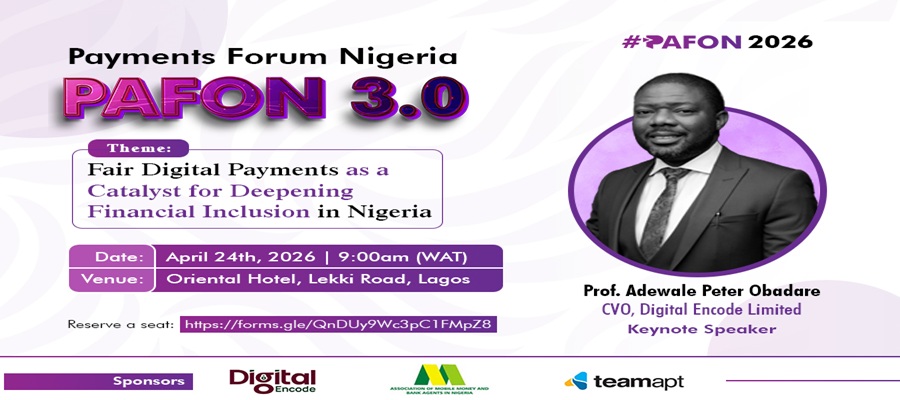
Digital Encode Limited has emerged the lead sponsor of the upcoming third edition of the forum (PAFON 3.0), the organisers have announced.

PAFON 3.0
PAFON 3.0 is scheduled to take place on Friday, April 24, 2026, at the Oriental Hotel, Lekki Road, Lagos, from 9:00 AM to 1:00 PM.
Themed “Fair Digital Payments as a Catalyst for Deepening Financial Inclusion in Nigeria,” PAFON 3.0 serves as a strategic platform for senior executives from banks, fintechs, regulatory agencies, and technology innovators to address the evolving digital payment landscape.
As Nigeria transitions toward a cash-light economy, the forum will focus on critical pillars of sustainability, including transparency, pricing integrity, and system resilience.
Bridging Cybersecurity and Financial Inclusion
Professor Adewale Peter Obadare, the Founder/chief visionary officer of Digital Encode will deliver a cybersecurity-focused keynote address that connects trust, resilience, fraud prevention, and consumer protection to financial inclusion.
His session will provide a specialized perspective on how information security serves as the bedrock of financial inclusion; exploring the vital links between building infrastructure that consumers can rely on, protecting the ecosystem to allow inclusion to scale, and ensuring equitable and secure access for all Nigerians.
Prof. Obadare is arguably the most Credentialed PAN-African Digital Trust Leader, CyberSecurity Strategist, GRC Thought Leader & Global Technopreneur.
He is a seasoned Multi-Award Cybersecurity & GRC expert with over 58 (Fifty-Eight) international professional certifications to his credit, Master of Science in Cybersecurity, Liverpool Unversity, UK, was awarded Honorarary Doctorate Degree in Cybersecurity from Trinity International University of Ambassadors Atlanta Georgia, United State of America and First Professor of Practice – Cybersecurity at Miva Open University, Abuja, Nigeria.
Prof. Obadare is a well-recognized subject matter expert with numerous successful engagements to his credit in Africa and the world. His skills and experience spans Data Privacy, Data Protection, CyberSecurity, Information Security, Vulnerability Management, Penetration Testing, Computer Forensics, Business Continuity, I T Governance, Risk Management and Compliance.
He is a Cybersecurity Advisory Board Member for Lagos State Government, a Platinum Team Member of Open-Source Security Testing Methodology Manual (OSSTMM), as well as a lifetime member of the Open Worldwide Application Security Project (OWASP). He is an alumnus of FATE Foundation and US Department of State Exchange program.
He is also a distinguished alumnus of executive education at Harvard Business School, Harvard School of Government, MIT Sloan School of Management, MIT Professional Education and Oxford University – Said Business School.
“Without trust in the security of digital payments, inclusion cannot scale. And we are happy to welcome Digital Encode as our Lead Sponsor this year. With what the company stands for and the personality of the CVO on a global scale, we have no doubt that attendees at this year’s PAFON will go home with lots of insights.”
“The theme for PAFON 3.0 was carefully selected because if digital payments are affordable, transparent, accessible, and trustworthy, more Nigerians, especially the underserved, will participate in the financial system”, Mr. Chike Onwuegbuchi, the co-convener of Payments Forum Nigeria, noted, highlighting Digital Encode distinguished leadership in Nigeria’s cybersecurity ecosystem.
Other Confirmed speakers: Dr. Jameelah Sharrieff-Ayedun, Vice President, Fintech Association of Nigeria (FintechNGR) & CEO, Credit Registry; Uche Uzoebo, MD/CEO, Shared Agent Network Expansion Facilities (SANEF Limited): Special Guest of Honour; Mojeed Abayomi Agboola, National President, Financial Inclusion Agents Multipurpose Cooperative Society (FIAMCS); Dr. Obioha Otti, National President, Association of Mobile Money and Bank Agents in Nigeria (AMMBAN); Chukwuemeka Enoch, Founder, Lagos Blockchain Week, and Sarafadeen Fasasi, National President, Association of Financial Inclusion Agents of Nigeria (AFiAN), amongst others.
The forum will feature speakers from across the financial spectrum, including mobile money operators, payment processors, and development institutions, to shape policy dialogue and industry standards.
PAFON is a premier industry gathering that aligns brand positioning with trust and innovation in Nigeria’s digital payments ecosystem. It provides a unique space for thought leadership, regulatory engagement, and market expansion within the payment infrastructure sector.

Meta Files Appeal over $25,000 Damages Awarded to Falana

Teenager Hacks Celebrities Whatsapps, Sells Adult Content in Delta

FG Unveils ePharmacy Platform to Regulate Digital Pharmaceutical Services

Elon Musk Accuses South Africa of Racism over Starlink Licence Block

SERAP Asks Tinubu to Probe Alleged N2.9Bn Fraud In NIGCOMSAT, NNRA

Spotify’s Loud & Clear Report Reveals Over ₦60Bn Revenue for Nigerian Artists in 2025

Kuda MFB Increases Kuda for Her Business Grants to ₦10 Million

Canal+ to Cut Jobs as Part Sweeping Restructuring

Nigeria tops global rankings for USDT, USDC ownership

NBC Boss Urges Content Ceators to Participate in DSO




 Broadcasting2 days ago
FG to Gift Nigerians over 100 Free TV Channels from May 15

 E-Financial2 days ago
CBN Dismisses Polaris Bank Liquidation Claim

 E-Financial2 days ago
AfDB Okays $200m for Nigeria’s Digital Backbone, Others

 General News2 days ago
FG New Approves Biometric Passenger Verification System for Airports Security

 E-Financial2 days ago
Nigeria’s Growth under Threat as Poverty Deepens, World Bank Warns

 News2 days ago
Experts Reveal a Steady Decline of High-severity Incidents Over the Years

 E-Business2 days ago
NESREA, ACMTI, Others Launch Carbon Utilisation Initiative in Nigeria

 General News2 days ago
Breaking Barriers: Cassava Technologies Expands Digital Access Across Africa