

Telecom
Stakeholders Reiterate Call for Quality Corporate Service Delivery

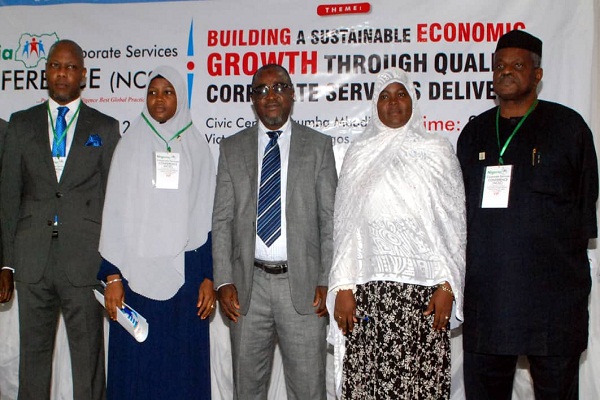
Stakeholders at the maiden edition of the Nigeria Corporate Services Conference organised by TenticP communicationsan have urge government to ensure strict compliance of quality corporate service delivery by businesses, organizations, entrepreneurs and government agencies.
The Chairman of the event, Mr. Abdulfatai Olayinka Olajide in his opening address said that the theme “Building A Sustainable Economic Growth Through Quality Corporate Services Delivery,” couldn’t have come at a better time citing the current situation in the power sector as an instance. He called on relevant agencies to improve on their corporate service delivery in the country.
In a paper titled: “Due diligence, best practices in revenue generation,” the Executive Chairman, Federal Inland Revenue Service (FIRS), Mr. Tunde Fowler, said that both the consumer and service providers must have understanding to achieve greater results and satisfaction.
The EC represented by Mr. Abolade Kehinde observed that State Governments across the country need money to finance their expenditure, which includes infrastructure and social services, and that such money, is generated majorly through taxation and borrowing.
He, however, argued that generally, taxation is deemed preferable to borrowing as debt has to be repaid usually with interest and other debt servicing obligations which can sometimes create additional burden on Government.
While identifying tax as a major enabler of generating revenue, Mr. Fowler said that in an ideal environment, voluntary compliance by the tax payer will ensure that revenue is made available for improving on the provision of social amenities and services.
Describing taxation as a social contract between government and taxpayers, he noted that taxation enhances accountability on government, because taxpayers have a greater stake in governance.
“In addition, when citizens play such a significant role in raising revenue, government will similarly have a strong motivation to account for revenues collected and their utilization”, Fowler said,
He further warned that it is therefore, important that in actualizing its mandate, revenue authorities must ensure that every effort is made to ensure that tax administration helps and does not hamper the valid interests of all stakeholders.
In building relationship between Corporate Governance and Public Sector best practice, Fowler advised that Government is expected to determine tax rates and tax laws but has to be very careful about simply increasing tax rates while making it difficult for taxpayers to comply.
According to him, “a country’s corporate governance system affects the degree to which tax changes affect the growth (or not) of tax revenue. So, when it is easy to divert income to avoid tax or when share ownership concentration is too unbalanced, an increase in the tax rate can reduce tax revenues.”
“By contrast, in a good corporate governance environment, Controlling shareholders will have too little incentive to divert income to avoid tax especially when they are accountable to other investors. This is because they take the personal risk of enforcement by tax authorities but benefits very little from it in terms of shareholder value.”
Fowler also noted that transforming a nation requires cultivating good character. Poverty according to him, does not cause corruption, it is corruption that rather causes poverty! To combat both, there is need for more than aid, investment or protests. “Nigeria needs the hearts and minds of all of us to be transformed by God’s word and Spirit,” he said.
He argued further that to attain due diligence and best practice in revenue generation in Nigeria, government must ensure that tax money works for the taxpayer; and that there should be accountability and value for money. In addition, taxpayers have the right to demand value for money if they themselves have been compliant.
Some of the other steps that would enhance due diligence and best practice in revenue collection in Nigeria, according to Fowler, would require full participation in the tax collection process by every Nigerian adult; participation in governance by asking questions on how taxpayers money is being spent; and whistle-blowing by reporting tax evaders.
In another keynote address titled “Ethics, the backbone of quality corporate services for economic growth,” the Director General, Lagos Chamber of Commerce and Industry, Mr. Muda Yusuf, said that the Conference was timely, because given the structure of the Nigerian economy, at no other time is the conversation on quality corporate services delivery in private and public sectors more appropriate than now as the country works to transform the economy from being resource-based to a knowledge-based, innovation and technology-driven economy for the good of all.
Yusuf said Services are increasingly important for their direct contribution to Gross Domestic Product (GDP), exports and employment, maintaining that with the change in the structure of the Nigeria economy from a real sector dominated system to services led economy- services sector has become the largest sector in the economy, with its share of GDP 52.62% in 2018, in addition to the sector also contributing the largest proportion of employment at 57.4%.”
According to him, “Nigeria has made significant progress in its services sector, becoming one of the leading corporate service providers in the continent of Africa- our banks have registered their footprint in many Africa countries, we have a robust Business Process Outsourcing (BPO) and others, providing diverse services to businesses and governments. These are immense economic opportunities we must optimize and unleash for tangible sustainable economic deliverables.”
He said that going by the enormous human resource available to the country and the demographic advantage, focus must be shifted on inculcating a culture of professionalism and ethical conduct in service vendors, adding that though many private sector operators have embedded ethical principles in their operations, there was need for a national consensus on ethical conducts within the country’s corporate and public service space, as this will improve the global competitiveness of the Nigerian economy.
Yusuf therefore, recommended among others, that:
“Nigeria must commit to abiding by the established rules, regulations and code of conducts in her corporate and public endeavours and must make doing things right her national priority. Citizens’ mindset should be changed from the entitlement based to a service focus;
“There is need for a formalized ethics regime which would ensure that all stakeholders know and understand the rules and expectations;
“There is a need to promote greater awareness of Ethics and the Code of Ethics in the public and private sector, as this is the best way of promoting ethical behaviour. The National Orientation Agency (NOA) and private sector institutions should step up and sustain enlightenment campaigns for standard ethical behavior;
“Sanctions should be given to unethical and unprofessional conduct with sufficient penalty for unethical practices to deter deviation from ethical behavior;
“Nigeria should endeavour to promote professionalism in the public and corporate sector should be promoted and to this end, service vendors in the public and private sectors must be encouraged to join a professional body that is related to what they do, among other recommendations.
The LCCI DG concluded by urging Nigerians to act in a responsible manner in accordance with all relevant laws, regulations, guidelines and industry standards, maintaining that if all should commit to standard practices and procedures, Nigeria will definitely be able to raise the bar of services delivery to drive the sustainable growth of the nation’s economy.
A 3-man panel made up of Engr. Falilat Olaitan Jimoh, representing the Director General of the National Information Technology Development Agency (NITDA), Dr. Isa Pantami; Mr. Victor Ayoola, representing Mr. Tom Isibor, Head, Association of Chartered Certified Accountants, ACCA Nigeria; and Dr. Adebowale Adeagbo- Chief Operating Officer, Halogen School of Security Management and Technology.
The session was anchored by Mr. Abdulfatai Olayinka Olajide who doubled as the Chairman of the occasion.
In her intervention, Engr. Falilat Olaitan Jimoh noted that ICT has come as a disruption to the way businesses are done, and said that the earlier Nigerians embrace this reality, the better, adding that NITDA though with its limited resources, wants huge impact of ICTs on the Nigerian people.
This she said, gave birth to the Agency’s roadmap aimed at ensuring digital inclusion, job creation through ICTs, local content promotion, cyber security, as well as regulation. “In NITDA, the game has changed, standards are being raised. Corruption is being tackled and global best practices guide NITDA’s policies and actions. We should join hands to make the country work,” she said.
Dr. Adebowale Adeagbo said in his own contribution that Nigeria’s biggest problem is in trhe inability of government to remain focused, explaining why there is insecurity everywhere. He argued that Security can only be achieved if it is devolved to the local community.
According to him, “Government should allow the private sector drive business as it has no business running businesses. Government should rather focus on governance, provide the enabling environment and allow the private sector drive the economy. Nigeria has a bright future.”
Victor Ayoola opined that Nigeria is where she is today because she started moving away from standards, insisting that the country needs to tell and sell its own story because “it’s a country endowed with very intelligent and brilliant citizens. We need to grow our capacity while each of us should maintain their space.”
Executive Chairman of Kosofe Local Government Area of Lagos State, Hon. Afolabi Babatunde Sofola noted that there is need for the reorientation of the country’s value system, go back to the basics, adding that God-fatherism in Nigerian politics must be dealt with. “In all, value should be rewarded. Today, Local Government chairmen are professionals trying to bring decorum and professionalism to governance.”
The programme ended with Awards given to some individuals and corporate organisations in recognition of their contributions to best practices, due diligence, business ethics and corporate governance advocacy.
Earlier, the Conference Convener and the Managing Director/Lead Strategist of TenticP Communications Nigeria Limited, Nahimah Ajakanle-Nurudeen, in her welcome address noted that the Nigeria Corporate Services Conference is projected to be an annual event aimed at driving best practices and innovations in the delivery of quality corporate services by businesses, organisations, entrepreneurs, and government agencies in Nigeria. It’s a platform designed to enhance business and economic growth, through promotion of best practices and due diligence for sustainable development in Nigeria.
She said that the Conference theme: “Building a sustainable economic growth through quality corporate services delivery” was picked because of its relevance to the country’s contemporary economic development at a time when observing global best practices, due diligence, business ethics and corporate governance are being amplified by stakeholders in both public and private sectors.
Non-observance of best practices, due diligence, business ethics and corporate governance she said, are some of the challenges confronting the Nigerian economy where business people, corporate organisations and individuals cut corners by shunning ethics for reasons best known to them.
It is believed that a lot needs to be done in emphasizing best practices, due diligence, business ethics and corporate governance because when a nation gets it right by doing the right thing, the country can adopt and run with the philosophy of best practices, as this would significantly improve the healthcare, education, governance, food security, social harmony, etc.
She observed that today, not many Nigerian consumers are aware that SERVICOM, an agency that gives them the right to demand good services as contained in MDAs Service Charter, exists, even as those who are aware, hardly make use of it.
She urged the Federal Government to ensure strict compliance to SERVICOM policy by all ministries, departments and agencies in Nigeria. This is in addition to government encouraging private initiatives such as in the promotion of best practices, due diligence, business ethics and corporate governance in the country.



Clean and reliable power for telecom networks in Ethiopia, Liberia, and Sierra Leone will be expanded following a $45 million investment by the International Finance Corporation (IFC) in IPT PowerTech.

The investment targets countries where limited power supply continues to slow digital connectivity and broader economic participation, the institution stated earlier this week.
To enable this expansion, the IFC is providing a $45 million corporate financing package consisting of an A-loan of $27 million and $18 million in blended finance.
The blended portion is sourced from the Canada-IFC Blended Climate Finance Programme and the IDA20 Private Sector Window Blended Finance Facility.
The initiative marks the IFC’s first direct infrastructure engagement in Liberia in a decade and in Sierra Leone in six years.
It will help scale solar- and battery-based power systems that reduce reliance on diesel and support greener, more resilient telecom networks.
By improving the quality and stability of power to telecom towers, the initiative will strengthen mobile coverage and ensure that households, schools, health centres, and small businesses can depend on consistent digital services, said the IFC.
The funding supports the modernisation, operation, and maintenance of 2 235 telecom sites across the three nations. More than 90% of these are located in off-grid or weak-grid locations.
With new solar and battery systems powering these sites, mobile networks will experience fewer outages and improved service quality.
Optimising the energy mix is estimated to reduce power costs for operators by up to 30% in Liberia, 26% in Sierra Leone, and 52% in Ethiopia.
This transition is also expected to cut emissions by more than 10 624 tonnes of carbon dioxide annually. Furthermore, the partnership will promote gender inclusion by expanding opportunities for women in technical, operational, and leadership roles within the sector, says the IFC.
This agreement reflects a shared vision for a greener telecom industry and empowers the company to scale its innovative energy platforms, according to Nabil Haddad, CEO of IPT PowerTech Group.
Reliable and affordable power for telecom networks is a cornerstone of Africa’s digital transformation, said Nathalie Kouassi-Akon, IFC regional director for West Africa and the Gulf of Guinea.
Through this partnership, the institution is supporting a scalable, private sector-led solution that enables mobile operators to reach underserved and fragile communities more sustainably, added Kouassi-Akon.
The project advances the World Bank Group and African Development Bank’s Mission 300 initiative, which aims to provide electricity to 300 million Africans by 2030.

Expedier has unveiled “Expedier for Business,” an online pro-banking platform to simplify global payments, multi-currency transactions, and financial operations for expanding companies.

Kingsley Madu
The tool centralizes payments, invoicing, payroll, and treasury into one secure dashboard, tackling challenges like fragmented systems and poor visibility that hinder international scaling.
Kingsley Madu, Co-Founder and CEO of Expedier, said: “African businesses are increasingly global… Expedier for Business was built to simplify how companies manage money across borders while maintaining visibility, control, and compliance.”
Key features include customizable dashboards for payments, invoices, and workflows; support for USD, CAD, GBP, EUR, and more; virtual cards; automated payroll/invoicing; currency swaps; and real-time tracking.
Security measures cover two-factor authentication, KYC/KYB verification, and team access controls.
As cross-border trade and remote work boom in Africa, the platform aids firms dealing with international suppliers, teams, and customers. It is now available for organizations scaling globally.

Nigerian fintech unicorn Moniepoint Inc. has finalised its acquisition of a 78% stake in Kenya’s Sumac Microfinance Bank, gaining a key deposit-taking licence for credit expansion in East Africa’s biggest economy.

The deal, marked by a Nairobi reception, bypasses the Central Bank of Kenya’s licence freeze, letting Moniepoint rival giants like Safaricom and Equity Group after a stalled Kopo Kopo bid.
It signals Africa’s fintech shift to licensed banking and mergers, equipping Moniepoint to roll out high-speed SME lending via Sumac’s 20-year-old infrastructure and branches.
The acquisition builds a cross-border merchant ecosystem beyond fees, integrating recent Orda buyout (cloud restaurant software) for “business-in-a-box” tools like inventory, payroll, and capital amid Kenya’s digital lending scrutiny.
Moniepoint, which hit $294 billion annualised transactions in 2025, eyes Kenya’s SMEs with Nigeria-honed retail expertise.

NCC to Curb SIM Fraud, Strengthen Digital Security with New Platform

NBC Boss Urges Content Ceators to Participate in DSO

Kidnappers Now Use Banks to Collect Ransoms — Expert

CBN Says Bank Customers Won’t Lose Deposits because of Recapitalisation

Jury Finds Meta, Google Liable for Woman’s Social Media Addiction

Kaspersky Discovers New Phishing Campaign Exploiting Google Tasks Notifications to Steal Corporate Credentials

esentry 2025 Report Shows Healthcare, Financial Services and Telecoms as Staging Grounds for Increased Cyberattacks in Africa

Spotify’s Loud & Clear Report Reveals Over ₦60Bn Revenue for Nigerian Artists in 2025

MTN Nigeria Posts Record N1.70 Trillion Pre‑Tax Profit, Declares N20 Dividend for 2025

China Threatens to Shut Nigeria’s Satellite Over $11.44m Unpaid Debt




 E-Financial3 days ago
CBN Directs IMTOs to Open Naira Settlement Accounts

 Telecom3 days ago
Nigerians Lose N12.5Bn to AI-Driven Scams- PwC

 General News3 days ago
Court Remands Hacker for Allegedly Stealing N3.09Bn from FCMB

 Telecom3 days ago
Airtel Africa, Starlink Mobile Data and Messaging Testing Take off in Kenya

 E-Financial3 days ago
DLM Capital Group’s AAA-Rated Sovereign Bond-Backed Composite Notes (“SBCNS”) Strengthens Investor Confidence with Successful First Principal & Interest Payment

 E-Business3 days ago
AU Sees AI Adoption Evolving to Boost Economic Growth in Africa

 News3 days ago
Kaspersky, AFRIPOL Conduct Joint Cybersecurity Training for African law Enforcement

 Telecom3 days ago
GATEWAY Programme Opens Doors for 340,000 Nigerian Youths to Tap into $1.85trn Global Gig Economy