

E-Business
Top Business Minds Confirm DEMO Africa 2014 Attendance

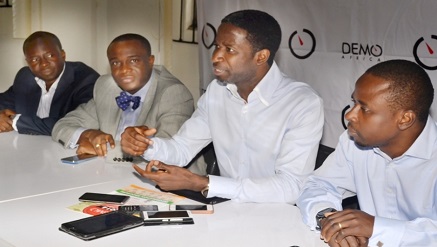
A sneak preview into DEMO-Africa’s list of expected guests has revealed the names of some of the most influential business and technology personalities.
The list features Mr. Tony Elumelu, chairman of Heirs Holdings and founder of Tony Elumelu Foundation, Mr. Baybars Altuntas, vice president of The European trade Association for Business Angels (EBAN), Fernando de Sousa, general manager, Microsoft for Africa initiative, Mr. Jason Njoku, founder of IROKO and Mr. John. Momoh, the CEO, of Channels TV, Nigeria.
This year’s edition of DEMO Africa which will also be addressed by Dr (Mrs.) Omobola Johnson, minister for Communication Technology, and her counterpart in the ministry, PS, Dr Tunji Olaopa, is expected to fuel discussions geared towards making critical adjustments that will allow Africa to create a better environment for business.
Besides gracing the event to scout for talent on the DEMO Africa stage, the key guests are scheduled to exchange ideas at the Angels Investors Summit on the 24th which will allow a knowledge exchange between the continent’s various angel investors and map out the future of angel investing in Africa.
Commenting on the heightened excitement from the expected participation, Mr. Yele Okeremi, the Chairman of the Local Organizing Committee, expressed confidence on the outcome of the event. “We feel honored to be able to host some of Africa’s biggest minds. We are positive that the ideas shared at this forum will be implemented to make Africa realize the dream of self-sufficiency.”
SpacePointe’s founder Sayu Abend, one of the finalists scheduled to pitch on the DEMO Africa, expressed optimism in the event stating that the unique mix of mentors and role models expected at the event is a rich source of important lessons for young entrepreneurs and the start-up businesses in Africa. “I am positive that SpacePointe and other participating start-ups are bound to grow from this experience.”
The DEMO Africa event preparations are now in the very final stages.
There is a special package available to investor delegates which comprises 15% discount on a DEMO Africa ticket, 15% discount on a VC4Africa Pro Account, Access to the companies’ financials, Ticket to the Investor Cocktail on DEMO Africa’s opening evening, Ticket to a special Investor Boomcamp as well as access to a special Investor Lounge and Deal Room at DEMO Africa.
This year’s event is being organized in collaboration with the LIONS@FRICA partners, Microsoft, Nokia, US State Department, DEMO, USAID, African Development Bank, VC4Africa among others and Nigeria’s Federal Ministry of Information and Communication Technologies.



Kaspersky Global Research and Analysis Team (GReAT) has uncovered a new Android malware campaign in which cybercriminals distributed the BeatBanker Trojan under the guise of the Starlink application for Android.

Threat actors primarily target users from Brazil; nevertheless, Kaspersky experts don’t rule out that users from other countries may also face this threat.
The Trojan employs a Monero cryptocurrency miner and additionally installs a BTMOB remote administration tool (RAT) on the infected devices. To maintain its persistence, BeatBanker uses an uncommon mechanism involving a nearly inaudible looped audio file.
“At first we saw BeatBanker being distributed under the guise of a public services app; it installed a banking Trojan in addition to a cryptocurrency miner. However, our recent detection efforts uncovered a new campaign with another BeatBanker variant that deploys the BTMOB RAT instead of the banker module.
The attackers appear to be using a fresh lure with the Starlink app to reach more victims from different countries. Therefore, it is important for users to stay vigilant and use advanced solutions to protect their smartphones,” comments Fabio Assolini, Head of the Americas & Europe units at Kaspersky GReAT.
Initial vector of infection
Kaspersky experts believe that cybercriminals distribute a fake Starlink application containing the BeatBanker Trojan through phishing pages that mimic the Google Play Store. After execution on a compromised device, the Trojan displays a user interface that also mimics Google Play. Cybercriminals trick victims into granting installation permissions, thus allowing the download of additional hidden malicious payloads.
Crypto mining and BTMOB RAT module
When a user clicks UPDATE on the fake Google Play page, a Monero cryptocurrency miner deploys. BeatBanker monitors battery percentage and the temperature of an infected smartphone, as well as user activity after which a hidden cryptocurrency miner is started or stopped.
The Android Trojan also installs a BTMOB RAT on the compromised device. BTMOB enables full remote control and is sold as Malware-as-a-Service.
It is capable of automatic granting of permissions, hide system notifications and has mechanisms designed to capture screen lock credentials, including PINs, patterns and passwords on compromised devices. The malware also gives cybercriminals access to the front and rear cameras, GPS location monitoring and constant collection of sensitive data.
To ensure persistence and hinder uninstallation, BeatBanker maintains a fixed notification in the foreground and activates a foreground service with silent media playback. This tactic is designed to prevent the operating system from removing the malicious process.
Kaspersky’s products detect this threat as HEUR:Trojan-Dropper.AndroidOS.BeatBanker and HEUR:Trojan-Dropper.AndroidOS.Banker.*.


By Shameel Joosub
For centuries, Africa has powered global economic growth through its resources, labour, and human potential, yet too little of that prosperity has been realised on the continent itself. Today, artificial intelligence presents a rare opportunity to change that trajectory.

As the global economic order undergoes its most significant transformation since the end of the Second World War, Africa stands at a decisive inflection point.
With the world’s youngest population, rapidly expanding digital adoption, and vast untapped potential, Africa is uniquely positioned not just to participate in the AI era, but to help shape it.
Realising this opportunity, however, will require deliberate investment, enabling regulation, and a commitment to ensuring that the benefits of AI reach all 1.5 billion people across the continent.
When I reflect on AI, what strikes me most is that it is enabled by humanity.
Intelligence is fundamentally human, and AI is an extraordinary amplifier of human creativity and capability.
It is not about replacing people. It is about empowering them to do more, faster, and better.
While this progress is remarkable, our responsibility as African businesses is to extend these capabilities beyond our corporate walls so that AI can unlock Africa’s underutilised potential and drive inclusive growth.
Unlocking Africa’s Potential Across Industries
As a purpose-led African connectivity and digital services company serving 223.2 million customers across South Africa, the DRC, Egypt, Ethiopia, Kenya, Lesotho, Mozambique, and Tanzania, Vodacom has invested strategically in AI across multiple sectors.
Our mobile networks reach a population of 588 million people. That reach must translate into opportunity.
Consider agriculture. One of our subsidiary companies, Mezzanine, leverages AI to unlock previously invisible insights into soil composition, empowering farmers to make data-driven decisions that improve crop yields and profitability.
When farmers thrive, food security strengthens and rural communities prosper. That is inclusive growth in action.
In financial services, AI is strengthening trust and security. In Kenya, Graph Network Analytics enhances M-Pesa fraud detection by mapping money movements in real time, helping protect more than 37 million customers who rely on the service in their daily lives.
As criminals target digital payment platforms, AI helps predict and prevent fraud scenarios, including SIM swap fraud and identity theft.
AI is also supporting national infrastructure. In South Africa, connectivity and IoT solutions monitor coal transport in real time from pit to port to power station.
This improves operational efficiency and supports energy security, addressing critical infrastructure challenges that have constrained economic growth.
These are not isolated examples. They represent a broader truth. Technology delivers its greatest value when it solves real problems for real people.
The Infrastructure Imperative: Modernising Regulation
Yet none of this is possible without one fundamental prerequisite: connectivity. Connectivity requires sustained investment in infrastructure, supportive policy environments, and regulatory frameworks that enable innovation.
If Africa is serious about universal access, modern and enabling regulation is essential. Spectrum licensing must be efficient and predictable. Infrastructure sharing must be supported. Universal service funds must be effectively deployed. Administrative barriers to infrastructure rollout must be reduced. Cloud and data platforms, which power AI capabilities, must be supported through enabling policy environments. These are not peripheral issues. They are fundamental to accelerating Africa’s digital and economic transformation.
These challenges represent only a portion of the regulatory barriers that must be addressed to deliver affordable, reliable connectivity to all Africans.
Pan-African Coordination: Our Collective Responsibility
Africa’s greatest advantage is its youth, but demographics alone will not deliver growth. To realise this potential, we must actively skill up young people in our schools and universities so they can take full advantage of an AI-driven future.
That requires modernising education curricula to embed AI literacy, data capability and practical problem-solving at scale. Companies like Vodacom are investing in digital skills development, but unlocking Africa’s potential will require coordinated action across government, academia and industry.
This is why governments and intergovernmental institutions such as the African Development Bank Group, the African Union, SADC, ECOWAS, and other regional bodies play a critical role in harmonising regulatory frameworks across the continent. Greater coordination can accelerate investment, enable scale, and support the development of an integrated digital economy.
Pan-African alignment of telecommunications regulation is not merely a technical objective. It is essential to unlocking inclusive growth and ensuring that Africa can compete effectively in the global digital economy.
Our Moment
Africa has long contributed to global progress. In the AI era, it has the opportunity to define its own future as a creator of innovation, productivity, and inclusive growth. The foundations are already in place. Our young population, expanding connectivity, and accelerating digital adoption position the continent to lead in ways that were not previously possible.
But this outcome is not guaranteed. It depends on the choices we make now. By modernising regulation, investing in connectivity as foundational infrastructure, and ensuring that AI empowers individuals, businesses, and communities, Africa can secure its place as a central force in the global digital economy.
That is the Africa I believe in. That is the Africa we are building at Vodacom, connecting people, enabling opportunity, and ensuring that technology serves the progress of society as a whole
Shameel Joosub, is group Chief Executive Officer, Vodacom Group
Source: Tech Africa News

Nigeria has begun consultations on plans to introduce age restrictions for social media use, as Africa’s most populous country joins the global trend of strengthening protections for children in the digital space.

The Ministry of Communications, Innovation and Digital Economy this week launched a nationwide survey inviting parents, educators, young people and technology experts to help shape policies aimed at regulating children’s access to social media and other digital platforms.
The consultation comes amid rising concerns over online risks facing Nigerian minors as smartphone ownership and internet usage continue to increase across the country.
Dr. Bosun Tijani, Minister of Communications, Innovation and Digital Economy, said the government is seeking a balanced approach that protects children while preserving the educational and social benefits of digital access.
“While the internet offers significant opportunities for learning, creativity, and communication, it also exposes children to risks such as cyberbullying, harmful content, online exploitation, misuse of personal data, and emerging challenges linked to artificial intelligence tools,” Tijani said.
The proposed framework could include age restrictions on social media platforms, stronger age-verification systems, and tougher accountability requirements for technology companies.
“As Nigeria evaluates potential policy approaches for protection of children online, including age restrictions, improved age verification systems, platform accountability measures, and enhanced regulatory oversight, public input is essential,” Tijani added.
The move follows alarming findings from a 2025 study cited by Nigeria’s telecom regulator. According to the Nigerian Communications Commission (NCC), nine in ten Nigerian children face at least one form of cyber risk online.
Nigeria’s push reflects a broader global trend as governments tighten online safety rules for minors.
Australia, for instance, implemented a social media ban for children under 16 in December 2025, requiring platforms such as TikTok, Instagram and YouTube to restrict access. Indonesia has also announced plans to bar under-16s from social media, while France and Denmark are pursuing similar restrictions for users under 15.
Similarly, Nigeria is confident that feedback from the public survey will help shape an evidence-based policy framework aimed at creating a safer digital environment for children.

Easybuy Sales Talent Program to Empower 10,000 Nigerians to Become Millionaires

Ghana Nabs 93 Nigerians in Cybercrime Crackdown

Kaspersky Uncovers a New Android Malware Campaign Disguised as Starlink Application

APC Chairman Yilwatda Set for Keynote at 2026 WACC, Charts Tech Path for 2027 Polls

Techeconomy Unveils IWD 2026 Power List Celebrating 100 Women Shaping the Future

Dr. Cairo Ojougboh Foundation Bolsters Nigeria’s Education Drive with ₦2.7m Student Support

Kaspersky Brings more Transparency to Threat Detection with New Hunt Hub

Kaspersky Discovers New Phishing Campaign Exploiting Google Tasks Notifications to Steal Corporate Credentials

esentry 2025 Report Shows Healthcare, Financial Services and Telecoms as Staging Grounds for Increased Cyberattacks in Africa

AfDB, UNDP Launch $10Bn AI Initiative for Africa




 Telecom2 days ago
US Court Dismisses All Claims Against Binance in Major Anti-Terrorism Lawsuit Victory

 Telecom2 days ago
China Threatens to Shut Nigeria’s Satellite Over $11.44m Unpaid Debt

 News3 days ago
Africa Startups Raised $272m in Funding in February

 Telecom2 days ago
TikTok Pumps $200k into AI Media Literacy for Sub-Saharan Africa at Nairobi Summit

 General News2 days ago
More Nigerians Emerge Millionaires in Week 9 of NIVEA’s Consumer Campaign

 E-Business2 days ago
NITDA, Nkenne AI Seek to Localise AI for Nigerians

 Telecom2 days ago
NCC Orders Telcos to Report Cyberattacks Within 4 Hours from 2027

 E-Business1 day ago
FG Moves to Strengthen Children’s Online Safety