

Broadcasting
With 16 PhDs, Accra Institute of Technology shows the way to produce doctorate degrees in Africa

By Dominic Osei-Boakye
Birthed in 2009, started walking fully in the latter part of 2010 at a one block building surrounded by beautifully designed containers at the premises of the Civil Service Training Center and Government Secretarial School at Cantonments, the Accra Institute of Technology (AIT) has defied all odds and become a leader in producing PhDs in Ghana, one of Africa’s major centres of learning.

Once described by a Nigerian journalist as a “potter cabin university” with the registrar’s office labeled as a “two by four cubicle”, the AIT success story provides a model on Africa’s pathway to knowledge and skill development in a more globalised economy. And it is worthy of emulation.
Captained by Professor Clement Dzidonu, a world renowned Computer Scientist, backboned by eminent academics in the Board of Trustees (BoT) including Prof Edward Ayensu (Formerly of World Bank Inspection Panel) as Chairman, Prof. Ivan Addae Mensah (Former Vice Chancellor, University of Ghana) as Vice Chairman, Prof. Jophus Anamuah Mensah (Former Vice Chancellor of University of Education, Winneba), and Prof. Samuel Adjepong (Former Vice Chancellor, University of Cape Coast), the AIT has been built on a solid rock of knowledge champions.
In this league are also Prof. William Otoo Ellis (Former Vice Chancellor, Kwame Nkrumah University of Science and Technology), Very Rev. Ama Afo Blay (Former Director General of Ghana Education Service), Dr. Grace Bediako (Former Government Statistician) and Mr. K.S. Yamoah (Former Managing Director of the Ghana Stock Exchange). All of these academic have helped AIT to lead the way in terms of production of quality PhDs in the country, and the rest of the continent to set the pace in knowledge engineering.
Through its partnership with Open University of Malaysia, the Accra Institute of Technology has produced Eighty-One (81) PhDs since 2016. This translates into an average of Fourteen (14) PhDs per year. This is unprecedented and a great achievement for a young private university like AIT. Considering the fact that the PhD per capita of Ghana is alarmingly low, the contributions of AIT in bridging this gap cannot be underrated. More importantly, the partnership has fostered the new direction of knowledge-sharing across continents to close the gap deep learning and development.
Did this Come Easy? Not at all! To offer, run and graduate students on an internationally benchmarked Doctor of Philosophy (PhD) degree programs in Ghana is by all standards a herculean task. As a non-religiously denominated or related private university which is school fees driven with no support from government nor any other organisations, running PhDs can be very expensive. After paying supervisors, external examiners and reviewers, PhD Research Committee members, internal and external moderators, etc, the university retains virtually nothing and makes no profit. This explains why most of the private universities shy away from this daring venture since it is not financially worthwhile.
Additionally, getting supervisors and external examiners to mentor these PhD students is another huge task. Running PhDs in special areas like Business Administration, Information Technology, Engineering and Education come with so many difficulties in attracting supervisors and external examiners who dully qualify to mentor the students.
However, AIT has surmounted this hurdle with collaborations with several internationally recognized universities with competent Professors who have been working hard to produce these PhDs.
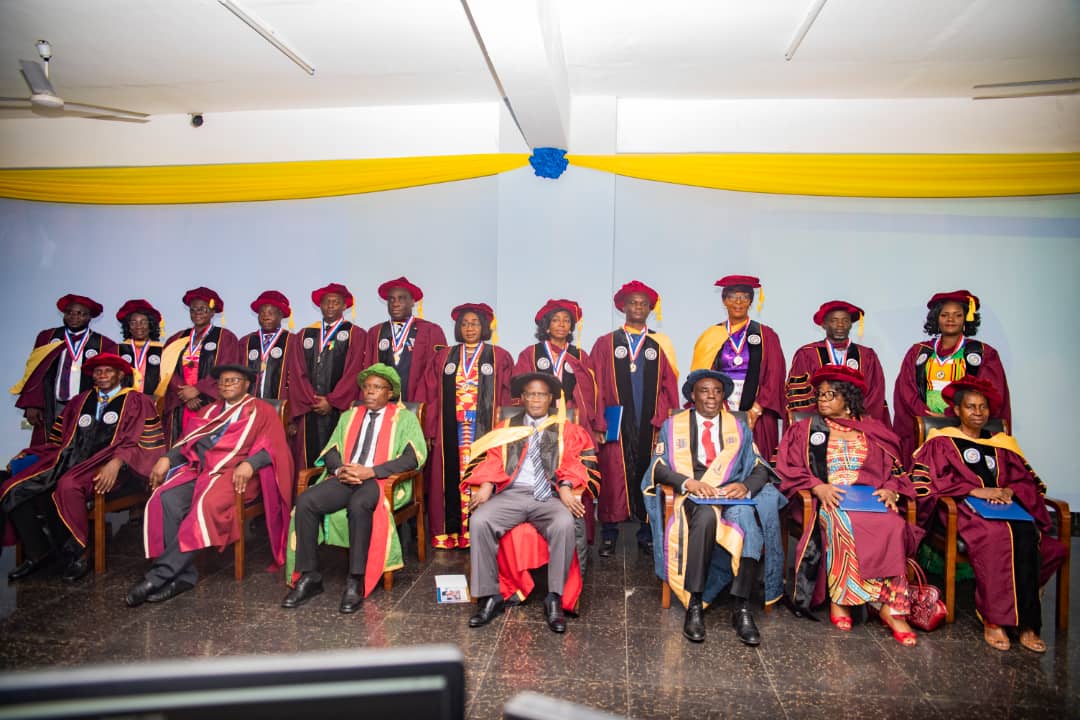
Speaking at the 18th graduation of AIT, held on 17th December, 2022 at the ultramodern Knowledge City Campus in Kokomlemle, where AIT graduated Sixteen (16) PhDs at a goal, the President of AIT could not hide his joy especially having led his team to make this huge contribution to academia in the country.
He stated: “Mr. Chairman, I will need to pause here to comment on the historic nature of the 18th Congregation of this young and dynamic University. Today we are making yet another history in this country’s annals of private university education. Mr. Chairman, it is my great honor and privilege to announce that we are today graduating for the 10th time, PhDs who studied at this university.
“This major achievement of a university barely ten years old makes AIT the first private university in Ghana to successfully offer and graduate students on an internationally benchmarked PhD program. This is no small achievement if put within the context of the fact that the PhD per capita of Ghana is extremely low. Mr. Chairman, we can claim that we have become one of the leading postgraduate research institutions on the continent. I want to take this opportunity to assure you that we are confident that we will again be graduating more PhDs next year.”
He added: “The Quality? The quality of the PhDs produced by AIT is not in contention. As highlighted by the President in his speech ‘Mr. Chairman, I am delighted to inform you that, at AIT, we are mindful of the need to provide high-standard tertiary education and training not only aimed at producing qualified and highly skilled people to drive the nation’s development in the information age but also to produce job creators, with the requisite entrepreneurial skills and expertise to set up and run their corporations in various fields.
“Also, as a research university, our focus on cutting-edge research work through our postgraduate programs and research initiatives is geared towards supporting the nation’s science, technology, and innovation (STI) drive towards developing a modern knowledge-based and wealth-generating economy in the information and technological age.”
AIT’s milestones underscored why it was ranked the best private university in Ghana in 2018 and 2019 and was also awarded the Best Technology University in Ghana for the fourth year running by Ghana Tertiary Awards.
Quality of the PhDs produced by AIT is shown in the progress of their graduates. Currently, AIT has Pro Vice Chancellors in public universities who became Professors in less than three years after completion. 60% of the graduates have become Senior Lecturers, Associate Professors and Full Professors few years after graduation. The strict requirements by AIT for students to publish minimum of five papers in a reputable and ranked journal sets the foundation for this growth. The PhD Candidature system where students are mentored by the PhD Research Committee for one year instead of just one supervisor through series of presentations and the strict requirement to write minimum three chapters of your thesis within that period also contributes heavily to the success of these students.
In the last 10 years of the program, AIT has graduated PhDs who are on the academic and administrative staff of almost all the private and public universities in Ghana and a number of Nigerian universities. Given the high international academic standard of the program, more than half of our PhD graduates in academia obtained their Associate or Full Professor within three years after graduation. These are outstanding landmarks pointing to how Africa can close the gaps for deep knowledge and research as it gears into the fourth industrial revolution (4IR).
If anyone thought AIT is resting on its laurels, then such people must rewrite their notes. At the 18th graduation ceremony, thirty-five (35) students graduated to become PhD Candidates after completing the first three chapters of their thesis in the first year. They should be completing their PhDs in two years. This is coupled with a number of students who are going through their Post Viva corrections and the twenty (20) students who are preparing to submit their thesis for examination. Two years from now, it is estimated that AIT will graduate not less than forty (40) additional PhDs.
The Chairman of the AIT Board of Trustees, Prof Edward Ayensu summed it all up in his speech at the 18th graduation: “So far, we are proud to report that our efforts in all directions are proceeding according to plan. We can assure this Congregation, and all stakeholders, that we shall not relent in our efforts to ensure the full fulfillment of that vision”
Conspicuously, the Accra Institute of Technology is showing the way and will fill the PhD gap in the country and across Africa in no time.
My final message to students all of Africa, start your journey with AIT from Bachelor’s, Master’s and PhD in Business Administration, Engineering, Information Technology, Computer Science, Education and Health and Safety.
Indeed! Your journey to the top starts at Accra Institute of Technology as it lives to its payoff as the University of the Future beginning today. Yes! In AIT, Africa has a chance to leapfrog; the milestones achieved by AIT in so short a while proved that point.
Dominic Osei-Boakye is Registrar at AIT


Federal Airports Authority of Nigeria (FAAN) says the country now ranks second in Africa for domestic passengers, hitting 10.5 million in 2025—a 10 percent jump.

FAAN
FAAN boss Olubunmi Kuku disclosed this at the Airports Council International Africa conference in Luanda, Angola.
Lagos’ Murtala Muhammed International Airport posted 11.8 percent growth in air traffic movements, one of Africa’s strongest.
Cargo surged 34.4 percent at Lagos, cementing its top-tier status.
Abuja’s Nnamdi Azikiwe and Lagos airports cracked Africa’s top 10 for domestic traffic.
Kuku stressed Nigeria’s push to host and shape African air links amid rising demand for modern, resilient airports.

Afro-pop star Joeboy takes centre stage this week as he features on the Easter edition of African Voices, the Globacom-sponsored magazine programme on CNN.

In this episode, the Nigeria-born singer sits down with show anchor, Larry Madowo, in Lagos, where he shares the story of his journey from a young university student with big dreams to becoming one of Afrobeats’ most recognised voices.
Long before global attention, Joeboy, born Joseph Akinwale Akinfenwa-Donus, started out experimenting with music and sharing covers online. His 2017 cover of Ed Sheeran’s “Shape of You” marked a turning point, helping him transition fully into singing and setting the stage for what was to come.
That moment soon opened new doors, including a connection with Mr. Eazi, who brought him into the emPawa Africa talent programme. This provided support and exposure for his music to reach a wider audience, laying the foundation for his professional career. The alliance also birth “Fààjí,” which featured Mr. Eazi in 2018, after which he was signed to Warner Music Africa.
Under this partnership, Joeboy released his hit single “Baby” in 2019, followed by “Beginning,” which has 23 million views on YouTube. He also released “Love & Light” the same year and featured Mayorkun in the tracks “Don’t Call Me” and “All for You”
Since then, the 29-year-old has gone on to release two albums, Somewhere Between Beauty & Magic in February 2021 and Body & Soul in 2023, while earning recognition across the continent, including awards for his contributions to African pop music. He won Best Artist in African Pop at the 2019 All Africa Music Awards and Best Pop at the 2020 Soundcity MVP Awards Festival.
The programme will air on Saturday at 7.30 a.m., with several repeat broadcasts scheduled across the weekend and into the following week. 11 a.m. on Saturday; on Sunday at 3.30 a.m. and 6 p.m. This continues on Monday at 3 a.m. and 5.45 p.m, and on Tuesday at 5.45 p.m. The schedule will be repeated next week until 3 a.m. on Monday.
The Court of Appeal sitting in Abuja has dismissed an appeal filed by the National Broadcasting Commission (NBC), seeking to overturn a Federal High Court judgement that restrained it from imposing fines on radio and television stations across the country.

NBC
Delivering the lead judgement, Justice Oyebiola Oyewumi, on behalf of a three-member panel, upheld the earlier ruling and set aside the fines imposed by the NBC on 45 broadcast stations on March 1, 2019, for alleged breaches of the Nigeria Broadcasting Code.
The panel was presided over by Justice Abba Mohammed, with Justice Donatus Okorowo as the third member.
According to a statement issued by Idowu Adewale, Communications Officer of Media Rights Agenda (MRA), the unanimous decision of the Court of Appeal stemmed from a suit filed by the non-governmental organisation in November 2021, challenging the NBC’s powers to impose fines on broadcasters.
The Federal High Court, in its judgement delivered on May 10, 2023, by Justice James Omotosho, ruled in favour of MRA after the NBC failed to defend the suit.
The court held that fines are sanctions imposed on persons found guilty of criminal offences and, under Nigerian law, only courts of law have the authority to impose such penalties.
Setting aside the fines of ₦500,000 each imposed on the affected stations, Justice Omotosho stated that the NBC “is neither a court nor a judicial tribunal to make pronouncements on the guilt of broadcast stations, notwithstanding what the NBC Code says.”
He added that the Commission’s actions violated the Constitution.
Dissatisfied with the ruling, the NBC filed a motion in July 2023, urging the same court to set aside the judgement on the grounds that it lacked jurisdiction and had reached its decision without considering relevant facts.
However, in November 2023, Justice Omotosho dismissed the application, describing it as futile and an afterthought, noting that available evidence showed the Commission had been duly served but failed to appear in court to defend the case.
The NBC subsequently approached the Court of Appeal in July 2024, seeking to overturn the judgement.
Advertisement
At the hearing on February 4, 2026, Mr Victor Ogude (SAN), leading Mr Kehinde Wilkey for the NBC, adopted his brief of argument and made additional submissions.
Counsel to MRA, Ezenwa Anumnu, also adopted his brief and responded accordingly.
In its ruling, the appellate court agreed with MRA’s position that the NBC, having failed to contest the suit at the Federal High Court, could not raise fresh challenges at the appellate level.
Justice Oyewumi held that the appeal lacked merit and accordingly dismissed it.
With this decision, MRA has secured victory in the first of two appeals involving the NBC over separate Federal High Court judgements barring the Commission from imposing fines on broadcast stations.
The second appeal, filed by the NBC against a similar judgement delivered on January 17, 2024 by Justice Rita Ofili-Ajumogobia of the Federal High Court, Abuja, is still pending. The Court of Appeal heard arguments in that matter on March 25, 2026 and has reserved judgement.
In that case, the NBC is challenging a ruling arising from a suit filed by MRA after the Commission imposed fines of ₦5 million each on a television station and three pay-TV platforms in 2022 for allegedly undermining national security through the broadcast of documentaries on banditry in Nigeria.

NIBSS Says 28 Percent of Nigerians have Registered for BVN

NITDA DG Urges Stronger Collaboration to Drive Nigeria’s Digital Economy

Ogun Set for Direct London Flights as Gateway Airport Gains Momentum

Airtel Becomes World’s Second Largest Telco as Global Customer Base Surpasses 650 Million

Nigeria Cyberattacks: Stronger Collaboration as a Panacea

Spotify’s Loud & Clear Report Reveals Over ₦60Bn Revenue for Nigerian Artists in 2025

Madonna University Taps Tech Guru Adote for Strategic Board Role

China Threatens to Shut Nigeria’s Satellite Over $11.44m Unpaid Debt

Healthcare Under Attack: Why Cybersecurity is Now Critical Care

Why JustMarkets Is a Strong Choice for Gold Trading




 General News3 days ago
Union Bank Looted: How Former Directors Gambled with Billions and Nearly Destroyed a National Bank

 E-Financial3 days ago
N4.65 Trillion in the Vault, but is the Real Economy Locked Out?

 E-Business1 day ago
FG to Strengthen Cybersecurity Coordination as NDPC Probes Alleged Data Breach

 Telecom1 day ago
Compensation for Poor Service Quality is Automatic- NCC

 General News1 day ago
Tinubu Approves N3.3 Trillion Payment Plan to Boost Power Supply

 Telecom1 day ago
FG Moves to Strengthen Cybersecurity Coordination as NDPC Probes Alleged Data Breach

 E-Business1 day ago
Offset Communications Slams N50m Suit against Qore Technologies for Alleged Copyright Infringement

 General News1 day ago
SERAP Sues CCB over Electoral Act, New Tax law