

Telecom
Aitec Boss Challenges Telcos on Collocation

Sean Moroney, Aitec Africa chairman, has urged telecom operators to look beyond crude competitive capitalism and find ways of sharing infrastructure to accelerate the roll-out of services across various networks.
Moroney stated this at the 2008 Mozambique Information and Communications technology (ICT) Convention. He said that the market has matured significantly over the past five years, with a multiplication of ICT service providers and vendors, and increasingly sophisticated installations by major companies.
“But all this is but a precursor to the major impact that will result from the landing of two undersea fibre cables within the next two years. The shortage and cost of bandwidth are suddenly no longer going to be major constrains on the development of the sector. However, this also presents great challenges,” he said.
Moroney said there is the need to plan now, to break down the internal monopolistic barriers that could continue to maintain bandwidth costs at a high level despite international availability.
“The last five years have also seen a dramatic spread of mobile services. But again, this has been constrained by a duopolistic regime based on a simplistic system of capitalistic competition. The egomania of uncreative competitive capitalism has created what I call the country’s “twin tower” landscape, where up and down the national highways duplicate sets of towers are set up within a stone’s throw of each other,” he stated.
According to him operators think they can demonstrate competitiveness through duplication infrastructure, instead of sharing infrastructure and competing at the far more meaningful level of quality of service. One industry estimate is that the cost of tower construction represents 70% of network roll-out investment. It is great business for the tower construction contractors but I think any first year University student would conclude that this approach imposes a major constraint on telecommunications infrastructure development.
Government and the private sector he said need to put their heads together to agree on an optimum strategy for the rapid roll-out of low-cost bandwidth on a shared infrastructure basis.
“I am making these points in all humility as an outsider, but with the interests of Mozambique and Africa very close to my heart. Perhaps it helps being an outsider to provide some fresh perspectives.”
Moroney suggested that vendors and service providers could form an ICT suppliers association, which could require members to subscribe to a code of business ethics.
“Some may not join; some may join and still transgress the code. But at least a bench-mark of ethical behaviour would have been established to which the industry as a whole could aspire. The association could play other valuable roles, such as lobbying and advising the government on legislation and regulations affecting the industry, working with Universities and other training institutions on course content and qualification standards; also working with them on internship and mentoring programmes, even creating scholarship programmes.”
He explained that ICT professionals could form a National ICT Society to represent the interests of ICT users. This could also adopt a code of conduct to resist corrupt practices creeping in to the awarding of ICT contracts. But the objectives could be much wider than that, to include issues of professional development, education, lobbying and advising government. Unfortunately ICT professionals across Africa tend to work in isolation, with very little dialogue with, or support from, fellow professionals. We need to create a more supportive, intellectually stimulating environment for ICT professionals to improve standards across the board and help stem the brain drain which continues to erode the county’s ICT skills capacity.


Airtel Africa Foundation, the philanthropic arm of Airtel Africa plc, has released its inaugural annual report, marking its first full year of delivery and impacting millions of learners and communities across Africa.

During the reporting period, the Foundation committed $6.2 million to interventions across its four strategic pillars; Financial Inclusion, Education, Environmental Sustainability and Digital Inclusion (FEED), with education receiving the largest share of investment.
Key achievements include connecting 1,028 schools to the internet through its partnership with UNICEF, bringing the total to 3,296 schools connected across 13 countries, reaching over 2 million learners and nearly 39,000 teachers. In addition, 64 zero-rated digital platforms enabled over 11 million learners to access free educational content.
The Foundation also improved the condition of public schools, with seven fully renovated and 43 undergoing upgrades under the School Adoption Programme that integrates infrastructure improvements with digital access and holistic student development.
Through the Airtel Africa Tech Fellowship, 257 full university scholarships were awarded in Malawi, Nigeria, Tanzania, the Democratic Republic of Congo, and Uganda, expanding access to STEM (Science, Technology, Engineering and Mathematics) education and building a pipeline of high-potential African technology leaders.
In addition to this, 30,530 youth and women were trained through digital skills initiatives delivered with national, multilateral, and private-sector partners.
Segun Ogunsanya, Chair, Airtel Africa Foundation said: “The Airtel Africa Foundation was established to help dismantle barriers caused by unequal access to opportunity. While talent and ambition are abundant, access to education, digital tools and economic participation remains uneven. Through partnerships and our continental reach, we are committed to investing in communities furthest from opportunity.”
The report also underscores the Foundation’s growing focus on measurable outcomes and long-term systems change.
The Foundation aims to scale proven interventions in the year ahead, including expanding its School Adoption Programme to over 80 schools, increasing scholarships to more than 600 youth, providing free internet connectivity to an additional 2000 schools, and extending digital skills and financial inclusion initiatives to underserved communities.
“As a Foundation, we are positioned to deliver skills development and lasting change at the individual and household level, while partnering with governments to unlock Africa’s economic transformation”, Mr Ogunsanya added.

Zoho Corporation, a global technology company and parent company of Zoho and ManageEngine, announced the launch of Nathu La, a designed-in-house server and a pivotal step in the company’s journey towards building its full technology stack, from the hardware layer to software applications.

Zoho
With Nathu La, Zoho has achieved equivalent performance with 12-18% lower power consumption and 20-30% lower total cost of ownership (TCO), thereby reducing inference costs. The Nathu La server, comprising Intel® Xeon® 6 processors, was developed collaboratively with Intel, leveraging their enablement capabilities and technical expertise.
“Zoho Corporation has invested in building its own technology stack from the ground up over the last three decades. The Nathu La server launch is in line with that goal,” said Kehinde Ogundare, Country Head, Zoho Nigeria.
“With our strategy of using contextual, right-sized models, running on our own platform, on our own servers, in our own data centres, we are compounding the benefits accrued from owning and operating our entire technology stack.
“This ensures that our solutions are more sustainable and accessible for businesses. These long-term R&D investments we are making at every layer of the stack are aimed at delivering customer value.”
Building the Full Technology Stack
The design philosophy behind Nathu La is rooted in the Open Compute Project (OCP), emphasising modularity, thermal efficiency, and ease of maintenance. This enables Zoho’s data centres to significantly reduce total cost of ownership and power consumption.
Zoho plans to host its applications on the Nathu La server platform, enabling the company to optimise the full software-hardware stack for its specific workloads, reduce costs, improve performance, and strengthen data governance for its global customers. This will also help bring down inference costs for Zoho’s AI usage.
Developed Hardware Engineering Talent
In 2020, Zoho established a small R&D team in Nagpur, a Tier 2 town in India, focused on projects such as server design and systems engineering. Members of the Nathu La R&D team include hires from SETU – short for Student’s Engagement for Transformative Upskilling – an initiative designed to build a pipeline of industry-ready engineers, with a focus on advanced learning in Electronics System Design and Manufacturing (ESDM).
The initiative directly addresses the growing need for stronger foundational engineering skills in an era increasingly influenced by AI-assisted development. By prioritising hands-on innovation and first-principles problem-solving, SETU helps cultivate deeper research capabilities, creativity, and applied engineering expertise. To date, over 300 students have been trained through the programme, some of whom have joined Zoho.
What’s Inside
The Nathu La server motherboard and chassis platform is the result of five years of R&D across hardware, firmware, and systems management. Based on Intel® Xeon® 6 Processors, the server is designed to optimise performance for virtualisation (VM), High Performance Computing (HPC), AI inference, and storage applications. This results in improved performance of Zoho applications for end users.
The server features customised power delivery subsystems, an in-house DC-SCM (Data Centre Secure Control Module) design, and modular chassis options compatible with diverse end-user environments, offering flexibility across deployment types.

All modular components – including the DC-SCM and NIC (Network Interface Card) – were designed in-house by Zoho’s hardware engineering team and assembled through electronics manufacturing partners, enabling tighter integration and quality control across the platform. Over five patents have been filed covering advanced thermal management and cost-optimised server architecture designs.
Moving Towards Technological Sovereignty
Nathu La is engineered with hardware-rooted security at every layer of the stack. The platform’s indigenous IP-driven approach reduces dependency on external entities for security audits, firmware updates, and licensing continuity.
The solution aligns with open-source software principles and reflects Zoho’s broader commitment to building sustainable, secure, and scalable digital infrastructure. It also supports the growing global focus on digital sovereignty, local innovation ecosystems, and high-performance computing capabilities.
Telecom
NDSF 2026: Teniola, Ebeledike Inducted into Hall of Fame as NiRA, MTN, Digital Realty sweep top honors

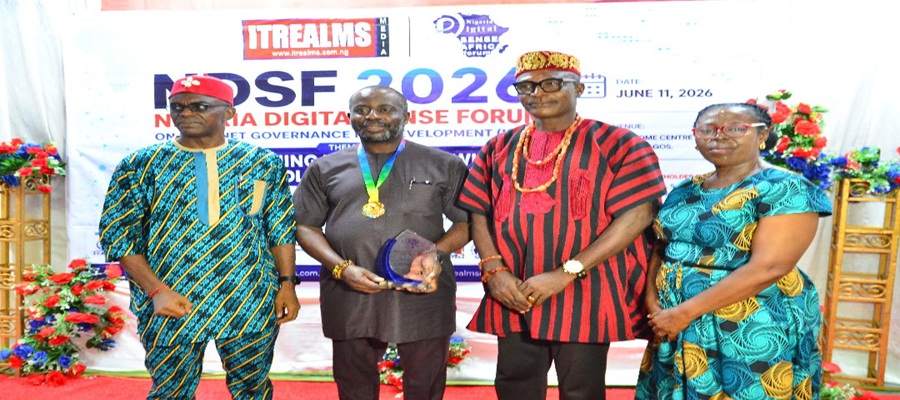
The 17th edition of the annual Nigeria DigitalSENSE Forum (NDSF) on Internet Governance for Development concluded on a high note Thursday, at the Welcome Centre Hotels, Lagos, culminating in the prestigious DigitalSENSE Africa Hall of Fame Awards.

Induction of chairman NDSF-26 – Ogbuefi Remmy Nweke, inductee Dr Olusola Teniola, award presenter and 2nd Vice President, Association of Anambra Development Unions (AASDU Lagos) Chief Mezie Okwuosa, and President, DNS WomenNG Foundation, Lolo Nkem Nweke at the 2026 DigitalSENSE Africa Awards and Induction held at prestigious Welcome Centre Hotels, International Airport Road, Lagos, on Thursday, June 11, 2026.
This landmark edition, themed “Sustaining WSIS Vision with Multistakeholder Synergy in Nigeria,” served as a vibrant backdrop for celebrating the pioneering individuals and corporate giants anchoring the nation’s digital evolution.
The high point of the forum was the official induction of industry titans into the DigitalSENSE Africa Hall of Fame; an elite circle reserved for trailblazers who have dedicated decades to defending digital rights, shaping technology policy, and building critical national infrastructure.
Dr. Olusola Teniola, who masterfully presided over the day’s proceedings as the Forum Chairman, was received into the Hall of Fame to a resounding ovation. A veteran with over 32 years of global technology experience, Dr. Teniola, currently the Director of Strategic Business Initiatives at ipNX Nigeria and former President of the Association of Telecommunications Companies of Nigeria (ATCON); was honored for his relentless advocacy in broadband expansion, internet affordability, and his steadfast guidance within Nigeria’s multi-stakeholder space.
Joining him in the Hall of Fame was the highly respected Ebeledike, whose strategic contributions to infrastructure resilience and ecosystem sustainability were formally enshrined. The induction celebrates a legacy of deep institutional dedication, recognizing leadership that successfully bridges the gap between complex digital policy and grassroots national development.
In a deeply emotional and poignant segment of the ceremony, the forum paid a special posthumous tribute to the late Gbolahan Awonuga, the beloved former Executive Secretary of the Association of Licensed Telecoms Operators of Nigeria (ALTON).
Recognized for his foundational contributions, unparalleled dedication, and decades of structural service to the telecommunications sector, the special posthumous honor was met with immense reverence by industry leaders. The organizers noted that Awonuga’s enduring legacy as a bridge-builder between operators and regulators remains a vital cornerstone of Nigeria’s modern digital infrastructure footprint.
In the corporate categories, the Nigeria Internet Registration Association (NiRA) emerged as a standout winner. Charged with managing Nigeria’s country-code Top-Level Domain (.ng), NiRA was named the ‘Custodian of the Decade’ in recognition of its monumental strides in digital sovereignty and cybersecurity. The organizers praised NiRA’s leadership for aggressively localizing Nigeria’s online identity, lowering barriers to domain acquisition, and fortifying the underlying Domain Name System (DNS) infrastructure against evolving global threats.
Simultaneously, telecom giant MTN Nigeria was honored with the DigitalSENSE Africa 2026 Mobile Inclusion and Connectivity Award. The accolade recognizes MTN’s unmatched contributions to expanding the Nigerian telecommunications landscape, bridging the digital divide, and ensuring millions of citizens are linked to the digital economy.
Adding to the stellar corporate honors, infrastructure giant Digital Realty was recognized with the DigitalSENSE Africa 2026 Infrastructure Backbone Award: Digital Realty Nigeria. The milestone award highlights Digital Realty’s foundational role in scaling Nigeria’s cloud readiness, anchoring local data hosting capabilities, and providing the robust data center framework necessary to power a secure, resilient African internet ecosystem.
Reflecting on the significance of this year’s awards, Ogbuefi Remmy Nweke, Lead Convener of NDSF and Group Executive Editor of ITREALMS Media Group, noted that the 2026 honors list represents the perfect intersection of regulation, infrastructure, and identity.
“Achieving true digital trust requires honoring the people who build the networks and the institutions that protect our identity on those networks,” Nweke stated. “Dr. Teniola, Ebeledike, MTN, Digital Realty, the late Gbolahan Awonuga, and the team at NiRA embody the exact multi-stakeholder synergy required to keep the WSIS vision alive and thriving in Nigeria.”
The 2026 NDSF enjoyed robust support from institutional heavyweights and industry pillars, including the Nigerian Communications Commission (NCC), IHS Nigeria, Digital Realty, Nigeria LNG Limited (NLNG), NiRA, the Association of Licensed Telecoms Operators of Nigeria (ALTON), the Internet Society (ISOC) Nigeria Chapter, the Guild of Corporate Online Publishers (GOCOP), and the Nigeria Information Technology Reporters Association (NITRA).
With this successful outing, the forum has once again solidified its position as the ultimate barometer for progress in Nigeria’s digital economy; celebrating foundational triumphs while actively mapping out the policy breakthroughs of tomorrow.

Airtel Africa Foundation Publishes Inaugural Annual Report

Mobile Internet Gender Gap Widest in Africa – GSMA

Kaspersky Warns of “Grey” Scam Websites Exploiting User Trust

Access Holdings Affirms Long-Term Value Strategy @ 4th AGM

Zoho Unveils Homegrown Server, Takes Bold Step Toward Tech Independence

CBN Extends PoS Geo-Fencing Enforcement Deadline to August 2026

FG to Launch Nationwide Free Digital TV Platform June 17

Jumia Nigeria Records Strong Q1 2026 Growth as Technology-Led Strategy Drives Market Expansion

NCC Drafts New Rules for Virtual Mobile Operators

FG to Balance Innovation with National Security with Stronger Drone Regulations




 E-Business2 days ago
Firm Discovered a New Corporate Phishing Technique using a Popular AI Web Development Platform

 E-Business3 days ago
Kaspersky Report Shows Early 2026 Witnessed an Increase in Cyberattacks on the Manufacturing Sector

 E-Financial3 days ago
Senate Moves to Regulate Crypto Sector, Seeks Investor Protection

 Telecom3 days ago
Nigeria, Others Stuck on WiFi 4 As World Adopts WiFi 6, WiFi 7

 Telecom3 days ago
Yuno Partners with Onafriq to Unlock Pan-African Payments for Global Merchants

 Telecom2 days ago
No More Deleting and Reposting: Instagram Unveils Long-Awaited Profile Update

 General News3 days ago
IMF Warns Nigeria of Risks in $5Bn Swap Deal with First Abu Dhabi Bank

 Telecom2 days ago
Airtel Nigeria Launches Web Data Calculator to Give Customers Greater Visibility into Data Usage