

General News
Kaspersky Warns of “Grey” Scam Websites Exploiting User Trust

Recent research by Kaspersky has shown that the so-called “grey” websites repeatedly target all world regions, and this may be driving both financial loss and large-scale data harvesting.

Grey websites are deceptive online platforms that fall outside traditional phishing definitions but still manipulate users into voluntarily handing over money and personal data. Kaspersky’s new report provides detailed insights into the threats posed by the grey websites on global and regional levels.
Unlike classic phishing attacks, which aim to steal credentials outright, grey websites rely on persuasion, misleading interfaces, and hidden terms to exploit users. They often impersonate legitimate services such as e-commerce platforms, financial tools, AI services, or subscription-based content, making them significantly harder to detect.
Kaspersky analysis shows that the majority of suspicious resources globally fall into several recurring categories:
- Fake browser extensions and “security tools” that actually harvest browsing data and track user activity.
- Fraudulent financial platforms including crypto exchanges, trading tools, and investment schemes promising unrealistic returns.
- Intermediary services (e.g., legal or real estate), charging for low-value or nonexistent services while harvesting sensitive personal data.
- Subscription traps offering low-cost trials that convert into costly recurring payments hidden in fine print.
- Fake online shops that either deliver counterfeit goods or nothing at all.
Example of a grey website.
A notable trend is the emergence of tools disguised as AI services or image-processing platforms, reflecting attackers’ ability to adapt to current digital trends and target younger audiences.

There are proven security solutions that help users to detect grey websites across different types of devices – those running on Windows, Linux, Android and iOS. The detection model is based on many factors, including domain name and age, IP reputation, stability of the infrastructure used, DNS configurations, HTTP security headers, digital identity and popularity of the web resource and other criteria.
Regional specifics
Regional variations in grey websites demonstrate how threat actors localise scams based on user behaviour and trending technologies.
In Europe, the threat landscape is dominated by links to suspicious browser extensions and fake “privacy-enhancing” tools.
These resources often present themselves as security solutions, promising safer browsing or anonymous search capabilities. In reality, they function as browser hijackers – intercepting traffic, collecting cookies, tracking user behaviour, and injecting advertisements.
The popularity of these threats reflects a high level of user concern around privacy and security, which attackers actively exploit. Additionally, these regions show a steady presence of phishing intermediaries and crypto-related scams, indicating a blend of technical and financially motivated attacks.
Across African markets, financial scams are the most prominent category of suspicious resources. Fraudulent trading platforms, fake brokers, and investment schemes frequently mimic legitimate financial services, often accompanied by fabricated licenses or endorsements.
These platforms typically prevent users from withdrawing funds, instead introducing additional “fees” or taxes to prolong the scam. The concentration of these threats highlights how attackers leverage growing interest in online investing while exploiting gaps in regulatory enforcement and financial literacy.
In the Middle East and North Africa region, suspicious resources frequently mimic communication (Internet telephony) tools, financial platforms, or betting services. Additionally, Ponzi-style investment schemes and crypto scams are widespread, often presented through polished interfaces that mimic legitimate platforms.
Web browser-based threats also play a significant role, with malicious extensions targeting user data and browsing activity. The regional threat profile reflects a convergence of financial fraud and technical compromise, where users risk both data exposure and monetary loss.
“Suspicious websites don’t look harmful at first glance. But they exploit trust, urgency, and familiarity, and a single click on what looks like a harmless AI image tool, a “secure” browser extension, or a heavily discounted online shop could be all it takes to lose money or expose sensitive data.
Instead of direct credential theft, attackers turn to behavioural manipulation – whether that’s subscribing, investing, or installing software,” comments Anna Larkina, Web Content and Privacy Analysis Expert at Kaspersky.


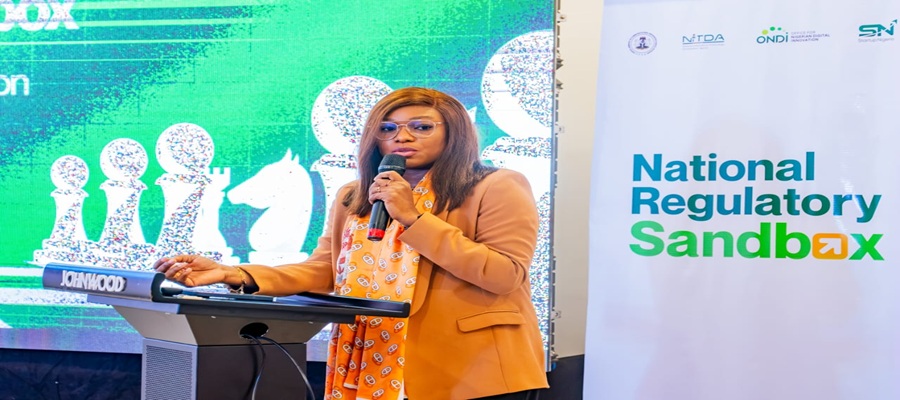
Kashifu Inuwa, Director General of the National Information Technology Development Agency (NITDA), has called for stronger collaboration among government regulators to accelerate the establishment of Nigeria’s National Regulatory Sandbox, describing inter-agency cooperation as the cornerstone for building an innovation-friendly regulatory ecosystem.

The Director General of the National Information Technology Development Agency (NITDA), Kashifu Inuwa, CCIE, represented by the National Coordinator of the Office for Nigerian Digital Innovation (ONDI), Mrs. Victoria Fabunmi, delivering his remarks at the National Regulatory Sandbox Governance and Implementation Planning Workshop held in Abuja.
Speaking through the National Coordinator of the Office for Nigerian Digital Innovation (ONDI), Ms. Victoria Fabunmi, at the National Regulatory Sandbox Governance and Implementation Planning Workshop in Abuja, Inuwa said the success of the initiative depends on regulators working collectively to develop a framework that promotes technological innovation while preserving regulatory integrity and public trust.
He noted that the workshop marks a significant transition from the design phase of the project to its implementation stage, where regulators are expected to jointly refine and validate the proposed governance structure before its rollout.
According to him, ONDI has spent several months laying the foundation for the initiative through extensive stakeholder consultations, ecosystem mapping, regulatory assessments and the preparation of a draft governance and implementation framework.
“The work completed so far provides a solid foundation, but the National Regulatory Sandbox can only achieve its objectives through collective ownership by all relevant regulatory institutions,” he said.
The NITDA Director General explained that the Technical Working Group was deliberately established as a collaborative platform to harness the expertise, experience and statutory mandates of participating agencies in shaping a regulatory model tailored to Nigeria’s innovation landscape.
He said the workshop was designed to critically review the proposed governance framework, test its assumptions and incorporate practical recommendations from stakeholders to ensure that the final model is inclusive, effective and adaptable to the country’s rapidly evolving digital economy.
Inuwa observed that while government institutions have different regulatory responsibilities, those differences should be viewed as strengths that can support the development of a coordinated and flexible implementation framework capable of responding to emerging technologies.
He further stated that the engagement would also establish clear implementation pathways, strengthen institutional partnerships and identify priority actions required to operationalise the National Regulatory Sandbox.
Expressing optimism about the outcome of the deliberations, the NITDA boss said the workshop would help build a shared national vision for the initiative while creating an enabling environment where innovators can safely develop, test and scale new technologies under appropriate regulatory supervision.
He commended participants for their commitment to strengthening Nigeria’s digital innovation ecosystem and encouraged them to make meaningful contributions that would shape a practical, innovation-driven regulatory framework capable of supporting sustainable economic growth and enhancing the country’s global competitiveness.
Speaking on the National Regulatory Sandbox journey and current worksream, Ms Ojonoka Yusufu, Implementing Partner Druve, said the initiative would provide a coordinated framework through which innovators and regulators can work together to test emerging technologies while ensuring compliance with existing laws and regulations.
She explained that the workshop was convened to build a shared understanding among participating regulators and stakeholders, develop consensus on the Sandbox’s operating model, identify implementation gaps before rollout and agree on the next steps for its successful implementation.
“We do not have anything set in stone yet. The idea is to work together to build a common understanding and ensure that all participating regulators and stakeholders are aligned on the objectives and implementation of the National Regulatory Sandbox,” she said.
Highlighting the importance of the initiative, Yusufu noted that Nigeria’s Information and Communications Technology (ICT) sector remains one of the country’s highest contributors to Gross Domestic Product (GDP), while the nation’s startup ecosystem continues to attract significant global investment.
She observed that Nigerian startups are creating jobs, attracting foreign investment and positioning the country as a leading innovation destination in Africa. According to her, the rapid expansion of startups beyond traditional sectors such as financial technology into healthcare, mobility, agriculture and other industries has made closer regulatory coordination increasingly necessary.
Yusufu added that the National Regulatory Sandbox is backed by the Nigeria Startup Act, providing the legal foundation required to drive responsible innovation and improve the country’s regulatory environment.
She described the Sandbox as a collaborative, multi-agency innovation governance mechanism that complements, rather than replaces, existing regulatory institutions.
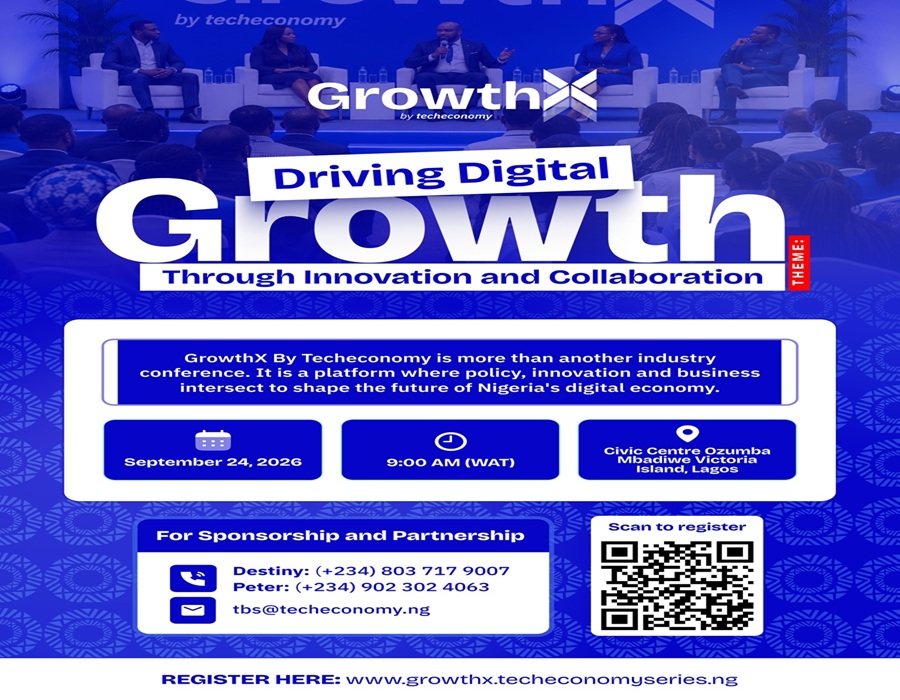
Techeconomy, a leading technology and digital economy publication, will celebrate its ninth anniversary with a one-day conference and awards ceremony aimed at promoting conversations on Nigeria’s digital economy and recognising excellence in innovation and technology leadership.

Techeconomy
The anniversary event, scheduled for Sept. 24 at the Civic Centre, Victoria Island, Lagos, will feature GrowthX by Techeconomy, a conference expected to bring together policymakers, regulators, industry leaders, investors and innovators to examine the future of Nigeria’s digital economy.
The event will also host the Technology Innovation and Leadership Awards (TiLAwards), which will honour organisations and individuals for outstanding contributions to innovation, leadership and digital transformation across various sectors.
According to a statement issued on Thursday by Peter Oluka, Editor of Techeconomy and organiser of the event, said, the anniversary celebration is intended to reflect on Nigeria’s technology journey over the past nine years while fostering dialogue on emerging opportunities and challenges shaping the country’s digital future.
Oluka said the event would provide a platform for stakeholders from the public and private sectors to exchange ideas on technology, innovation, entrepreneurship, digital policy and economic growth.
He added that the conference would feature keynote presentations, panel discussions and networking sessions involving industry experts, government officials, business executives and technology entrepreneurs.
According to him, the TiLAwards will recognise outstanding organisations and individuals whose innovations and leadership have significantly contributed to the growth of Nigeria’s technology and business ecosystem.
As part of activities marking the anniversary, Techeconomy has invited media organisations to partner with the event through news coverage, publicity and participation.
The publication also expressed appreciation to members of the media and industry stakeholders for their support over the past nine years, describing their collaboration as instrumental to its growth and continued coverage of Nigeria’s technology, business and digital economy.
The organisers said details of the conference programme, speakers and partnership opportunities would be unveiled ahead of the event.

International Trade Union Confederation, (ITUC-Africa), representing trade unions from countries in Africa, has called on Nigeria and other African governments to ensure that industrialisation translates into improved living standards for workers and ordinary citizens.

According to ITUC-Africa, economic growth must lift Nigerians and other Africans out of poverty rather than deepen inequality, frowning at Nigeria’s government plans to remove subsidy on electricity.
Delivering his opening remarks at the New Energy for Africa 11 Convening: African Workers’ Contributions to Energy Sovereignty, Green Industrialization, and a Common African for COP31, Akhator Joel Odigie, general secretary of ITUC-Africa, said, industrialisation remains central to Nigeria and Africa’s liberation and development agenda but warned that it would be meaningless if it failed to improve the welfare of the continent’s people.
He faulted the plans by the Nigerian government to remove so-called subsidy on electricity in 2027, arguing that it is aimed at satisfying the Bretton Woods institutions such as the International Monetary Fund, IMF, and the World Bank.
According to him, such removal would worsen the poverty rate in Nigeria and regress any marginal progress towards industrialisation. Subsidy removal will make electricity inaccessible to workers and the majority of the citizens.
He said, “As we speak now, Nigeria is talking of subsidy removal on electricity. The plan is not to satisfy or help Nigerians, but IMF, World Bank and other donor countries. The talk that subsidy is bad economics is a lie. All developed economies depended on public sector-driven electricity and not private sector.
“For us as Africans, industrialisation is central to our liberation and development. It is part of our aspiration to define our own identity and achieve shared prosperity through an industrialised Africa. Unfortunately, that vision has yet to be realised.
“We have also come to understand that lamenting our circumstances is not enough. Identifying the barriers to Africa’s development or pointing fingers at those who may be responsible does not move us forward. The more important question is: What next? What solutions can we pursue together?
“It is from that perspective that we confront the reality that more than 600 million Africans still lack access to electricity, while privatisation continues to deny many people affordable access to energy. This compels us to ask: What can we do differently?”
According to him, organised labour believes industrialisation can be achieved without worsening the climate crisis if governments, workers and development partners commit to energy justice.
Odigie noted that “When we speak about sustainable industrialisation, we are asking how Africa can industrialise without increasing environmental degradation or worsening the climate challenges our people already experience every day.
“We know this is possible. But it will require negotiation, compromise and genuine partnerships. It demands serious discussions on technology transfer, skills development and financing.”
He stressed that developing technical skills and mobilising investment for energy infrastructure are essential if Africa is to industrialise sustainably, saying “These are not impossible skills to acquire. With the right investment and commitment, Africa can build them. Equally important is access to finance and the resources needed to develop the infrastructure that will support sustainable industrialisation.
“An industrialised Africa has little meaning if it does not improve the lives of our people. Our vision is an Africa where prosperity is shared.
“We must reverse the growing phenomenon of the working poor. We must end the situation where women, children and older persons bear the greatest burden whenever governments attempt to balance national budgets.
“What does prosperity mean if ordinary people cannot enjoy a decent quality of life? A worker who returns home after a long day’s work should be able to switch on a fan during hot weather, watch television, listen to the news and spend meaningful time with family because electricity is available, reliable and affordable.
“If our people cannot enjoy these basic necessities, then what kind of prosperity are we really talking about?
“Energy justice means energy that is accessible, affordable and capable of improving people’s lives.”
Odigie also renewed ITUC-Africa’s campaign for stronger public participation in Africa’s energy sector, citing Finland as an example of how governments can ensure affordable electricity while working with private investors.
“Recently, we visited Finland, where we observed a successful model that combines public and private participation, with strong public leadership. Energy there is affordable. In fact, electricity costs less in Finland than it does here in Nairobi.
“Our hosts explained that this is possible because the state retains an important role in the energy sector, including the ability to influence pricing to ensure affordability for everyone.”
Ahead of the COP31 climate negotiations, he called for closer collaboration between organised labour and the African Group of Negotiators (AGN), saying trade unions are partners in governance rather than adversaries.
“Trade unions are not antagonistic to governments, even though we are sometimes misunderstood.
“Our responsibility is to strengthen accountability and help governments perform better because, from time to time, leaders can become too comfortable.”
Using a metaphor that drew applause from participants, Odigie likened the role of trade unions to keeping leaders “close to the fire.”
“Our responsibility is to keep the feet of our leaders close to the fire so that their heads do not become too cold. We want them to continue thinking clearly, making sound decisions and remaining connected to the realities faced by ordinary people.
“That is why we are not in opposition. We are not enemies.”
He said organised labour’s partnership with the AGN is intended to ensure African governments enter international climate negotiations with the full backing of workers across the continent.
Speaking, Dr Nana Amoah, chair of the African Group of Negotiators, AGN, said Africa’s energy transition presents both an urgent challenge and a historic opportunity, lamenting that “More than 600 million Africans still lack access to electricity, even though our continent possesses exceptional solar, wind, hydro and geothermal resources. Yet Africa continues to receive only a very small share of global clean-energy investment.”
Represented by Dr George Manful, AGN Senior Advisor, Amoah, said: “This imbalance must be corrected if the transition is to support Africa’s development rather than reproduce existing patterns of dependence, extraction and inequality.
“For the African Group of Negotiators, a just transition cannot be measured solely by installed megawatts, emissions reductions or new electricity connections. It must also be measured by the quality of jobs created, affordability of energy, protection of workers, participation of women and young people, development of local industries, and the capacity of African countries to retain value from their natural resources.
“Initiatives such as Mission 300 must therefore go beyond expanding access. They must strengthen public institutions, mobilise affordable and debt-sensitive finance, support local manufacturing and skills development, and guarantee that no worker, community or vulnerable group is left behind.
“Africa’s critical minerals must similarly become a foundation for green industrialisation—not another chapter of raw-material extraction. Our policies must promote local processing, technology transfer, decent work, environmental integrity and equitable participation in global value chains.”

Glovo Pioneers AI Quick-Commerce

Fleeing Southeast Asia Scam Syndicates Find New Homes in Nigeria, Kenya- Report

DSS Arraigns Eze for Allegedly Hacking, Stealing N800m from SunTrust Bank

SEC Unveils Probate/Unclaimed Monies Clinic to Help Families Recover Inherited Investments

We have Multiple Layers of Protection for 281m Accounts in Nigeria – NDIC

From Scarcity to Scale: What Africa Can Learn from India’s Agricultural Transformation

BON Establishes Six Ad Hoc Committees to Modernize Broadcasting

EFCC Busts NIS Visa Overstay Racket, Uncovers N700m in an Account

How EFCC Turned Recovered Loot Into School Supplies for Thousands of Nigerian Students

BVN Enrollments Hit 69.55m- NIBSS




 E-Business3 days ago
Kaspersky Reveals a New Malicious Framework Targeting Cryptocurrency Users with the Use of OkoSpyware

 E-Business3 days ago
CMS T&M Launches TMO Rides to Enable a Faster & Cashless Transport Experience for CMS – Ajah Passengers

 E-Business3 days ago
Nigeria Tightens Data Privacy Compliance as FG Issues Directive to MDAs

 E-Business3 days ago
Firm to recruit over 100 professionals to boost NRS e-Invoicing compliance

 Telecom3 days ago
FG Commences 90,000km Fibre Optic Rollout within Weeks

 E-Financial2 days ago
Access Holdings Deepens Sustainable Finance Impact, Expanding Green Assets to ₦92.14 Billion

 Telecom3 days ago
Dimension Data to Channel Funds to Support Nigerian Fibre Expansion

 E-Financial3 days ago
Zenith Bank Confirms Cyberattack, Says Hackers Accessed Limited Customer Data